Questions

3 Marks Question

🎯

Test yourself on this topic

14 questions · timed · auto-graded

Question 13 Marks
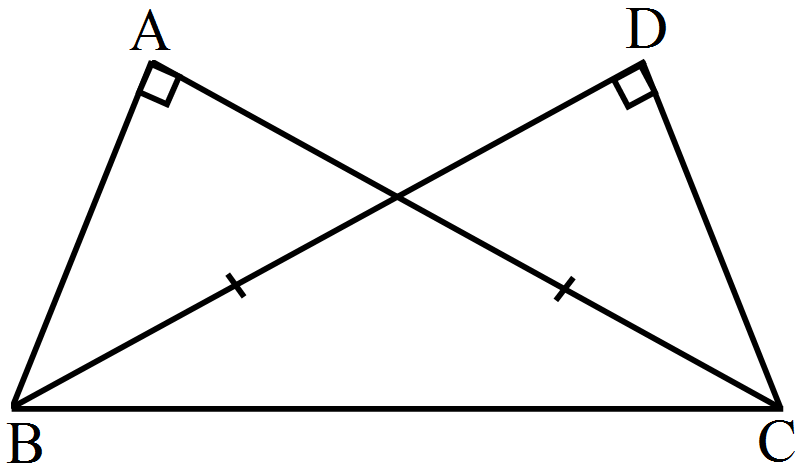
In the given figure, triangles $ABC$ and $DCB$ are right angled at $A$ and $D$ respectively and $AC = DB$ Prove that $\triangle\text{ABC}\cong\triangle\text{DCB.}$
Answer
Given: In right triangles $ABC$ and $DCB$ right angled at $A$ and $D$ respectively and $AC = DB.$
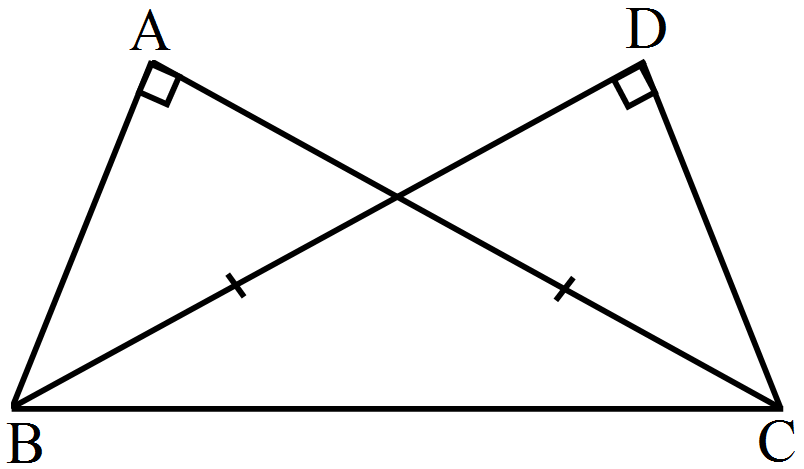
To prove: $\triangle\text{ABC}\cong\triangle\text{DCB.}$
Proof: In right angled $\triangle\text{ABC}$ and $\triangle\text{DCB},$
​​​​​​​hypotenuse $BC = BC ($common$)$ side $AC = DB ($given$)$
$\triangle\text{ABC}\cong\triangle\text{DCB.}$
$(RHS$ condition$)$ Hence proved.
View full question & answer
Question 23 Marks
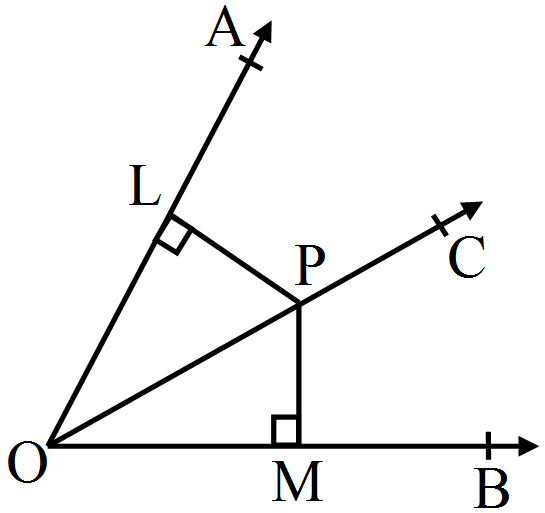
In fig. (i) $\text{PL}\bot\text{OA}$ and $\text{PM}\bot\text{OB}$ such that $\text{PL}=\text{PM}$. Is $\triangle\text{PLO}\cong\triangle\text{PMO}?$ Give reason in support of your answer.
Answer
In fig.$\text{PL}\bot\text{OA}$ and $\text{PM}\bot\text{OB}$ and $\text{PL}=\text{PM}$
Now in right $\triangle\text{PLO}$ and $\triangle\text{PMO}$,
Side $\text{PL}=\text{PM}$ (given)
Hypotenuse $\text{OP}=\text{OP}$ (common)
$\triangle\text{PLO}\cong\triangle\text{PMO} (RHS$ condition$)$
Yes $\triangle\text{PLO}\cong\triangle\text{PMO}$
Hence proved.
View full question & answer
Question 33 Marks
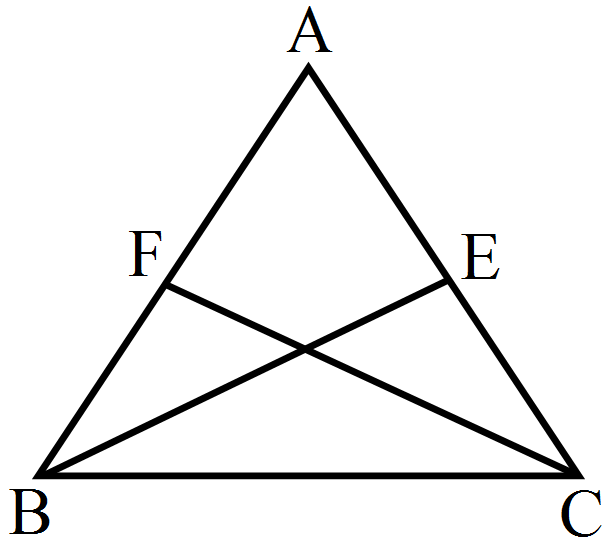
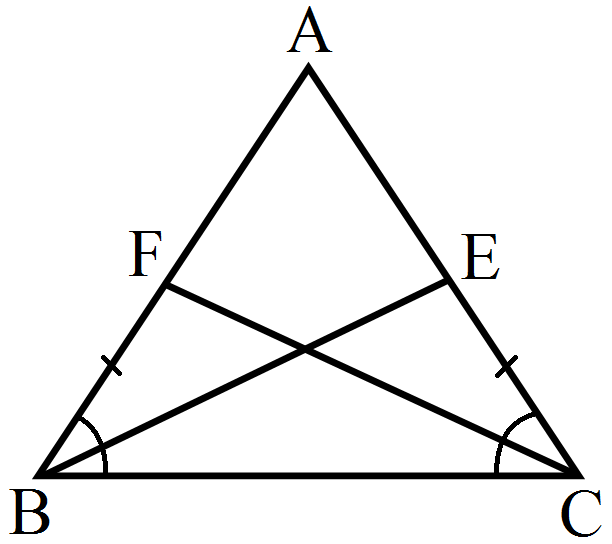
In the adjoining figure, $\triangle\text{ABC}$ is an isosceles triangle in which $AB = AC.$ If $E$ and $F$ be the midpoints of $AC$ and $AB$ respectively, prove that $BE = CF.$
Answer
Given: $\triangle\text{ABC}$ is an isosceles triangle in which $AB = AC.\ E$ and $F$ are the midpoints of $AC$ and $AB$ respectively.

 To prove: $BE = CF$ Proof: IN $\triangle\text{BCF}$ and $\triangle\text{CBE},$
$BC = BC ($common$) BF = CE$
$($Half of equal sides $AB$ and $AC)$
$\angle\text{CBF}=\angle\text{BCF}$ (Angles opposite to equal sides) $\triangle\text{BCF}\cong\triangle\text{CBE}$
$(SAS$ condition$)$
$CF = BE (c.p.c.t.)$ or $BE = CF$ Hence proved.
 
View full question & answer
Question 43 Marks
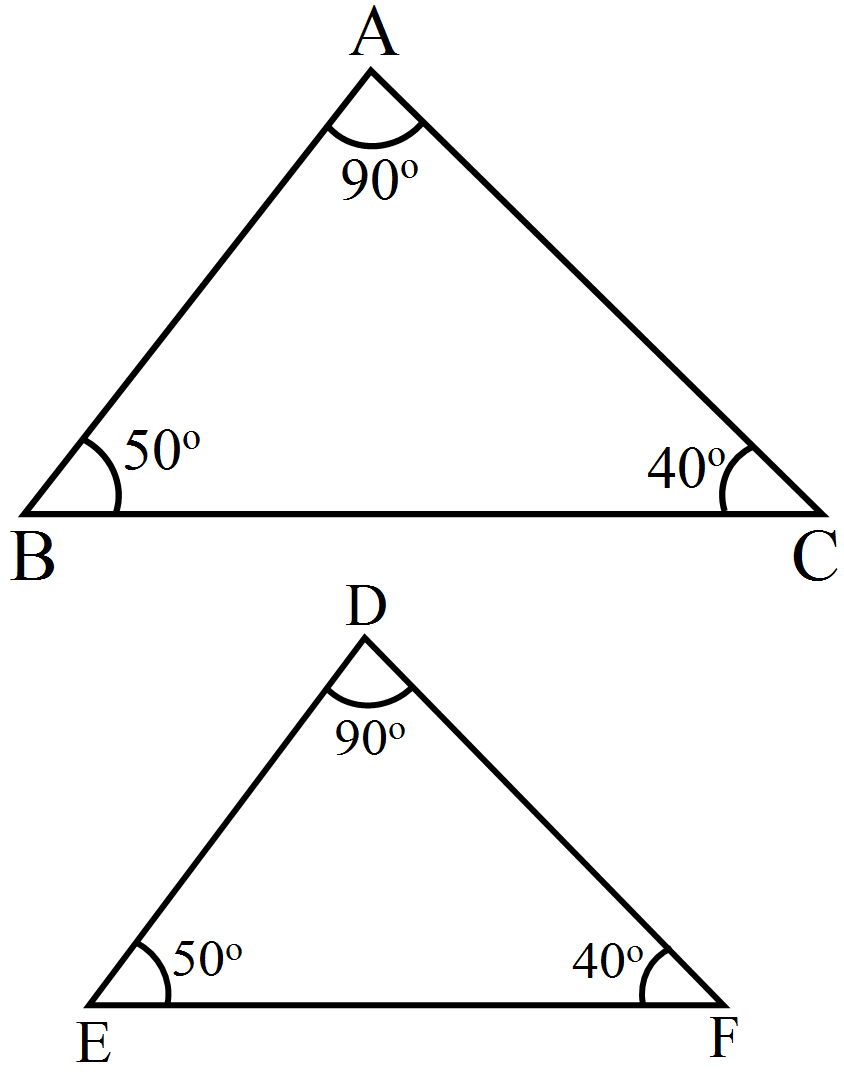
If two triangles have their corresponding angles equal, are they always congruent? If not, draw two triangles which are not congruent but which have their corresponding angles equal.
Answer
Two triangles whose corresponding angles are equal, it is not necessarily that they should be congruent. It is possible if at least one side must be equal. Below given a pair of triangles whose angles are equal but these are not congruent.
View full question & answer
Question 53 Marks
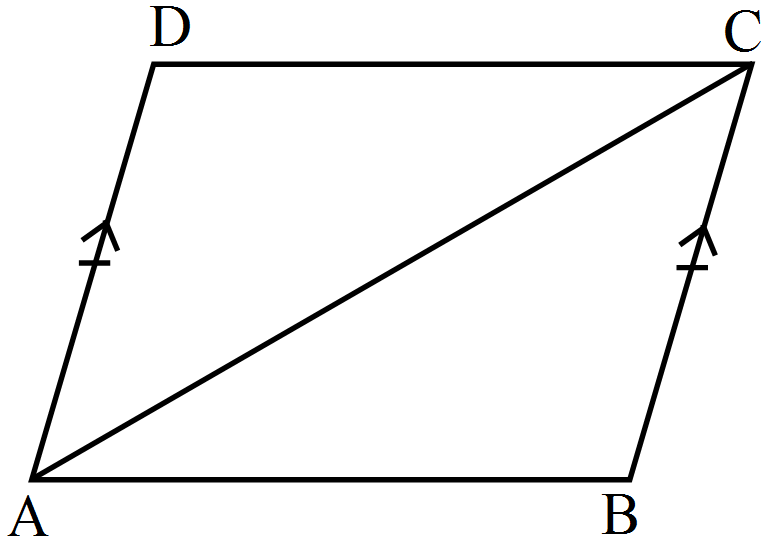
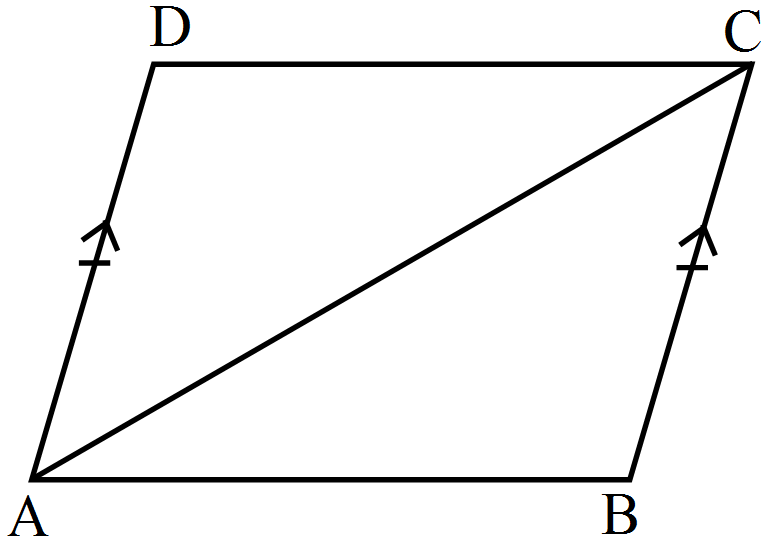
In fig. $(i) \text{AD}=\text{BC}$ and $\text{AD}||\text{BC}$. Is $\text{AB}=\text{DC}?$ Give reasons in support of your answer.
Answer
In the figure,

$\text{AD}=\text{BC}$ and $\text{AD}||\text{BC}$
In $\triangle\text{ABC}$ and $\triangle\text{ADC}$,
$\text{AC}=\text{AC}$ (common) $\text{BC}=\text{AB}$ (given)
$\angle\text{ACB}=\angle\text{CAD}$ (Alternate angles)
​​​​​​​$\triangle\text{ABC}\cong\triangle\text{ADC} (SAS$ condition$)$
$\text{AB}=\text{DC}$ (c.p.c.t.) Hence proved.
View full question & answer
Question 63 Marks
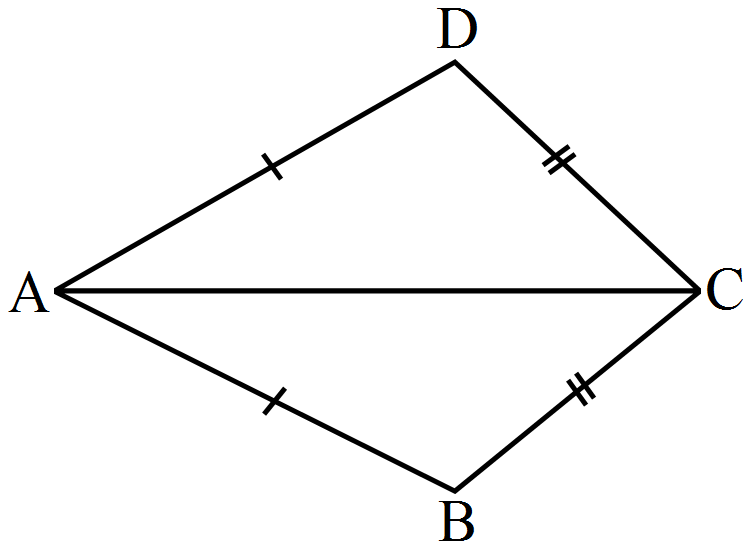
In the adjoining figure, $\text{AB}=\text{AD}$ and $\text{CB}=\text{CD.}$ Prove that $\triangle\text{ABC}\cong\triangle\text{ADC.}$
Answer
In the figure, $\text{AB}=\text{AD},\text{CB}=\text{CD}$
To prove: $\triangle\text{ABC}\cong\triangle\text{ADC}$
Proof: In $\triangle\text{ABC}$ and $\triangle\text{ADC.}$
$\text{AC}=\text{AC}$ (common)
$\text{AB}=\text{AD}$ (given)
$\text{CB}=\text{CD}$ (given)
$\triangle\text{ABC}\cong\triangle\text{ADC} (SSS$ condition$)$
​​​​​​​Hence proved.
View full question & answer
Question 73 Marks
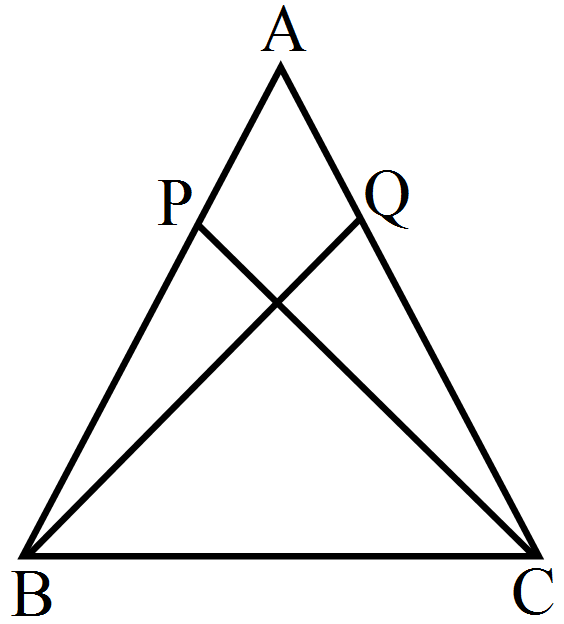
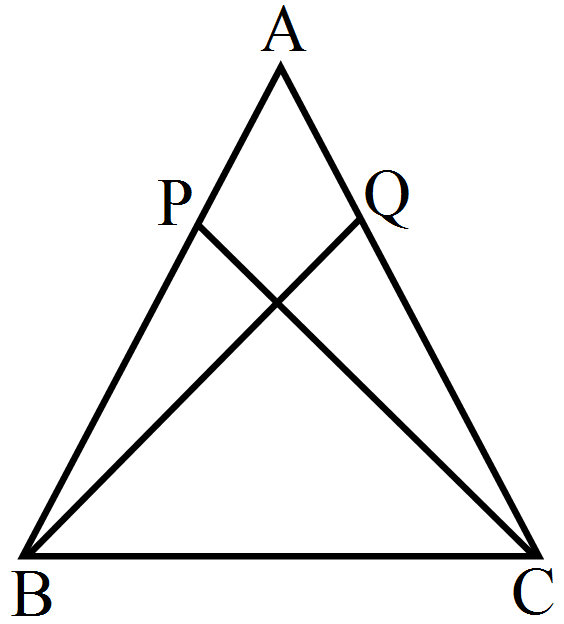
In the adjoining figure, $P$ and $Q$ are two points on equal sides $AB$ and $AC$ of an isosceles triangle $ABC$ such that $AP = AQ.$ Prove that $BQ = CP.$
Answer
Given : In isosceles $\triangle\text{ABC,} AB = AC. P$ and $Q$ are the points on $AB$ and $AC$ respectively such that $AP = AQ.$ To prove: $BQ = CP.$

Proof: In $\triangle\text{ABQ}$ and $\triangle\text{ACP,}$
$AB = AC ($given$)$
$AQ = AP ($given$)$
$\angle\text{A}=\angle\text{A}($ common$)$
$\triangle\text{ABQ}\cong\triangle\text{ACP} (SAS$ condition$)$
$BQ = CP (c.p.c.t.)$
Hence proved.
View full question & answer
Question 83 Marks
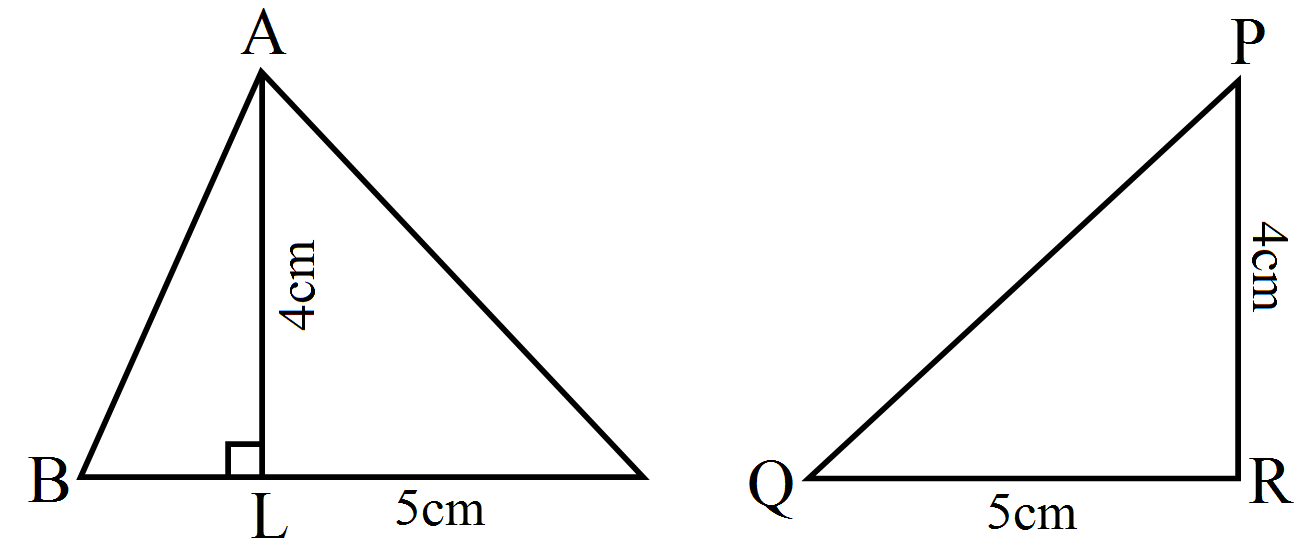
Draw $\triangle\text{ABC}$ and $\triangle\text{PQR}$ such that they are equal in area but not congruent.
Answer
In $\triangle\text{ABC},$ $\text{Area}=\frac{1}{2}\times\text{BC}\times\text{AL}$ $=\frac{1}{2}\times5\times4=10\text{ cm}^2$ and in $\triangle\text{PQR}$ $\text{Area}=\frac{1}{2}\times\text{QR}\times\text{PR}$ $=\frac{1}{2}\times5\times4=10\text{ cm}^2$ In these triangles, Areas of both triangles are equal but are no congruent to each other.
View full question & answer
Question 93 Marks
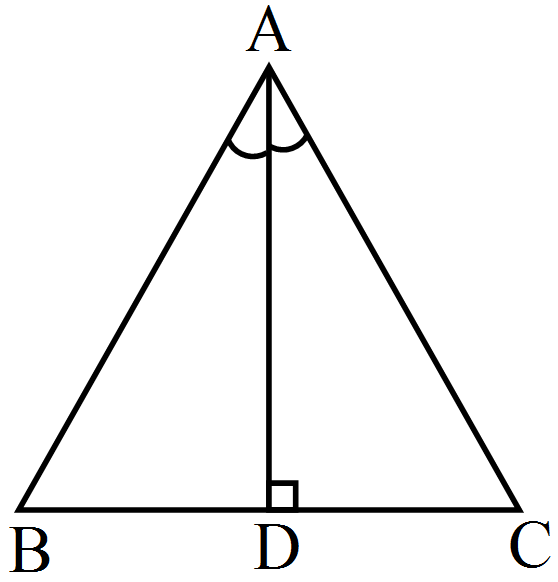
In the adjoining figure, $ABC$ is a triangle in which $AD$ is the bisector of $\angle\text{AD}.$ If $\text{AD}\bot\text{BC},$ show that $\triangle\text{ABC}$ is an isosceles.
Answer
Given: In $\triangle\text{ABC},\text{AD}$ is the bisector of $\angle\text{A}$ i.e. $\angle\text{BAD}=\angle\text{CAD}$
$\text{AD}\bot\text{BC}.$
To prove: $\triangle\text{ABC}$ is an isosceles
Proof: In $\triangle\text{ADB}$ and $\triangle\text{ADC.}$
$\text{AD}=\text{AD}$ (common)
$\angle\text{BAD}=\angle\text{CAD}\text{ (AD}$ is the bisector of $\angle\text{A})$
$\angle\text{ADB}=\angle\text{ADC}($ each $90^\circ,\text{AD}\bot\text{BC})$
$\triangle\text{ADM}\cong\triangle\text{ADC}$ (ASA condition)
$\text{AB}=\text{AC}$ (c.p.c.t.)
Hence $\triangle\text{ABC}$ is an isosceles triangle.
Hence proved.
View full question & answer
Question 103 Marks
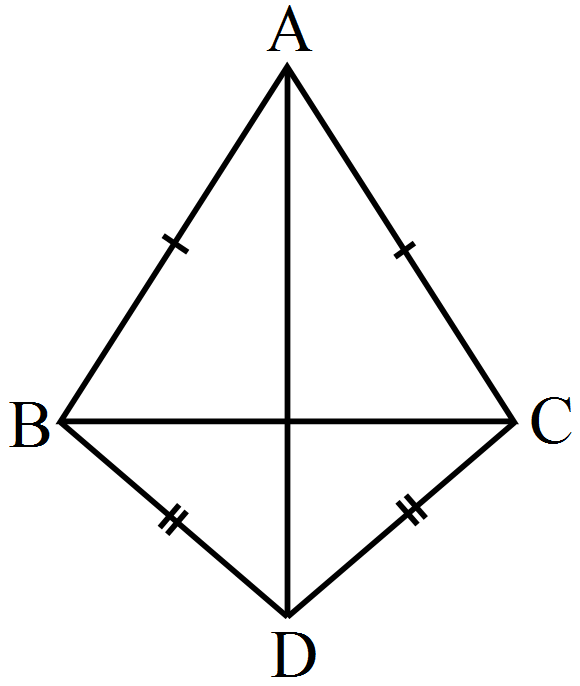
In the adjoining figure, $\triangle\text{ABC}$ is an isosceles triangle in which $AB = AC$. Also, $D$ is a point such that $BD = CD.$ Prove that $AD$ bisects $\angle\text{A}$ and $\angle\text{D.}$
Answer
Given: In $\triangle\text{ABC,}$
$AB = AC.$
$D$ is point such that $BD = CD.$
$AD, BD$ and $CD$ are joined.
To prove: Ad bisects $\angle\text{A}$ and $\angle\text{D}$ Proof:
In $\triangle\text{ABD}$ and $\triangle\text{CAD,}$
$AD = AD ($Common$)$
$ AB = AC ($given$) $
$BD = CD ($given$)$
$\triangle\text{ABD}\cong\triangle\text{CAD} (SSS$ condition$)$
$\angle\text{BAD}=\angle\text{CAD} (c.p.c.t.)$ and
$\angle\text{BDA}=\angle\text{CDA} (c.p.c.t.)$
Hence, $AD$ is the bisector of $\angle\text{A}$ and $\angle\text{D}.$
Hence proved.
View full question & answer
Question 113 Marks
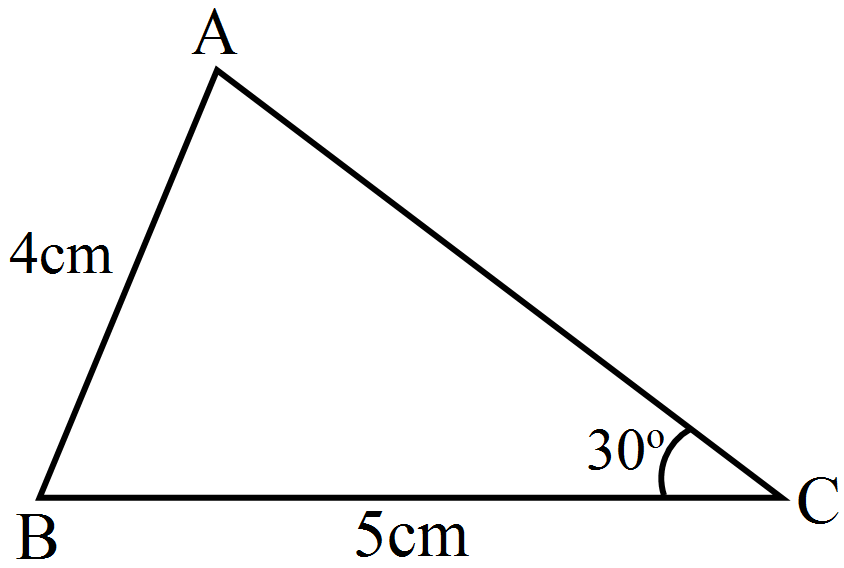
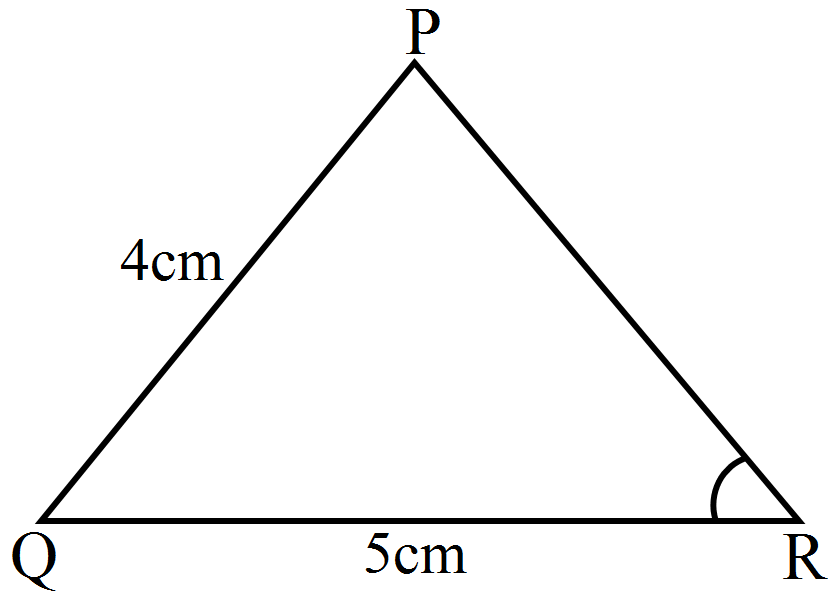
Are two triangles congruent if two sides and an angle of one triangle are respectively equal to two sides and an angle of the other? If not then under what conditions will they be congruent?
Answer
In two triangles, if two sides and and included angle of the one equal to the corresponding two sides and included angle, then the two triangles are congruent. If another angle except included angles are equal to each other and two sides are also equal these are not congruent. In the above figures, in $\triangle\text{ABC}$ and $\triangle\text{PQR}$, two corresponding sides and one angle are equal, but these are not congruent.
View full question & answer
Question 123 Marks
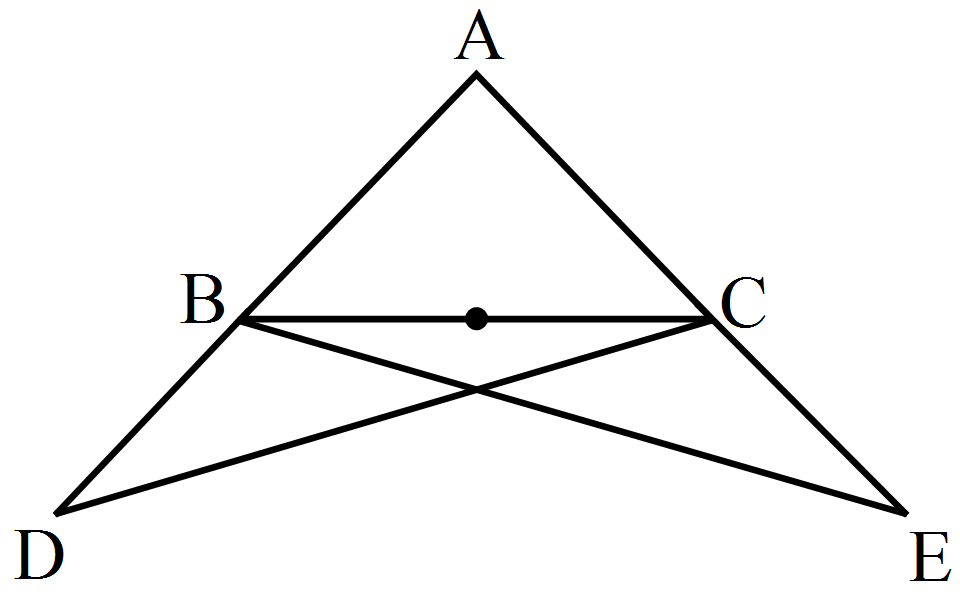
In the given figure, $\triangle\text{ABC}$ is an isosceles triangle in which $AB = AC.$ If $AB$ and $AC$ are produced to $D$ and $E$ respectively such that $BD = CE,$ prove that $BE = CD.$
Answer
Given: $\triangle\text{ABC}$ is an isosceles triangle in which $AB = AC.$
$AB$ and $AC$ are produced to $D$ and $E$ respectively such that $BD = CE.$
$BE$ and $CD$ are joined. To prove: $BE = CD.$ Proof: $Ab = Ac$ and $BD = CE$
Adding we get: $AB + BD = AC + CE AD = AE$
Now, in $\triangle\text{ACD}$ and $\triangle\text{ABE}$
$AC = AB ($given$)$
$\angle\text{A}=\angle\text{A}$ (common)
$\triangle\text{ACD}\cong\triangle\text{ABE} (SSA $ condition$) CD = BE (c.p.c.t)$
Hence, $BE = CD.$
View full question & answer
Question 133 Marks
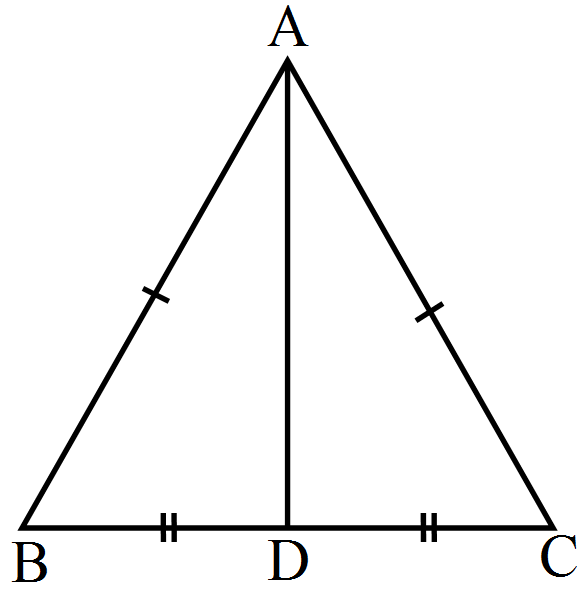
In the adjoining figure, $\text{AB}=\text{AC}$ and $\text{BD}=\text{DC}.$ Prove that $\triangle\text{ADB}\cong\triangle\text{ADC}$ and hence show that.
$i. \angle\text{ADB}=\angle\text{ADC}=90^\circ$
$ii. \angle\text{BAD}=\angle\text{CAD}$
Answer
In $\triangle\text{ABD}$ and $\triangle\text{ACD},$
$\text{AD}=\text{AD} ($common$)$
$\text{AB}=\text{AC} ($given$)$
$\triangle\text{ABD}\cong{}\triangle\text{ADC} (\ce{SSS}$ condition$)$
$\angle\text{BAD}=\angle\text{CAD} (c.p.c.t.)$ and
$\angle\text{ADB}=\angle\text{ADC} (c.p.c.t.)$ But
$\angle\text{ADB}+\angle\text{ADC}=180^\circ ($Linear pair$)$
$\angle\text{ADB}=\angle\text{ADC}=90^\circ$ Hence proved.
View full question & answer
Question 143 Marks
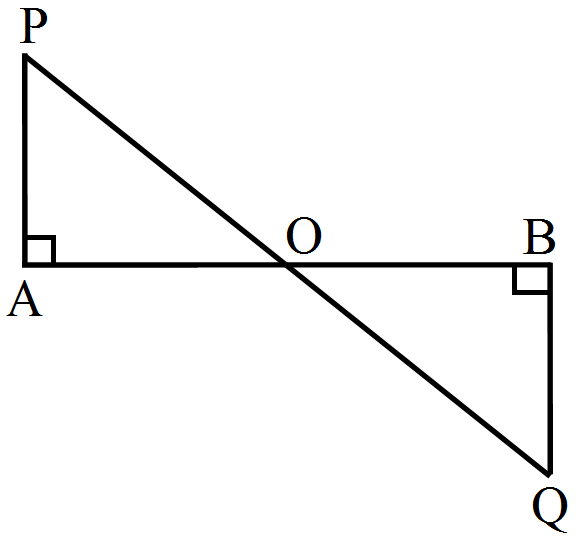
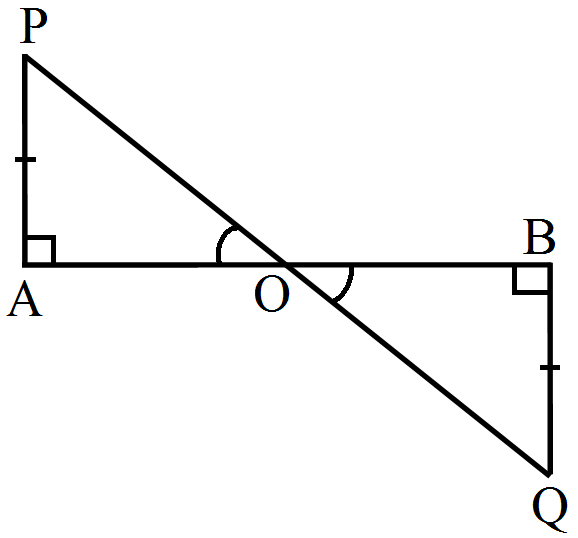
In the given figure, $\text{PA}\bot\text{AB},\text{QB}\bot\text{AB}$ and $PA = QB$. Prove that $\triangle\text{OAP}\cong\triangle\text{OBQ.}$ Is $OA = OB?$
Answer

Given: In the figure,$\text{PA}\bot\text{AB},\text{QB}\bot\text{AB}$ and $PA = QB.$
To prove: $\triangle\text{OAP}\cong\triangle\text{OBQ,}$
Is $OA = OB?$
Proof: In $\triangle\text{OAP}$ and $\triangle\text{OBQ,}$
$\angle\text{A}=\angle\text{B} ($each $90^\circ )$
$AP = BQ ($given$)$
$\angle\text{AOP}=\angle\text{BOQ}$ (vertically opposite angles)
$\triangle\text{OAP}\cong\triangle\text{OBQ} (AAS$ condition$)$
$OA = OB (c.p.c.t.)$
Hence proved.
View full question & answer