Questions

5 Marks Questions

Take a timed test

6 questions · self-marked practice — reveal the answer and mark yourself.

Question 15 Marks
Rita has bought a carpet of size $4\text{m}\times6\frac{2}{3}\text{m}$ But her room size is $3\frac{1}{3}\text{m}\times5\frac{1}{3}\text{m}$ What fraction of area should be cut off to fit wall to wall carpet into the room?
Answer
Given, carpet size $=4\text{m}\times6\frac{2}{3}\text{m}=4\times\frac{(6\times3)+2}{3}$
$=4\times\frac{(18+2)}{3}=4\times\frac{20}{3}$
$=\frac{4}{1}\times\frac{20}{3}=\frac{80}{3}=\frac{80}{3}\text{m}^{2}$
$\because$ Room size $=3\frac{1}{3}\text{m}\times5\frac{1}{3}\text{m}$
$=\frac{(3\times3)+1}{3}\times\frac{(5\times3)+1}{3}$
$=\frac{(9+1)}{3}\times\frac{(15+1)}{3}$
$=\frac{10}{3}\times\frac{16}{3}=\frac{160}{9}\text{m}^{2}$
$\therefore$ Difference between the area of carpet and room sizes = size of the carpet - size of the room $=\frac{80}{3}-\frac{160}{9}=\frac{240-160}{9}=\frac{80}{9}\text{m}^{2}$
[$\because LCM$ of $3$ and $9 = 9]$
In fraction, $\frac{\text{Area that will be cut - of}}{\text{Original area}}$
$\frac{\big(\frac{80}{9}\big)}{{\big(\frac{80}{3}\big)}}=\frac{80}{9}\times\frac{3}{80}=\frac{1}{3}$
Hence, $\frac{1}{3}$ of area should be cut - off.
View full question & answer
Question 25 Marks
Find the value of: $\frac{(0.2\times0.14)+(0.5\times0.91)}{(0.1\times0.2)}$
Answer
Given, $\frac{(0.2\times0.14)+(0.5\times0.91)}{(0.1\times0.2)}$
$\therefore0.2=\frac{2}{10}0.14=\frac{14}{100}\text{ and }0.5=\frac{5}{10}$
$\therefore0.19=\frac{91}{100}0.1=\frac{1}{10}\text{ and }0.2=\frac{2}{10}$
$\therefore\frac{(0.2\times0.14)+(0.5\times0.91)}{(0.1\times0.2)}$
$=\frac{\big(\frac{2}{10}\times\frac{14}{100}\big)+\big(\frac{5}{10}\times\frac{91}{100}\big)}{\big(\frac{1}{10}\times\frac{2}{10}\big)}$
$=\frac{\frac{2\times14}{1000}+\frac{5\times91}{1000}}{\frac{1\times2}{100}}$
$=\frac{\frac{28}{1000}+\frac{455}{1000}}{\frac{2}{100}}$
$=\frac{\frac{28+455}{1000}}{\frac{2}{100}}=\frac{\frac{483}{1000}}{\frac{2}{100}}$
$=\frac{483}{1000}\times\frac{100}{2}$
[$\because$ division is reverse of the multiplication] $=\frac{483}{10\times2}=\frac{2415}{10}=24.15$
View full question & answer
Question 35 Marks
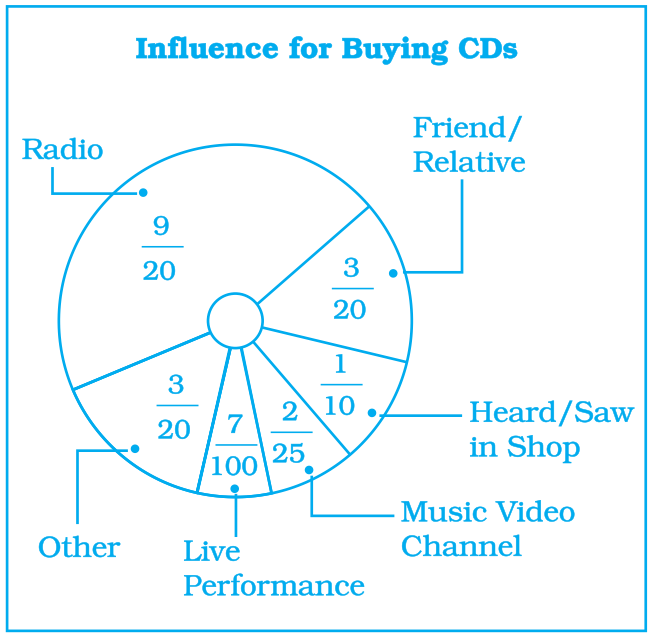
In a survey, $200$ students were asked what influenced them most to buy their latest $CD$. The results are shown in the circle graph.
$a.$ How many students said radio influenced them most?
$b.$ How many more students were influenced by radio than by a music video channel?
$c.$ How many said a friend or relative influenced them or they heard the $CD$ in a shop?
Answer
 
$a.$ Fraction of radio $($in figure$) =\frac{9}{20}$
Total number of student $= 200$
$\therefore$ Number of students influenced by radio the most $\frac{9}{20}$ of $200$
$=\frac{9}{20}\times200$
$=90$
$b.$ We have to find
$($Students influenced by radio$)-($Students influenced by music video channel$)$
$= ($Frantion of radio $\times $ Total number of students$)$
$=\frac{9}{20}\text{ of }200-\frac{2}{25}\text{ of }200$
$=\frac{9}{20}\times200-\frac{2}{25}\times200$
$=90-16$
$=74$
Hence, $74$ more students were influenced by radio than by a music video channel.
$c.$ We have to find
$($Students who influenced by a friend or relative$)+($Students who influenced by hearing song in shop$)$
$=\frac{3}{20}\text{ of }200+\frac{1}{10}\text{ of }200$
$=\frac{3}{20}\times200+\frac{1}{10}\times200$
$=30+20$
$=50$
 
View full question & answer
Question 45 Marks
State whether the answer is greater than $1$ or less than $1$. Put a $\checkmark$ mark in appropriate box.
Questions
Greater than $1$
Less than $1$
$\frac{2}{3}\div\frac{1}{2}$    
$\frac{2}{3}\div\frac{2}{1}$    
$6\div\frac{1}{4}$    
$\frac{1}{5}\div\frac{1}{2}$    
$4\frac{1}{3}\div3\frac{1}{2}$    
$\frac{2}{3}\times8\frac{1}{2}$    
Answer
$i. \frac{2}{3}+\frac{1}{2}=\frac{2}{3}\times\frac{2}{1}=\frac{4}{3}=1.33(>1)$
$ii. \frac{2}{2}+\frac{2}{1}=\frac{2}{3}\times\frac{1}{2}=\frac{1}{3}=0.33(<1)$
$iii. 6+\frac{1}{4}=6\times\frac{4}{1}=24(>1)$
$iv. \frac{1}{5}+\frac{1}{5}=\frac{1}{5}\times\frac{2}{1}=\frac{2}{5}=0.4(<1)$
$v. 4\frac{1}{3}+3\frac{1}{2}=\frac{13}{3}+\frac{7}{2}=\frac{13}{3}\times\frac{2}{7}=\frac{26}{21}=1.24(>1)$
$vi. \frac{2}{3}\times8\frac{1}{2}=\frac{2}{3}\times\frac{17}{2}=\frac{17}{3}=5.67(>1)$
Questions
Greater than $1$
Less then $1$
$\frac{2}{3}\div\frac{1}{2}$ $\checkmark$  
$\frac{2}{3}\div\frac{2}{1}$   $\checkmark$
$6\div\frac{1}{4}$ $\checkmark$  
$\frac{1}{5}\div\frac{1}{2}$   $\checkmark$
$4\frac{1}{3}\div3\frac{1}{2}$ $\checkmark$  
$\frac{2}{3}\times8\frac{1}{2}$ $\checkmark$  
View full question & answer
Question 55 Marks
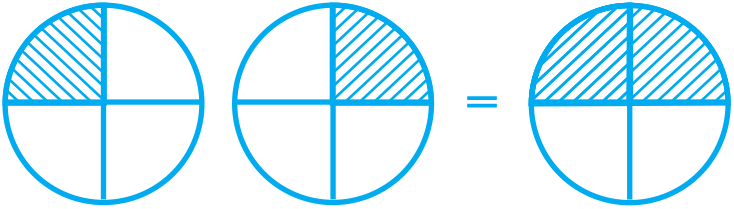
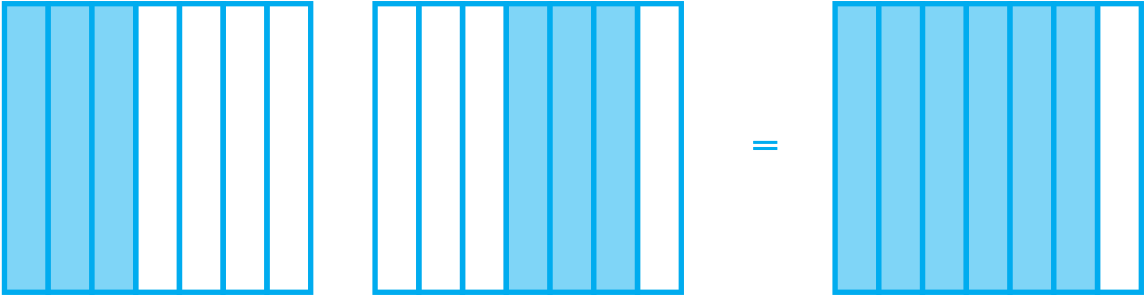
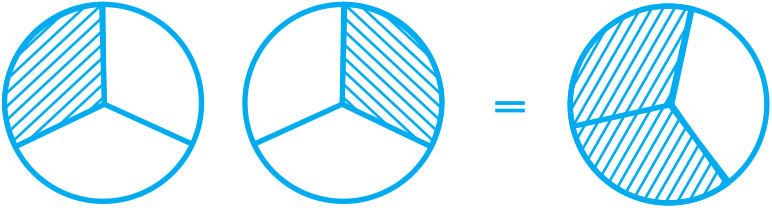
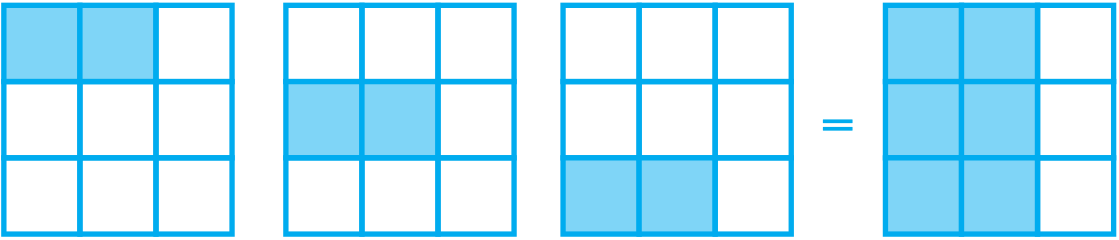
Some pictures $(a)$ to $(f)$ are given below. Tell which of them show:
$i. 2\times\frac{1}{4}$
$ii. 2\times\frac{3}{7}$
$iii. 2\times\frac{1}{3}$
$iv. \frac{1}{4}\times4$
$v. 3\times\frac{2}{9}$
$vi. \frac{1}{4}\times3$
$a.$
$b.$ 
$c.$ 
$d.$ 
$e.$ 
$f.$ 
Answer
$i. 2\times\frac{1}{4}$
$d.$ 

Solution:
$\frac{1}{4}+\frac{1}{4}=2\times\frac{1}{4}$
$ii. 2\times\frac{3}{7}$
$f.$

Solution:
$\frac{3}{7}+\frac{3}{7}=2\times\frac{3}{7}$
$iii. 2\times\frac{1}{3}$
$c.$ 

Solution:
$\frac{1}{3}+\frac{1}{3}=2\times\frac{1}{3}$
$iv. \frac{1}{4}\times4$
$b.$ 

Solution:
$\frac{1}{4}+\frac{1}{4}+\frac{1}{4}+\frac{1}{4}+=4\times\frac{1}{4}$
$v. 3\times\frac{2}{9}$
$a.$

Solution:
$\frac{2}{9}+\frac{2}{9}+\frac{2}{9}+=3\times\frac{2}{9}$
$f. \frac{1}{4}\times3$
$e.$

Solution:
$\frac{1}{4}+\frac{1}{4}+\frac{1}{4}+=3\times\frac{1}{4}$
View full question & answer
Question 65 Marks
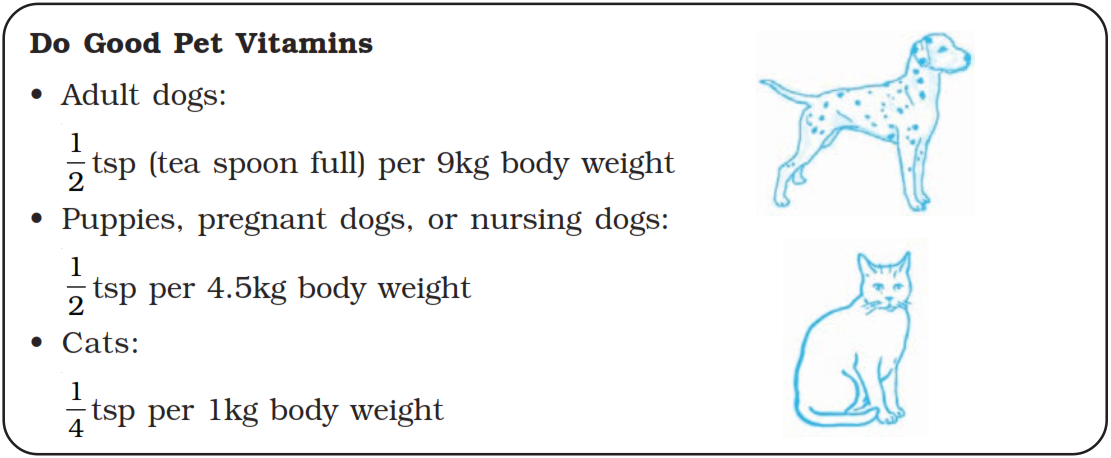
The label on a bottle of pet vitamins lists dosage guidelines. What dosage would you give to each of these animals?
$a.$ A $18\ kg$ adult dog.
$b.$ A $6\ kg$ cat.
$c.$ A $18\ kg$ pregnant dog.
Answer
$a.$ Dosage prescribeb for a adult dog is $\frac{1}{2}$ per $9\ kg$ body weight.
$\therefore$ For a $18\ kg$ adult dog, dosage $=\frac{(\frac{1}{2})}{9}\times18$
$=\frac{1}{2\times9}\times18$
$=\frac{1}{18}\times18$
$=\frac{1}{2\times9}\times18$
$=\frac{1}{18}\times18$
$=1\ \text{tsq}$
$b.$ Dosage prescribed for a cat is $\frac{1}{4}$ per $1\ kg$ body weight.
$\therefore$ For a $6\ kg$ cat, dosage $=\frac{(\frac{1}{4})}{1}\times6$
$=\frac{1}{4}\times6\ \text{tsp}$
$\frac{6}{4}=\frac{3}{2}\ \text{tsp}$
$=\frac{6}{4}=\frac{3}{2}\ \text{tsp}$
$=1\ \frac{1}{2}\ \text{tsp}$
$c.$ Dosage prescribed for pregnant dogs is $\frac{1}{2}$ per $4.5\ kg$ body weight.
$\therefore$ For a $18\ kg$ pregnat dog, dosage $=\frac{\big(\frac{1}{2}\big)}{4.5}\times18$
$=\frac{1}{2\times4.5}\times18$
$=\frac{1}{9}\times18$
$=\frac{18}{9}\ \text{tsp}$
$=2\ \text{tsp}$
View full question & answer