MCQ 1011 Mark
Product of the numbers $78.12$ and $1.5$ is:
- A
$117.81$
- ✓
$117.18$
- C
$117.32$
- D
$117.80$
AnswerCorrect option: B. $117.18$
$78.12\times1.5 = \frac{7812}{100}\times\frac{15}{10}$
$ = \frac{117180}{1000}$
$= 117.180$
$= 117.18$
View full question & answer→MCQ 1021 Mark
A rational number is defined as a number that can be expressed in the form $\frac{\text{p}}{\text{q}},$ where $p$ and $q$ are integers and
- A
$\text{q}=0$
- B
$\text{q}=1$
- C
$\text{q}\neq1$
- ✓
$\text{q}\neq0$
AnswerCorrect option: D. $\text{q}\neq0$
A number that can be expressed in the form of $\frac{\text{p}}{\text{q}},$ where $p$ and $q$ are integers and $\text{q}\neq0,$ is called a rational number.
View full question & answer→MCQ 1031 Mark
Which one of the following is a rational number?
- ✓
$(\sqrt{2})^{2}$
- B
$2\sqrt{2}$
- C
$2+\sqrt{2}$
- D
$\frac{\sqrt{2}}{2}$
AnswerCorrect option: A. $(\sqrt{2})^{2}$
$(\sqrt{2})^{2} = \sqrt{2}\times\sqrt{2} = {2}$ So $(\sqrt{2})^{2}$ is a rational number.
View full question & answer→MCQ 1041 Mark
Mark $(\checkmark)$ against the correct answer in the following: Which is smaller between $\frac{-5}{6}$ and $\frac{-7}{12}?$
- ✓
$\frac{-5}{6}$
- B
$\frac{-7}{12}$
- C
$\frac{6}{5}$
- D
AnswerCorrect option: A. $\frac{-5}{6}$
Since $LCM$ of $6$ and $12$ is $12$
$\frac{-5\times2}{6\times}=\frac{-10}{12}$
$\frac{-7\times1}{12\times1}=\frac{-7}{12}$
$\frac{-5}{6}<\frac{-7}{12}$
View full question & answer→MCQ 1051 Mark
Express $ \frac{126}{-196}$ as simplest rational number with numerator equal to:
Answer Given $ \frac{126}{-196} =\frac{ {-9}\times{14}}{14\times14} = \frac{-9}{14}$
View full question & answer→MCQ 1061 Mark
$(-2)\div\Big(-\frac{5}{3}\Big)=$
- A
$\frac{5}{6}$
- B
$-\frac{5}{6}$
- ✓
$\frac{6}{5}$
- D
$\frac{-6}{5}$
AnswerCorrect option: C. $\frac{6}{5}$
$(-2)\div\Big(-\frac{5}{3}\Big)$
$=-2\times\Big(-\frac{3}{5}\Big)$ $\text{x}\div\text{y}=\text{x}\times\frac{1}{\text{y}}$
$=\frac{-2}{1}\times\frac{(-3)}{5}$
$=\frac{-2\times(-3)}{1\times5}$ $\Big(\frac{\text{a}}{\text{b}}\times\frac{\text{c}}{\text{d}}=\frac{\text{a}\times\text{c}}{\text{b}\times\text{d}}\Big)$
$=\frac{6}{5}$
Hence, the correct answer is option $(c).$
View full question & answer→MCQ 1071 Mark
A rational number is defined as a number that can be expressed in the form $\frac{\text{p}}{\text{q}}$ where $p$ and $q$ are integers and:
- A
$q = 0$
- B
$q = 1$
- C
${\text{q}}\neq{1}$
- ✓
${\text{q}}\neq{0}$
AnswerCorrect option: D. ${\text{q}}\neq{0}$
According to the definition of a rational number, it can be expressed in the form of $\frac{\text{p}}{\text{q}}$ where $p$ and $q$ are an integer and ${\text{q}}\neq{0}$
View full question & answer→MCQ 1081 Mark
Mark $(\checkmark)$ against the correct answer in the following: $\text{if }\frac{\text{x}}{6}=\frac{7}{-3}$ then the value of $x$ is:
Answer The correct option is $(a).$
The value of $x$ is $-14$
$\Big[\text{x}=\frac{7\times6}{-3}=\frac{42^{14}}{-3_1}=-14\Big]$
View full question & answer→MCQ 1091 Mark
Which one of the following is a rational number?
- ✓
$( \sqrt{7} )^{2}$
- B
$ 211\sqrt{7}$
- C
$8+\sqrt{7}$
- D
$\frac{\sqrt{7}}{9}$
AnswerCorrect option: A. $( \sqrt{7} )^{2}$
$( \sqrt{7} )^{2}$
View full question & answer→MCQ 1101 Mark
Mark $(\checkmark)$ against the correct answer in the following: $\frac{-6}{13}-\Big(\frac{-7}{15}\Big)=?$
- A
$\frac{-181}{195}$
- B
$\frac{181}{195}$
- ✓
$\frac{1}{195}$
- D
$\frac{-1}{195}$
AnswerCorrect option: C. $\frac{1}{195}$
The correct option is $(c).$
$\frac{-6}{13}-\frac{[-7]}{15}$
$LCM$ of $13$ and $15$ is $195$
$\frac{-6}{13}-\frac{[-7]}{15}$
$=\frac{-90+91}{195}$
$=\frac{1}{195}$
View full question & answer→MCQ 1111 Mark
Every rational number is:
Answer Real number is a value that represents a quantity along the number line. Real number includes all rational and irrational numbers. Rational numbers are numbers which can be represented in the form $\dfrac {\text{ p} }{\text{ q} }$ where, ${\text{q}} \neq 0\ p, q $ are integers. rational number is a subset of real number.
View full question & answer→MCQ 1121 Mark
For any two rational numbers $x$ and $y$ which of the following is $/$are correct, if $x$ is positive and $y$ is negative$?$
$x < y , x = y , x > y$
- A
Both $1$ and $2$
- B
Both $2$ and $3$
- ✓
Only $3$
- D
$1, 2$ and $3$
AnswerCorrect option: C. Only $3$
Given that, $x$ is positive and $y$ is negative
$\Rightarrow x > 0$ and $y < 0$
$\therefore x > y$ is the only true statement amongst the given ones.
View full question & answer→MCQ 1131 Mark
If $x, y, z$ be rational numbers such that $x > y$ and $z < y$ then:
- A
$Z > x$
- ✓
$Z < x$
- C
$Y < z$
- D
$Y > x$
AnswerCorrect option: B. $Z < x$
$x > y$ and $y > z$
$\therefore x > y > z$
$\Rightarrow x > z$
View full question & answer→MCQ 1141 Mark
Calculate the remainder when $30$ is divided by $7.$
- A
$0$
- B
$0.2857140$
- ✓
$2$
- D
$2.2857142$
Answer The remainder is the integer amount left over after a number is divided by another. The number $7$ goes into $30$ four times, with $2$ left over i.e. $7 \times 4 + 2 = 30,$ so the remainder is $2.$
View full question & answer→MCQ 1151 Mark
Divide $\frac{7}{12}\div\Big(\frac{-7}{12}\Big),$ the result is:
View full question & answer→MCQ 1161 Mark
$\frac{-5}{13}+?=-1$
- A
$\frac{8}{13}$
- ✓
$\frac{-8}{13}$
- C
$\frac{-18}{13}$
- D
$\frac{18}{13}$
AnswerCorrect option: B. $\frac{-8}{13}$
$\frac{-5}{13}+?=-1$
$\Rightarrow?=-1-\Big(\frac{-5}{13}\Big)$
$\Rightarrow?=-1+\frac{5}{13}$ $\Big[-\Big(\frac{-5}{13}=\frac{5}{13}\Big)\Big]$
$\Rightarrow?=\frac{-1\times13+5}{13}$
$\Rightarrow\frac{-13+5}{13}$
$\Rightarrow=\frac{-8}{13}$
Hence, the correct answer is option $(b).$
View full question & answer→MCQ 1171 Mark
Which of the following statement is true about a rational number $\frac{-2}{3}?$
AnswerCorrect option: A. It lies to the left side of $′0′$ on the number line.
It lies to the left side of $′0′$ on the number line.
View full question & answer→MCQ 1181 Mark
What should be subtracted from $\frac{-2}{3}$ to get$\frac{4}{5}?$
- A
$\frac{22}{15}$
- ✓
$\frac{-22}{15}$
- C
$\frac{15}{22}$
- D
$\frac{-15}{22}$
AnswerCorrect option: B. $\frac{-22}{15}$
Difference of the given number and required number $=\frac{4}{5}$
Given number $=\frac{-2}{3}$
$\therefore$ Required number = Given number - Difference of the numbers
$=\frac{-2}{3}-\frac{4}{5}$
$=\frac{-2}{3}+\Big(\frac{-4}{5}\Big)$
$=\frac{-2\times5+(-4)\times3}{15}$
$=\frac{-10+(-12)}{15}$
$=\frac{-22}{15}$
Hence, the correct answer is option $(b).$
View full question & answer→MCQ 1191 Mark
Which of the following is not zero$?$
- A
$0\times0$
- B
$\frac{0}{3}$
- C
$\frac{7-7}{3}$
- ✓
$9\div0$
AnswerCorrect option: D. $9\div0$
AIf any number is multiplied by $0,$ the product is $0.$
$\therefore0\times0=0$
If $0$ is divided by any number $(\neq0),$ the quotient is always $0.$
$\therefore\frac{0}{3}\text{ and }\frac{7-7}{3}=\frac{0}{3}=0$
Division of any number by $0$ is meaningless and is not defined.
$\therefore9\div0$ is not defined.
Hence, the correct answer is option $(d).$
View full question & answer→MCQ 1201 Mark
Which of the following rational numbers is not to equivalent to $\frac{3}{5}?$
- A
$\frac{6}{10}$
- B
$\frac{-3}{-5}$
- C
$\frac{9}{15}$
- ✓
$\frac{12}{24}$
AnswerCorrect option: D. $\frac{12}{24}$
$\frac{12}{24}$
View full question & answer→MCQ 1211 Mark
Assertion: $2$ is a rational number. Reason: The square roots of all positive integers are irrationals:
- A
Both Assertion and Reason are correct and Reason is the correct explanation for Assertion
- B
Both Assertion and Reason are correct but Reason is not the correct explanation for Assertion
- ✓
Assertion is correct but Reason is incorrect
- D
Assertion is incorrect but Reason is correct
AnswerCorrect option: C. Assertion is correct but Reason is incorrect
An integer is a rational number, so the assertion is true. Whereas root of any integer cant be termed as irrational as $4$ is an integer and a perfect square at the same time, so the root will be rational only.
View full question & answer→MCQ 1221 Mark
The rational number between the pair of number $\frac{1}{2}$ and $\sqrt{1}$ is:
- A
$\frac{9}{4}$
- ✓
$\frac{3}{4}$
- C
$\frac{5}{4}$
- D
$\frac{7}{4}$
AnswerCorrect option: B. $\frac{3}{4}$
$\frac{3}{4}$
View full question & answer→MCQ 1231 Mark
Between any two rational numbers:
- A
There is no rational number
- B
There is exactly one rational number
- ✓
There are infinitely many rational numbers
- D
There are only rational numbers and no irrational numbers
AnswerCorrect option: C. There are infinitely many rational numbers
There are infinitely many rational numbers
View full question & answer→MCQ 1241 Mark
If $S > 0$ and $\sqrt { \frac { \text{r} }{\text{ s} } } =\text{s}$ what is $r$ in terms of $s?$
Answer given that
$\sqrt { \frac { \text{r} }{\text{ s} } } =\text{s}$ where $S > 0$
squaring both sides
$\Rightarrow \frac{\text{r}}{\text{s}} = \text{s}^{2}$
$⇒ r = s^2× s$
$⇒ r =s^3$
View full question & answer→MCQ 1251 Mark
Mark $(\checkmark)$ against the correct answer in the following: $\frac{2}{3}-1\frac{5}{7}=?$
- A
$1\frac{1}{21}$
- ✓
$-1\frac{1}{21}$
- C
$\frac{5}{21}$
- D
$\frac{-5}{21}$
AnswerCorrect option: B. $-1\frac{1}{21}$
$-1\frac{1}{21}$
View full question & answer→MCQ 1261 Mark
The multiplicative inverse of $\frac{4}{-5}$ of:
- A
$-\frac{4}{5}$
- B
$\frac{5}{4}$
- ✓
$\frac{5}{-4}$
- D
$\frac{-5}{-4}$
AnswerCorrect option: C. $\frac{5}{-4}$
We know that the multiplicative inverse of the rational number $\frac{\text{a}}{\text{b}}\text{ is }\frac{\text{b}}{\text{a}}$
$\therefore$ Multiplicative inverse of $\frac{4}{-5}=\frac{-5}{4}=\frac{5}{-4}$
Hence, the correct answer is option $(c).$
View full question & answer→MCQ 1271 Mark
Compare $\frac{19}{20} $ and $\frac{14}{20}$
- A
$\frac{19}{20} = \frac{14}{20}$
- ✓
$\frac{19}{20} > \frac{14}{20}$
- C
$ \frac{19}{20} \geq \frac{14}{20}$
- D
$ \frac{19}{20} \leq \ \frac{14}{20}$
AnswerCorrect option: B. $\frac{19}{20} > \frac{14}{20}$
As ${19} > {14}\frac{19}{20} > \frac{14}{20}$
View full question & answer→MCQ 1281 Mark
Which of the following is a rational number $(s)?$
- A
$ \frac{-2}{9}$
- B
$\frac{4}{-7}$
- C
$ \frac{-3}{17}$
- ✓
All the three given numbers
AnswerCorrect option: D. All the three given numbers
All the three given numbers
View full question & answer→MCQ 1291 Mark
The value of $(+12) + (+25)$ is:
Answer As both the digits have equal $(+)$ signs and the operation to be performed is addition, so resultant is $(+12) + (+25) = 37$
View full question & answer→MCQ 1301 Mark
What is the multiplicative identity element in the set of whole numbers$?$
AnswerWe know that if a is a whole number, then $a \times 1 = a = 1 \times a.$
Therefore, $1$ is the multiplicative identity element for multiplication of whole numbers because it does not change the identity or value of the whole number during the operation of multiplication.
Hence, the correct answer is option $(b).$
View full question & answer→MCQ 1311 Mark
$5$ is a rational number. It can be written as $..........:$
- ✓
$\frac{5}{1}$
- B
$\frac{1}{5}$
- C
$\frac{5}{5}$
- D
$\frac{5}{25}$
AnswerCorrect option: A. $\frac{5}{1}$
$\frac{5}{1}$
View full question & answer→MCQ 1321 Mark
Mark $(\checkmark)$ against the correct answer in the following: $\frac{-9}{14}+?=-1$
- A
$\frac{5}{14}$
- ✓
$\frac{-5}{14}$
- C
$\frac{1}{7}$
- D
$\frac{-1}{7}$
AnswerCorrect option: B. $\frac{-5}{14}$
The correct option is $(b).$
$\frac{-9}{14}+?=-1$
$\therefore?=-1-\frac{(-9)}{14}$
$?=\frac{14+9}{14}$
$?=\frac{-5}{14}$
View full question & answer→MCQ 1331 Mark
To reduce a rational number to its standard form, we divide its numerator and denominator by their:
AnswerCorrect option: B. $HCF.$
To reduce a rational number to its standard form, we divide its numerator and denominator by their $HCF.$
View full question & answer→MCQ 1341 Mark
The reciprocal of a negative rational number is:
- A
- ✓
- C
Always $1$
- D
Always $0.$
View full question & answer→MCQ 1351 Mark
Which of the following cannot be a rational number?
- A
$\frac{0}{5}$
- B
$\frac{0}{-5}$
- ✓
$\frac{5}{0}$
- D
${-1}$
AnswerCorrect option: C. $\frac{5}{0}$
$\frac{5}{0}$
View full question & answer→MCQ 1361 Mark
$0\div\frac{3}{5}=$
- ✓
$0$
- B
$\frac{5}{3}$
- C
$\frac{3}{5}$
- D
$-\frac{3}{5}$
AnswerWe know that $0$ divided by any non-zero rational number is always $0.$
$\therefore0\div\frac{3}{5}=0$
$\Big(0\div\frac{\text{a}}{\text{b}}=0\Big)$
Hence, the correct answer is option $(a).$
View full question & answer→MCQ 1371 Mark
The reciprocal of a negative rational number is:
AnswerThe reciprocal of a negative rational number is negative. Let no. be $-a$ its reciprocal is $ \frac{-1}{\text{a}}$ which is a negative number.
View full question & answer→MCQ 1381 Mark
Mark $(\checkmark)$ against the correct answer in the following: $\frac{5}{4}-\frac{7}{6}-\frac{-2}{3}=?$
- ✓
$\frac{3}{4}$
- B
$\frac{-3}{4}$
- C
$\frac{-7}{12}$
- D
$\frac{7}{12}$
AnswerCorrect option: A. $\frac{3}{4}$
$\frac{5}{4}-\frac{7}{6}-\frac{(-2)}{3}$
$LCM$ of $4, 6$ and $3$ is $12$
$=\frac{15-14+8}{12}$
$=\frac{9^3}{12_4}$
$=\frac{3}{4}$
View full question & answer→MCQ 1391 Mark
Mark $(\checkmark)$ against the correct answer in the following: What should be subtracted from $\frac{-3}{4}$ to get $\frac{5}{6}?$
- A
$\frac{19}{12}$
- ✓
$\frac{-19}{12}$
- C
$\frac{1}{12}$
- D
$\frac{-1}{12}$
AnswerCorrect option: B. $\frac{-19}{12}$
The correct option is $(b).$
Let the number that is to be subtracted be $x.$
$\frac{-3}{4}-\text{x}=\frac{5}{6}$
$\Rightarrow-\text{x}=\frac{5}{6}-\Big(\frac{-3}{4}\Big)$
$\Rightarrow-\text{x}=\frac{5}{6}+\frac{-3}{4}$
$\Rightarrow-\text{x}=\frac{(5\times2)+(3\times3)}{12}$
$\Rightarrow\text{x}=-\frac{19}{12}$
Hence, $\frac{-19}{12}$ should be subtracted from $\frac{-3}{4}$ to get $\frac{5}{6}$
View full question & answer→MCQ 1401 Mark
If we divide a positive integer by another positive integer, what is the resulting number$?$
AnswerIf we divide a positive integer by another positive integer, the resulting number is always a rational number. Though it can be a natural number and an integer only if the denominator is $1.$
View full question & answer→MCQ 1411 Mark
Two fractions are equivalent, if their cross multiplications are ......
AnswerTwo fractions are equivalent if their cross multiplications are equal.
For example,
$\frac{2}{5} = \frac{2}{5}$
If we cross multiply the above fraction the $2 \times 5 = 10$
View full question & answer→MCQ 1421 Mark
If $p:$ every fraction is a rational numberq: every rational number is a fractionthen which of the following is correct$?$
- ✓
$P$ is true and $q$ is false.
- B
$P$ is false and $q$ is true.
- C
Both $p$ and $q$ are true.
- D
Both $p$ and $q$ are false.
AnswerCorrect option: A. $P$ is true and $q$ is false.
$P$ is true and $q$ is false.
View full question & answer→MCQ 1431 Mark
Mark $(\checkmark)$ against the correct answer in the following: $\frac{-3}{8}\div=0?$
- A
$\frac{-3}{8}$
- B
$0$
- C
$\frac{-8}{3}$
- ✓
AnswerThis is because $\frac{-3}{8}\div0$ is not defined.
View full question & answer→MCQ 1441 Mark
If $A:$ The quotient of two integers is always a rational number, and $R: \frac{1}{0}$ is not rational, then which of the following statements is true$?$
- A
$A$ is True and $R$ is the correct explanation of $A$
- ✓
$A$ is False and $R$ is the correct explanation of $A$
- C
$A$ is True and $R$ is False
- D
Both $A$ and $R$ are False
AnswerCorrect option: B. $A$ is False and $R$ is the correct explanation of $A$
Since $\frac{1}{0}$ is not rational, the quotient of two integers is not rational.
View full question & answer→MCQ 1451 Mark
The rational number $\frac{-21}{28}$ in standard from is$.....$
- ✓
$\frac{-3}{4}$
- B
$\frac{3}{4}$
- C
$\frac{3}{7}$
- D
$\frac{-3}{7}$
AnswerCorrect option: A. $\frac{-3}{4}$
$\frac{-3}{4}$
View full question & answer→MCQ 1461 Mark
If ${\frac{-3}{\text{x}} =\frac{\text{x}}{27}}$ then the value of, $x$ is .........
Answer$\frac{-3}{\text{x}} = \frac{\text{x}}{27}$
$x × x = -3 × 27$
$⇒ x^2= -81$
$⇒ x^2 = -81$
$\text{x}=\sqrt{−81}$ which is not a rational number.
View full question & answer→MCQ 1471 Mark
Mark $(\checkmark)$ against the correct answer in the following: $\frac{33}{-55}$ in standard form is:
- A
$\frac{3}{-5}$
- ✓
$\frac{-3}{5}$
- C
$\frac{33}{-55}$
- D
AnswerCorrect option: B. $\frac{-3}{5}$
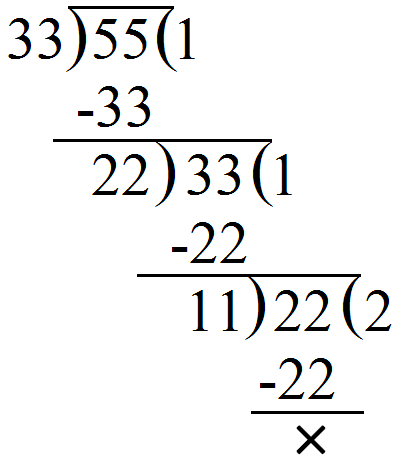
$H.C.F$ of $33$ and $55$ is $11$
$=\frac{-33\div11}{55\div11}=\frac{-3}{5}$
View full question & answer→MCQ 1481 Mark
How many rational numbers are there between $−1$ and $0?$
Answer There are infinite number of rational numbers between any two integers.
View full question & answer→MCQ 1491 Mark
Which of the following rational numbers is negative?
AnswerCorrect option: D. $\frac{3}{-7}$
$(a). -\big(\frac{-3}{7}\big)=\frac{3}{7}$
$(b). \frac{-5}{-8}=\frac{5}{8}$
$(c). \frac{9}{8}=\frac{9}{8}$
$(d). \frac{3}{-7}=\frac{-3}{7}$
View full question & answer→MCQ 1501 Mark
The sum of $\frac{5}{4}+\frac{(-25)}{4} = .......$
View full question & answer→