Questions

1 Marks Question

🎯

Test yourself on this topic

32 questions · timed · auto-graded

Question 11 Mark
Identify the complementary and supplementary pairs of angle from the following pair:
$63^\circ , 27^\circ $
Answer
$63^\circ + 27^\circ = 90^\circ $ so, this is a complementary pair of angle.
Here, $(i)$ and $(iii)$ are complementary pair of angles and $(ii)$ and $(iv)$ are supplementary pair of angles.
View full question & answer
Question 21 Mark
Identify the complementary and supplementary pairs of angle from the following pair:
$25^\circ , 65^\circ $
Answer
$25^\circ + 65^\circ = 90^\circ $ so, this is a complementary pair of angle.
Here, $(i)$ and $(iii)$ are complementary pair of angles and $(ii)$ and $(iv)$ are supplementary pair of angles.
View full question & answer
Question 31 Mark
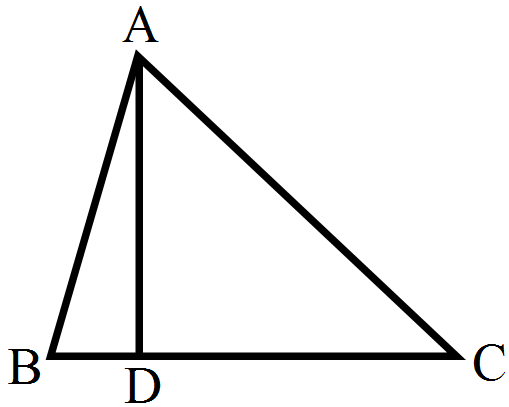
In figure, name all the pairs of adjacent angles.
Answer
In fig., the adjacent angles are: $\angle\text{BAD}\text{ and }\angle\text{DAC}$ $\angle\text{BDA}\text{ and }\angle\text{CDA}$
View full question & answer
Question 41 Mark
Find the supplement of the following angle: $135^\circ $
Answer
The two angle are said to be supplementary angle if the sum of those angle is $180^\circ 180^\circ - 135^\circ = 45^\circ $
View full question & answer
Question 51 Mark
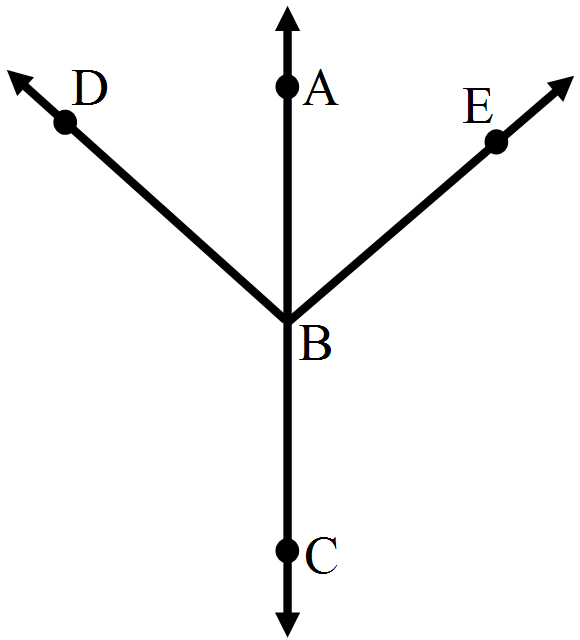
In Figure, $\ce{A, B, C}$ are collinear points and $\angle\text{DBA}=\angle\text{EBA}$
$i.$ Name two linear pairs.
$ii.$ Name two pairs of supplementary angles.
Answer
$i.$ Linear pairs:
$\angle \text{ABD}$ and $\angle \text{DBC}$
$\angle \text{ABE}$ and $\angle \text{EBC}$
$ii.$ Because every linear pair forms supplementary angles, these angles are:
$\angle \text{ABD}$ and $\angle \text{DBC}$
$\angle \text{ABE}$ and $\angle \text{EBC}$
View full question & answer
Question 61 Mark
Identify the complementary and supplementary pairs of angle from the following pair: $120^\circ , 60^\circ $
Answer
$120^\circ + 60^\circ = 180^\circ $ so, this is a supplementary pair of angle.
Here, $(i)$ and $(iii)$ are complementary pair of angles and $(ii)$ and $(iv)$ are supplementary pair of angles.
View full question & answer
Question 81 Mark
Find the complement of the following angle: $35^\circ $
Answer
The two angles are said to be complementary angles if the sum of those angle is $90^\circ $ Complementary angle for the following angle are: $90^\circ - 35^\circ = 55^\circ $
View full question & answer
Question 91 Mark
Find the complement of the following angle: $45^\circ $
Answer
The two angles are said to be complementary angles if the sum of those angle is $90^\circ $ Complementary angle for the following angle are: $90^\circ - 45^\circ = 45^\circ $
View full question & answer
Question 101 Mark
Can two acute angles form a linear pair?
Answer
No, two acute angles cannot form a linear pair because their sum is always less than $180^\circ $.
View full question & answer
Question 111 Mark
Identify the complementary and supplementary pairs of angle from the following pair: $100^\circ , 80^\circ $
Answer
$100^\circ + 80^\circ = 180^\circ $ so, this is a supplementary pair of angle.
Here, $(i)$ and $(iii)$ are complementary pair of angles and $(ii)$ and $(iv)$ are supplementary pair of angles.
View full question & answer
Question 121 Mark
Find the complement of the following angle: $72^\circ $
Answer
The two angles are said to be complementary angles if the sum of those angle is $90^\circ $ Complementary angle for the following angle are: $90^\circ - 72^\circ = 18^\circ $
View full question & answer
Question 131 Mark
One of the angles forming a linear pair is an obtuse angle. What kind of angle is the other?
Answer
One of the Angles of a linear pair is obtuse, then the other angle should be acute, only then their sum will be $180^\circ .$
View full question & answer
Question 141 Mark
One of the angles forming a linear pair is a right angle. What can you say about its other angle?
Answer
One of the Angle of a linear pair is the right angle $(90^\circ )$ Therefore, the other angle is $\Rightarrow 180^\circ - 90^\circ = 90^\circ $
View full question & answer
Question 151 Mark
One of the angles forming a linear pair is an acute angle. What kind of angle is the other?
Answer
One of the Angles of a linear pair is acute, then the other angle should be obtuse, only then their sum will be $180^\circ .$
View full question & answer
Question 161 Mark
Find the supplement of the following angle:
$90^\circ $
Answer
The two angle are said to be supplementary angle if the sum of those angle is $180^\circ $
$180^\circ - 90^\circ = 90^\circ $
View full question & answer
Question 171 Mark
Find the supplement of the following angle: $70^\circ $
Answer
The two angle are said to be supplementary angle if the sum of those angle is $180^\circ\ 180^\circ - 70^\circ = 110^\circ $
View full question & answer
Question 181 Mark
How many pairs of adjacent angles are formed when two lines intersect in a point?
Answer
If the two lines intersect at a point, then four adjacent pairs are formed and those are linear as well.
View full question & answer
Question 191 Mark
Find the complement of the following angle: $85^\circ $
Answer
The two angles are said to be complementary angles if the sum of those angle is $90^\circ $ Complementary angle for the following angle are: $90^\circ - 85^\circ = 5^\circ $
View full question & answer
Question 201 Mark
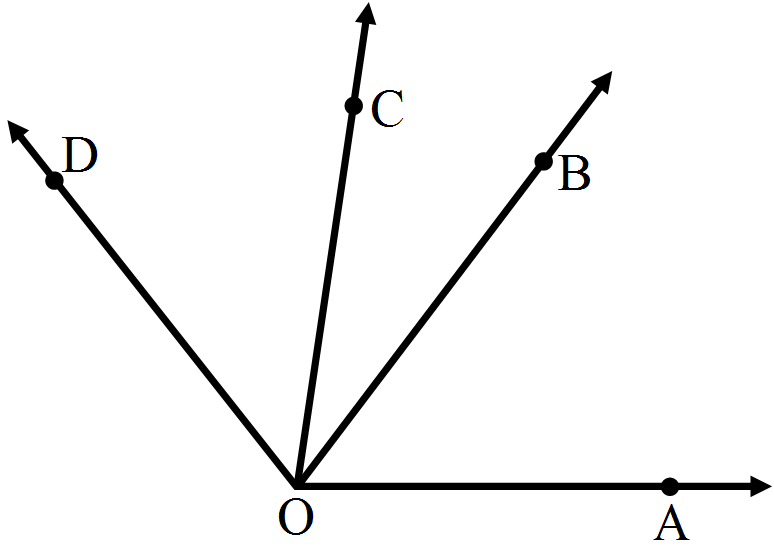
Write down each pair of adjacent angles shown in Figure.

Answer
The angles that have common vertex and a common arm are known as adjacent angles.
The adjacent angles are:
$\angle \text{DOC}\text{ and }\angle \text{BOC}$
$\angle \text{COB}\text{ and }\angle \text{BOA}$
View full question & answer
Question 211 Mark
Find the supplement of the following angle: $120^\circ $
Answer
The two angle are said to be supplementary angle if the sum of those angle is $180^\circ $
$180^\circ - 120^\circ = 60^\circ $
View full question & answer
Question 251 Mark
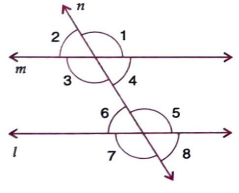
In Fig. a transversal $n$ cuts two lines $l$ and $m$ such that $\angle 2=65^{\circ}$ and $\angle 8=65^{\circ}$. Are the lines parallel?
Image
Answer
Yes
View full question & answer
Question 261 Mark
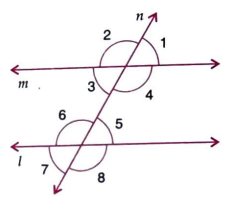
In Fig. a transversal $n$ cuts two lines $l$ and $m$. If $\angle 1=70^{\circ}$ and $\angle 7=80^{\circ}$, is $l \| m$ ?
Image
Answer
No
View full question & answer
Question 291 Mark
One of the angles forming a linear pair is an acute angle. What kind of angle is the other?
Answer
Obtuse
View full question & answer
Question 301 Mark
One of the angles forming a linear pair is an obtuse angle. What kind of angle is the other?
Answer
Acute
View full question & answer
Question 311 Mark
One of the angles forming a linear pair is a right angle. What can you say about its other angle?
Answer
$90^{\circ}$
View full question & answer
1 Marks Question - MATHS STD 7 Questions - Vidyadip