Questions

3 Marks Question

🎯

Test yourself on this topic

2 questions · timed · auto-graded

Question 13 Marks
Copy the figure given here. Take any one diagonal as a line of symmetry and shade a few more squares to make the figure symmetric about a diagonal. Is there more than one way to do that? Will the figure be symmetric about both the diagonals?
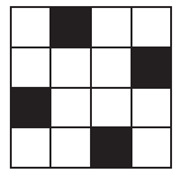
Answer
To make the figure symmetrical about the diagonals, we need to shade the figure in the following way:
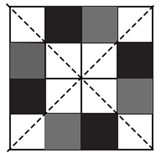
Yes, the figure will be symmetrical about both the diagonals.
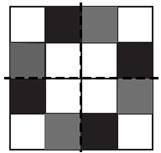
Yes, the figure can be made symmetrical by more than one way which is shown as follows:
View full question & answer
Question 23 Marks
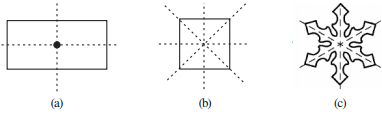
The following figures have more than one line of symmetry. Such figures are said to have multiple lines of symmetry

Identify multiple lines of symmetry, if any, in each of the following figures:
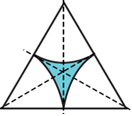
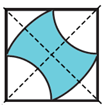
$(a)$  $(b)$  $(c)$ $(d)$
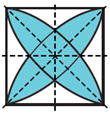
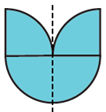
$(e)$ $(f)$​​​​​​​$(g)$​​​​​​​ $(h)$
Answer
$a. $

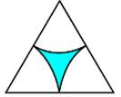
The figure has $3$ lines of symmetry. The figure has an equilateral triangle and $3$ different quadrants of a circle and hence, can be divided into $2$ identical halves in $3$ ways.
$b.$

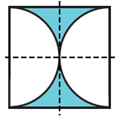
The figure has $2$ lines of symmetry. The figure has $2$ semi$-$circles inscribed in a square and hence, can be divided into $2$ identical halves in $2$ ways.
$c.$

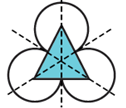
 The figure has $3$ lines of symmetry. The figure has $4$ triangular shaped interconnected and hence, can be divided into $2$ identical halves in $3$ ways.
$d.$

The figure has $2$ lines of symmetry. The figure has a shape inscribed in a square. The diagonals of the square are the lines of symmetry.
$e.$

The figure has $4$ lines of symmetry. The figure has a shape symmetrical about horizontal and vertical axis along with the diagonals of the square.
$f.$

The figure has only one line of symmetry. The figure can only be divided by the horizontal axis through the middle.
$g.$

The figures has $4$ lines of symmetry. The figure has a square and $4$ different quadrants of a circle and hence, can be divided in $4$ ways.
$h.$

The figure has $6$ lines of symmetry. The figure has $5$ different circles overlapping each other and hence, can be divided into $2$ identical halves in $6$ ways.
View full question & answer