MCQ 11 Mark
The top of a broken tree touches the ground at a distance of $12m$ from its base. If the tree is broken at a height of $5m$ from the ground then the actual height of the tree is:
AnswerLet $AB$ be the given that tree of height h m, which is broken at $D$ which is $12m$ away from its base and the height of remaining part, i.e. $CS$ is $5m$.
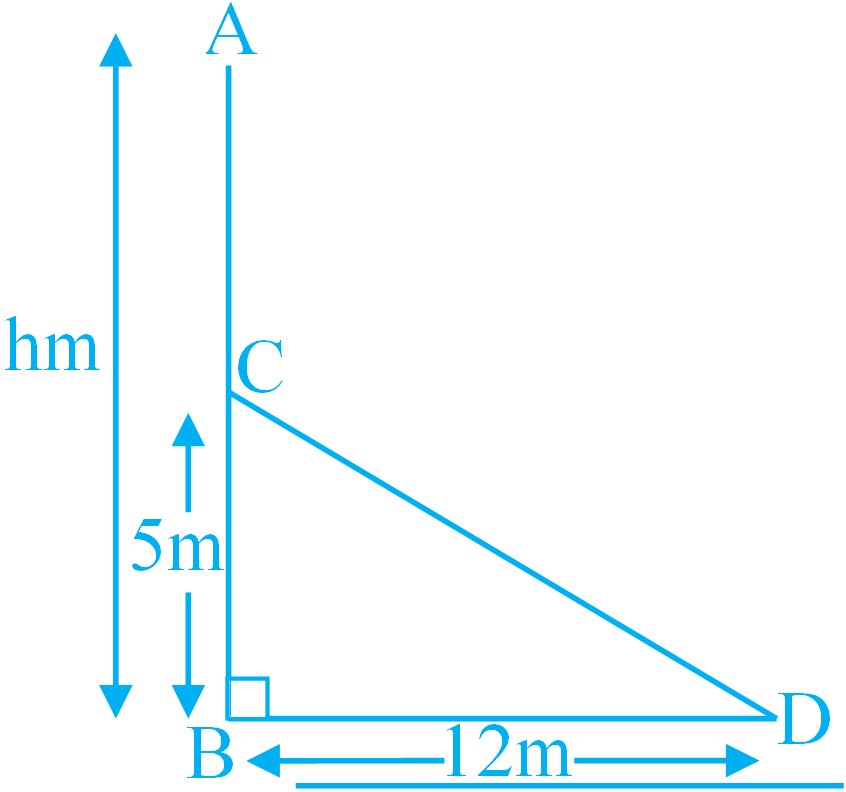
Now, $A b=A C=B C$
$\Rightarrow A C=A B-B C=h-5$
$\Rightarrow A C=C D=h-5 \ldots(i)$
In right angled $\triangle \mathrm{BDC}, C D^2=C B^2+B D^2$ [by pythagoras theoram]
$\Rightarrow(\mathrm{h}-5)^2=(5)^2+(12)^2 \text { [from Eq. (i)] }$
$\Rightarrow(\mathrm{h}-5)^2=25+144$
$\Rightarrow(\mathrm{~h}-5)^2=169$
$\Rightarrow \mathrm{~h}-5=\sqrt{169}=13$
$\Rightarrow \mathrm{~h}=13+5$
$\Rightarrow \mathrm{~h}=18 \mathrm{~m}$
Hence, the height of the tree is $18\ m$ . View full question & answer→MCQ 21 Mark
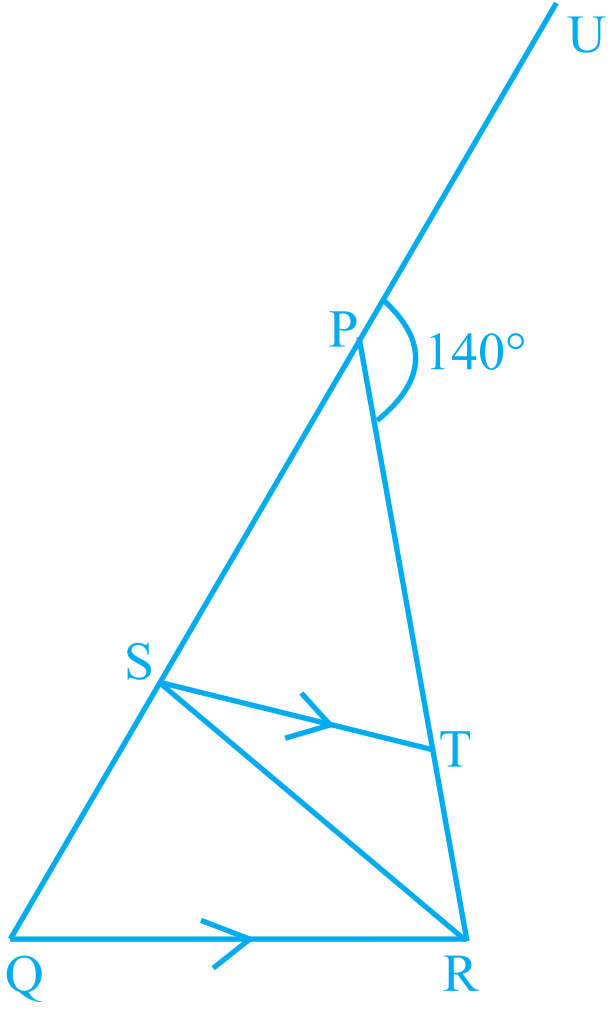
In Figure. $PQ = PR, RS = RQ$ and $ST\ ||\ QR$. If the exterior angle $RPU$ is $140^\circ $, then the measure of angle $TSR$ is:
- A
$55^\circ $
- ✓
$40^\circ $
- C
$50^\circ $
- D
$45^\circ $
AnswerCorrect option: B. $40^\circ $
Here,
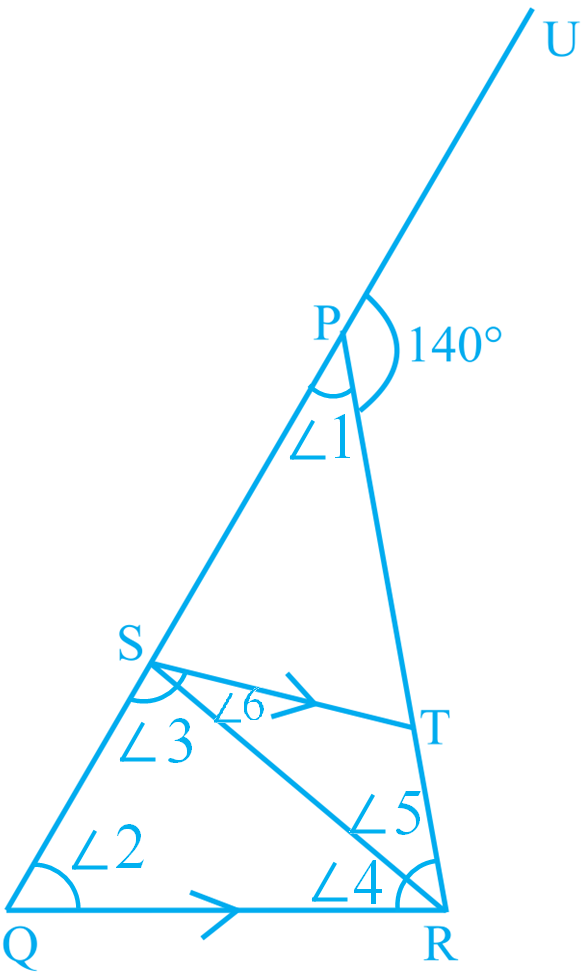
$\ \angle1+\angle\text{P}=180^{\circ}$ $[\text{linear pair}]$
$\Rightarrow\ \angle1+\angle\text{140}^{\circ}=180^{\circ}$
$\Rightarrow\ \angle1=180^{\circ}-\angle\text140^{\circ}$
$\Rightarrow\ \angle1=40^{\circ}$
Since, $PQ = PR$
$\therefore \ \angle\text{Q}=\angle\text{R}=\text{x} \ $ $[\text{say}]$
In$ \ \triangle\text{PQR},$ $\ \angle\text{P}+\angle\text{Q}+\angle\text{R}=180^{\circ}$ [angle sum property of a triangle]
$\Rightarrow \ 40^{\circ}+\text{x}+\text{x}=180^{\circ}$
$\Rightarrow \ 2\text{x}=180^{\circ}-40^{\circ}$
$\Rightarrow \text{2x}=140^{\circ}$
$\Rightarrow\text{x}=70^{\circ}$
So, $\angle\text{Q}=\angle\text{R}=70^{\circ}$
Given that, $RS = RQ$
$\therefore \ \angle2=\angle3=70^{\circ}$
$\text{In} \ \triangle\text{SQR},$ $\angle2+\angle3+\angle4=180^{\circ}$ [angle sum property of a triangle]
$\Rightarrow \ 70^{\circ}+70^{\circ}+\angle4=180^{\circ}$
$\Rightarrow \ \angle4=180^{\circ}-140^{\circ}$
$\Rightarrow \ \angle4 = 40^{\circ}$
Also, $ST\ ||\ QR$ [given]
Now, $\angle4=\angle6=40^{\circ}$ [alternate interior angles]
$\therefore \ \angle\text{TSR}=40^{\circ}$ View full question & answer→MCQ 31 Mark
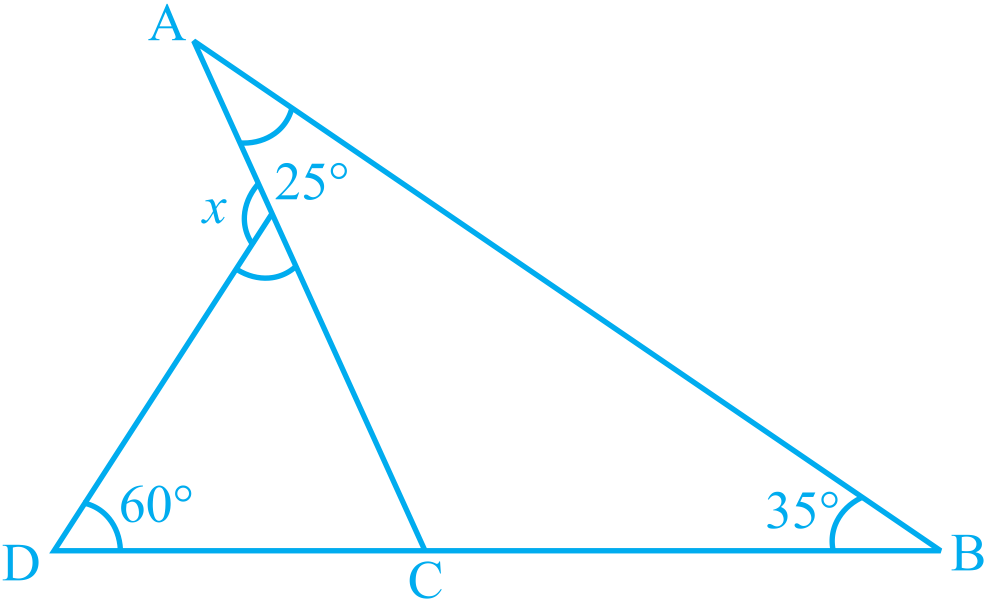
From the following figure, the value of $x$ is:
- A
$75^\circ $
- B
$90^\circ$
- ✓
$120^\circ $
- D
$60^\circ$
AnswerCorrect option: C. $120^\circ $
$\text{In} \ \triangle\text{ABC},$ $\angle\text{CAB}+\angle\text{ABC}+\angle\text{BCA}=180^{\circ}$ $[\text{angle sum property of a triangle}]$
$\Rightarrow \ 25^{\circ}+35^{\circ}+\angle\text{BCA}=180^{\circ}$
$\Rightarrow\angle\text{BCA}=180^{\circ}-60^{\circ}$
$\Rightarrow \ \angle\text{BCA}=120^{\circ}$
Also, $\ \angle\text{BCA}$ is an exterior angle.
$\therefore \ \angle\text{BCA}=\angle\text{D}+\text{y}$
$\Rightarrow \ \text{y}=\angle\text{BCA}-\angle\text{D}=120^{\circ}-60^{\circ}$
$\Rightarrow \ \text{y}=60^{\circ}$
Now, $\angle\text{x}$ and $\angle\text{y}$ form a linear pair.
$\therefore \ \text{x}+\text{y}=180^{\circ}$
$\Rightarrow \ \text{x}+\text{60}^{\circ}=180^{\circ}$
$\Rightarrow \ \text{x}=180^{\circ}-60^{\circ}=120^{\circ}$
View full question & answer→MCQ 41 Mark
The perimeter of the rectangle whose length is $60\ cm$ and a diagonal is $61\ cm$ is:
- A
$120\ cm$
- B
$122\ cm$
- C
$71\ cm$
- ✓
$142\ cm$
AnswerCorrect option: D. $142\ cm$
Given, length of rectangle $= 60\ cm$ and its diagonal $= 61\ cm.$
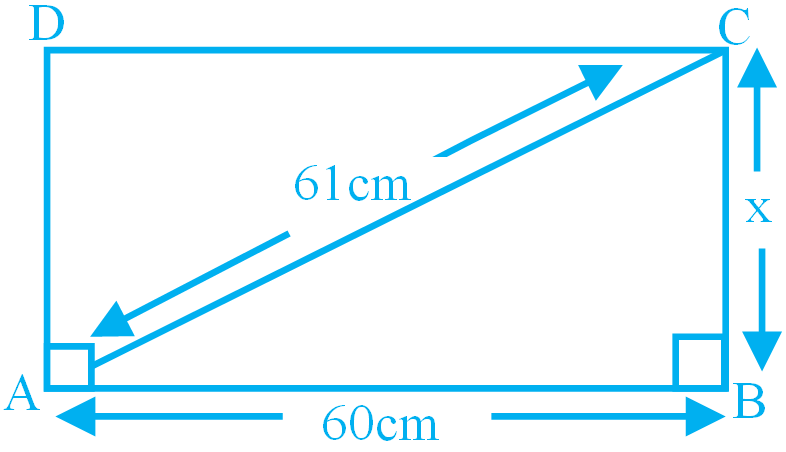
Let the breadth of a rectangle be $x \mathrm{~cm}$.
In right angled $\triangle \mathrm{ABC}$
$\Rightarrow(A C)^2=(A B)^2+(B C)^2$
$\Rightarrow(B C)^2=(A C)^2+(A B)^2[\text { by pythagoras theoram }]$
$\Rightarrow x^2=(61)^2-(60)^2=3721-3600=121$
$\Rightarrow x=\sqrt{121}=11 \mathrm{~cm}$
$\therefore$ Breadth of rectangle $=11 \mathrm{~cm}$ and length of rectangle $=60 \mathrm{~cm}$.
Now, perimeter of rectangle $=2(l+b)$
$=2(60+11)=2 \times 71$
$=142 \mathrm{~cm} .$ View full question & answer→MCQ 51 Mark
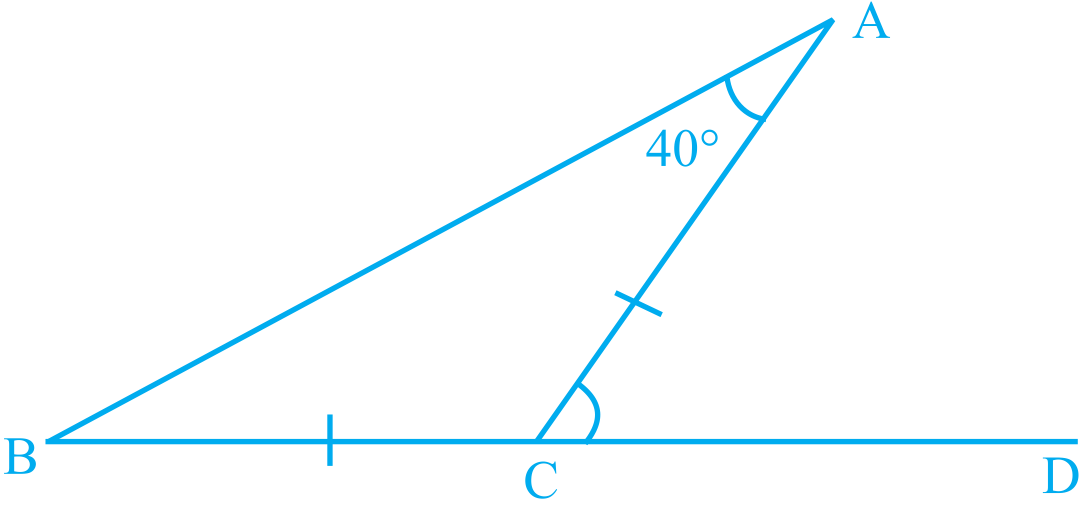
In Figure. $BC = CA$ and $\angle\text{A} = 40$. Then, $\angle\text{ACD}$ is equal to:
- A
$40^\circ $
- ✓
$80^\circ $
- C
$120^\circ $
- D
$60^\circ $
AnswerCorrect option: B. $80^\circ $
$\text{Given}, \ \text{BC}=\text{CA},$
$\therefore\angle\text{B}=\angle\text{A}=40^{\circ}$ $[\because$ opposite angles of two equal sides are equal$]$
As we know, the measure of any exterior angles of a triangle is equal to the sum of the measure of its two interior opposite angles.
So, $\angle\text{ACD}=\angle\text{A}+\angle\text{B}=40^{\circ}+40^{\circ}$
$\angle\text{ACD}=80^{\circ}$.
View full question & answer→MCQ 61 Mark
If in an isosceles triangle, each of the base angles is $40^\circ $, then the triangle is:
- A
- B
- ✓
- D
Isosceles right-angled triangle.
AnswerAs we know, the sum of the interior angles of a triangle is $180^\circ $.
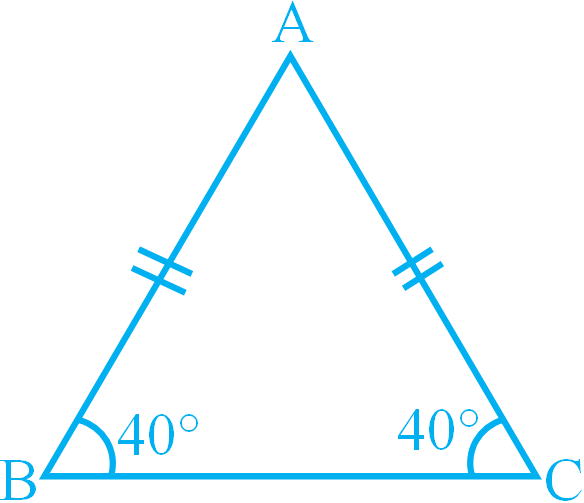
$\text{In} \ \angle\text{ABC},$ $\angle\text{A}+\angle\text{B}+ \angle\text{C}=180^{\circ}$ [angle sum property of a triangle]
$\Rightarrow \ \angle\text{A}+40^{\circ}+40^{\circ}=180^{\circ}$
$\Rightarrow \ \angle\text{A}=180^{\circ}-80^{\circ}$
$\Rightarrow \ \angle\text{A}=100^{\circ}$ $[\text{obtuse angle }]$
Therefore, it is an obtuse angled triangle. Since, it has one angle which is greater than $90^\circ $. View full question & answer→MCQ 71 Mark
In $\triangle\text{ABC},$ $\angle\text{A}=50^{\circ},$$\angle\text{B}=70^{\circ}$ and bisector of $\angle\text{C}$ Meets $AB$ in $D$ figure. Measure of $\angle\text{ADC}$
is. 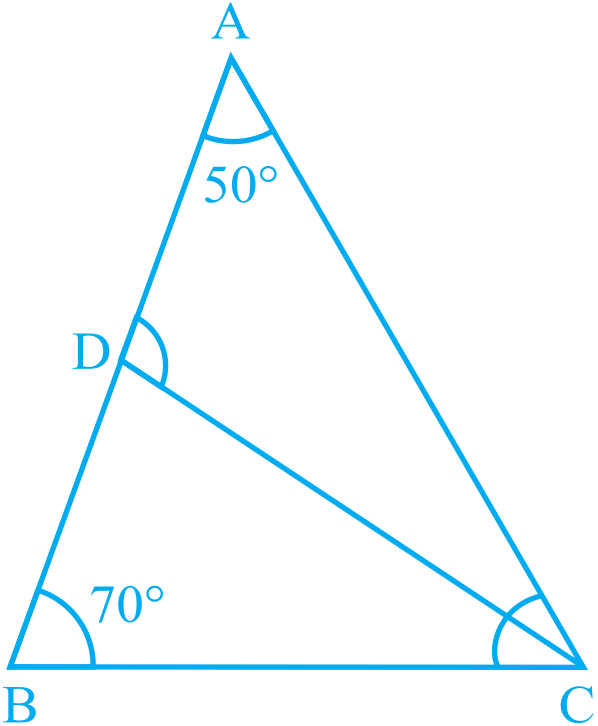
- A
$50^\circ $
- ✓
$100^\circ $
- C
$30^\circ $
- D
$70^\circ $
AnswerCorrect option: B. $100^\circ $
In $\triangle\text{ADC},$
$\angle\text{ADC}+\angle\text{DAC}+\angle\text{ACD}=180^{\circ}$ [angle sum property of a triangle]
$\Rightarrow \ \angle\text{ADC}+50^{\circ}+\angle\text{ACD}=180^{\circ}$ $[\because\angle\text{DAC}=50^{0}]$
$\Rightarrow \ \angle\text{ACD}=130^{\circ}-\angle\text{ACD}......(\text{i})$
In $\triangle\text{ DBC},$ $\angle\text{ADC}=\angle\text{DBC}+\angle\text{BCD}$
$[\because$ exterior angle is equal to sum of opposite interior angles$]$
$\Rightarrow \ \angle\text{ADC}=70^{\circ}+\angle\text{ACD}$ $[\because\angle\text{ACD}=\angle\text{BCD}]$
$\Rightarrow \ \angle\text{ADC}=70^{\circ}+130^{\circ}-\angle\text{ADC}$ [from equation $(i)$]
$\Rightarrow \ \angle\text{ADC}=200^{\circ}-\angle\text{ADC}$
$\Rightarrow 2\ \angle\text{ADC}=200^{\circ}$
$\Rightarrow \ \angle\text{ADC}=\frac{200^{\circ}}{2}$
$\Rightarrow \ \angle\text{ADC}=100^{\circ}$
View full question & answer→MCQ 81 Mark
If $D$ is the mid-point of the side $BC$ in $\triangle\text{ABC}$ where $AB = AC$, then $\angle\text{ADC}$ is:
- A
$60^\circ $
- B
$45^\circ $
- C
$120s^\circ $
- ✓
$90^\circ $
AnswerCorrect option: D. $90^\circ $
In $\triangle\text{ADB} \ \text{and} \ \triangle\text{ADC},$ $BD = DC$ [$D$ is the mid-point]
$AB = AC$ [given]
$AD = AD$ [common side]
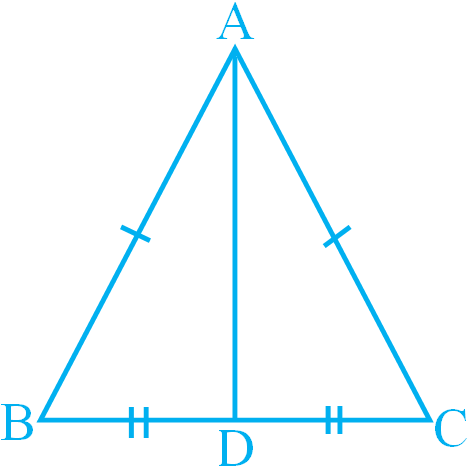
By $SSS$ congruence criterion, $\triangle\text{ABD}\cong\triangle\text{ACD}$
$\therefore \ \triangle\text{ADB}\cong\triangle\text{ADC}$ [by $CPCT$]
We know that, $\angle\text{ADB}+\angle\text{ADC}=180^{\circ}$ [linear pair]
$\Rightarrow2\angle\text{ADC}=180^{\circ}$ $[\because\angle\text{ADB}=\angle\text{ADC}]$
$\Rightarrow \ \angle\text{ADC}=90^{\circ}$ View full question & answer→MCQ 91 Mark
If for $\triangle \text{ABC}$ and $\triangle\text{DEF},$ the correspondence $CAB ↔ EDF$ gives a congruence, then which of the following is not true?
AnswerCorrect option: B. $AB = EF$
Two figures are said to be congruent, if the trace copy of figure $1$ fits exactly on that of:
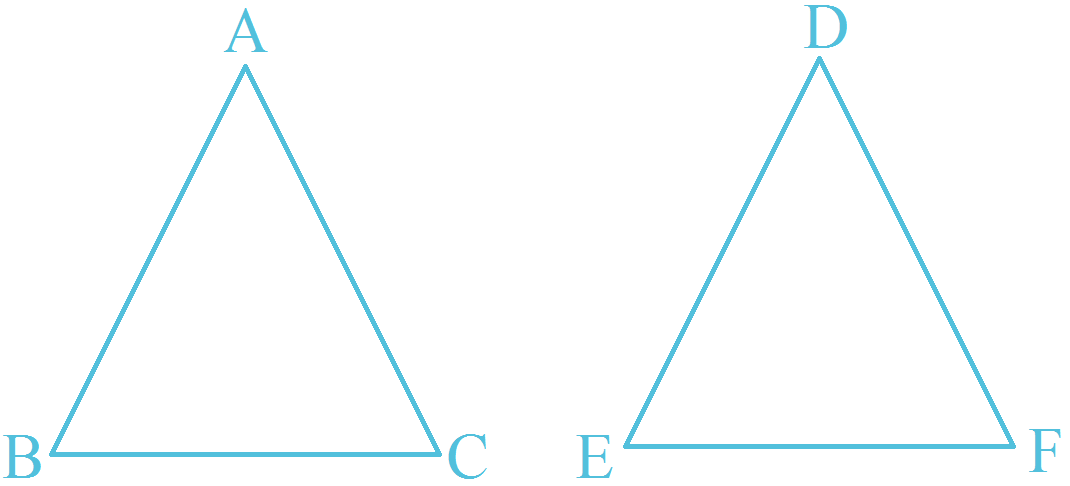
Now, if $\triangle\text{ABC}$ and $\triangle\text{DEF}$ are congruent, then
$AB = DF, BC = EF$
$AC = DE$, $\angle\text{A}=\angle\text{D}$
$\angle\text{B}=\angle\text{F},$ $\angle\text{ C}=\angle\text{E}$
Hence, option (b) is not true. View full question & answer→MCQ 101 Mark
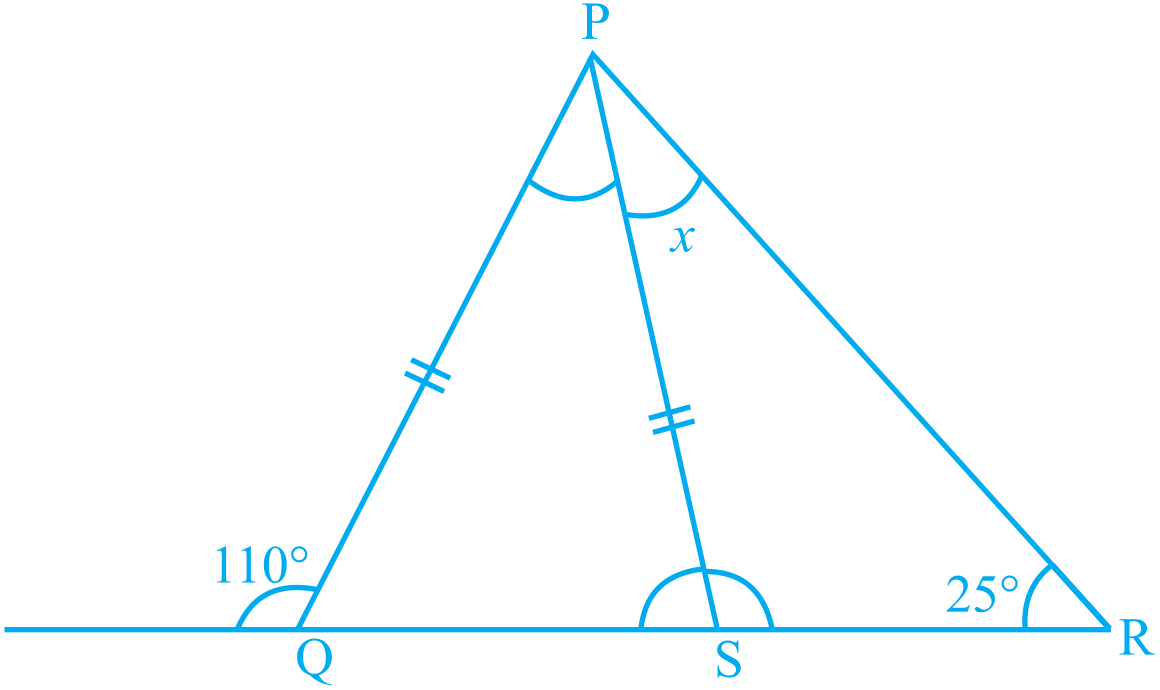
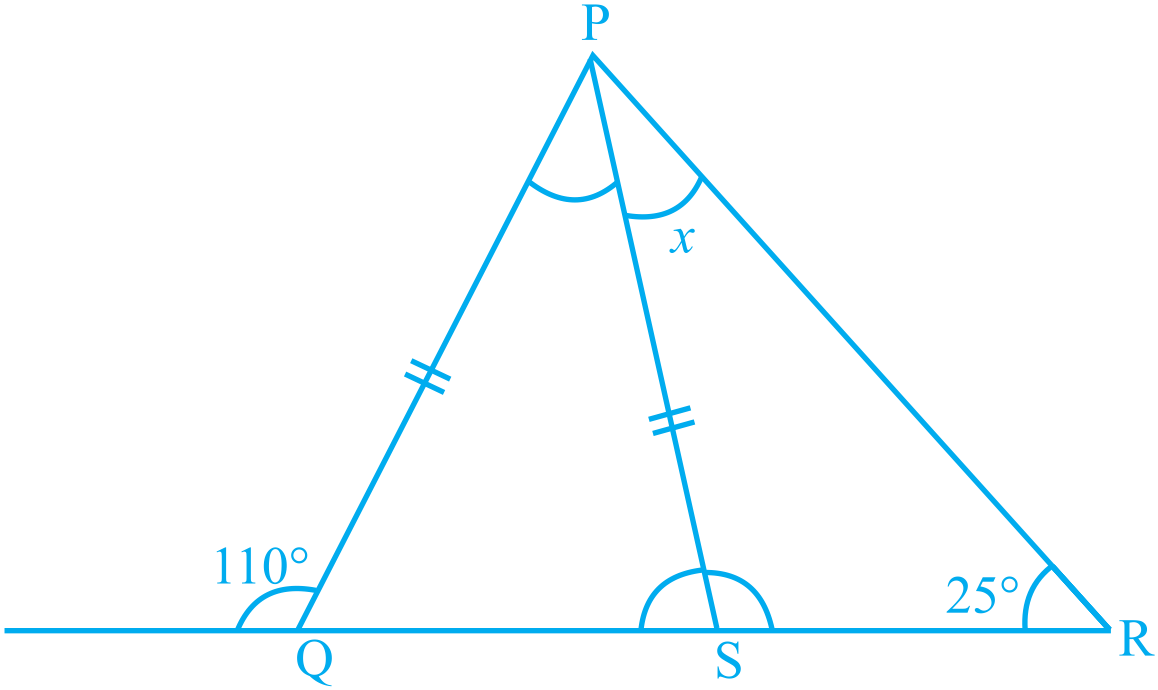
In Figure. $PQ = PS.$
The value of $x$ is:
- A
$35^\circ$
- ✓
$45^\circ $
- C
$55^\circ$
- D
$70^\circ $
AnswerCorrect option: B. $45^\circ $
In $\triangle\text{PQS},$
$110^{\circ}+\angle\text{1}=180^{\circ}$ [linear pair of angles]
$\Rightarrow \ ∠\text{1}=180^{\circ}-110^{\circ}$
$\Rightarrow\angle\text{1}=70^{\circ}$
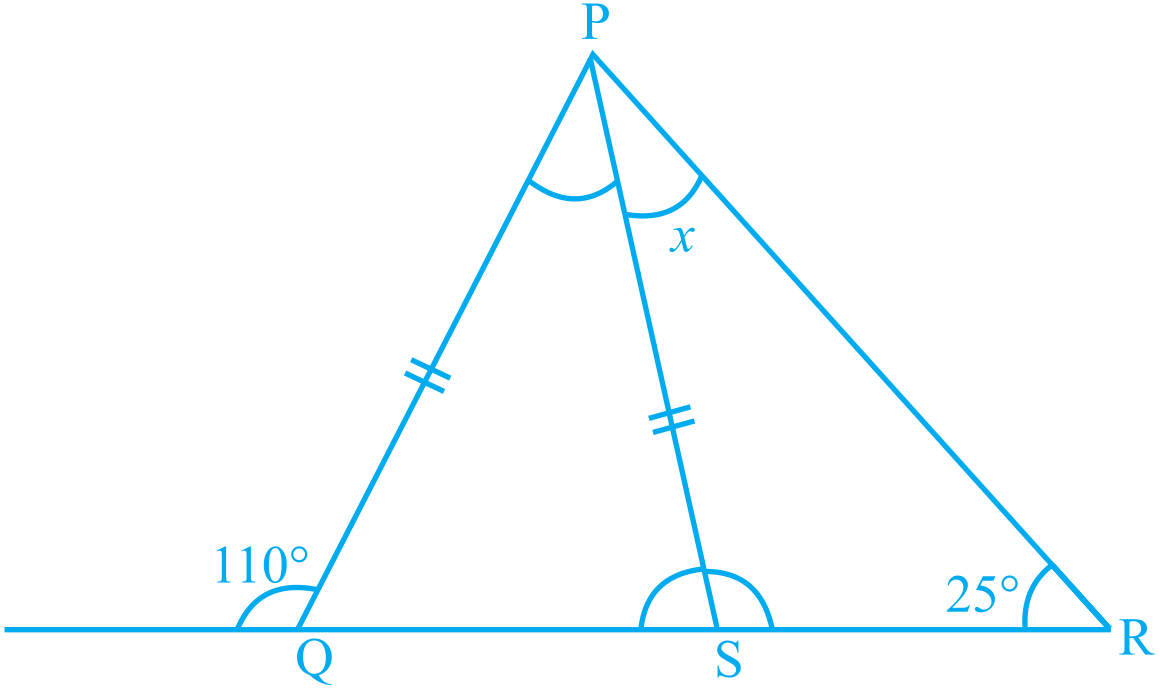
Also, $ \ ∠\text{1}=\angle\text{2}=70^{\circ}$ $[\because\text{PQ}=\text{PS}]$
As we know, the measures of any eterior angle of a triangle is equal to the sum of the measures of its two interior opposite angles.
$\therefore \ \angle2=\text{x}+25^{\circ}$
$\Rightarrow 70^{\circ}=\text{x}+25^{\circ}$ $\because\angle2=70^{0}$
$\Rightarrow\text{x}=70^{\circ}-25^{\circ}$
$\Rightarrow \ \text{x}=45^{\circ}$ View full question & answer→MCQ 111 Mark
Two trees $7m$ and $4m$ high stand upright on a ground. If their bases (roots) are $4m$ apart, then the distance between their tops is:
AnswerLet $BE$ be the smaller tree and $AD$ be the bigger tree. Now, we have to find $AB$ (i.e. the distance between their tops).
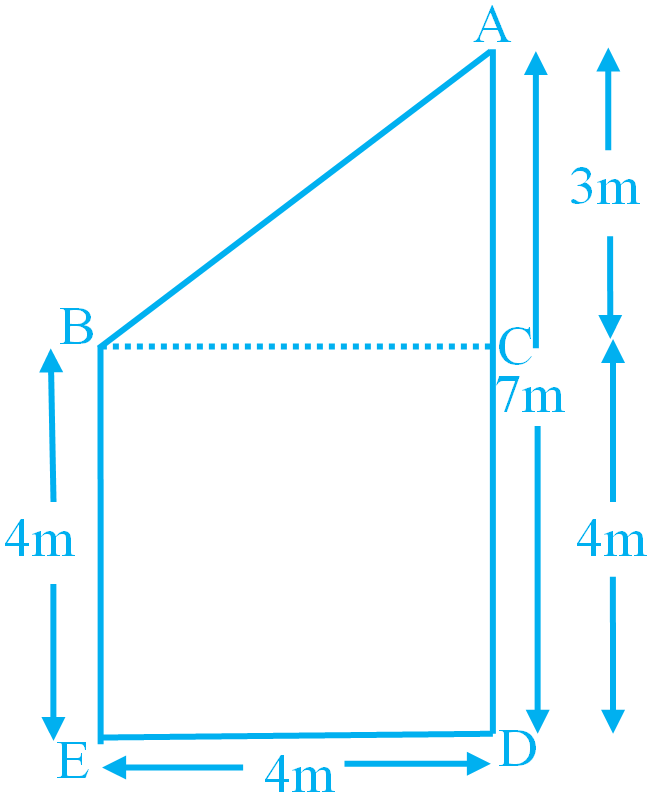
By observing,
$E D=B C=4 \mathrm{~m} \text { and } B E=C D=4 m$
In $\triangle \mathrm{ABC}, \mathrm{BC}=4 \mathrm{~m}$
$\text { and } A C=A D-C D=(7-4) m=3 m$
In right angled $\triangle \mathrm{ABC}, \mathrm{AB}=A C^2+B C^2=4^2+3^2$ [by pythagoras theoram]
$=16+9$
$\Rightarrow A B^2=25$
$\Rightarrow \mathrm{AB}=\sqrt{25}$
$\Rightarrow \mathrm{AB}=5 \mathrm{~m}$
Therefore, distance between thier tops is $5\ m$ .
View full question & answer→MCQ 121 Mark
If length of two sides of a triangle are $6\ cm$ and $10\ cm$, then the length of the third side can be:
- A
$3\ cm$
- B
$4\ cm$
- C
$2\ cm$
- ✓
$6\ cm$
AnswerCorrect option: D. $6\ cm$
As we know, sum of any two sides of a triangle is always greater than the third side.
So, option $(d)$ satisfy this rule.
Verification
$6 + 6 > 10$
$6 + 10 > 6$
$10 + 6 > 6.$
View full question & answer→MCQ 131 Mark
In a triangle, one angle is of $90^\circ $. Then:
$1.$ The other two angles are of $45^\circ $ each.
$2.$ In remaining two angles, one angle is $90^\circ $ and other is $45^\circ $.
$3.$ Remaining two angles are complementary.
In the given option$(s)$ which is true?
- A
$(i)$ only
- B
$(ii)$ only
- ✓
$(iii)$ only
- D
$(i)$ and $(ii)$
AnswerCorrect option: C. $(iii)$ only
In a right angled $\triangle{\text{ABC}},$
$\angle\text{B}=90^{\circ}$
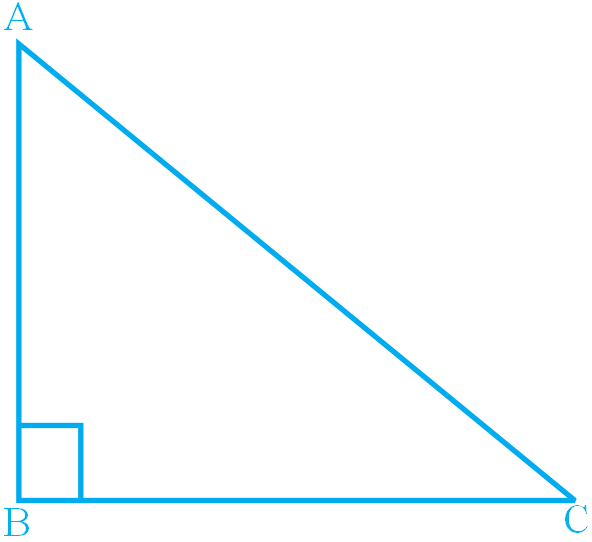
As we know,
$\angle\text{A}+\angle\text{B}+\angle\text{C}=180^{\circ} [$angle sum property of a triangle$]$
$\Rightarrow \angle\text{A}+90^{\circ}+\angle\text{C}=180^{\circ}$
$\Rightarrow \angle\text{A}+\angle\text{C}=180^{\circ}-90^{\circ}=90^{0}$
Hence, remaining two angles are complementary. View full question & answer→MCQ 141 Mark
How many altitudes does a triangle have?
AnswerA triangle has $3$ altitudes.
View full question & answer→MCQ 151 Mark
If one of the angles of a triangle is $110^\circ $, then the angle between the bisectors of the other two angles is:
- A
$70^\circ $
- B
$110^\circ $
- C
$35^\circ $
- ✓
$145^\circ $
AnswerCorrect option: D. $145^\circ $
$\text {In}\triangle\text{ABC},$ $\angle\text{A}=110^{\circ}$
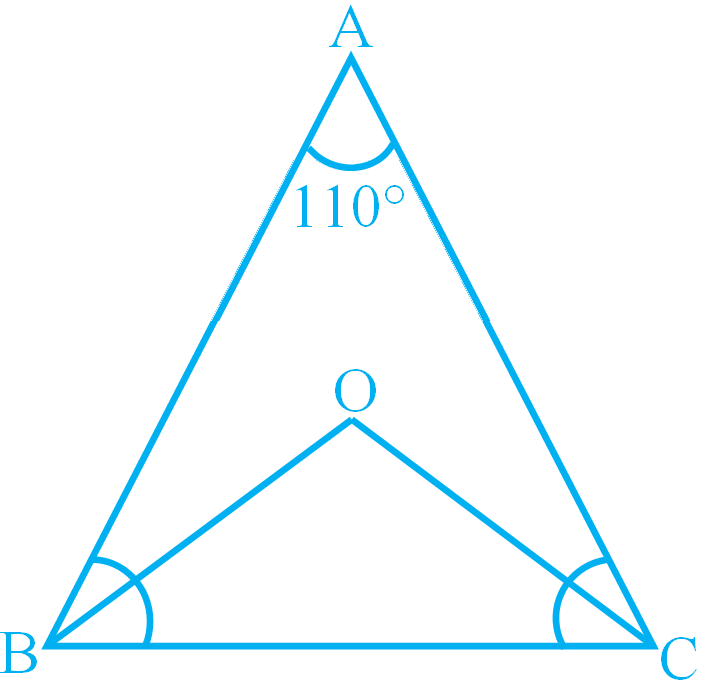
We know that,
$\angle\text{A}+\angle\text{B}+\angle\text{C}=180^{\circ}$ [angle sum property of a triangle]
$\Rightarrow \ \angle\text{B}+\angle\text{C}=180^{\circ}-\angle\text{A}$
$\Rightarrow \ \angle\text{B}+\angle\text{C}=180^{\circ}-110^{\circ}$
$\Rightarrow \ \angle\text{B}+\angle\text{C}=70^{\circ}.....(\text{i})$
$\Rightarrow \ \frac{1}{2}\angle\text{B}+\frac{1}{2}\angle\text{C}+=\frac{70}{2}=35^{\circ}$ $[\because$ Equation $(i)$ is divided by $2$$]$
$\Rightarrow \ \frac{1}{2}(\angle\text{B}+\angle\text{C})=35^{\circ}$
Now, in $\triangle\text{BOC},$
$\angle\text{BOC}+\angle\text{OBC}+\angle\text{OCB}=180^{\circ}$ [angle sum property of a triangle]$....(ii)$
$\Rightarrow \ \angle\text{BOC}+\frac{1}{2}(\angle\text{B}+\angle\text{C})=180^{\circ}$
$[\because$ $OB$ and $OC$ are the bisectors of $\angle\text{B}$ and$\angle\text{C},$ then$\triangle\text{OBC}=\frac{1}{2}\angle\text{B}$ and $\triangle\text{OCB}=\frac{1}{2}\angle\text{C}]$
$\Rightarrow \ \angle\text{BOC}+35^{\circ}=180^{\circ}$
$\Rightarrow \ \angle\text{BOC}=180^{\circ}-35^{\circ}$
$\Rightarrow \ \angle\text{BOC}=145^{\circ}$ View full question & answer→MCQ 161 Mark
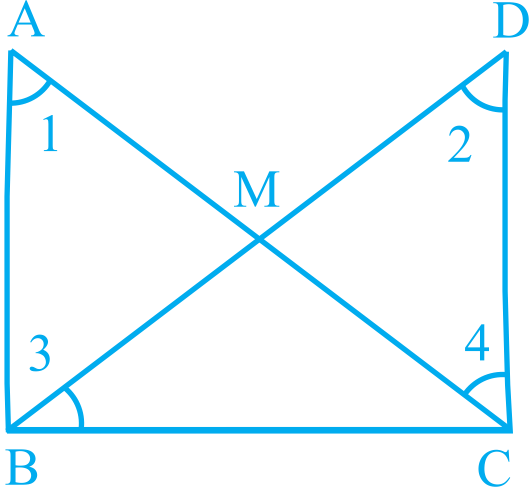
In Figure. $M$ is the mid-point of both $AC$ and $BD$. Then:
- A
$\angle\text{1}=\angle\text{2}$
- ✓
$\angle\text{1}=\angle\text{4}$
- C
$\angle\text{2}=\angle\text{4}$
- D
$\angle\text{1}=\angle\text{3}$
AnswerCorrect option: B. $\angle\text{1}=\angle\text{4}$
In $\triangle\text{AMB}$ and $\triangle\text{CMD},$ $AM = CM$ [$M$ is the mid-point]
$BM = DM$ [$M$ is the mid-point]
$\angle\text{AMB}=\angle\text{CMD}$ [vertically opposite angles]
By sas congruence criterion.
$\angle\text{AMB}\cong\angle\text{CMD}$
$\therefore \ \angle1=\angle4$ [by $CPCT$]
View full question & answer→MCQ 171 Mark
In $\triangle\text{ABC},$ $AD$ is the bisector of $\angle\text{A}$ meeting $BC$ at $D, CF$ $\bot$ $AB$ and $E$ is the mid-point of $AC$. Then median of the triangle is:
AnswerAs we know, median of a triangle bisects the opposite sides.
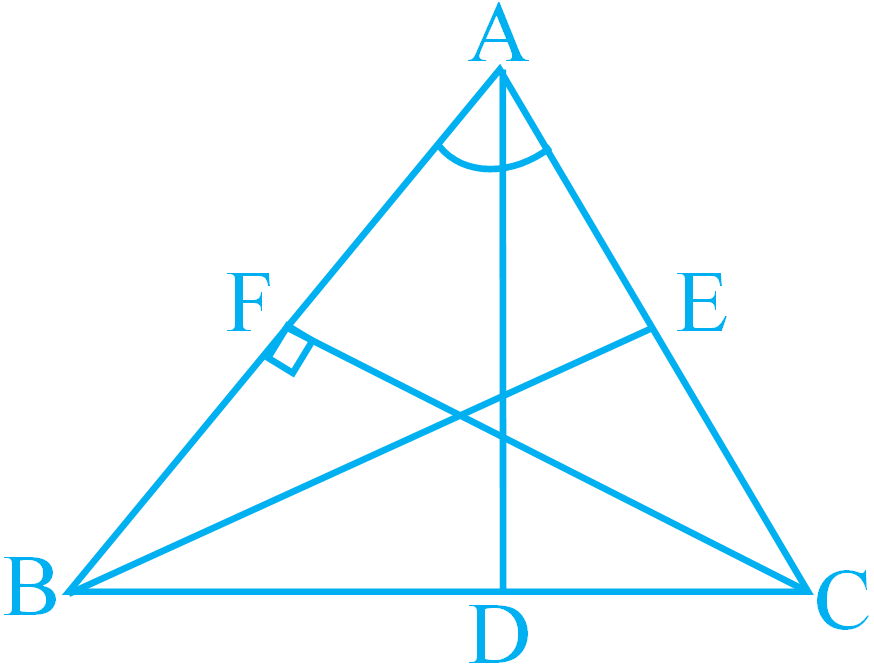
Hence, the median is $BE$ as $AE = EC.$ View full question & answer→MCQ 181 Mark
In Figure. if $AB\ | |\ CD$, then:
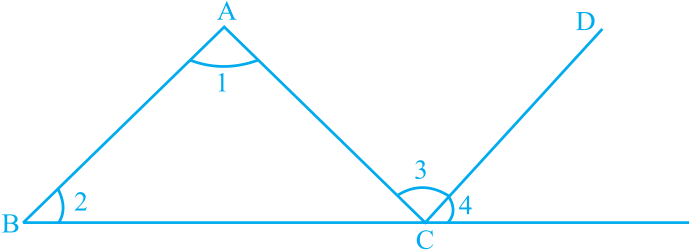
AnswerCorrect option: D. $\angle1+\angle2=\angle3+\angle4$
Given, $AB\ | |\ CD$ and $AC$ is the transversal.
So, $\angle1=\angle3$
Also, in $\triangle\text{ABC},$ $\angle3+\angle4=\angle1+\angle2$
$[\because$ exterior angle = sum of two opposite interior angles$]$
View full question & answer→MCQ 191 Mark
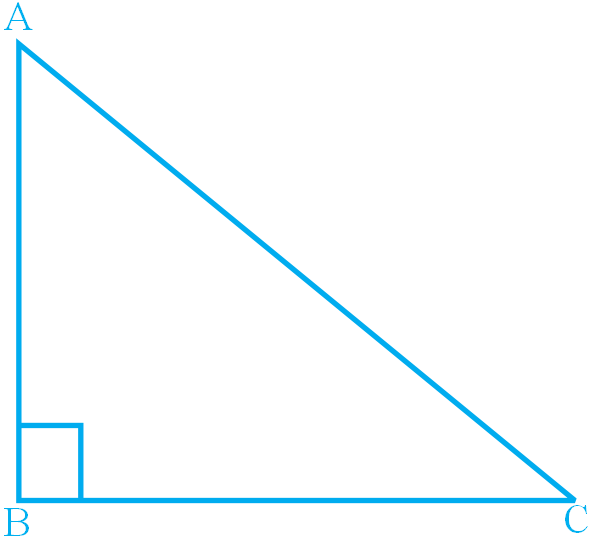
In a right-angled triangle $ABC$, if angle $B = 90^\circ $, then which of the following is true?
AnswerCorrect option: B. $A C^2=A B^2+B C^2$
$\text { (Hypotenuse }^2=(\text { perpendiculer })^2+(\text { Base })^2$
$\Rightarrow A C^2=A B^2+B C^2$
View full question & answer→MCQ 201 Mark
Two triangles are congruent, if two angles and the side included between them in one of the triangles are equal to the two angles and the side included between them of the other triangle. This is known as the:
- A
$RHS$ congruence criterion.
- ✓
$ASA$ congruence criterion.
- C
$SAS$ congruence criterion.
- D
$AAA$ congruence criterion.
AnswerCorrect option: B. $ASA$ congruence criterion.
Under $ASA$ congruence criterion, two triangles are congruent, if two angles and the side included between them in one of the triangles are equal to the two angles and the side included between them of the other triangle.
View full question & answer→MCQ 211 Mark
If one angle of a triangle is equal to the sum of the other two angles, the triangle is:
AnswerLet $A, B$ and $C$ be the angles of the triangle. Then, one angle of a triangle is equal to the sum of the other two angles.
i.e. $\angle\text{A}+\angle\text{B}+\angle\text{C}.....(\text{i})$
As we know,
$\angle\text{A}+\angle\text{B}+\angle\text{C}=180^{\circ}$ [angle sum property of a triangle]
$\Rightarrow \ \angle\text{A}+\angle\text{A}=180^{\circ}$
$\Rightarrow \ 2\angle\text{A}=180^{\circ}$
$\angle\text{A}=\frac{180^{\circ}}{2}$
$\Rightarrow \ \angle=90^{\circ}$
Hence, the triangle is right angled.
View full question & answer→MCQ 221 Mark
$\text{In} \ \triangle\text{ABC},$
- ✓
$AB + BC > AC$
- B
$AB + BC < AC$
- C
$AB + AC < BC$
- D
$AC + BC < AB$
AnswerCorrect option: A. $AB + BC > AC$
As we know, sum of any two sides in a triangle is always greater than the third side.
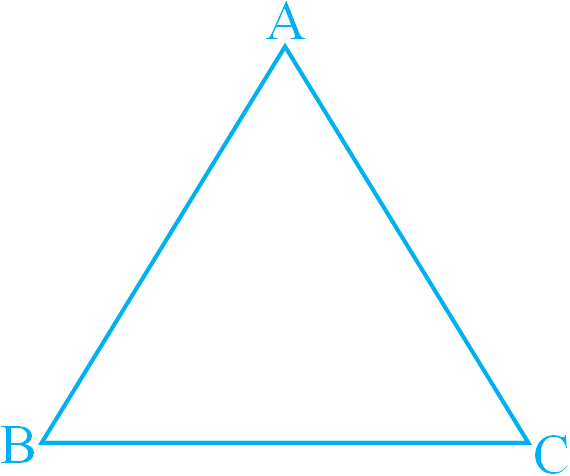
$\text{In} \ \triangle\text{ABC},$
$\text{AB}+\text{BC}>\text{AC}$ View full question & answer→MCQ 231 Mark
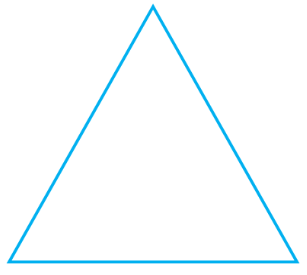
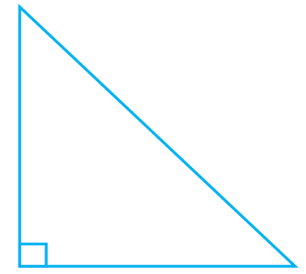
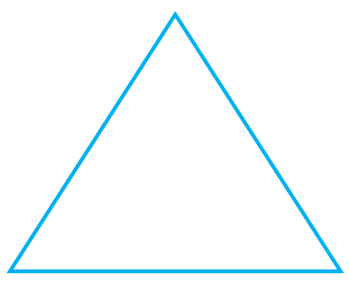
Which of the following figures will have it’s altitude outside the triangle?
Answer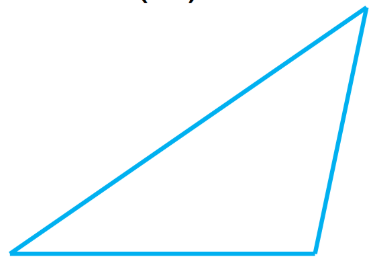
As we know, the perpendicular line segment from a vertex of a triangle to its opposite side is called an altitude of the triangle.
View full question & answer→MCQ 241 Mark
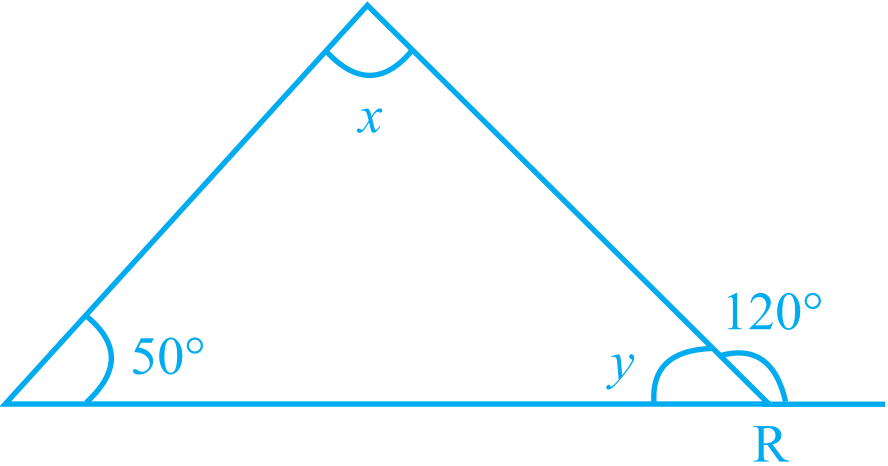
The measures of $\angle\text{x}$ and $\angle\text{y}$ in Figure. are respectively:
- A
$30^\circ , 60^\circ $
- B
$40^\circ , 40^\circ $
- C
$70^\circ , 70^\circ $
- ✓
$70^\circ , 60^\circ $
AnswerCorrect option: D. $70^\circ , 60^\circ $
As we know,
Measure of exterior angle = Sum of the opposite interior angles.
$\Rightarrow \ \angle\text{R}=\angle\text{P}+\angle\text{Q}$
$\Rightarrow \ 120^{0}=\text{x}+50^{0}$ $[\because \angle\text{R}=120^{0}]$
$\Rightarrow \ \text{x}=120^{0}-50^{0}$
$\Rightarrow \ \text{x}=70^{0}$
Now, the sum of the interior angles of a triangles is $180^\circ .$
$\therefore$ $x + y + 50^\circ = 180^\circ $
$\Rightarrow 70^\circ + y + 50^\circ = 180^\circ $
$\Rightarrow 120^\circ + y = 180^\circ $
$\Rightarrow y = 180^\circ - 120^\circ $
$\Rightarrow y = 60^\circ $
View full question & answer→MCQ 251 Mark
In an isosceles triangle, one angle is $70^\circ $. The other two angles are of:
$55°$ and $55^\circ $
$70^\circ $ and $40^\circ $
any measure
In the given option$(s)$ which of the above statement$(s)$ are true?
- A
$(i)$ Only
- B
$(ii)$ Only
- C
$(iii)$ Only
- ✓
$(i)$ And $(ii)$
AnswerCorrect option: D. $(i)$ And $(ii)$
As we know, the sum of the interior angles of a triangles is $180^\circ .$
According to the qustion,
$70^\circ +55^\circ + 55^\circ = 180^\circ $
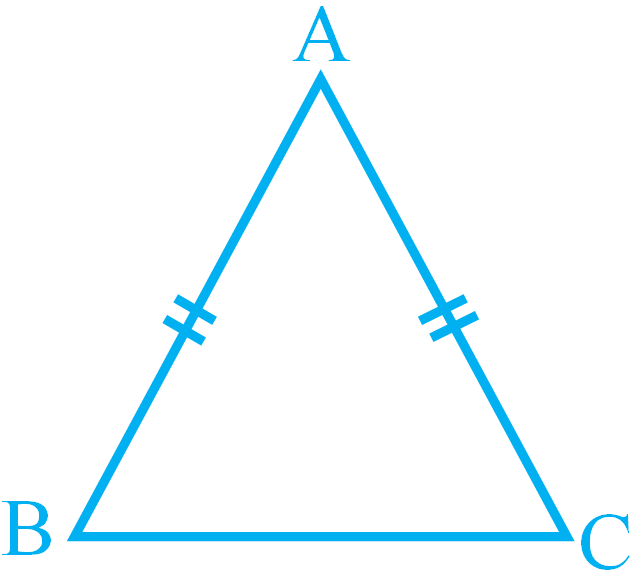
According to the question,
$70^\circ + 70^\circ + 40^\circ = 180^\circ $
Not possible, because two angles must be equal in an isosceles triangle.
So, $(i)$ and $(ii)$ can be possible. View full question & answer→MCQ 261 Mark
In Figure. $PB = PD$. The value of $x$ is:
- A
$85^\circ $
- B
$90^\circ $
- ✓
$25^\circ$
- D
$35^\circ $
AnswerCorrect option: C. $25^\circ$
$\text{In} \ \triangle\text{PBD},$ $\angle1+120^{\circ}=180^{\circ}$ $[\text{linear pair}]$
$\angle1=180^{\circ}-120^{\circ}=60^{\circ}$
Also, $\angle1=\angle2=60^{\circ}$ $[\because\text{PB}=\text{PD}]$
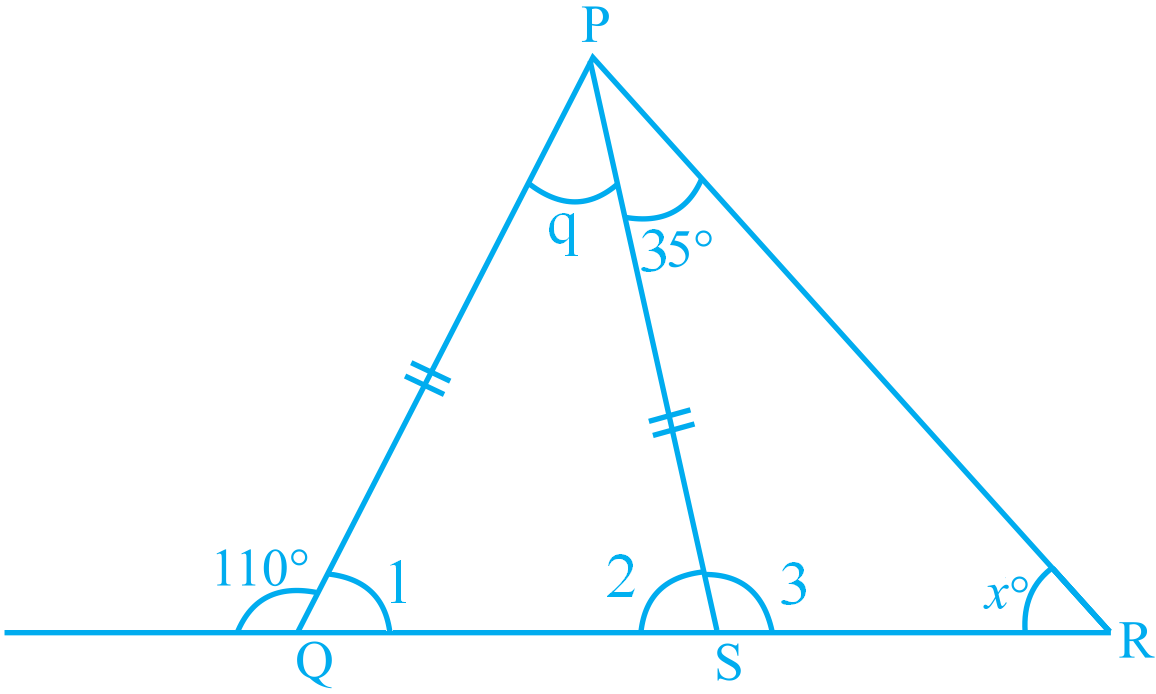
Also, $\angle2+\angle3=180^{\circ}$ $[\text{linear pair}]$
$\Rightarrow60^{\circ}+\angle3=180^{\circ} \ \Rightarrow \ \angle3=180^{\circ}-60^{\circ}$
$\Rightarrow\angle3=120^{\circ}$
$\text{In} \ \triangle\text{PDC},$ $35^{\circ}+\angle3+\text{x}^{\circ}=180^{\circ}$ [angle sum property of a triangle]
$\Rightarrow \ 35^{\circ}+120^{\circ}+\text{x}^{\circ}=180^{\circ}$
$\Rightarrow \ 155^{\circ}+\text{x}^{\circ}=180^{\circ}\Rightarrow \ \text{x}^{\circ}=180^{\circ}-155^{\circ}$
$\Rightarrow \ \text{x}=25^{\circ}$ View full question & answer→MCQ 271 Mark
Lengths of sides of a triangle are $3 \mathrm{~cm}, 4 \mathrm{~cm}$ and $5 \mathrm{~cm}$. The triangle is:
- A
- B
- ✓
- D
An Isosceles right triangle.
AnswerSince, these sides satisfy the Pythagoras theorem, therefore it is right angled triangle. Lengths of the sides of a triangle are $3 \mathrm{~cm}, 4 \mathrm{~cm}$ and $5 \mathrm{~cm}$.
According to Pythagoras theorem,
$3^2+4^2=5^2$
$\Rightarrow 9+16=25$
$\Rightarrow 25=25 \text { (satisfied) }$
Note: the area of the square built upon the hypotenuse of a right angled triangled.
View full question & answer→MCQ 281 Mark
In a right-angled triangle, the angles other than the right angle are:
AnswerIn right angled $\triangle\text{ABC},$ $\angle\text{B}=90^{\circ}$ [angle sum property of a triangle]
$\angle\text{A}+\angle\text{B}+\angle\text{C}=180^{\circ}$
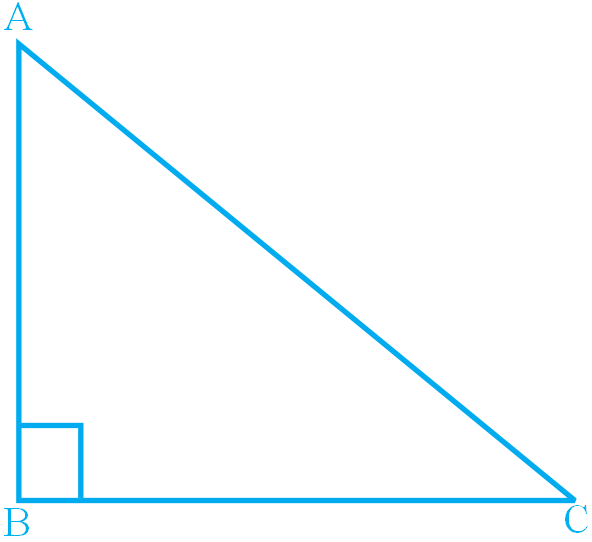
$\Rightarrow \ \angle\text{A}+90^{\circ}+\angle\text{C}=180^{\circ}$
$\Rightarrow \ \angle\text{A}+\angle\text{C}=180^{\circ}-90^{\circ}=90^{\circ}$
Hence, in a right angled triangle, the angles other than the right angle are acute. View full question & answer→MCQ 291 Mark
In $\triangle\text{PQR},$ if $\angle\text{P}=60^{\circ},$ and $\angle\text{Q}=40^{\circ},$ then the exterior angle formed by producing $QR$ is equal to:
- A
$60^\circ $
- B
$120^\circ $
- ✓
$100^\circ$
- D
$80^\circ $
AnswerCorrect option: C. $100^\circ$
As we know, the measure of exterior angle is equal to the sum of opposite two interior angles.
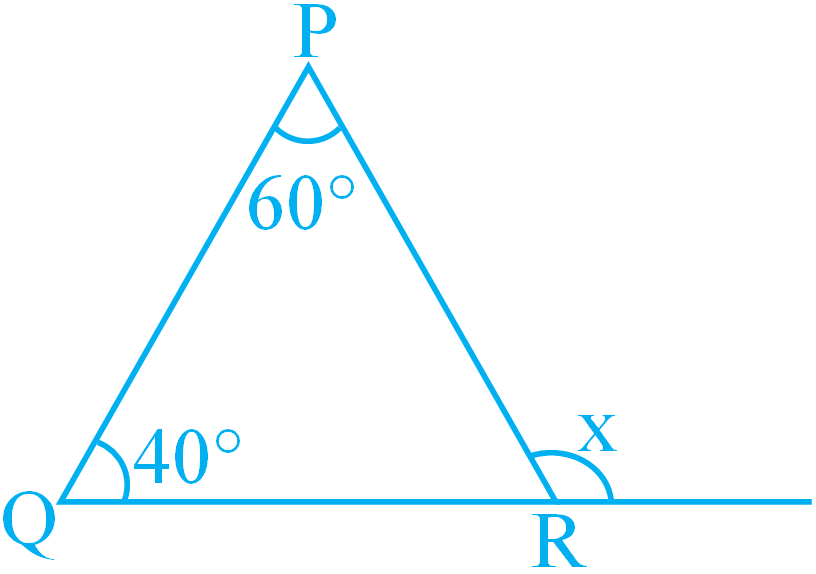
In $\triangle\text{PQR},$ $\angle\text{x}$ is the exterior angle.
So, $\angle\text{x}=\angle\text{P}+\angle\text{Q}$
$=60^{\circ}+40^{\circ}=100^{\circ}$ View full question & answer→MCQ 301 Mark
$\text{In} \ \triangle\text{PQR},$
- A
$PQ - QR > PR$
- B
$PQ + QR < PR$
- ✓
$PQ - QR < PR$
- D
$PQ + PR< QR$
AnswerCorrect option: C. $PQ - QR < PR$
As we know, sum of the lengths of any two sides of a triangle is always greater than the length of the third side.
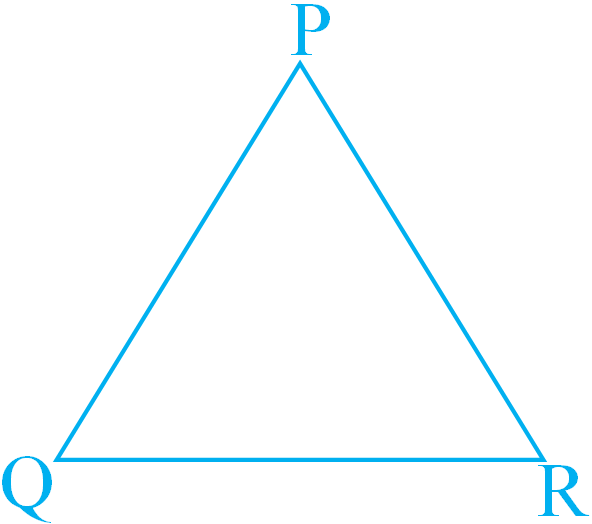
$\text{In} \ \triangle\text{PQR,}$ $PR + QR > PQ$
$\Rightarrow PR > PQ - QR$
$\Rightarrow PQ - QR < PR$ View full question & answer→MCQ 311 Mark
Which of the following can be the length of the third side of a triangle whose two sides measure $18\ cm$ and $14\ cm$?
- A
$4\ cm$
- B
$3\ cm$
- ✓
$5\ cm$
- D
$32\ cm$
AnswerCorrect option: C. $5\ cm$
As we know, sum of any two sides of a triangle is always greater than the third side.
Hence, option $(c)$ satisfies the given condition.
Verification
$18 + 14 > 5$
$18 + 5 > 14$
$5 + 14 > 18.$
View full question & answer→MCQ 321 Mark
Triangle $DEF$ of Figure. is a right triangle with $\angle=90^{\circ}$. What type of angles are $\angle\text{D}$ and $\angle\text{F}$? 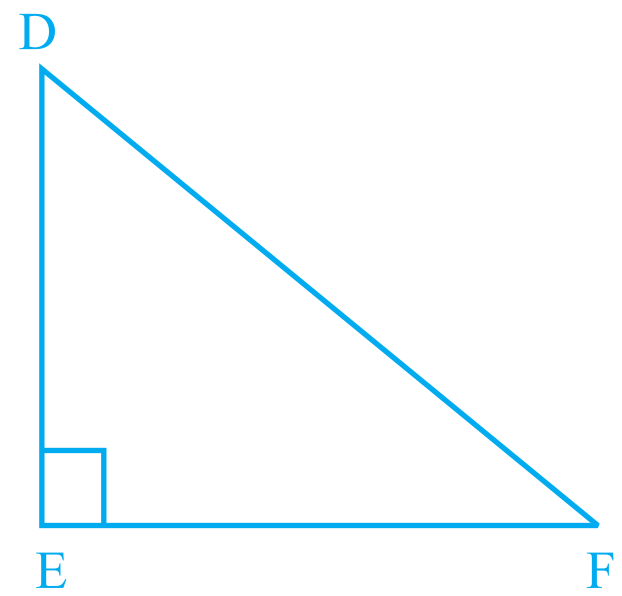
- A
- B
They form a pair of adjacent angles.
- ✓
They are complementary angles.
- D
They are supplementary angles.
AnswerCorrect option: C. They are complementary angles.
Since, $∠\text{D}$ and $∠\text{F}$ are complementary angles.
In $\triangle\text{DEF},$
$∠\text{D}+\angle\text{E}+\angle\text{F}=180^{\circ}$ [angle sum property of a triangle]
$\Rightarrow \ ∠\text{D}+90^{\circ}+\angle\text{F}=180^{\circ}$$[\because\angle\text{E}=90^{\circ},\text{given}]$
$\Rightarrow \ ∠\text{D}+\angle\text{F}=180^{\circ}-90^{\circ}$
$\Rightarrow \ ∠\text{D}+\angle\text{F}=90^{\circ}$
Note: Two angles whose measures add to $180^\circ $ are known as supplementry angles and two angles whose measures add to $90^\circ $ are known as complementary angles.
View full question & answer→MCQ 331 Mark
By which of the following criterion two triangles cannot be proved congruent?
- ✓
$AAA.$
- B
$SSS.$
- C
$SAS.$
- D
$ASA.$
AnswerCorrect option: A. $AAA.$
$AAA $ is not a congruency criterion, because if all the three angles of two triangles are equal; this does not imply that both the triangles fit exactly on each other.
View full question & answer→MCQ 341 Mark
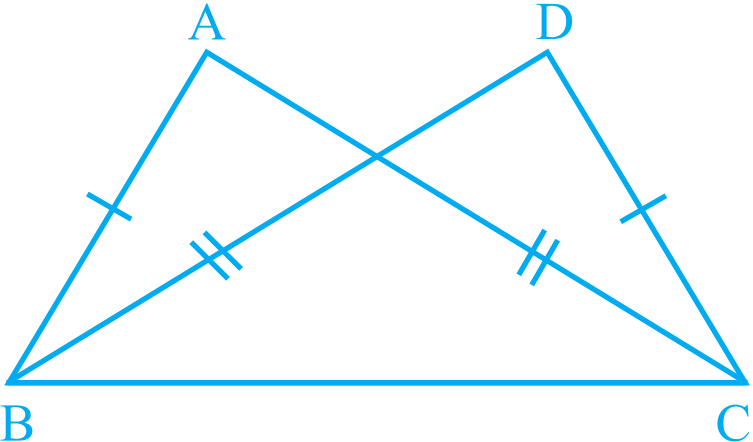
If $\triangle\text{ABC}$ and $ \triangle\text{DBC}$ are on the same base BC, AB = DC and AC = DB (figure). then which of the following gives a congruence relationship?
- A
$\triangle\text{ABC}\cong\triangle\text{DBC}$
- B
$\triangle\text{ABC}\cong\triangle\text{CBD}$
- ✓
$\triangle\text{ABC}\cong\triangle\text{DCB}$
- D
$\triangle\text{ABC}\cong\triangle\text{BCD}$
AnswerCorrect option: C. $\triangle\text{ABC}\cong\triangle\text{DCB}$
Since, $AB = DC$ [given]
and $AC = DB$ [common base]
$BC = BC$
By $SSS$ congruence criterion, $\triangle\text{ABC}\cong\triangle\text{DCB}$
View full question & answer→MCQ 351 Mark
If the exterior angle of a triangle is $130^\circ $ and its interior opposite angles are equal, then measure of each interior opposite angle is:
- A
$55^\circ $
- ✓
$65^\circ $
- C
$50^\circ$
- D
$60^\circ $
AnswerCorrect option: B. $65^\circ $
As we know, the measure of any exterior angle is equal to the sum of two opposite interior angles.
Let the interior angle be $x$.
Given that, interior opposite angles are equal.
$\therefore \ 130^{\circ}=\text{x}+\text{x}$
$\Rightarrow \ 130^{\circ}=2\text{x}$
$\Rightarrow \ \text{x}=\frac{130^{\circ}}{2}$
$\Rightarrow \ \text{x}=65^{\circ}$
Hence, the interior angle is $= 65^\circ .$
View full question & answer→MCQ 361 Mark
If we join a vertex to a point on opposite side which divides that side in the ratio $1:1$, then what is the special name of that line segment?
AnswerConsider $\triangle ABC$ in which $AD$ divides $BC$ in the ratio $1:1$.
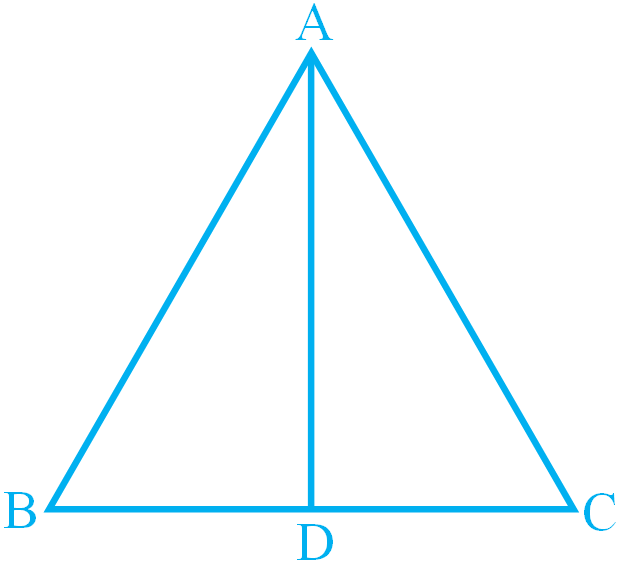
Now, $BD : DC = 1 : 1$
$\Rightarrow \ \frac{\text{BD}}{\text{DC}}=\frac{1}{1}$
$\therefore \ \text{BD}=\text{DC}$
Since, Ad divides BC into two equal parts. Hence, $AD$ is the median. View full question & answer→MCQ 371 Mark
Which of the following statements is not correct?
- A
The sum of any two sides of a triangle is greater than the third side.
- B
A triangle can have all its angles acute.
- C
A right-angled triangle cannot be equilateral.
- ✓
Difference of any two sides of a triangle is greater than the third side.
AnswerCorrect option: D. Difference of any two sides of a triangle is greater than the third side.
The difference of the length of any two sides of a triangle is always smaller than the length of the third side.
View full question & answer→MCQ 381 Mark
Which of the following triplets cannot be the angles of a triangle?
- A
$67^\circ , 51^\circ , 62^\circ $
- B
$70^\circ , 83^\circ , 27^\circ $
- C
$90^\circ , 70^\circ , 20^\circ $
- ✓
$40^\circ , 132^\circ , 18^\circ $
AnswerCorrect option: D. $40^\circ , 132^\circ , 18^\circ $
We know that, the sum of the interior angles of a triangle is $180^\circ $.
Now, we will verify the given triplets:
$a. 67^\circ + 51^\circ + 62^\circ = 180^\circ $
$b. 70^\circ + 83^\circ + 27^\circ = 180^\circ $
$c. 90^\circ + 70^\circ + 20^\circ = 180^\circ $
$d. 40^\circ + 132^\circ + 18^\circ = 190^\circ $
Clearly, triplets in option $(d)$ cannot be the angles of a triangle.
View full question & answer→MCQ 391 Mark
In a right-angled triangle $ABC$, if angle $B = 90^\circ , BC = 3\ cm$ and $AC = 5\ cm$, then the length of side $AB$ is:
- A
$3\ cm$
- ✓
$4\ cm$
- C
$5\ cm$
- D
$6\ cm$
AnswerCorrect option: B. $4\ cm$
Since, $\triangle ABC$ is a right angled triangle.
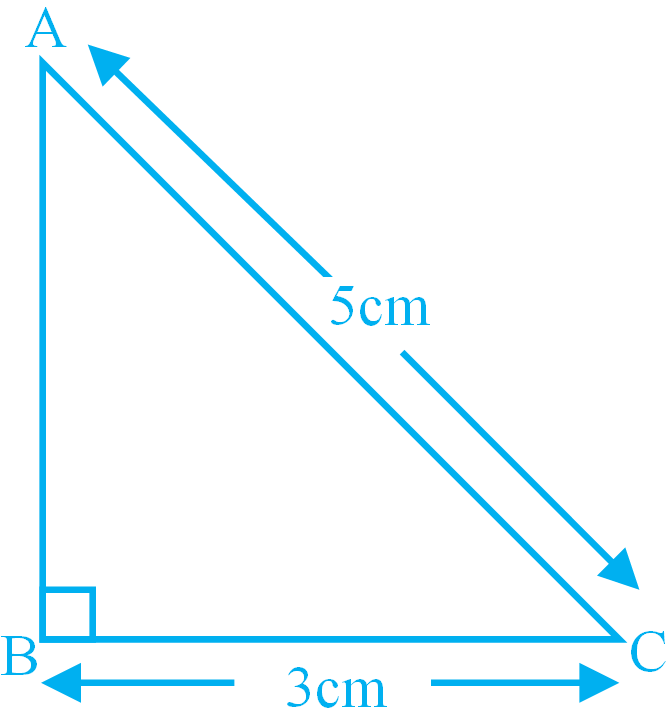
In right angled $\triangle \text{ABC},$
$A C^2=A B^2+B C^2[\text { by pythagoras theoram }]$
$\Rightarrow 5^2=A B^2+3^2[\because A C=5 \mathrm{~cm} \text { and } B C=3 \mathrm{~cm} \text {, given }]$
$\Rightarrow A B^2=25-9$
$\Rightarrow A B^2=16$
$\Rightarrow\text{AB}=\sqrt{16}$
$\Rightarrow \text{AB} = 4\text{cm.}$ View full question & answer→MCQ 401 Mark
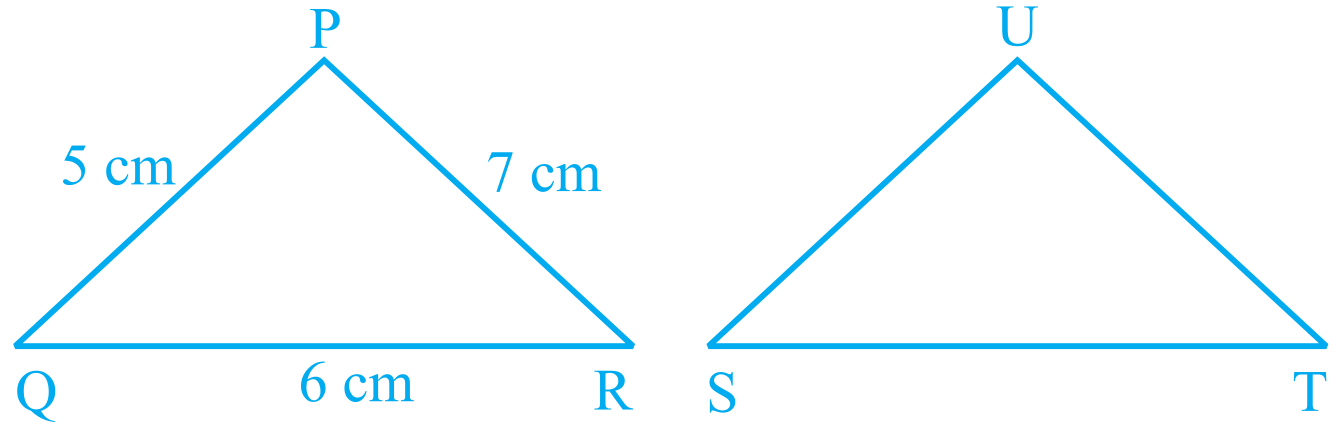
If $\triangle\text{PQR}$ is congruent to$ \triangle\text{STU}$ Figure. then what is the length of $TU$?
- A
$5\ cm.$
- ✓
$6\ cm.$
- C
$7\ cm.$
- D
AnswerCorrect option: B. $6\ cm.$
Given that, $\triangle\text{PQR}\cong\triangle\text{STU}$
$\Rightarrow \ \text{PQ} =\text{ST} $
$\Rightarrow \ \text{QR} =\text{TU} $
$\Rightarrow \ \text{PR} =\text{SU} $
Hence, $\text{TU}=\text{QR}=6\text{cm}.$
View full question & answer→MCQ 411 Mark
The sides of a triangle have lengths (in cm) $10, 6.5$ and $a$, where a is a whole number. The minimum value that a can take is:
AnswerAs we know, sum of any two sides in a triangle is always greater than the third side.
So, only $4$ is the minimum value that satisfies as a side in triangle.
$\begin{cases}10<6.5+4\\6.5<10+4\\4<10+6.5\end{cases}\Bigg\}$
View full question & answer→MCQ 421 Mark
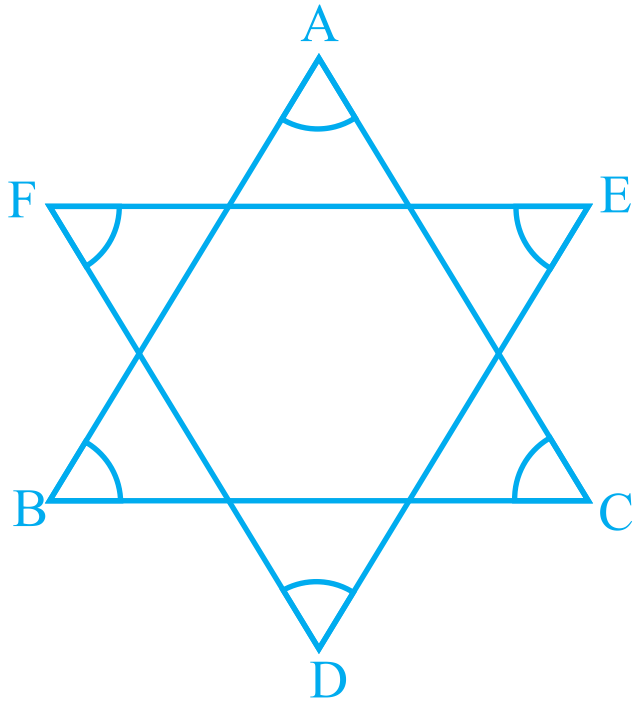
In Figure. the value of $\angle\text{A}+\angle\text{B}+\angle\text{C}+\angle\text{D}+\angle\text{E}+\angle\text{F} \ \text{is}:$
- A
$190^\circ $
- B
$540^\circ$
- ✓
$360^\circ$
- D
$180^\circ $
AnswerCorrect option: C. $360^\circ$
As we know, sum of all the interior angles of a triangle is $180^\circ $.
$\text{In} \ \triangle\text{ABC}, \ \angle\text{A}+\angle\text{B}+\angle\text{C}=180^{\circ}$ $[\text{interior angles of }\triangle\text{ABC}].....(\text{i})$
$\text{In} \ \triangle\text{DEF}, \ \angle\text{D}+\angle\text{E}+\angle\text{F}=180^{\circ}$ $[\text{interior angles of }\triangle\text{DEF}].....(\text{ii})$
On adding Equation. $(i)$ and $(ii)$, we get.
$\angle\text{A}+\angle\text{B}+\angle\text{C}+\angle\text{D}+\angle\text{E}+\angle\text{F}\\$$=180^{\circ}+180^{\circ}$
$=360^{\circ}$
View full question & answer→MCQ 431 Mark
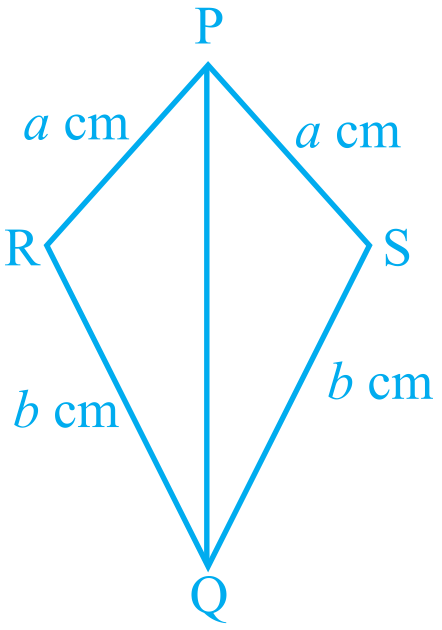
By which congruency criterion, the two triangles in Figure. are congruent?
- A
$RHS.$
- B
$ASA.$
- ✓
$SSS.$
- D
$SAS.$
AnswerCorrect option: C. $SSS.$
In $\triangle\text{PQR}$ and $\triangle\text{PQS},$
$PR = PS = a\ cm$
$RQ = SQ = b\ cm$
$PQ = PQ =$ Common line segment
By $SSS$ congruence criterion,
$\triangle\text{PQR}\cong\triangle\text{PQS}$
View full question & answer→MCQ 441 Mark
If two angles of a triangle are $60^\circ $ each, then the triangle is:
- A
Isosceles but not equilateral.
- B
- ✓
- D
Answer$\text{In} \ \angle\text{ABC},$ $\angle\text{A}+\angle\text{B}+ \angle\text{C}=180^{\circ}$ [angle sum property of a triangle]
$\Rightarrow \ \angle\text{A}+60^{\circ}+60^{\circ}=180^{\circ}$ ${[\because\angle\text{B}=\angle{\text{C}}=60^{\circ},\text{given}]}$
$\Rightarrow \ \angle\text{A}=120^{\circ}-80^{\circ}$
$\Rightarrow \ \angle\text{A}=60^{\circ}$
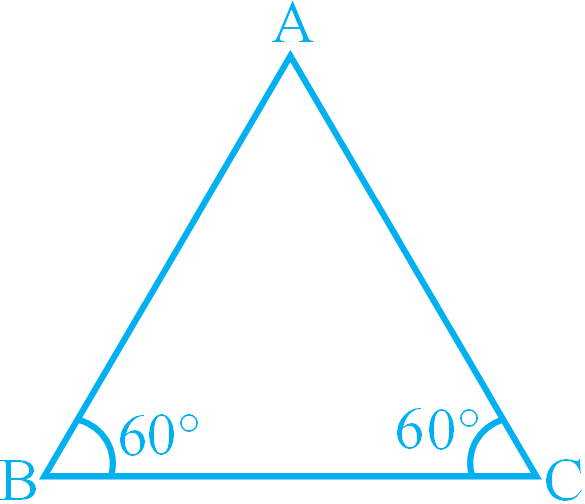
Since, all the angles are of $60^\circ $. so, it is an equilateral triangle. View full question & answer→MCQ 451 Mark
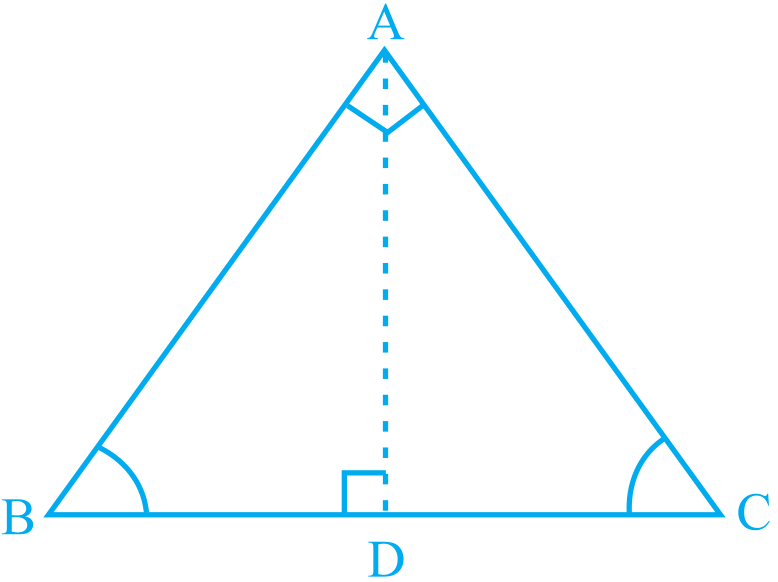
In Figure. $\angle\text{BAC}=90^{\circ},$ $\text{AD}\bot\text{BC}$ and$\angle\text{ BAD}=50^{\circ},$ then$\angle\text{ ACD}$ is:
- ✓
$50^\circ $
- B
$40^\circ $
- C
$70^\circ $
- D
$60^\circ $
AnswerCorrect option: A. $50^\circ $
Given, $\angle\text{BAC}=90^{\circ},$
$\text{AD}\bot\text{BC}$ and $\angle\text{ BAD}=50^{\circ}$
In $\triangle\text{ABD},$
$\angle\text{ABD}+\angle\text{DAB}+\angle\text{ADB}=180^{\circ}$ [angle sum property of a triangle]
$\Rightarrow \ \angle\text{ABD}+50^{\circ}+90^{\circ}=180^{\circ}$
$\Rightarrow \ \angle\text{ABD}+140^{\circ}=180^{\circ}$
$\Rightarrow \ \angle\text{ABD}=180^{\circ}-140^{\circ}$
$\Rightarrow \ \angle\text{ABD}=40^{\circ}$
Now In$\triangle\text{ABD},$
$\angle\text{A}+\angle\text{B}+\angle\text{C}=180^{\circ}$ [angle sum property of a triangle]
$\Rightarrow \ 90^{\circ}+40^{\circ}+\angle\text{C}=180^{\circ}$
$\Rightarrow \ \angle\text{C}=180^{\circ}-130^{\circ}$
$\Rightarrow \ \angle\text{C}=50^{\circ}$
$\therefore\ \angle\text{ACD}=50^{\circ}$
View full question & answer→MCQ 461 Mark
The trianlge $\text{ABC}$ formed by $\ce{AB = 5\ cm, BC = 8\ cm, AC = 4\ cm}$ is:
- A
An isosceles triangle only.
- ✓
- C
An isosceles right triangle.
- D
Scalene as well as a right triangle.
Answer$i.$ It’s not isosceles triangle as all the sides are of different measure.
$ii.$ It’s not right triangle, since it does not follow Pythagoras theorem.
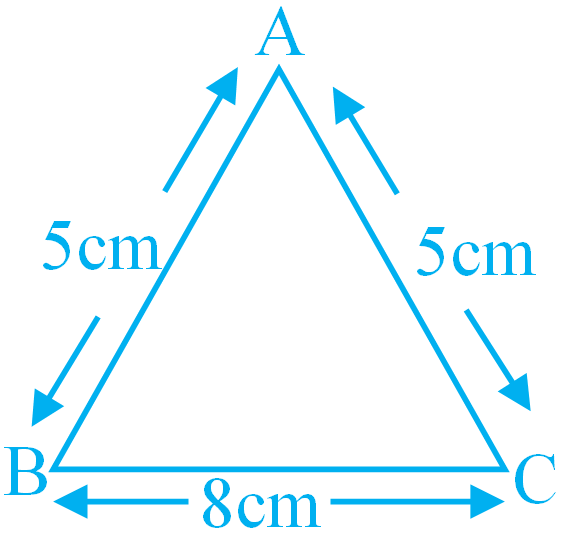
$\Rightarrow 4^2+5^2=8^2$
$\Rightarrow 16+25=64$
$\Rightarrow 41\neq64 ($not satisfied$) $
Hence, it is scalane triangle as all the sides are of different measure.
View full question & answer→MCQ 471 Mark
In $\triangle\text{PQR},$ if $PQ = QR$ and $\angle\text{Q}$ $= 100^\circ $, then $\angle\text{R}$ is equal to:
- ✓
$40^\circ $
- B
$80^\circ $
- C
$120^\circ $
- D
$50^\circ $
AnswerCorrect option: A. $40^\circ $
$\text{In} \ \triangle\text{PQR},$ $\text{PQ} = \text{QR}$
$\text{Let} \ \angle\text{P}=\angle\text{R}=\text{x}$
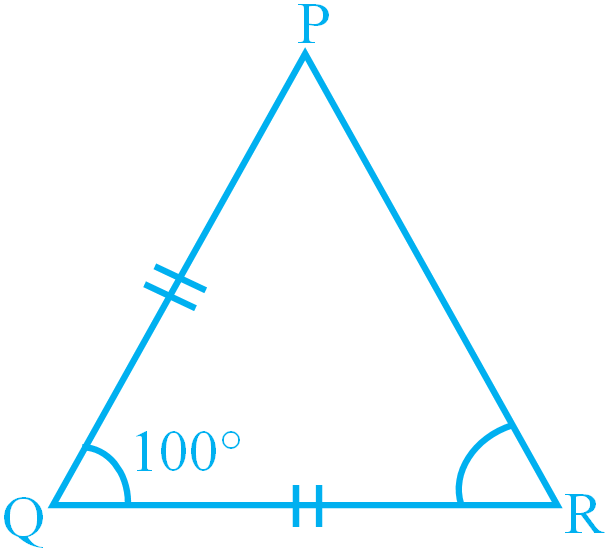
As we know,
$\therefore\ \angle\text{P}+\angle\text{Q}+\angle\text{R}=\text{180}^{\circ}$ [angle sum property of a triangle]
$\Rightarrow \ \text{x}+100^{\circ}+\text{x}=180^{\circ}$ $[\because\angle\text{Q}=100^{\circ},\text{given}]$
$\Rightarrow \ \text{2x}+100^{\circ}=180^{\circ}$
$\Rightarrow \ \text{2x}=80^{\circ}$
$\Rightarrow \ \text{x}=40^{\circ}$
Hence, $\angle\text{P}=\angle\text{R}=\text{40}^{\circ}$ View full question & answer→MCQ 481 Mark
In $\triangle\text{ABC},$ $\angle\text{A}=100^{\circ},$ $AD$ bisects$\angle\text{A}$ and $AD$ $\bot$ $BC$. then, $\angle\text{B}$ is equal to:
- A
$80^\circ $
- B
$20^\circ $
- ✓
$40^\circ $
- D
$30^\circ $
AnswerCorrect option: C. $40^\circ $
Given, $\angle\text{BAD}=\angle\text{DAC}=50^{\circ}$ $[\because\text{AD} \ \text{bisect}\angle\text{A} \ \text{and} \ \angle\text{A}=100^{\circ}]$
and $\angle\text{BDA}=\angle\text{ADC}=90^{\circ}$ $[\because\text{AD}\bot\text{BC}]$
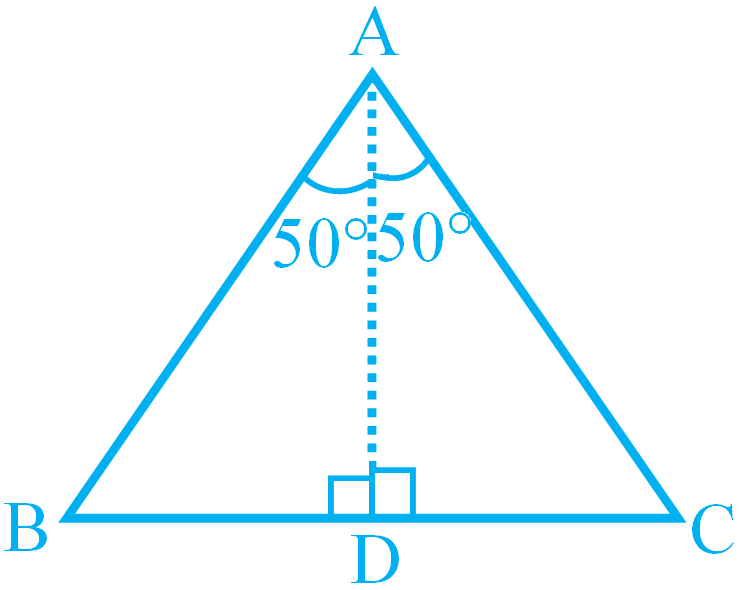
Now, in $\triangle\text{ABD},$
$\angle\text{ABD}+\angle\text{BAD}+\angle\text{BDA}=180^{\circ}$ [angle sum property ofb triangle]
$\Rightarrow \ \angle\text{ABD}+50^{\circ}+90^{0}=180^{\circ}$
$\Rightarrow \ \angle\text{ABD}+140^{\circ}=180^{\circ}$
$\Rightarrow \ \angle\text{ABD}=180^{\circ}-140^{\circ}$
$\Rightarrow \ \angle\text{ABD}=140^{\circ}$ View full question & answer→MCQ 491 Mark
The length of two sides of a triangle are $7\ cm$ and $9\ cm$. The length of the third side may lie between:
- A
$1\ cm$ and $10\ cm.$
- B
$2\ cm$ and $8\ cm.$
- ✓
$3\ cm$ and $16\ cm.$
- D
$1\ cm$ and $16\ cm.$
AnswerCorrect option: C. $3\ cm$ and $16\ cm.$
The third side must be greater than the difference between two sides and less than the sum of two sides.
Sum of two sides $= 7 + 9 = 16\ cm$
Difference of two sides $= 9 - 7 = 2\ cm$
So, length of the third side must lie between $2\ cm$ and $16\ cm$.
View full question & answer→