Questions

3 Marks Question

🎯

Test yourself on this topic

23 questions · timed · auto-graded

Question 13 Marks
Describe the process of neutralization with the help of an example.
Answer
The reaction between an acid and a base is known as neutralization reaction. In this reaction, both acid and base cancel each other's effect. Neutralisation reaction results in the formation of salt and water. During this reaction, energy in the form of heat is evolved.Acid + Base $\rightarrow$ Salt + Water + HeatFor example, when sodium hydroxide $(\mathrm{NaOH})$ is added to hydrochloric acid $(\mathrm{HCl})$, sodium chloride $(\mathrm{NaCl})$ and water $\left(\mathrm{H}_2 \mathrm{O}\right)$ are obtained.

Image
View full question & answer
Question 23 Marks
Name the source from which litmus solution is obtained. What is the use of this solution?
Answer
Litmus solution is obtained from lichens. A natural dye extracted from lichens is dissolved in distilled water to obtain litmus solution.

It is used as an indicator to distinguish between acids and bases.

Solution Colour of litmus solution
Acidic Red
Basic Blue
Neutral No change
View full question & answer
Question 33 Marks
Blue litmus paper is dipped in a solution. It remains blue. What is the nature of the solution? Explain.
Answer
We know that basic and neutral solutions do not change the colour of blue litmus paper. Since blue litmus remains blue after dipping in the solution, the solution is either basic or neutral in nature.

Put a drop of this solution on a red litmus paper. If it turns blue, then the above solution is basic in nature and if no colour change occurs, then it is neutral.

View full question & answer
Question 43 Marks
Is the distilled water acidic/ basic/ neutral? How would you verify it?
Answer
Distilled water is neutral in nature. The same can be verified by using red and blue litmus papers. Neither will show a colour change with distilled water. This proves that distilled water is neutral.
View full question & answer
Question 53 Marks
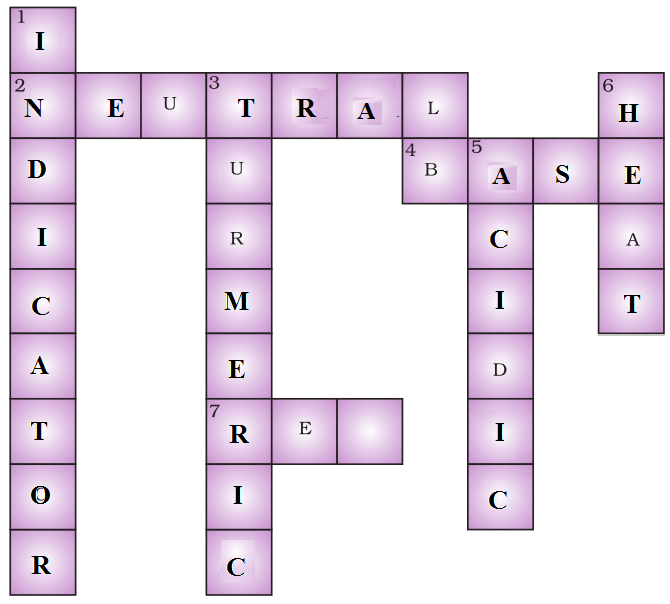
Fill in the cross word given as Figure 5.2 with the help of the clues provided. Across:
  1. The solution which does not change the colour of either red or blue litmus.
  2. Phenolphthalein gives pink colour in this type of solution.
  3. Colour of blue litmus in lemon juice.
Down:
  1. It is used to test whether a substance is acidic or basic.
  1. It is a natural indicator and gives pink colour in basic solution.
  1. Nature of ant’s sting.
  1. It is responsible for increase in temperature during a neutralisation reaction.
Answer
Across:
  1. Neutral
  1. Base
  1. Red
Down:
  1. Indicator
  1. Turmeric
  1. Acidic
  1. Heat
View full question & answer
Question 63 Marks
Nitesh was playing with his friends in the garden. Suddenly, Nitesh was stung by a honeybee and was in great pain. Immediately, his friends call his mother. She applied baking soda solution on the affected area and then took him to the doctor.
Read the above passage and answer the following Questions:
  1. What could be the reason for this burning pain?
  2. Why did his mother applied baking soda solution on the affected area?
  3. What values are shown by Nitesh’s friends?
Answer
  1. The reason for this burning pain is honeybee sting which causes pain and irritation. This is due to the acidic liquid (formic acid) injected into the skin by the honeybee.
  2. The effect of acid can be neutralised by rubbing the affected area by baking soda solution which is a mild base.
  3. Nitesh’s friends are caring, supportive and helpful.
View full question & answer
Question 73 Marks
Identify the organic acid present in the following:
  1. Bile juice.
  2. Urine.
  3. Genetic material in biological cell.
  4. Tamarind.
  5. Tomato.
Answer
  1. Cholic acid.
  2. Uric acid.
  3. Nucleic acid.
  4. Tartaric acid.
  5. Oxalic acid.
View full question & answer
Question 83 Marks
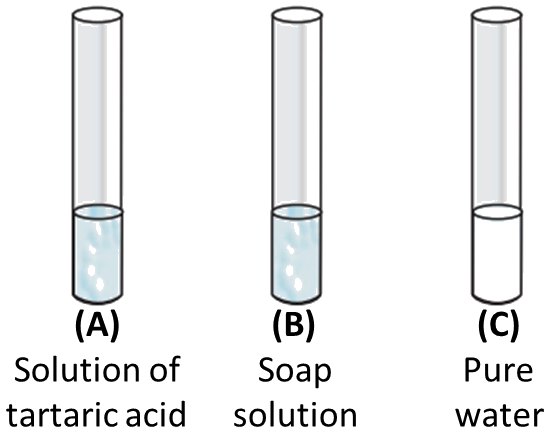
You are provided with three test tubes A, Sand Cas shown in figure with different liquids. What will you observe when you put,
  1. A piece of blue litmus paper in each test tube?
  2. A piece of red litmus paper in each test tube?
  3. A few drops of phenolphthalein solution to each test tube?
Answer
Test tube
Effect on blue litmus paper
Effect on red litmus paper
Effect on phenolphthalein solution
A
Turns red
Remains red
Colourless
B
Remains blue
Turns blue
Pink colour
C
Remains blue
Remains red
Colourless
View full question & answer
Question 93 Marks
Explain two neutralisation reactions related to daily life situations.
Answer
  1. Ant bite: When an ant bite injects the acidic liquid (formic acid) into the skin, the effect of the acid can be neutralised by rubbing moist baking soda (sodium hydrogen carbonate) or caiamine solution, which contains zinc carbonate.
  2. Indigestion: Our stomach contains hydrochloric acid. It helps $US$ to digest food but too much of acid in the stomach causes indigestion. Sometimes, indigestion is painful. To relieve indigestion, we take an antacid such as milk of magnesia which contains magnesium hydroxide. It neutralises the effect of excessive acid.
View full question & answer
Question 103 Marks
Dorji has a few bottles of soft drink in his restaurant. But, unfortunately, these are not labelled. He has to serve the drinks on the demand of customers. One customer wants acidic drink, another wants basic and third one wants neutral drink. How will Dorji decide which drink is to be served to whom?
Answer
Dorji can use litmus test on these drinks. Just drop few drops of drink on litmus paper and take the secision according to the following:
  • If it turns blue, drink is basic.
  • If it turns red, drink is acidic.
  • If it turns green, drink is neutral.
View full question & answer
Question 113 Marks
Blue litmus paper is dipped in a solution. It remains blue. What is the nature of the solution? Explain.
Answer
We know that basic and neutral solutions do not change the colour of blue litmus paper. Since blue litmus remains blue after dipping in the solution, the solution is either basic or neutral in nature. Put a drop of this solution on a red litmus paper. If it turns blue, then the above solution is basic in nature and if no colour change occurs, then it is neutral.
View full question & answer
Question 123 Marks

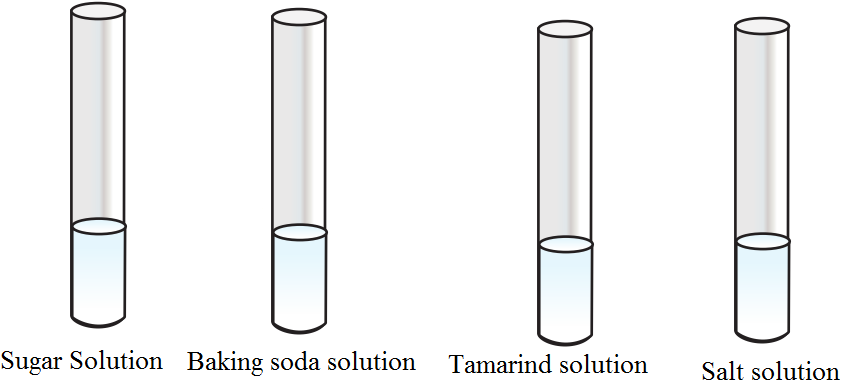
You are provided with four test tubes containing sugar solution, baking soda solution, tamarind solution, salt solution. Write down an activity to find the nature (acidic/ basic/ neutral) of each solution.
Answer
We can use both red and blue litmus solutions to find the nature (acidic/ basic/ neutral) of each solution. In acidic media, blue litmus solution turns to red and in basic media, red litmus solution turns to blue.
Solution
Effect on red litmus solution (change in colour)
Effect on blue litmus solution (change in colour)
Nature of solution found
Sugar solution
No change
No change
Neutral
Baking soda solution
Red changes to blue color
No change
Basic
Tamarind solution
No change
Blue changes to red colour
Acidic
Salt solution (neutral)
No change
No change
Netural
View full question & answer
Question 133 Marks
Describe the process of neutralisation with the help of an example.
Answer
Neutralization is a process in which an acid solution when mixed with base solution, react with each other to produce a salt and water along with generation of heat. Salt so produced, may be acidic, basic or neutral in nature. In this process the acidic nature of the acid and the basic nature of the base are destroyed. Acid + base salt + water. (heat is evolved) For example: $HCl + NaOH NaCl +$ $\text{H}_{2}\text{O}$.
View full question & answer
Question 143 Marks
Write the characteristics of acids by which we can identify acids.
Answer
Characteristics of acids are:
  1. They are sour in taste.
  2. They turn blue litmus paper/ solution to red.
  3. Dilution of acid in water is an exothermic reaction, i.e. heat energy is evolved.
View full question & answer
Question 153 Marks

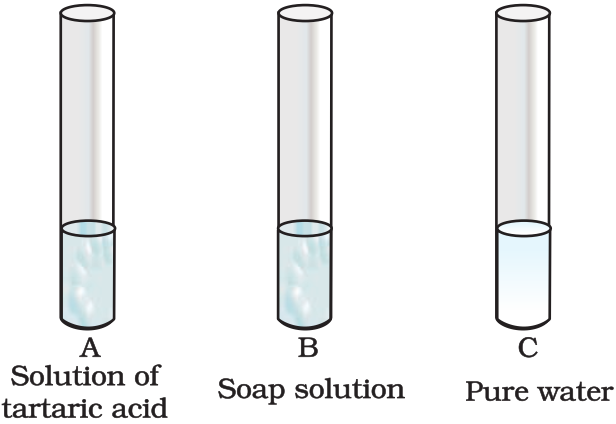
You are provided with three test tubes $A, B$ and $C$ as shown in figure with different liquids. What will you observe when you put:
  1. A piece of blue litmus paper in each test tube?
  2. A piece of red litmus paper in each test tube?
  3. A few drops of phenolphthalein solution to each test tube?
Answer
Test tube
Effect on blue litmus papaer
Effect on red litmus papaer
Effect on phenolphthalein solution
$A$
Turns red
Remains red
Colourless
$B$
Remains blue
Turns blue
Pink color
$C$
Remains blue
Remains red
Colourless
View full question & answer
Question 163 Marks
One day Rahul’s mother after taking meal felt pain and irritation in her stomach. His father was out of station. Rahul was an intelligent boy. He remembered his teacher’s statement and gave his mother some baking soda solution Which gave her a relief from pain and irritation of stomach. Read the above passage and answer the following Questions.
  1. Which information given by Rahul’s teacher that helped him to select the baking soda as remedy?
  2. Why he selects baking soda as a cure?
  3. What values are shown by Rahul?
Answer
  1. Rahul knows that our stomach contains hydrochloric acid. It helps us to digest food. But, too much acid in the stomach causes indigestion. Sometimes, indigestion is painful and some mild base should be taken to relief from this pain. So, this information given by his teacher helped him.
  2. He gave her mother baking soda solution which was available in the kitchen easily. He selects baking soda because it is a mild base and neutralises the excess acid in the stomach and it will give relief from pain.
  3. Rahul is very intelligent and caring boy.
View full question & answer
Question 173 Marks
A small amount of hydrochloric acid is always produced in the stomach. Is it useful or harmful for us? If excess of acid is produced in the stomach, what should we do?
Answer
A small amount of hydrochloric acid produced in the stomach is useful as it can kill the harmful bacteria that may enter into the stomach along with the food.
However, if excess of acid is produced, there is a burning sensation in the stomach. We should take milk of magnesia as an antacid medicine to neutralise the excess acid.
View full question & answer
Question 183 Marks
Which of the following are acidic and which are basic?
Lime water, Vinegar, Toothpaste, Stomach juices, Lemon juice, Baking soda solution, Milk of magnesia, Ammonia solution.
Answer
Acidic in nature
Basic in nature
Vinegar
Lime water
Stomach juices
Toothpaste
Lemon juice
Baking soda solution
Milk of magnesia
Ammonia solution
View full question & answer
Question 193 Marks
Write two uses of the following.
  1. Calcium hydroxide.
  2. Sodium hydroxide.
Answer
  1. Calcium hydroxide:
  • It is used to make chalks.
  • It is used in preparation of insecticides and fungicides.
  1. Sodium hydroxide:
  • It is used in manufacturing of soaps and detergents.
  • It is used to manufacture paper in wood industry.
View full question & answer
Question 203 Marks
A farmer was unhappy because of his low crop yield. He discussed the problem with an agricultural scientist and realised that the soil of his field was either too acidic or too basic. What remedy would you suggest the farmer to neutralise the soil?
Answer
The reason for low crop yield in farmer’s field was that the soil at a place is either too acidic or too basic. The soil may be acidic or basic naturally. The excessive use of fertilisers in the fields also makes the soil too acidic. When the soil is too acidic, it is treated with base such as quicklime (calcium oxide) or slaked lime (calcium hydroxide) which neutralises the excess acid present in the soil and reduces its acidic nature. If the soil is too basic, then decaying organic matter (called manure or compost) is added it. The decaying organic matter releases acid which neutralises the excess bases present in the soil and reduces its basic nature.
View full question & answer
Question 213 Marks
Boojho, Paheli and their friend Golu were provided with a test, each containing China rose solution which was pink in colour. Boojho added $2$ drops of solution $‘A’$ in his test tube and got dark pink colour. Paheli added $2$ drops of solution $‘S’$ to her test tube and got green colour. Golu added $2$ drops of solution $‘C$ but could not get any change in colour. Suggest the possible cause for the variation in their results.
Answer
China rose (gudhal) is an acid-base indicator.
China rose solution in different medium shows following changes:
  • China rose + acid $\rightarrow $ Give dark pink colour, hence $A$ is an acidic solution.
  • China rose + base $\rightarrow $ give green colour, hence $6$ is a basic solution.
  • China rose + neutral $\rightarrow $ No change in colour, hence $C$ is a neutral solution.
View full question & answer
Question 223 Marks
Name the source from which litmus solution is obtained. What is the use of this solution?
Answer
Litmus solution is obtained from lichens. A natural dye extracted from lichens is dissolved in distilled water to obtain litmus solution. It is used as an indicator to distinguish between acids and bases.
Solution
Colour of litmus solution
Acidic
Red
Basic
Blue
Neutral
No change
View full question & answer
Question 233 Marks
Name three bases used in the laboratory with their formulae.
Answer
Bases which are mostly used in laboratory as below-
  • Sodium hydroxide $(\mathrm{NaOH})$
  • Calcium hydroxide $\left[\mathrm{Ca}(\mathrm{OH})_2\right]$
  • Ammonium hydroxide $\left(\mathrm{NH}_4 \mathrm{OH}\right)$
View full question & answer
3 Marks Question - Science STD 7 Questions - Vidyadip