Questions

5 Marks Questions

🎯

Test yourself on this topic

13 questions · timed · auto-graded

Question 15 Marks
Three liquids are given to you. One is hydrochloric acid, another is sodium hydroxide and the third is a sugar solution. How will you identify them? You have only turmeric indicator.
Answer
We will put a drop each of hydrochloric acid, sodium hydroxide, and sugar solution on the turmeric indicator. The liquid which changes the colour of turmeric indicator to red is basic in nature, that is, sodium hydroxide.

Image
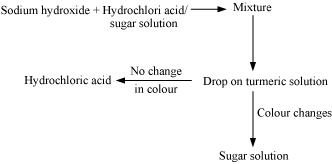
Now, we will put a drop of sodium hydroxide on a drop of each of the other two liquids separately. After that, we will put the drops of these mixtures on turmeric indicator. The drop which will change the colour of the turmeric indicator to red contains sugar solution. This is because the mixture of basic and neutral solutions is basic in nature. On the other hand, the drop which will not change the colour of turmeric indicator contains hydrochloric acid. This is because hydrochloric acid reacts with sodium hydroxide to form a neutral solution.
Image
View full question & answer
Question 25 Marks
Dorji has a few bottles of soft drink in his restaurant. But, unfortunately, these are not labelled. He has to serve the drinks on the demand of customers. One customer wants acidic drink, another wants basic and third one wants neutral drink. How will Dorji decide which drink is to be served to whom?
Answer
Since the drinks are edible, Dorji can take the decision by tasting the drinks. Acidic drinks will be sour to taste whereas basic drinks will be bitter to taste and neutral drinks will have no taste.

If Dorji has litmus indicator (solution or paper), then he can take its help. He should put one drop of each drink on blue litmus paper. If the colour of the litmus paper changes to red, then it is an acidic drink. Out of the remaining drinks, some are basic and some are neutral. Again, he should put one drop of the remaining drinks on red litmus paper. If the colour changes to blue, then it is basic and the others are neutral. In this way, he can serve all the three customers their respective drinks.

View full question & answer
Question 35 Marks
State the differences between acids and bases.
Answer
Acids Bases
These are sour to taste These are bitter to taste.
Acids are proton donors or electron acceptors Bases are proton acceptors or electron donors
Acids have a $pH$ value of $ < 7.$ Bases have a $pH$ value $ > 7.$
Acids turn blue litmus red. Bases do not change the colour of blue litmus.
Acids do not change the colour of red litmus Bases turn red litmus blue
With china rose indicator, these give a dark pink colour. Bases give green colour with china rose indicator.
Acids do not change the colour of the turmeric indicator. Bases turn the colour of the turmeric indicator to red
Acid is a substance that contains hydrogen ion $(H^+)$ Bases are substances that contain hydroxyl ion $(OH^-)$
View full question & answer
Question 45 Marks
Three liquids are given to you. One is hydrochloric acid, another is sodium hydroxide and third is a sugar solution. How will you identify them? You have only turmeric indicator.
Answer
We will put a drop each of hydrochloric acid, sodium hydroxide, and sugar solution on the turmeric indicator. The liquid which changes the colour of turmeric indicator to red is basic in nature, that is, sodium hydroxide. $\text{Turmeric indicator}\ +\ \text{Sodium hydroxide/}\xrightarrow[\text{to red}]{\ \ \text{Colour changes}\ \ \ }\ \text{Sodium hydroxide}\\\ \ \ \ \ ^{(\text{Yellow)}}\ \ \ \ \ \ \ \ \ \ \ \ \ \ \ \ \ \ \ \ \ \ \ \ \ \ \ ^\text{Hydrochloric acid/}\\ \ \ \ \ \ \ \ \ \ \ \ \ \ \ \ \ \ \ \ \ \ \ \ \ \ \ \ \ \ \ \ \ \ \ \ \ \ \ \ \ \ \ \ \ ^\text{Sugar solution}$ Now, we will put a drop of sodium hydroxide on a drop of each of the other two liquids separately. After that, we will put the drops of these mixtures on turmeric indicator. The drop which will change the colour of the turmeric indicator to red contains sugar solution. This is because the mixture of basic and neutral solutions is basic in nature. On the other hand, the drop which will not change the colour of turmeric indicator contains hydrochloric acid. This is because hydrochloric acid reacts with sodium hydroxide to form a neutral solution. $\text{Sodium Hydroxide}\ +\ \text{Hydrochlori acid/}\xrightarrow{\ \ \ \ \ \ \ \ \ \ \ \ \ }\ \text{Mixture}\\ \ \ \ \ \ \ \ \ \ \ \ \ \ \ \ \ \ \ \ \ \ \ \ \ \ \ \ \ \ \ \ \ \ \ \ \ \ \ \ \ \ \ \ \ \ \ \ \ \ \ \ \ \ \ \ \ \ \ \ \ \ \ \ \ \ \ \ \ \ \ \ \ \ \ \ \ \ \ \ \ \ \ \ \ \ \ \ \ \ \ \bigg\downarrow{\ \ \ }\\ \ \ \ \ \ \ \ \ \ \ \ \ \ \ \ \ \ \ \ \text{Hydrochloric acid}\ \xleftarrow[\text{in colour}]{\ \ \text{No change}\ \ }\ \text{Drop on turmeric solution}\\ \ \ \ \ \ \ \ \ \ \ \ \ \ \ \ \ \ \ \ \ \ \ \ \ \ \ \ \ \ \ \ \ \ \ \ \ \ \ \ \ \ \ \ \ \ \ \ \ \ \ \ \ \ \ \ \ \ \ \ \ \ \ \ \ \ \ \ \ \ \ \ \ \ \ \ \ \ \ \ \ \ \ \ \ \ \ \ \ \ \ \Bigg\downarrow{\text{Colour changes}}\\ \ \ \ \ \ \ \ \ \ \ \ \ \ \ \ \ \ \ \ \ \ \ \ \ \ \ \ \ \ \ \ \ \ \ \ \ \ \ \ \ \ \ \ \ \ \ \ \ \ \ \ \ \ \ \ \ \ \ \ \ \ \ \ \ \ \ \ \ \ \ \ \ \ \ \ \ \ \ \ \ \ \text{Sugar solution}$
View full question & answer
Question 55 Marks
What are the differences between acids and bases?
Answer
S.No.
Acid
Bases
1.
Acids are sour in taste.
Bases are bitter in taste and soapy to touch.
2.
The chemical nature of such substances is acidic.
The nature of such substances is said to be basic.
3.
Acid turns blue litmus red.
Bases turn red litmus blue.
4.
Acids are generally found in Vinegar, Curd, Spinach, Amla, Citrus fruits, Tamarind, grapes, unripe mangoes, Citrus fruits such as oranges, lemons, etc.
Bases are generally found in lime water, soap, window cleaner, Milk of Magnesia.
5.
Acids do not react with ammonium salt.
Reacts with ammonium salt to give ammonia gas.
6.
Do not absorb carbon dioxide gas.
Some bases like $NaOH$ absorbs carbon dioxide gas.
View full question & answer
Question 65 Marks
Give two uses of the following acids.
  1. Nitric acid.
  2. Hydrochloric acid.
  3. Sulphuric acid.
Answer
  1. Nitric acid:
  • It is used by goldsmiths for cleaning gold and silver ornaments.
  • It is used to make fertilisers.
  1. Hydrochloric acid:
  • It is secreted in stomach for digestion.
  • It is used to remove rust from iron before galvanising and painting.
  1. Sulphuric acid:
  • It is used in batteries of cars, buses and inverters.
  • It is used for preparing alum.
View full question & answer
Question 75 Marks
State few properties of acids.
Answer
  • Acids are sour in taste.
  • The chemical nature of such substances is acidic.
  • Acid turns blue litmus red.
  • It gives hydrogen ion when dissolves in water.
  • Do not give any colour with phenolphthalein indicator.
  • Do not absorb carbon dioxide gas.
  • Acids do not react with ammonium salt.
  • Acids are generally found in Vinegar, Curd, Spinach, lemons, Citrus fruits, Amla, Tamarind, grapes, unripe mangoes, Citrus fruits such as oranges, etc.
View full question & answer
Question 85 Marks
State few properties of bases.
Answer
  • Bases are bitter in taste and soapy to touch.
  • Base turns red litmus blue.
  • The nature of such substances is said to be basic.
  • It gives hydroxide ions when dissolves in water.
  • It give pink colour with phenolphthalein indicator.
  • Some bases like $NaOH$ absorbs carbon dioxide gas.
  • Bases are generally found in lime water, soap, window cleaner, Milk of Magnesia.
  • Reacts with ammonium salt to give ammonia gas.
View full question & answer
Question 95 Marks
Match the substances in Column I with those in Column II.
 
Column I
 
Column II
$(a)$
Tartaric acid
$(i)$
soap
$(b)$
Calcium hydroxide
$(ii)$
curd
$(c)$
Formic acid
$(iii)$
unripe mangoes
$(d)$
Sodium hydroxide
$(iv)$
ant's sting
$(e)$
Lactic acid
$(v)$
lime water
Answer
 
Column I
 
Column II
$(a)$
Tartaric acid
$(iii)$
unripe mangoes
$(b)$
Calcium hydroxide
$(v)$
lime water
$(c)$
Formic acid
$(iv)$
ant's sting
$(d)$
Sodium hydroxide
$(i)$
soap
$(e)$
Lactic acid
$(ii)$
curd
View full question & answer
Question 105 Marks
Explain the universal indicator.
Answer

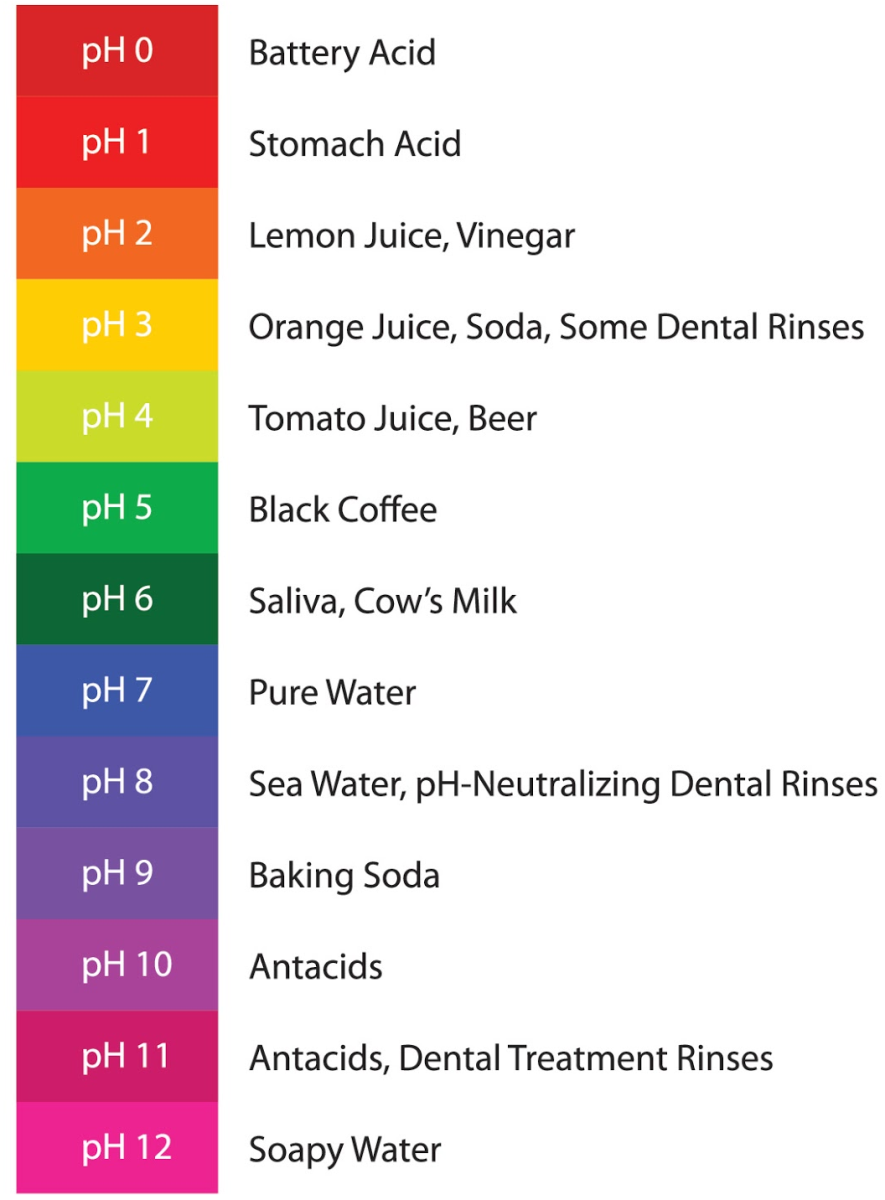
Universal indicator gives a range of colour that can be used to determine the level of acidity or basic of a solution, this level is called the pH value.
View full question & answer
Question 115 Marks
State differences between acids and bases.
Answer
 
Acids
Bases
$(i)$
These are sour to taste.
These are bitter to taste.
$(ii)$
Acids turn blue litmus red.
Bases do not change the colour of blue litmus.
$(iii)$
Acids do not change the colour of red litmus.
Bases turn red litmus blue.
$(iv)$
With china rose indicator, these give dark pink colour.
Bases give green colour with china rose indicator.
$(v)$
Acids do not change the colour of turmeric indicator.
Bases turn the colour of turmeric indicator to red.
View full question & answer
Question 125 Marks
Arnav is provided with three kinds of liquid of them one is sodium hydroxide; another is hydrochloric acid and third is a sugar solution. How will he identify them when he have only turmeric indicator.
Answer
Turmeric is yellow in colour, when it is exposed to neutral (Sugar Solution) or acidic substances (Hydrochloric Acid) it will retain its yellow colouration. However, if turmeric is exposed to more alkaline substances (sodium hydroxide) it becomes a dark pink/ red. So first we detect sodium hydroxide a basic substance by a colour change from yellow to dark or red. Then will test for an acid or neutral substance with indication of no colour change. Now out of these two, we will mix one with already tested solution for basic substance sodium hydroxide with dark or red colour, if on mixing the colour reverses back to yellow, the liquid is an acid and the remaining third liquid is neutral.
View full question & answer
Question 135 Marks
Describe the process of neutralisation with the help of an example.
Answer
The reaction between an acid and a base is known as neutralization reaction. In this reaction, both acid and base cancel each other’s effect. Neutralisation reaction results in the formation of salt and water. During this reaction, energy in the form of heat is evolved. $\text{Acid}+\text{Base}\xrightarrow{\ \ \ \ \ \ \ \ }\text{Salt}+\text{Water}+\text{Heat}$ For example: When sodium hydroxide $(\mathrm{NaOH})$ is added to hydrochloric acid $(\mathrm{HCl})$, sodium chloride $(\mathrm{NaCl})$ and water $\left(\mathrm{H}_2 \mathrm{O}\right)$ are obtained. $\text{NaOH}\ \ \ \ +\ \ \ \ \text{HCl}\ \ \ \ \ \xrightarrow{\ \ \ \ \ \ \ \ \ \ }\ \ \ \ \ \text{NaCl}\ \ \ \ +\ \ \ \ \text{H}_2\text{O}\ \ \ +\ \ \ \text{Heat}\\ \ ^\text{Sodium}\ \ \ \ \ \ \ \ \ \ ^\text{Hydrochloric}\ \ \ \ \ \ \ \ \ \ \ \ \ \ \ ^\text{ Sodium}\ \ \ \ \ \ \ \ \ \ \ \ ^\text{Water}\\ ^\text{hydroxide}\ \ \ \ \ \ \ \ \ ^\text{acid}\ \ \ \ \ \ \ \ \ \ \ \ \ \ \ \ \ \ \ \ \ \ \ \ \ ^\text{chloride}$
View full question & answer