- AOnly a convex mirror.
- ✓Only a concave mirror.
- COnly a plane mirror.
- DBoth convex and concave mirrors.
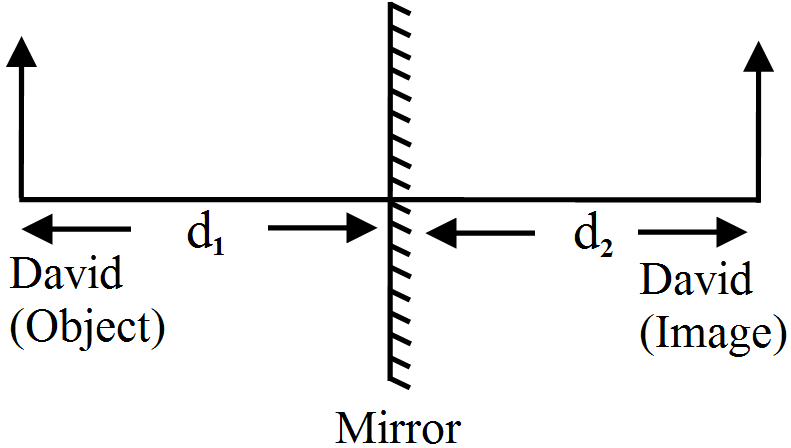
The image formed by a plane mirror is at the same distance behind the mirror as the object is in front of it. Therefore, the distance between object and image is given by.
distance between object and mirror $+$ distance between mirror and image $= 0.5m + 0.5m = 1m.$
Isaac Newton was the first person to split sunlight into seven colors using a glass prism.
When he tried to split the band of colors further using a second prism placed in the inverted position as compared to that of the first, he observed that the emergent ray was white - colored.
This gave him an idea that sunlight is made up of $7$ colors and any other light that gives a spectrum similar to that of sunlight is often referred to as white light.
As per $VIBGYOR,$ we have Violet, Indigo, Blue, Green, Yellow, Orange and Red colours in the rainbow.
Hence Purple colour is not available in the rainbow.
Refraction of light is the phenomenon of bending of light or change in the direction of light, when it passes obliquely from one transparent medium to another.
Reflection is the phenomenon in which light rays on striking a polished surface(such as a mirror) bounce back or are sent back into the same medium.
Dispersion is the phenomenon of splitting of white light into its component colours $(VIBGYOR)$ on passing through a glass prism.
Scattering is the phenomenon by which a beam of light is redirected or deflected in many different directions, when it passes through an imperfect medium, due to interaction with the particles of the medium.
A magnifying lens is simply a convex lens and forms a magnified erect virtual image of objects.
The sequence of colors obtained on the splitting of white light is $VIBGYOR-$ Violet, indigo, blue, green, yellow, orange, and red.