Questions

5 Marks Questions

🎯

Test yourself on this topic

12 questions · timed · auto-graded

Question 15 Marks
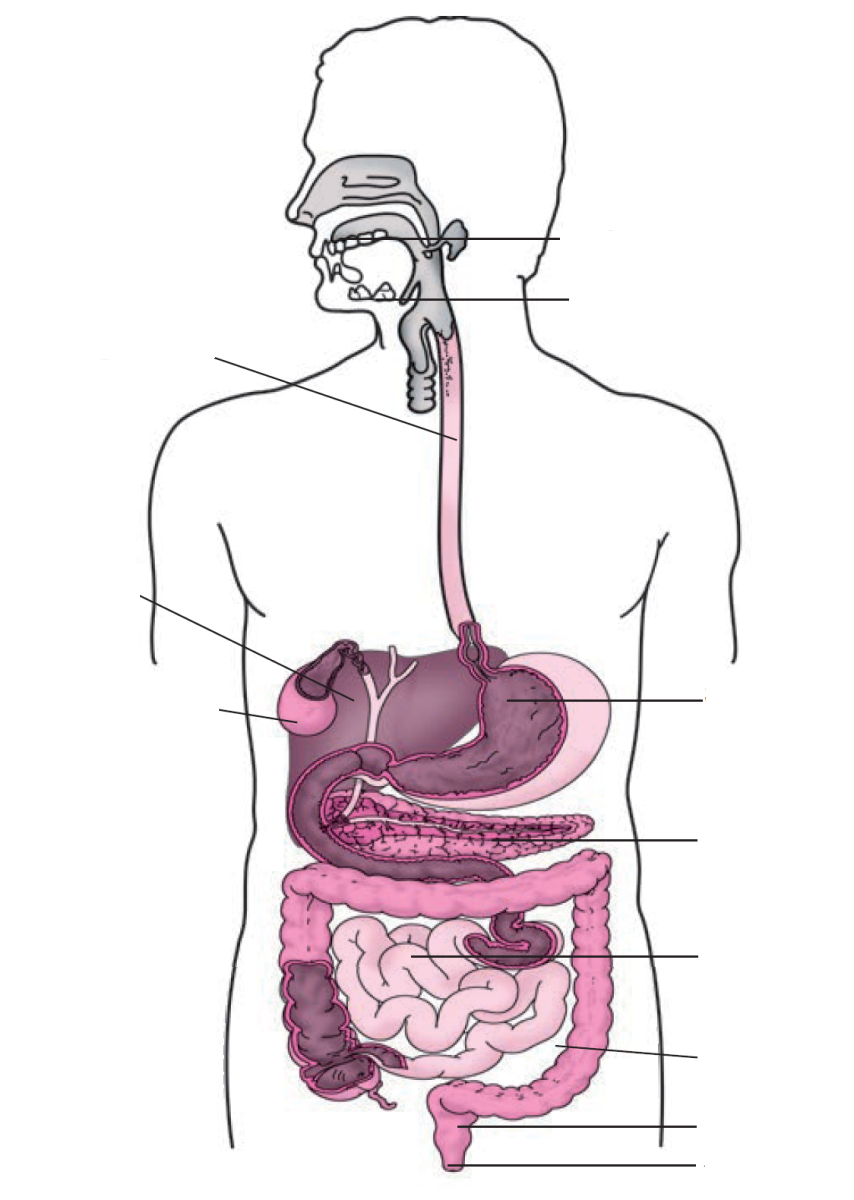
Match the items of Column I with those given in Column II:
Column I Column II
Food components Product(s) of digestion
Carbohydrates Fatty acids and glycerol
Proteins Sugar
Fats Amino acids
Answer
Column I Column II
Food components Product(s) of digestion
Carbohydrates Sugar
Proteins Amino acids
Fats Fatty acids and glycerol
View full question & answer
Question 35 Marks
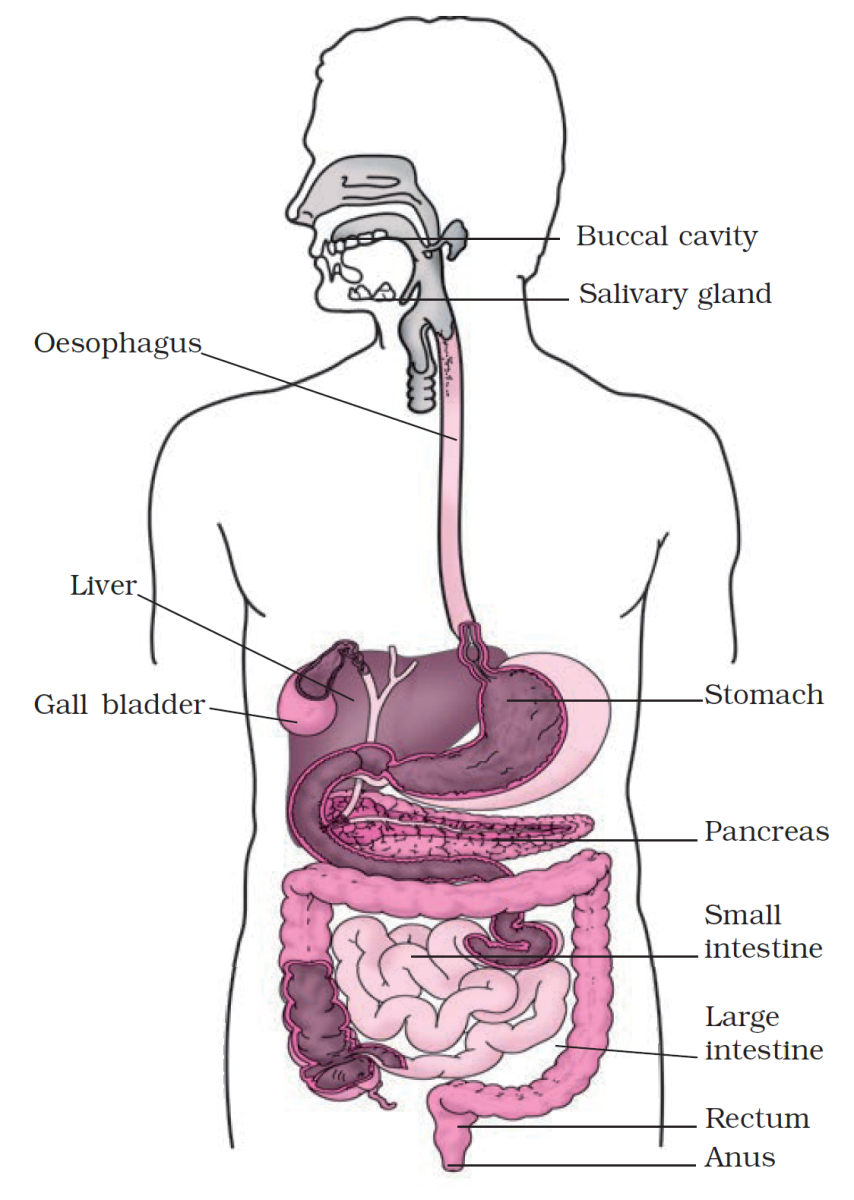
Match the items of Column I with suitable items in Column II
Column I Column II
Salivary gland Bile juice secretion
Stomach Storage of undigested food
Liver Saliva secretion
Rectum Acid release
Small intestine Digestion is completed
Large intestine Absorption of water
Release of faeces
Answer
Column I Column II
Salivary gland Saliva secretion
Stomach Acid release
Liver Bile juice secretion
Rectum Storage of undigested food
Small intestine Digestion is completed
Large intestine Absorption of water

View full question & answer
Question 45 Marks
Write one similarity and one difference between the nutrition in Amoeba and human beings.
Answer
Similarity between nutrition in Amoeba and human beings:

Both Amoeba and humans require energy for the growth and maintenance of their bodies. This energy is derived from the food that they eat. The food that they consume is always in a complex form and is therefore broken down into simpler forms by the process of digestion. Hence, both these organisms are heterotrophs.

Differences between nutrition in Amoeba and human beings:

Digestion in Humans Digestion in Amoeba
Humans have a mouth and a complex digestive system. Mouth and digestive system are absent in Amoeba.
Digestive juices are secreted in the buccal cavity, stomach, and small intestine. Digestive juices are secreted in the food vacuole.
Digestion of carbohydrates, proteins, and fats starts in separate regions. All the food components are digested in the food vacuole
View full question & answer
Question 55 Marks
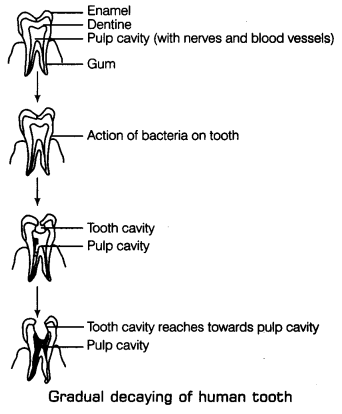
With the help of labelled diagram show the gradual decay of tooth.
Answer

Sweets and Tooth Decay The tooth is covered by white, hard outer covering of tooth called Enamel enamel below which dentine is present. It is similar to bone which Pulp cavity (with nerves and blood vessels) protects the pulp cavity having nerves and blood vessels. Bacteria are Gum present in our mouth but they are not harmful to us. However, if we do not clean our teeth and mouth after eating, many harmful bacteria also begin to live and grow in it. These bacteria breakdown the sugars present from the leftover food and release acids. The acids gradually damage the tooth. This is called tooth decay.
Therefore, tooth decay is defined as the process of rotting of tooth and formation of cavity or holes in it which leads to the toothache.
When the holes or cavity reaches to the pulp cavity, it causes pain. If these cavities are not treated on time it causes severe toothache and may result in tooth loss.
Tooth decay can be prevented by adapting following measures:
  1. One should rinse and clean its teeth thoroughly after every Pulp cavity meal.
  2. We should clean our teeth with the help of datun or brush Gradual decaying of human tooth and toothpaste, twice a day.
  3. We should use dental floss which is a special strong thread. It is moved between two teeth to take out trapped food particles.
  4. Dirty fingers or unwashed objects must be avoided to put in the mouth.
  5. We should avoid the use of sweets, chocolates, toffees, ice-cream, etc. Much use of cold drink should also be avoided.
View full question & answer
Question 65 Marks
Match the items of Column $I$ with suitable items in Column $II.$
 
Column I
 
Column II
$(a)$
Salivary gland
$(i)$
Bile juice secretion
$(b)$
Stomach
$(ii)$
Storage of undigested food
$(c)$
Liver
$(iii)$
Saliva secretion
$(d)$
Rectum
$(iv)$
Acid release
$(e)$
Small intestine
$(v)$
Digestion is completed
$(f)$
Large intestine
$(vi)$
Absorption of water
 
 
$(vii)$
Release of faeces
Answer
 
Column I
 
Column II
$(a)$
Salivary gland
$(iii)$
Saliva secretion
$(b)$
Stomach
$(iv)$
Acid release
$(c)$
Liver
$(i)$
Bile juice secretion
$(d)$
Rectum
$(ii)$
Storage of undigested food
$(e)$
Small intestine
$(v)$
Digestion is completed
$(f)$
Large intestine
$(vi)$
Absorption of water
View full question & answer
Question 75 Marks
Define oral rehydration solution and when it is given to the patient? How can you prepare $ORS$ at home?
Answer
Oral rehydration solution is the solution of sugar and salt in a particular ratio in the clean water. When a person passes out watery stools frequently, the disease is called diarrhoea. In this condition there is a loss of water and salt from the body of a person. This is called dehydration which may be fatal if not cured at proper time. In order to prevent dehydration, the person or patient should be given $ORS.\ ORS$ makes up the loss of water and salts in the body and sugar provides energy which helps in the recovery of disease. It should be given to a patient suffering from diarrhoea at a regular interval. At home the $ORS$ can be prepared by dissolving a teaspoonful of sugar and pinch of salt in a glass of clean water. The water used for preparing $ORS$ should be first boiled and then cooled so that all the microorganisms or harmful bacteria may be killed.
View full question & answer
Question 85 Marks
Complete the following table, from the options given below:(Scraping, chewing, siphoning, capturing and swallowing, sponging, sucking, etc.)
Name of animal
Kind of animal
Mode of feeding
Snail
 
 
Ant
 
 
Eagle
 
 
Humming bird
 
 
Lice
 
 
Mosquito
 
 
Butterfly
 
 
Housefly
 
 
Answer
Name of animal
Kind of food
Mode of feeding
Snail
Leaves and insects
Scraping
Ant
Food particles
Chewing
Humming bird
Nectar of flower
Sucking
Lice
Blood
Sucking
Mosquito
Blood
Sucking
Butterfly
Nactar of flower
Siphoning
Housefly
All most everything
Sponging
View full question & answer
Question 105 Marks
Match the organs in Column $I$ with the words listed in Column $II.$
  Column I   Column II
$(a)$ Rectum $(i)$ Mucous
$(b)$ Gell bladder $(ii)$ Villi
$(c)$ Stomach $(iii)$ Taste buds
$(d)$ Tongue $(iv)$ Faeces
$(e)$ Small intestine $(v)$ Bile juice
Answer
  Column I   Column II
$(a)$ Rectum $(iv)$ Faeces
$(b)$ Gell bladder $(v)$ Bile juice
$(c)$ Stomach $(i)$ Mucous
$(d)$ Tongue $(iii)$ Taste buds
$(e)$ Small intestine $(ii)$ Villi
View full question & answer
Question 115 Marks
Read the following passage carefully and answer the questions that follows it. Bile juice is stored in a sac called, gall bladder, located near its organ of secretion, liver. The gall bladder releases the bile juice into the small intestine whenever food reaches there. Though bile juice is devoid of any digestive enzymes, it is required for the digestion of fats. The fats cannot be digested easily because they are insoluble in water and are present as large globules. Bile juice breaks down big fat droplets into smaller droplets. These are then easily digested by the enzymes released from the pancreas.
  1. Which organ secretes the bile juice?
  2. Why is digestion of fats difficult as compared to that of other nutrients?
  3. How does bile juice help in digestion of fat?
  4. Where is the digestion of fat completed?
  5. Does bile juice digest fat completely?
Answer
  1. Bile juice is secreted by the liver.
  2. Digestion of fats is difficult as compared to that of other nutrients because of insolubility of fat in water.
  3. Bile juice helps in digestion of fat by breaking down big fat droplets into smaller droplet. This is called emulsification of fats.
  4. Digestion of fat is completed in small intestine.
  5. No, fat is not digested by bile juice. Bile contains bile salts, which helps in its emulsification. This makes the action of pancreatic lipase easier that completes fat digestion.
View full question & answer
5 Marks Questions - Science STD 7 Questions - Vidyadip