Questions

3 Marks Question

🎯

Test yourself on this topic

20 questions · timed · auto-graded

Question 13 Marks
How would you test the presence of starch in leaves?
Answer

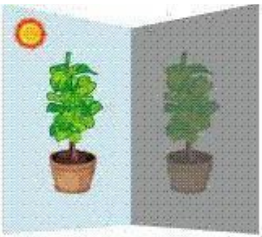
Experiment to test the presence of starch in leaves:

i. Take two healthy green potted plants of the same type.
ii. Keep one potted plants in a dark room for one or two days in order to remove all the starch from the leaves.
iii. Keep the other plant in sunlight.
iv. Now, take one leaf from each potted plant and put a few drops of iodine solution on them.
v. Note down the change in the colour of both the leaves.
Image

Observation: No blue-black colour will be observed on the leaves of plant kept in the dark room. This indicates the absence of starch. Blue-black colour will be observed on the leaves of the plant kept in sunlight. This indicates the presence of starch.

Concept insight: Plants prepare glucose during photosynthesis which gets stored in plants in the form of starch. Iodine turns blue-black when reacted with starch.

View full question & answer
Question 23 Marks
Whether food is made in all parts of a plant or only in certain parts? Explain.
Answer
Only certain parts of plant like leaves have green pigment called chlorophyll. So Leaves are called the food factories of plants. Besides leaves, photosynthesis also takes place in other green parts of the plant like in green stems and green branches. The desert plants have scale or spine like leaves to reduce loss of water by transpiration. These plants have green stems which carry out the process of photosynthesis.
View full question & answer
Question 33 Marks
Nitrogen is an essential nutrient for plant growth. But farmers who cultivate pulse crops like green gram, bengal gram, black gram, etc. do not apply nitrogenous fertilizers during cultivation. Why?
Answer
The plants such as gram, peas, pulses are called Leguminous plants (legumes). These plants have root nodules in them which have a symbiotic association with bacteria such as Rhizobium. This bacteria convert gaseous nitrogen of air into water soluble nitrogen compounds (like nitrates). Some of these nitrogen compounds are used by the leguminous plants for their growth. Hence, farmers do not need to apply nitrogenous fertilisers in the fields during cultivation.
View full question & answer
Question 53 Marks
What is cell?
Answer
The body of living organisms are made of tiny units called cells, therefore Cell are called the building blocks of living organism. Cells can be seen only under the microscope. Some organisms are made of single cell they are called Unicellular. Ex. Amoeba, Paramecium etc. While others are made of multicells and are called multicellular. Ex. man, tree etc.
View full question & answer
Question 63 Marks
Asha went to visit her grandfather in his village. He was having a serious discussion with his fellow members regarding the productivity level of crops for present year. They all were worried about how to increase the productivity of crop Asha listened to this and then suggested to the group that the reason may be decreased level of minerals in soil. She told her grandfather to plant crops like pulses, gram, beans, etc., for a year then follow with regular crops. This will increase the crop productivity?
  1. What will you name the process suggested by Asha? Why is there decrease in crop productivity?
  2. What are noted benefits of this process? Will the results be as what Asha expressed?
  3. What values are shown by Asha?
Answer
  1. This process is known as crop rotation. All the plants/crops grown in soil use the minerals present in soil for their own use. This continuous usage depletes the concentration of mineral in soil.
  2. After growing leguminous plants, the mineral content of soil is restored and enriched to new level. Yes, the benefit of leguminous plant is the re-enrichment of soil minerals.
  3. Asha is observant, sincere and interested in applying her knowledge to situations.
View full question & answer
Question 73 Marks
What is symbiosis? Explain with an example.
Answer
It is the mode of nutrition where two organisms live together for mutual benefit. For example, lichens. The association of algae and fungi is called lichen. Alga survives in water. Its need for water is fulfilled by the fungus which in turn consumes the food made by alga. The fungus in turn gives to the alga, water and minerals it obtains from the substratum on which it lives. This association of algae and fungi makes them look as if they are one single organism.
View full question & answer
Question 83 Marks
If plant has a requirement for nitrogen, then from where will they obtain it?
Answer
Soil contains nitrogen in the form that is not usable by plants. Bacteria like Rhizobium converts nitrogen into soluble form that can be easily used by plants. So, if plant has a requirement for nitrogen, then it will obtain that which the help of bacteria.
View full question & answer
Question 93 Marks
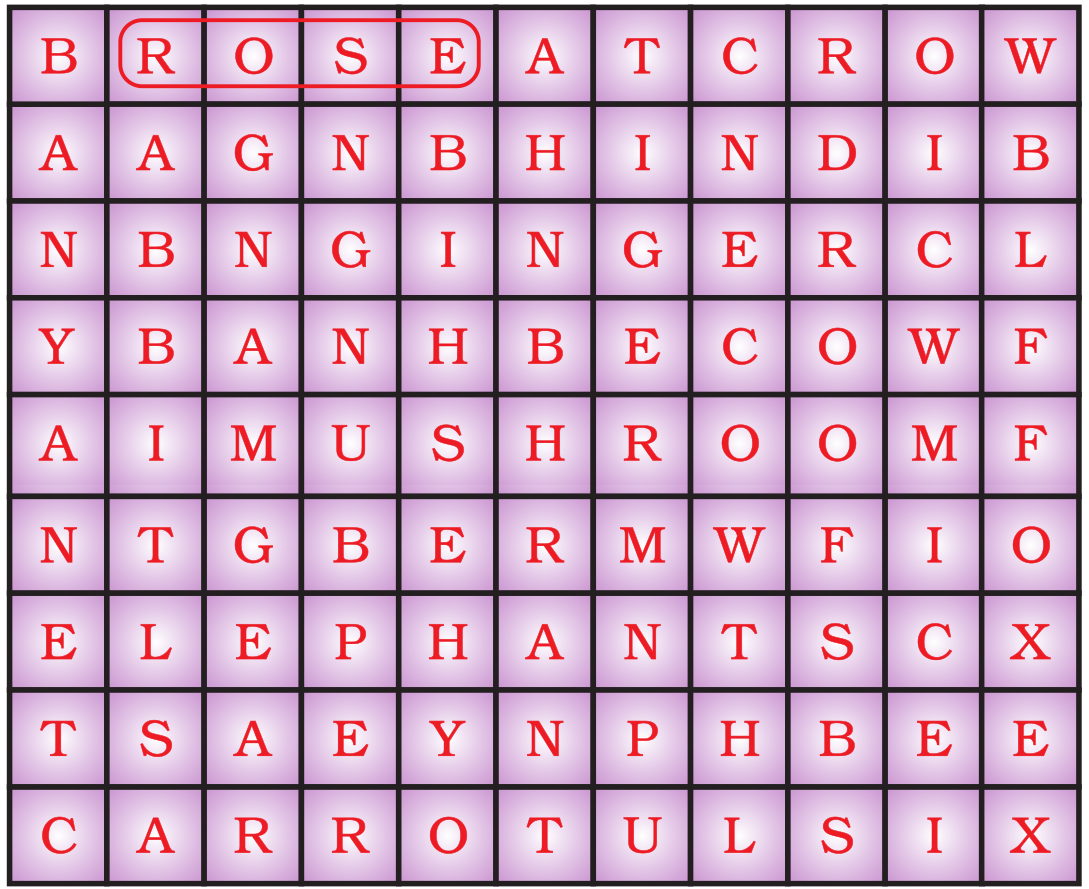
Spot as many organisms as possible in the puzzle given as Figure by encircling them as shown. Write the names on a sheet of paper and categorise them into autotrophs and heterotrophs. Classify the heterotrophs into herbivores, carnivores, omnivores and saprophytes.

Answer


Autotrophs- Rose, Mango, Bhindi, Carrot, Banyan, Tulsi, Ginger, Yam

Heterotrophs- Elephant, Ant, Yeast, Tiger, Mushroom, Fox, Mice, Owl, Cow, Crow, Rabbit, Bee, Fish.

  1. Herbivores- Elephant, Cow, Rabbit, Bee, Ox
  2. Carnivores- Fox, Tiger
  3. Omnivores- Ant, Mice, Owl, Crow, Fish
  4. Saprophytes- Mushroom, Yeast
View full question & answer
Question 103 Marks
Harish went to visit his grandfather in village where he saw that his grandfather’s field of wheat are infected with fungus but no one is aware of this. Harish rushed to his grandfather’s side and told him that the field have been infected with fungi. He should use an antifungal agent in his fields to stop this infection.
  1. What is fungus?
  2. Can fungus only cause diseases or can it be helpful also?
  3. What values are shown by Harish?
Answer
  1. Fungus are saprophytic organisms usually present as spores in atmosphere which can germinate on any substrate in optimal conditions.
  2. Fungus are also useful in that they produce many antibiotics which can cure different types of infections like penicillin.
  3. Harish is sincere, curious and knowledgeable with a keen sense of applying it where necessary.
View full question & answer
Question 123 Marks
Show with the help of a sketch that plants are the ultimate source of food.
Answer
Solution is as follows.
View full question & answer
Question 133 Marks
In what unique manner does a pitcher plant derive its nutrition?
Answer
Nepenthes or pitcher plant modifies its leaf axis into a long tubular pitcher to form a pitfall trap. Inside the pitcher sticky liquid is present. When any insect comes in contact with the leaf, the lid present on it is closed and insect is trapped. The liquid contains digestive enzymes which slowly digest the trapped insects.
View full question & answer
Question 153 Marks
Sun is called the ultimate source of energy for all living organisms. Comments.
Answer
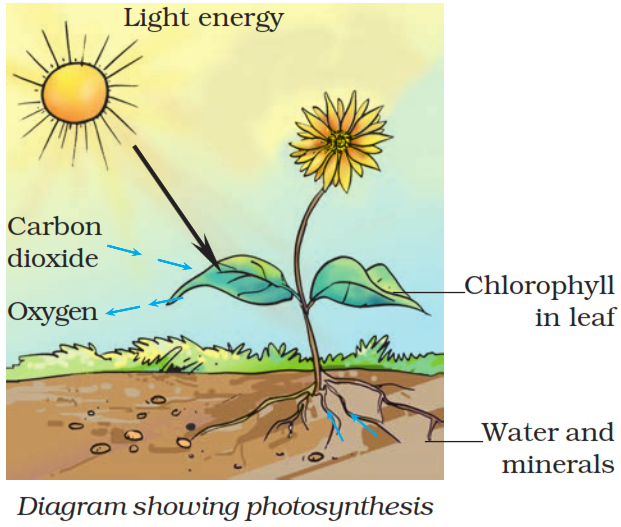
The solar energy is very important to carry out the process of photosynthesis, it is captured by the leaves and stored in the plant in the form of food. And this in turn use by other organism to get food to obtain energy Thus, we say that sun is the ultimate source of energy for all living organisms.
View full question & answer
Question 163 Marks
Sunlight, chlorophyll, carbon dioxide, water and minerals are raw materials essential for photosynthesis. Do you know where they are available? Fill in the blanks with the appropriate raw materials.
  1. Available in the plant: _________________
  2. Available in the soil: _________, ________
  3. Available in the air: _________________
  4. Available during day: _________________
Answer
  1. Available in the plant: Chlorophyll

  2. Available in the soil: Water, minerals

  3. Available in the air: Carbon dioxide

  4. Available during day: Sunlight

View full question & answer
Question 183 Marks
Fill in the blanks of the paragraph given below with the words provided in the box. chlorophyll, energy, food, carbon dioxide, water, photosynthesis Note: A word can be used more than once. Leaves have a green pigment called (a) which captures (b) from sunlight. This (c) is used in the process of (d) and along with other raw materials like (e) and (f) synthesize (g).
Answer
Leaves have a green pigment called chlorophyll which captures energy from sunlight. This energy is used in the process of photosynthesis and along with other raw materials like carbon dioxide and water​​​​​​​ synthesize food.
View full question & answer
Question 193 Marks
What are the various raw materials for photosynthesis?
Answer
Plants utilise carbon dioxide from air and water and minerals are derived from soil (through roots) as raw material for photosynthesis. Besides these chlorophyll present in green leaf is necessary for the process and sunlight is the source of energy which is converted into chemical energy during the process of photosynthesis.
View full question & answer
Question 203 Marks
Give a brief description of the process of synthesis of food in green plants.
Answer
Photosynthesis is the process synthesis of food in the plants with the help of chlorophyll and carbon dioxide in the presence of sunlight. Water and minerals present in the soil are absorbed by the roots and transported to the leaves by the vessels. Carbon dioxide from air is taken through stomata present in leaves. Leaves are the food factories of the plants which capture the energy of the sunlight with the help of chlorophyll. This energy is used to synthesize food from carbon dioxide and water.
View full question & answer