Questions

2 Marks Questions

🎯

Test yourself on this topic

33 questions · timed · auto-graded

Question 12 Marks
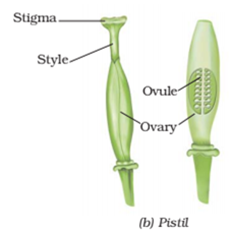
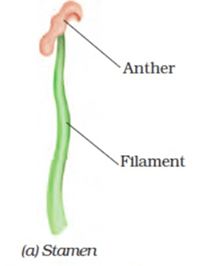
Sketch the reproductive parts of a flower.
Answer
Image

Male Reproductive Part : Stamen

Image

Femal Reproductive Part : Pistil

View full question & answer
Question 22 Marks
Explain what you understand by sexual reproduction.
Answer
Sexual reproduction is a process which involves production of seeds. It requires two parents. Most plants reproduce sexually with the help of flowers. The main function of a flower is to reproduce and therefore develop new seeds that can grow into new plants
View full question & answer
Question 32 Marks
When you keep food items like bread and fruits outside for a long time especially during the rainy season, you will observe a cottony growth on them. What is this growth called?
Answer
When food items like bread and fruits are kept outside for a long time especially during rainy season, a cottony growth of bread mould (a fungus) is observed.
View full question & answer
Question 42 Marks
Distinguish between the following. Stamen and Pistil.
Answer
S. No.
Stamen
Pistil
$(i)$
It is the male reproductive organ of the flower.
It is the female reproductive organ of the flower.
$(ii)$
It consists of anther and filament.
It consists of stigma, style and ovary.
View full question & answer
Question 52 Marks
How does yeast reproduce?
Answer
Yeast reproduces by a process called budding. A small bulb-like projection that comes out from the yeast is known as a bud. This bud grows and detaches itself from the parent cell, and then grows independently as a new plant.
View full question & answer
Question 62 Marks
Explain reproduction in plants by fragmentation.
Answer
Fragmentation, the splitting of cells into two parts and makes new bodies is known as fragmentation. Each fragment develops into a mature clone genetically and morphologically identical to its parent. It is a type of asexual reproduction or vegetative propagation.
View full question & answer
Question 72 Marks
How does yeast reproduce?
Answer
Yeasts are microscopic unicellular fungi that are used to make bread, beer and wine by fermentation. Yeasts reproduce by budding (asexual reproduction), when a small bud forms and splits to form a new daughter cell, but under stress conditions they can produce spores (a form of sexual reproduction).
View full question & answer
Question 82 Marks
Give one difference between unisexual and bisexual flower.
Answer
Unisexual flowers are those which contain either male or female reproductive part and bisexual flower has both reproductive parts (i.e. male and female) on the same flower.
View full question & answer
Question 92 Marks
Why is vegetative propagation a preferred method of asexual reproduction?
Answer
The following advantages of vegetative reproduction makes it a preferred method:
  • It takes less time to grow and bear flower and fruits than those produced from seeds.
  • The new plants are the exact copies of parent plant because they are produced from a single parent.
View full question & answer
Question 102 Marks
When you keep food items like bread and fruits outside for a long time especially during the rainy season, you will observe a cottony growth on them. How does the growth take place?
Answer
The growth of fungus takes place by spores present in air, which when comes in contact with moisture on bread germinates and grow to produce new cells.
View full question & answer
Question 112 Marks
Distinguish between the following. Unisexual flower and Bisexual flower.
Answer
S. No.
Unisexual flower
Bisexual flower
$(i)$
These are flowers having either male or female reproductive organs.
These are flowers having both male and female reproductive organs.
$(ii)$
For example, papaya, corn, etc.
For example, rose, brinjal, etc.
View full question & answer
Question 122 Marks
What is binary fission?
Answer
Binary fission, asexual reproduction by a separation of the body into two new bodies. In the process of binary fission, an organism duplicates its genetic material, or deoxyribonucleic acid $(DNA)$, and then divides into two parts (cytokinesis), with each new organism receiving one copy of $DNA$.
View full question & answer
Question 132 Marks
How does male gamete present in pollen grain reaches female gamete present in ovule?
Answer
After pollination, the pollen grains fall on the surface of stigma and germinate to form a long tube, reaching the ovules inside the ovary, the egg or female gamete is present in the ovule. The outer surface of pollen grains rupture and male gametes are released to fuse with egg.
View full question & answer
Question 142 Marks
Explain flower of a plant.
Answer
A flower is the reproductive part of flowering plants. A flower is a special part of the plant. Flowers are also called the bloom or blossom of a plant. Inside the part of the flower that has petals are the parts which produce pollen and seeds. In all plants, a flower is usually its most colourful part.
View full question & answer
Question 152 Marks
Why are there so many varieties of fruits?
Answer
Fruits develop by many ways so there are many varieties of fruits. For example, some fruits develop without the act of fertilization. Such fruits are called arthenocarpic fruits. E.g. seedless grapes, guava, mango etc.
View full question & answer
Question 162 Marks
The process of layering is commonly used in jasmine for reproduction. Explain how this process of layering is performed in jasmine.
Answer
Layering is a method of vegetative reproduction in branches. In this method, a mature branch of parent plant is bent down and covered with soil.
The tip of the branch is kept above the ground. After few days the roots are developed from the branch buried under the soil and develops into a new plant. This method is done in the plants that have long and slender branches, e.g. jasmine.
View full question & answer
Question 172 Marks
What do you mean by vegetative propagation? Explain with example.
Answer
Vegetative propagation is the ability of plants to reproduce by using vegetative parts like roots, stems and leaves. example: Yeast, Hydra, Bryophyllum reproduce by budding, algae and fungi reproduce by spores.
View full question & answer
Question 182 Marks
Coconut is a large and heavy fruit. How is it adapted for dispersal by water?
Answer
The coconut fruits have a very developed fibrous outer coat which enables them to float in water. They are thus carried away by flowing water to distant places.
View full question & answer
Question 192 Marks
Write short notes on sexual reproduction in plants.
Answer
Sexual reproduction in flowering plants involves the production of male and female gametes, the transfer of the male gametes to the female ovules in a process called pollination. After pollination occurs, fertilization happens and the ovules grow into seeds within a fruit.
View full question & answer
Question 202 Marks
Pick the odd one out from the following on the basis of mode of reproduction and give reason for it, Sugarcane, Potato, Rice, Rose.
Answer
The odd one out is rice. As it reproduces by sexual reproduction. All the other three, i.e. sugarcane, potato and rose reproduce through vegetative propagation.
View full question & answer
Question 212 Marks
Write short notes on reproduction in plants by vegetative propogation.
Answer
It is a type of asexual reproduction in which new plants are produced from roots, stems, leaves and buds. Since reproduction is through the vegetative parts of the plant, it is known as vegetative propagation. Cut a branch of rose or champa with a node. This piece of branch is termed a cutting.
View full question & answer
Question 222 Marks
How is zygote formed in plants?
Answer
When male gamete present in pollen grain moves into ovules and fuse with female egg cell inside ovules and zygote is formed .This process is called fertilization.
View full question & answer
Question 232 Marks
How does a fern reproduce?
Answer
Most ferns reproduce sexually, and that involves meiosis and fertilization. When you are thinking of the typical big fern plant, what it does is, by meiosis, produces spores, and spores have half the number of chromosomes of the big parent plant. The spores are released into the wind.
View full question & answer
Question 242 Marks
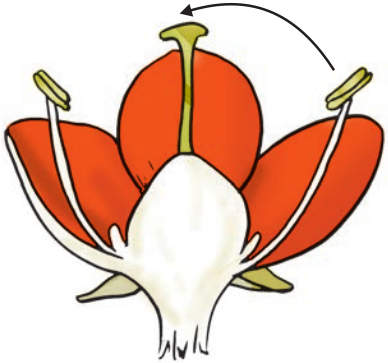
Which type of pollination does the Figure indicate?
Answer
The given figure shows self-pollination, as the pollen grains from anther of the flower are transferred to the stigma of same flower.
View full question & answer
Question 252 Marks
Name the four whorls of a flower. Write the function of each.
Answer
The four whorls of a flower are: sepals which enclose the entire flower, petals which are coloured to attract insects for pollination, stamens which are the male reproductive organs and the carpels which are the female reproductive organs.
View full question & answer
Question 262 Marks
How can we grow a new rose plant from the parent plant?
Answer
A new rose plant can be grown by cutting off a part of the stem of an existing plant, with two or more nodes, and planting it in the ground. A node is a part of the stem from where a leaf grows. This stem grows into a new rose plant.
View full question & answer
Question 272 Marks
One morning as Paheli strolled in her garden she noticed many small plants which were not there a week ago. She wondered where they had come from as nobody had planted them there. Explain the reason for the growth of these plants.
Answer
The small plants which were not there in the garden a weak ago may have grown up due to the seed dispersal. The seeds from the tree may have fallen below or have been dispersed by wind or animals on the ground, which on germination developed into new small plants.
View full question & answer
Question 282 Marks
Define reproduction. Why is it important?
Answer
Reproduction is defined as the production of new individuals by parents of same species. It is important because it replaces death by maintaining the continuity of life so that species do not die out.
View full question & answer
Question 292 Marks
What would happen if all the seeds of a plant fall under the parent plant?
Answer
If all the seeds of a plant fall under the parent plant, it would result in over-crowding and saplings would experience scarcity of nutrients, light, air and space.
View full question & answer
Question 302 Marks
How does the process of fertilization take place in flowers?
Answer
Fertilization in flowering plants happens through a process called pollination. Pollination occurs when pollen grains from the anther land on a stigma. Fertilization occurs when one of the sperm cells fuses with the egg inside of an ovule. After fertilization occurs, each ovule develops into a seed.
View full question & answer
Question 312 Marks
What is sexual reproduction? Explain with example.
Answer
Sexual reproduction is the process in which two components male and female are involved to produce offspring of their own kind. The flower is a reproductive organ of a flowering plant.
View full question & answer
Question 322 Marks
Explain reproduction in plants by spore formation.
Answer
Spore, a reproductive cell capable of developing into a new individual without fusion with another reproductive cell. Spores are agents of asexual reproduction, whereas gametes are agents of sexual reproduction. Spores are produced by bacteria, fungi, algae, and plants. Example: Mosses and ferns reproduce by spore formation.
View full question & answer
Question 332 Marks
Explain reproduction in Bryophyllum.
Answer
Bryophyllum propagates vegetatively by the formation of leaf buds on the margins of a leaf. When the buds come in contact with moist soil, each bud is capable of growing into a new plant.
View full question & answer