Questions

3 Marks Question

🎯

Test yourself on this topic

27 questions · timed · auto-graded

Question 23 Marks

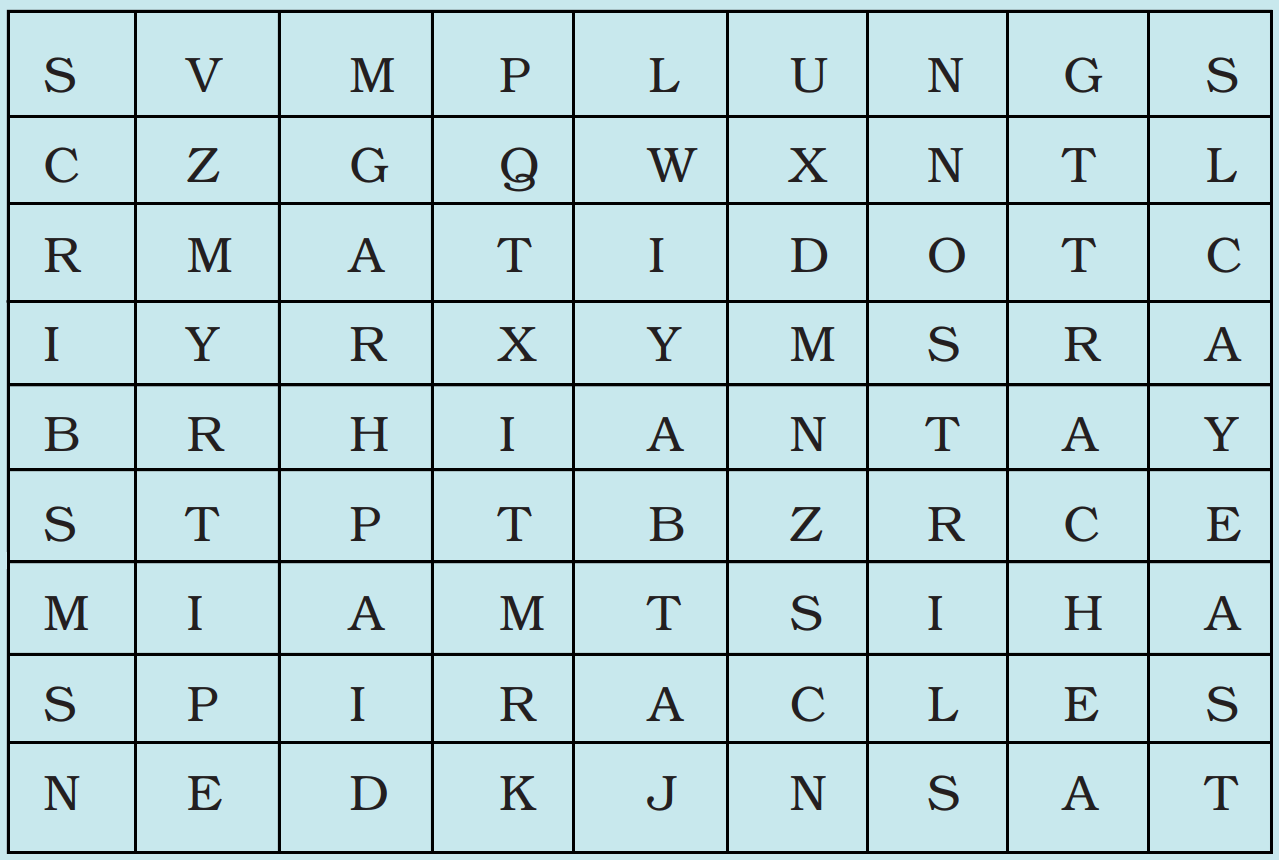
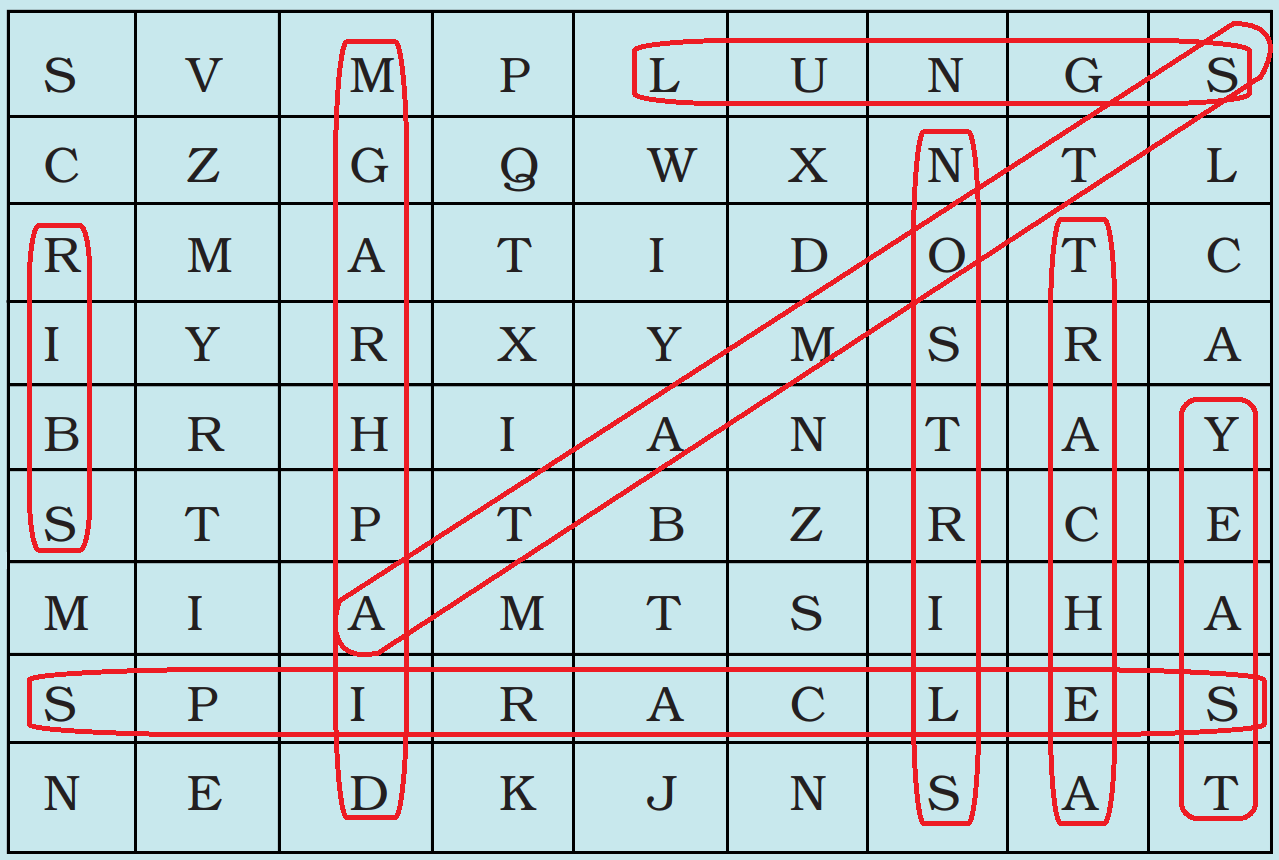
Given below is a square of letters in which are hidden different words related to respiration in organisms. These words may be present in any direction-upwards, downwards, or along the diagonals. Find the words for your respiratory system. Clues about those words are given below the square.

  1. The air tubes of insects.
  2. Skeletal structures surrounding chest cavity.
  3. Muscular floor of chest cavity.
  4. Tiny pores on the surface of leaf.
  5. Small openings on the sides of the body of an insect.
  6. The respiratory organs of human beings.
  7. The openings through which we inhale.
  8. An anaerobic organism.
  9. An organism with tracheal system.
Answer

  1. Trachea.
  2. Ribs.
  3. Diaphragm.
  4. Stomata.
  5. Spiracles.
  6. Lungs.
  7. Nostrils.
  8. Yeast.
View full question & answer
Question 33 Marks

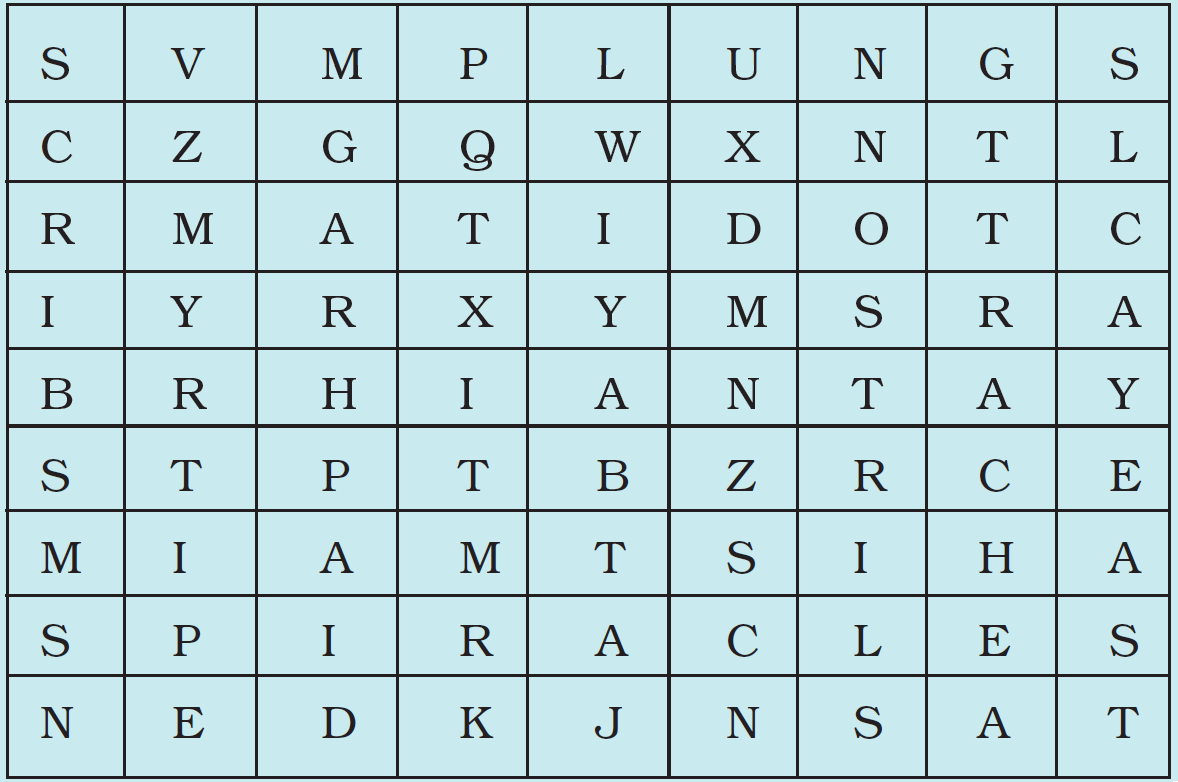
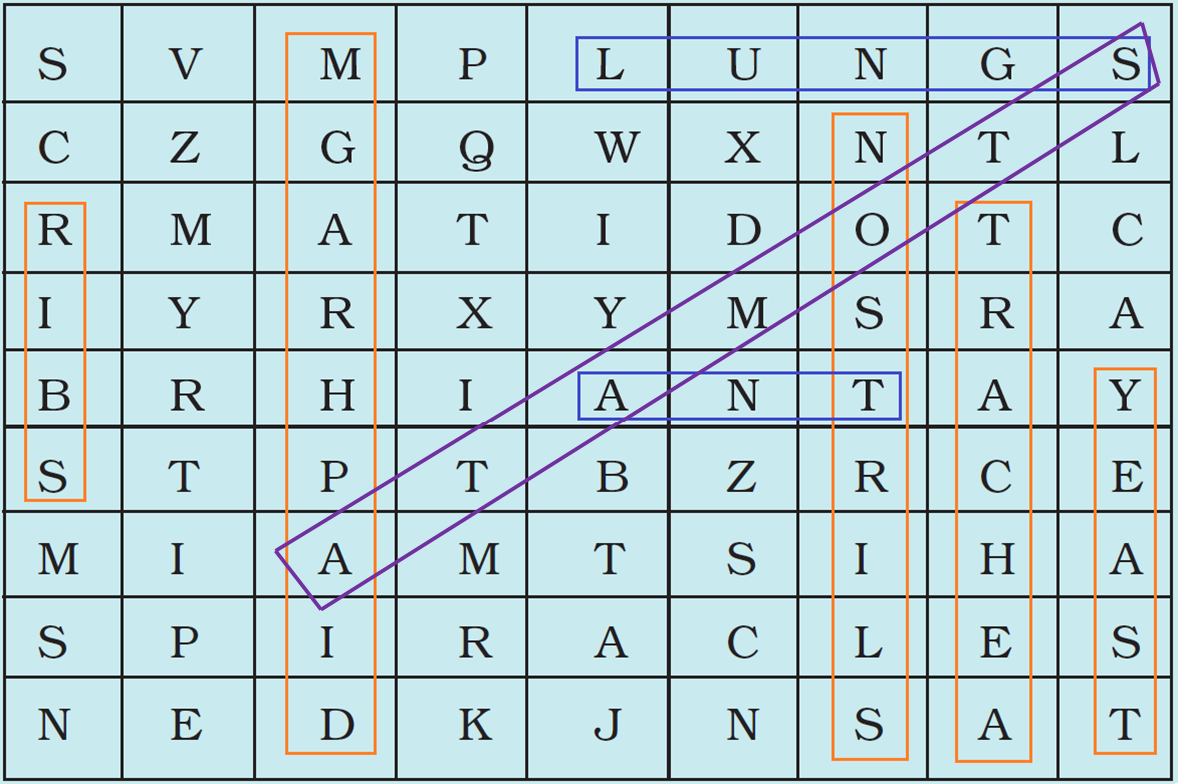
Given below is a square of letters in which are hidden different words related to respiration in organisms. These words may be present in any direction- upwards, downwards, or along the diagonals. Find the words for your respiratory system. Clues about those words are given below the square.


Clues:
  1. The air tubes of insects.
  2. Skeletal structures surrounding chest cavity.
  3. Muscular floor of chest cavity.
  4. Tiny pores on the surface of leaf.
  5. Small openings on the sides of the body of an insect.
  6. The respiratory organs of human beings.
  7. The openings through which we inhale.
  8. An anaerobic organism.
  9. An organism with tracheal system.
Answer
  1. Trachea
  2. Ribs
  3. Diaphragm
  4. Stomata
  5. Spiracles
  6. Lungs
  7. Nostrils
  8. Yeast
  9. Ant

View full question & answer
Question 43 Marks
Insects and leaves of a plant have pores through which they exchange gases with the atmosphere. Can you write two points of differences between these pores with respect to their position, number and extension into the body?
Answer
  1. Spiracles are present on the sides of insects’ body while stomata are present on the lower surface of leaves.
  2. Spiracles are fewer in number as compared to stomata.
  3. Spiracles lead to an extensive network of tracheal system which is absent in the leaves.
View full question & answer
Question 53 Marks
Differentiate between aerobic and anaerobic respiration.
Answer
S.No. Aerobic respiration Anaerobic respiration
$1.$ An aerobic respiration takes place using oxygen, inhaled in breathing. Whereas an anaerobic respiration requires no oxygen.
$2.$ In aerobic respiration, breakdown of glucose results in production of Carbon Dioxide, Water and Energy. In anaerobic respiration, the breakdown of glucose first results in Lactic Acid and energy then lactic acid break down into carbon dioxide and water.
$3.$ An aerobic respiration uses respiratory organs such as lungs or gills. anaerobic respiration take place at cellular or muscular level.
View full question & answer
Question 63 Marks
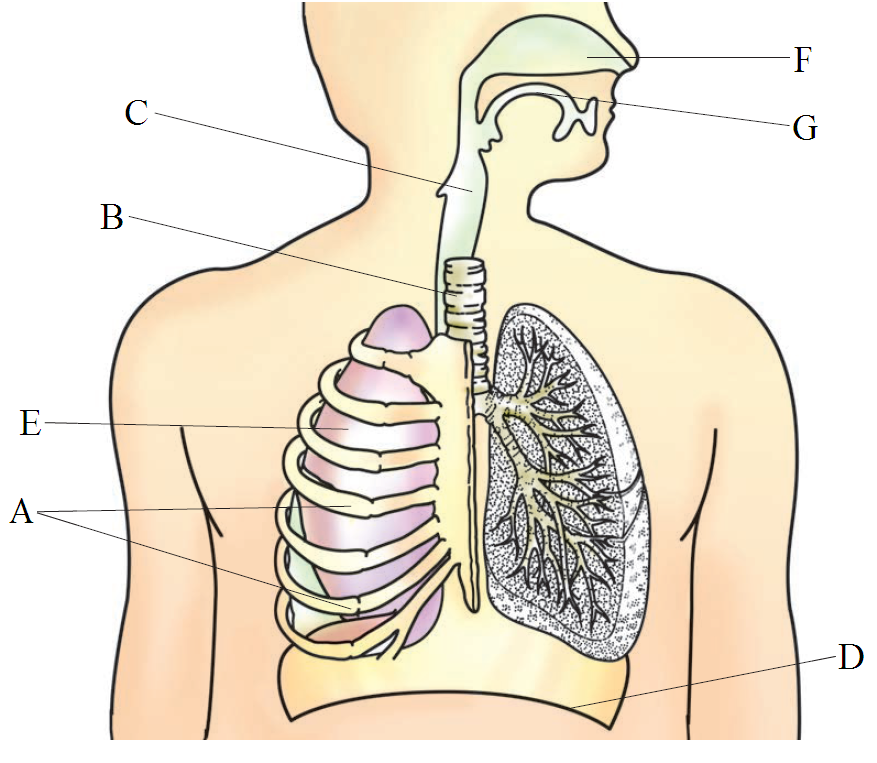
Observe the given diagram of human respiratory system. List the organs from $(A)$ to $(G).$

Answer
The human respiratory system have following organs: $A$-Ribs $B$- Trachea $C$- Pharynx $D$- Diaphragm $E$- Lungs $F$- Nasal passage $G$- Oral cavity
View full question & answer
Question 73 Marks
A girl was suffering from cold and was sneezing continuously. She joined her family at dinner and suddenly started sneezing without covering her nose, thus sending particles all over the place. On realising her mistake, said sorry and next time covered her nose.
  1. During sneezing, what are the precautionary steps to be followed?
  2. Can infections be passed from one person to another via sneezing?
  3. Is sneezing a respiration process?
  4. What values do we pick from this situation?
Answer
  1. When sneezing, you should cover your nose so that the particles expelled by you would not be inhaled by others.
  2. Yes.
  3. No, it is process to remove/ clear the particles harmful for us resulting in clean, fresh air to enter the lungs.
  4. Cleanliness and hygiene maintenance.
View full question & answer
Question 83 Marks
Write short notes on inhalation.
Answer
The process of taking in of air rich in oxygen into the body is called 'inhalation'. During inhalation, ribs move up and outwards and diaphragm moves down. This movement increases space in our chest cavity and air rushes into the lungs. Exhalation is the process of giving out of air giving out of air rich in carbon dioxide is known as 'exhalation'. During exhalation, ribs move down and inwards while, diaphragm moves up to its former position. This movement reduces the size of our chest cavity and air is pushed out.
View full question & answer
Question 93 Marks
How does plant respire?
Answer
Plant respires through the following ways:
  1. Through stomata present in leaves.
  2. Through lenticels present on the bark of stem.
  3. Through root hairs which takes up air via spaces present between the soil particles.
View full question & answer
Question 103 Marks
Why does an athlete breathe faster and deeper than usual after finishing the race?
Answer
An athlete needs to supply extra energy to his muscle cells which have worked hard during running. For this, he breathes faster and deeper so that more oxygen is supplied to the cells. This speeds up the breakdown of food and as a result, more energy is released.
View full question & answer
Question 113 Marks
It is not wise to sleep under a tree during night. Why?
Answer
During day, plants photosynthesise in the presence of sunlight and uses $\mathrm{CO}_2$ produced during respiration. During this process $\mathrm{O}_2$ is released as a byproduct and a balance between $\mathrm{O}_2$ and $\mathrm{CO}_2$ is maintained in the atmosphere.
But in the night, plants do not photosynthesise. Plants are unable to use $\mathrm{CO}_2$ during night and produces $\mathrm{CO}_2$ and takes $\mathrm{O}_2$ during respiration.
This leads to the increase in the proportion of $\mathrm{CO}_2$ in the air.
So, if one sleeps under a tree at night, he will have problems in breathing as the amount of $\mathrm{CO}_2$ in the air around will certainly be more than oxygen. Therefore, it is not advisable to sleep under trees during night because the person will suffer from suffocation and feel excess weight on chest.
View full question & answer
Question 123 Marks
What are the functions of ribs and diaphragm during breathing? Describe their functioning.
Answer
Diaphragm and ribs help in breathing activity:
  • During inhalation: Ribs move up and outwards and diaphragm moves down. This movement increases space in our chest cavity and air rushes into the lungs. The lungs get filled with air.
  • During exhalation: Ribs move down and inwards, while diaphragm moves up to its former position. This reduces the size of the chest cavity and air is pushed out of the lungs.
View full question & answer
Question 133 Marks
How breathing is different from respiration?
Answer
S.No.
Breathing
Respiration
$1.$
It involves intake of oxygen and release of Carbon dioxide.
Respiration is more complex and it includes.
breathing as well as oxidation of food in cells to release energy.
$2.$
It is a physical process i.e. exchange of gases.
It is a bio-chemical process in which food is broken along with release of energy.
$3.$
It involves breathing organs e.g. lungs in mammals.
It occurs at cellular level.
View full question & answer
Question 143 Marks
Explain similarities between aerobic and anaerobic respiration.
Answer
  • Both aerobic and anaerobic respiration are necessary for the survival of living organism.
  • In both type of respiration, the food is broken and energy is released for the functioning of an organism.
  • In both type of respiration, Carbon Dioxide, Water and Energy is produced finally.
View full question & answer
Question 153 Marks
Palak wants to be a great cyclist. She cycles daily for about $2$ hours followed by some exercises. Today, she thought she will cycle for longer and managed it for $41/2$ hours. Now she is feeling cramped up and her breathing is disturbed. Her mother took her to hospital where the doctor examined and told her not to push herself more than necessary. Palak understood and promised herself to move show and steadily.
  1. Why did Palak had cramps in her legs?
  2. Is breathing rate also affected after doing long hour of exercise. Why?
  3. When there is not enough oxygen supply, what happens to body and process of respiration? What values you learn from this?
Answer
  1. Due to extensive exercise, formation of lactic acid occurred as muscles starts to respire anaerobically.
  2. Yes, breathing rate will be faster. Normally we are breathing at a slower rate but during physical activities, to make sufficient amount of $\mathrm{O}_2$ reaching cells we breathe faster.
  3. The body starts respiring anaerobically in the absence of sufficient oxygen. Glucose is partially broken into lactic acid which causes body cramps. Values learned – We should not force ourselves exercise but not over burn yourself discipline.
View full question & answer
Question 163 Marks
A group of people were smoking cigarettes in a restaurant. The atmosphere was full of smoke. An old man sitting next to the group asked them to stop smoking while sitting in the premise or move out. They agreed to do so and promised not to repeat then mistake.Answer the following Questions.
  1. Write any three hazards of smoking.
  2. Can smoking also affect the person who does not smoke?
  3. Do you support the group’s decision to not smoke in public or indiviually. What values do we understand from here.
Answer
  1. Smoking is very injurious for the respiratory system. It harms lungs.
  • It causes blockage in respiratory tract.
  • It leads to lung cancer.
  • It can cause disease like asthma and heart diseases.
  1. Yes, smoking affects people who are passive smokers, i.e. those present nearby smokers.
  2. Yes, the people should bot smoke in public areas as it can cause discomfort to others.
The values we understand are obedience, respect elders and healthy habits.
View full question & answer
Question 173 Marks
Insects and leaves of a plant have pores through which they exchange gases with the atmosphere. Can you write two points of differences between these pores with respect to their position, number and extension into the body.
Answer
Pores present on the sides of insects are called spiracles, while pores present on the surface of leaves are called stomata. These structures are responsible for the exchange of gases with the atmosphere.

Differences between these two are as follows:
  1. Spiracles are fewer in number as compared to stomata.
  2. Spiracles lead to an extensive network of tracheal system, which is absent in the leaves.
  3. Spiracles are present on the sides of insect’s body while stomata are present on the surface of leaves.
View full question & answer
Question 183 Marks
Answer the following:
  1. When does a person need artificial respiration?
  2. From where can the person get supply of oxygen for artificial respiration?
  3. Does the person need to be kept on artificial respiration temporarily or permanently?
Answer
  1. During emergency conditions (e.g. fatal accidents, lungs failure etc.), lungs do not work properly, artificial respiration is required.
  2. The person gets oxygen though an instrument called ventilator which act as artificial lungs.
  3. The person is kept on artificial respiration temporarily. When a person regains his health and starts breathing naturally, artificial respiration is no longer required.
View full question & answer
Question 193 Marks
Whenever we feel drowsy or sleepy, we start yawning. Does yawning help us in anyway?
Answer
Yawning is the action of opening one’s mouth wide while taking a long and deep breath of air. It is caused by insufficient oxygen in the body. It usually occurs when we are drowsy or sleepy because our breathing rate slows down during these situation. The lungs do not get enough oxygen from the air for respiration. Yawning helps in bringing more oxygen into the body through the wide open mouth.
View full question & answer
Question 203 Marks
Frogs are amphibians. They survive on land and water, do they have any respiratory issue? How does frog breathe when they are in water? Do they possess lungs? Explain the role of lungs in frogs.
Answer
Frog breathe by their moist skin and through lungs also. So, they do not have any, respiratory issue.
When frog enters into water, the skin of frog helps in respiration.
The oxygen rich air enters through the skin. When the frog is on land, a pair of lungs helps in respiration.
The lungs take the oxygen rich air through the nostrils from where the oxygen is absorbed by the blood and carried throughout the body.
The carbon dioxide from the blood is diffused back through the skin and lungs into the atmosphere.
View full question & answer
Question 213 Marks
Insects and leaves of a plant have pores through which they exchange gases with the atmosphere. Can you write two points of differences between these pores with respect to their position, number and extension into the body?
Answer
Pores present on the sides of insects are called spiracles while pores present on the surface of leaves are called stomata. These structures are responsible for the exchange of gases with the atmosphere.
Differences between these two are as follows:
  • Spiracles are fewer in number as compared to stomata.
  • Spiracles lead to an extensive network of tracheal system which is absent in the leaves.
View full question & answer
Question 223 Marks
Paheli participated in a $400m$ race competition held at her school and won the race. When she came home she had mixed feelings of joy and pain as she had cramps in her leg muscles. After a massage she was relieved of the pain. Answer the following questions related to the situation. What can be the possible reasons for the pain in her legs?
Answer
Paheli had cramps in her leg muscles after running. She felt pain in her legs because of accumulation of lactic acid in the leg muscles. Lactic acid is formed due to the anaerobic respiration in the muscle cells after heavy exercise or running. During heavy exercise, we require large amount of energy that is provided by muscle cells through anaerobic respiration (Oxygen present is used up for energy, so there is lack of oxygen). Due to the partial breakup of glucose lactic acid is formed. It gets accumulated in the muscle cells and causes pain and muscle cramps.
View full question & answer
Question 233 Marks
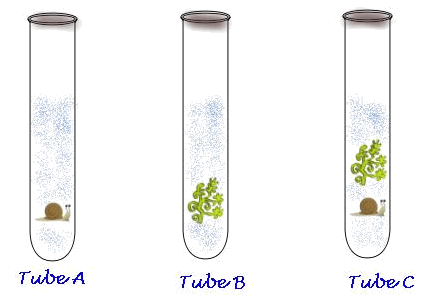
Take three test-tubes. Fill $\frac34\text{th}$ of each with water. Label them $A, B$ and $C.$ Keep a snail in test-tube $A,$ a water plant in test-tube $B$ and in $C,$ keep snail and plant both. Which test-tube would have the highest concentration of $\mathrm{CO}_2$?

Answer
Test tube A will have highest concentration of $\mathrm{CO}_2$. The experiment shows the relationship between plants and animals. During breathing snail inhales dissolved oxygen from water and releases carbon dioxide $\left(\mathrm{CO}_2\right)$. Water-plant along with respiration performs another important function called photosynthesis. During photosynthesis, water-plant, absorbs $\mathrm{CO}_2$, prepares food and releases oxygen. Therefore, Tube $B$ and $C$ has less amount of $\mathrm{CO}_2$ concentration as compared to test tube $A .$
View full question & answer
Question 243 Marks

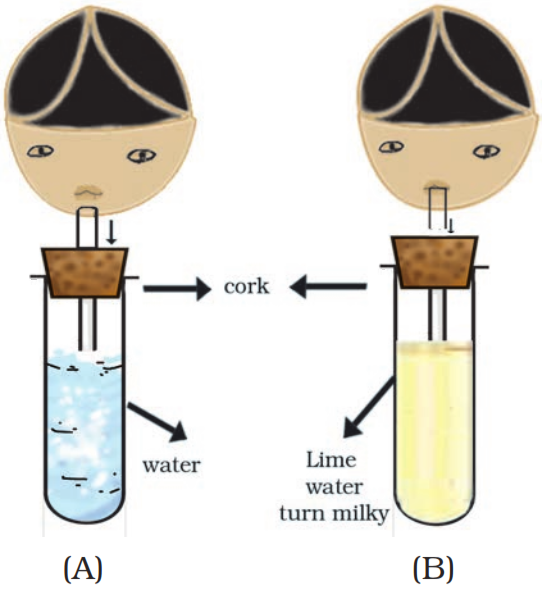
Observe the figure carefully and answer the following questions.

  1. Which process is being tested in the activity?
  2. What is the result of the activity? Give reasons.
Answer
  1. Exhalation, a part of process of respiration is being tested in the activity.
  2. The lime water in test tube $6$ turns milky, but water in test tube $A$ remains unchanged. Because $\mathrm{CO}_2$ present in the exhaled air, mixes with lime water in test tube $B$ and turns it milky.
View full question & answer
Question 253 Marks
On an average, an adult human being at rest breathes $15–18$ times per minute. The breathing rate, however, may differ under different conditions. Arrange the following activities given in the box in order of increasing breathing rates and give reason for your answer.
sleeping, cycling, brisk walk, watching $T.V.$
Answer
In order of increasing breathing rates, the activities are:
Sleeping $ < $ Watching $TV < $ Brisk walk $ < $ Cycling
This is because whenever, a person does an activity, the breathing rate increases depending on the nature of the activity. With strenuous work to provide more oxygen to cells for more energy, the breathing rate further increases.
Therefore, sleeping has minimum breathing rate, while cycling (a physical exercise) has maximum rate.
View full question & answer
Question 263 Marks
Name one organism who respires anaerobically. How does this organism help in beverage and baking industry?
Answer
Yeast is a single celled organism. During anaerobic respiration (also called fermentation), yeast produces ethanol or alcohol as a byproduct which is used in making wine and beer. The carbon dioxide produced by yeast is used in the bread making industry. The $\mathrm{CO}_2$ gas released during this process causes the bread dough to rise.
View full question & answer
Question 273 Marks
Why do we often sneeze when we inhale a lot of dust-laden air?
Answer
We often sneeze when we inhale a lot of dust-laden air to expel out these foreign particles. These particles get past the hair in the nasal cavity and irritate the lining of the cavity which results in sneezing.
View full question & answer