Questions

SHORT ANSWER QUESTIONS(3 Mark)

Take a timed test

40 questions · self-marked practice — reveal the answer and mark yourself.

Question 13 Marks
How is oxygen a constituent of the atmosphere?
Answer
  1. Oxygen is the second most plentiful gas in the air.
  2. Humans and animals take oxygen from the air as they breathe.
  3. Green plants produce oxygen during photosynthesis.
  4. In this way, oxygen content in the air remains constant.
  5. If we cut trees, this balance gets disturbed.
View full question & answer
Question 23 Marks
Explain why astronauts have to wear special protective space suits when they go to the moon.
Answer
Astronauts have wear special protective space suits filled with air when they go to the moon. If they did wear these space suits, counter pressure entered by the body of the astronaut would make the blood vessels burst. The astronauts would bleed.
View full question & answer
Question 33 Marks
Why does the amount of insolation decreases from equator towards poles?
Answer
  1. The earth is spherical in shape.
  2. Therefore the regions close to the equator receive vertical rays of the sun that are concentrated so smaller area.
  3. Due to the curvature of the earth the regions away form the equator receive slanting rays of the that are spread over a large area. Thus the heating provided by the same amount of sunlight is more in the equatorial region and much less in the polar region which at higher latitude.
View full question & answer
Question 43 Marks
What are the harmful effects arising from the greenhouse effect?
Answer
When its level in the atmosphere increases due to factory smoke or car fumes, the heat retained increases the temperature of the earth. This is called global warming. This rise in temperature causes the snow in coldest parts of the world to melt. As a result the sea level rises, causing floods in the coastal areas. There may be drastic changes in the climate of a place leading to extinction of some plants and animals in the long run.
View full question & answer
Question 53 Marks
How are clouds formed? How do clouds cause precipitation?
Answer
  • When water vapour rises, it starts cooling.
  • Water vapour condenses which results in formation of droplets of water.
  • These droplets hanging in the air above are called clouds.
  • Clouds are masses of these water droplets.
  • When these droplets of water become too heavy to float in the air, they come down as precipitation.
View full question & answer
Question 63 Marks
How does humidity affect us?
Answer
  1. When the air is full of water vapour, we call it a humid day.
  2. As the air gets warmer, its capacity to hold the water vapour increases and so it becomes more and more humid.
  3. On a humid day, clothes take longer to dry, and sweat from human body does not evaporate easily, making us feel uncomfortable.
View full question & answer
Question 73 Marks
Describe the composition of atmosphere.
Answer
The atmosphere consists of mixture of gases having a relatively uniform composition in the lower layer. An average sample of pure dry air consist of nitrogen (78%), oxygen (21%) and argon (0.9%), other gases such as carbon dioxide, hydrogen helium and ozone are present in minute quantities. The lower layer of atmosphere also contains water vapour in variable quantities.
View full question & answer
Question 83 Marks
What are the effects of global warming?
Answer
  1. The rise in temperature causes the snow in the coldest parts of the world to melt.
  2. Due to this, sea level rises causing floods in the coastal areas.
  3. There may be drastic changes in the climate of a plate leading to extinction of some plants and animals in the long run.
View full question & answer
Question 93 Marks
What is importance of rainfall?
Answer
Rainfall is very important for the survival of plants and animals. It brings fresh water to the earth’s surface. If rainfall is less the it may cause drought on the other hand if it is more floods will takes place.
View full question & answer
Question 103 Marks
Differentiate between weather and climate.
Answer
Weather:
  • Condition of the atmosphere at a particular place over a short period of time.
  • It changes day today, hour to hour or even in minutes. It affects our day to day life.
Climate: Condition of atmosphere that prevail over a long period, say 30 years. It remains same for period of time. It affects the lifestyle of people.
View full question & answer
Question 113 Marks
What is global warming? What is its affect?
Answer
When the heat retained through greenhouse gas increases the temperature of the earth,It causes global warming:
  • The plants maintain the balance of gases. However this balance is upset by burning fuels such as coal, petroleum oil and large scale deforestation.
  • This rise in temperature causes the snow in coldest parts to melt.
  • As a result the sea level rises causing floods in the coastal areas.
  • This may bring changes in weather and climate leading to extinction of certain plants and animal species.
View full question & answer
Question 123 Marks
Explain the three major types of winds.
Answer
Winds cam be broadly divided into three types.
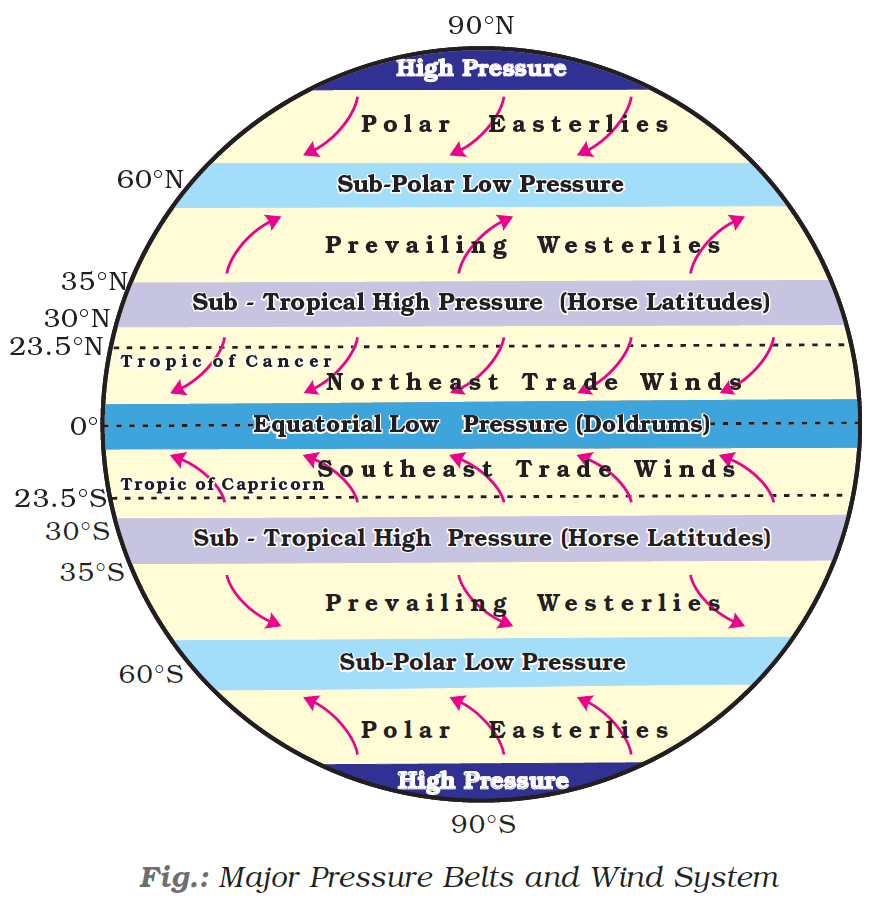
  • Permanent winds: The trade winds, westerlies and easterlies are the permanent winds. These blow constantly throughout the year in a particular direction.
  • Seasonal winds : These winds changes their direction in different seasons. For example monsoons in India.
  • Local Winds: These blow only during a particular period of the day or year in a small area. For example, alnd and sea breeze.
View full question & answer
Question 133 Marks
Give an account of the composition of the atmosphere.
Answer
Our atmosphere is composed of mainly two gases- nitrogen (78%) and oxygen (21%). Other gases like carbon dioxide, helium, ozone, orgon and hydrogen are found in lesser quantities. Apart from these gases, tiny dust particles are also present in the air.
View full question & answer
Question 143 Marks
Explain the term dynamic environment.
Answer
The physical and biological elements in the environment are dynamic in nature .changes take place slowly and suddenly in the nature of landforms. The circulation air and water brings about changes in the climatic conditions in different seasons.
View full question & answer
Question 153 Marks
What are the various categories of wind? Explain with a diagram.
Answer
Winds can be broadly divided into three types:
  • Permanent winds: which blow constantly throughout the year in a particular direction.
Example, easterlies and westerlies.
  • Seasonal winds: which change directions in different seasons. For example, monsoon winds.
  • Local winds: blow only during a particular period of the day or the year in a small area. For example, land or sea breeze, or loo.
​​​​​​​
View full question & answer
Question 163 Marks
Which layer the most suitable conditions for flying aeroplanes?
Answer
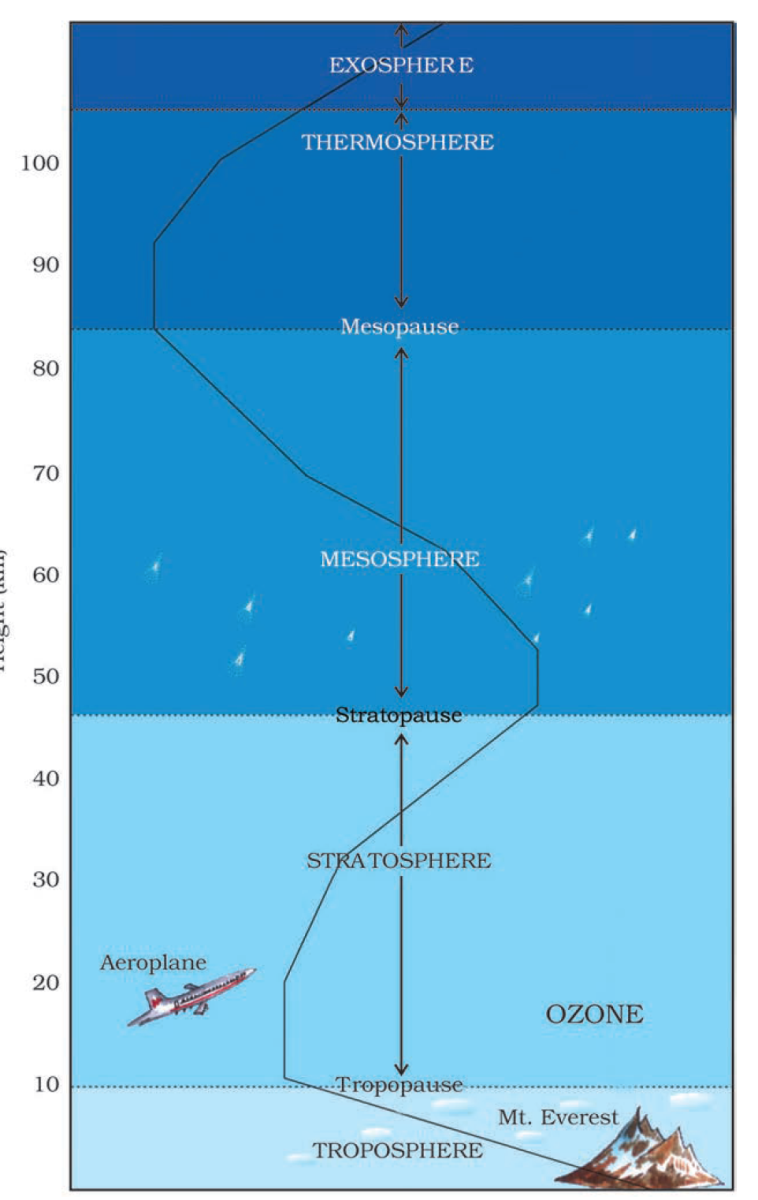
Stratosphere:
  • The stratosphere lies above the troposphere.
  • It extends up to a height of 50km.
  • This layer is almost free from clouds.
  • No weather phenomenon occurs in this layer making conditions most ideal for flying aeroplanes.
  • Stratosphere contains a layer of ozone gas.
  • It protects living beings from the harmful effects of the sun rays.
View full question & answer
Question 173 Marks
Explain does the density of air decrease with the increase in height?
Answer
The air pressure is height at sea level and decrease with height. As we go up the layers of the atmosphere, the pressure falls rapidly. This is because the effect of gravity reduce and the air becomes thinner in the upper layers with heavier gases concentrating in the lower layers.
View full question & answer
Question 183 Marks
Define low and high pressure.
Answer
In areas where temperature is high the air gets heated and rises. This creates a low pressure area.In the area having low temperature the air is cold. It is therefore heavy. Heavy air sinks and creates a high pressure.
View full question & answer
Question 193 Marks
Which is most important layer of the atmosphere?
Answer
Troposphere:
  • Troposphere is the important layer of the atmosphere.
  • Its average height is 13km.
  • It is 8 kilometres on the poles and 18 kilometres on the equator.
  • The air (which living beings breathe) exists here.
  • All the weather phenomena like winds, rainfall, fog, hailstorm etc. occur in this layer.
View full question & answer
Question 203 Marks
How does water vapour lead to precipitation?
Answer
  1. When the water vapour rises, it starts cooling.
  2. The water vapour condenses, causing the formation of droplets of water.
  3. When these droplets of water become too heavy to float in air, they come down as precipitation.
View full question & answer
Question 213 Marks
How did cyclone affect Odisha in October 1999?
Answer
  1. The cyclone in Odisha in October 1999 affected 13 million people, uprooted trees and damaged the houses.
  2. A large number of livestock were killed. Standing crops of paddy, vegetables and fruits were heavily damaged.
  3. Due to salinisation caused by tidal surge, large tract of agricultural land became infertile.
  4. Large number of mangrove forests vanished.
View full question & answer
Question 223 Marks
Briefly write about thermosphere?
Answer
Thermosphere:
  • In thermosphere temperature rises very rapidly with increasing height.
  • Ionosphere is a part of this layer.
  • It extends between 80 and 400km.
  • This layer helps in radio transmission.
  • Radio waves transmitted from the earth are reflected back to the earth by this layer.
View full question & answer
Question 233 Marks
Explain how the oxygen and carbon dioxide balance is maintained in air?
Answer
Green plants use carbon dioxide to make their food and during this process release oxygen:
  • Humans and animals release carbon dioxide and take oxygen from air.
  • The amount of carbon dioxide released by them is equal to amount used by plants to make their food. Hence a balance is maintained.
  • But now the excess of carbon dioxide is released by burning of fuels. The reduction in number of plants upset the balance of gases like carbon dioxide affecting earth’s weather and climate.
View full question & answer
Question 243 Marks
How is nitrogen a constituent of the atmosphere?
Answer
  1. Nitrogen is the most plentiful gas in the air.
  2. When we inhale, we take some amount of nitrogen into our lungs and exhale it.
  3. But plants need nitrogen for their survival.
  4. They cannot take nitrogen directly from the air.
  5. Bacteria, which live in the soil and roots of some plants, take nitrogen from the air and change its form so that plants can use it.
View full question & answer
Question 253 Marks
What is air circulation?
Answer
When air is heated it becomes lighter and goes up. Cold air is denser and heavy that is why it tends to sink down. When hot air rises, cold air from surrounding area rushes there to fill the gap. This is how air circulation takes place.
View full question & answer
Question 263 Marks
What are the different types of winds?
Answer
Winds can be broadly divided into three types.
  • Permanent winds: The trade winds, westerlies and easterlies are the permanent winds. These blow constantly throughout the year in a particular direction.
  • Seasonal winds: These winds change their direction in different seasons. For example: monsoons in India.
  • Local winds: These blow only during a particular period of the day or year in a small area. For example: land and sea breeze and loo.
View full question & answer
Question 273 Marks
What is the relation between temperature and pressure?
Answer
Distribution of air pressure is influenced by the temperature of the area:
  • Where temperature is high the air gets heated and rises. This creates a low pressure area.
  • Low pressure is associated with cloudy skies and wet weather.
  • In areas with low temperature, the air is cold and heavy so, it sinks down. This creates a high pressure area.
  • High pressure is associated with clear and sunny skies.
  • Air always moves from high pressure to low pressure areas.
View full question & answer
Question 283 Marks
Horizontally the distribution air pressure is influenced by temperature by of a place. Explain.
Answer
Horizontally the distribution of air pressure is influenced by temperature of air at a given place. In areas temperature is high the air gets heated and rises, this creates a low- pressure area. In areas having lower temperature, the air is cold. It is therefore heavy. Heavy air skin and creates a high pressure area.
View full question & answer
Question 293 Marks
Why do astronauts wear special protective suits when they go to the moon?
Answer
Astronauts wear special protective space suits filled with air when they go to the moon. If they did not wear these space suits, the counter pressure exerted by the body of the astronauts would make the blood vessels burst. The astronauts would bleed.
View full question & answer
Question 303 Marks
How does nature balance our life? What is the result if this balance is disturbed?
Answer
Green plants use carbon dioxide to make their food and release oxygen. Humans or animals release carbon dioxide. The amount of carbon dioxide released by humans or animals seems to be equal to the amount used by the plants which make a perfect balance. But this balance is disturbed by burning of fuels, which add billions of tons of carbon dioxide in the atmosphere. As a result, the increased volume of carbon dioxide is affecting the earth’s weather and climate.
View full question & answer
Question 313 Marks
Define the term relative humidity.
Answer
The ratio between actual amount of water vapour present in the air at a given temperature and the maximum amount of water vapour that the atmosphere can retain at that temperature is known as relative humidity.
View full question & answer
Question 323 Marks
Write a short note on the distribution of air pressure in atmosphere.
Answer
Air pressure is the pressure exerted by the weight of air on the earth's surface. As we go up the layers of atmosphere, the pressure falls rapidly .The air pressure is highest at the sea level and decreases with height. Horizonally the distribution of air pressure is influenced by temperature of air at a given place. In areas where temperature is high the air gets heated and rises. This creates a low pressure area. In areas having lower temperature, the air is cold, hence, it is heavy. Heavy air sinks and creates a high pressure area.
View full question & answer
Question 333 Marks
Why do jet planes leaves a white trail behind them?
Answer
Jet planes flying in the sky leave a white trail behind them,
  • The moisture from their engines condenses.
  • We see trails of this condensed moisture for sometime when there is no air movement to disturb it.
  • These trails of condensed moisture are actually clouds.
View full question & answer
Question 343 Marks
Write an account of composition of atmosphere.
Answer
Nitrogen and oxygen are two gases which up the bulk of the atmosphere. Carbon dioxide, helium, ozone, argon and hydrogen are found in lesser quantities. Apart from the gases, tiny dust articles are also present in the air. The pie chart gives you the percentage of different constituents of air.
View full question & answer
Question 353 Marks
How is rainfall important for us? What happens when there is excess rain?
Answer
Rainfall is very important for the survival of plants and animals. It brings fresh water to the earth's surface. If rainfall is less, there is water scarcity which sometime causes drought like situation. If there is excess rain, floods take place which make the life of the affected people miserable.
View full question & answer
Question 363 Marks
Discuss how carbon dioxide is responsible for global warming.
Answer
The amount of carbon dioxide released by human or animals seems to be equal to the amount used by the plants which make a perfect balance. However, the balance is upset by burning of fuels, such as coal and oil. Hey add billions of tons of carbon dioxide into the atmosphere each year, as a result, the increased volume of carbon dioxide is affecting the earth’s weather and climate.
View full question & answer
Question 373 Marks
What is wind? Mention its different types.
Answer
Wind is the movement of air from high pressure area to low pressure areas.It is divided into three types:
  1. Permanent winds: The trade winds, westerlies and easterlies are the permanent winds. These blow constantly throughout the year in a particular direction.
  2. Seasonal winds: These winds change their direction in different seasons. For example: monsoons in India.
  3. Local winds: These winds blow only during a particular period of the day or year in a small area. For example: land and sea breeze. Loo is a local wind which hot and dry and blow in the northern plains of India during summers.
View full question & answer
Question 383 Marks
i
Trade Winds
a
Incoming solar energy.
ii
Loo
b
Seasonal wind.
iii
Monsoon
c
Horizontal movement of Air.
iv
Wind
d
Layer of ozone gas.
 
 
e
Permanent wind.
 
 
f
Local wind.
Answer
i
Trade Winds
e
Permanent wind.
ii
Loo
f
Local wind.
iii
Monsoon
b
Seasonal wind.
iv
Wind
c
Horizontal movement of Air.
View full question & answer
Question 393 Marks
Write the main features of Troposphere and Stratosphere.
Answer
Troposphere: This is the most important layer of the atmosphere. Its average height is 13km. The air we breath exists here. Almost all the weather phenomena like rainfall, fog and hailstorm occur in this layer.
Stratosphere: Above the troposphere lies the stratosphere. It extends up to a height of 50km. This layer is almost free clouds and associated weather phenomenon, making condtios most idead for flying aeroplanes. One important feature of stratosphere is that contains a layer of ozone gas. We have just learnt how it protects us from the harmful effect of the sun rays.
View full question & answer
Question 403 Marks
How does nature maintain a balance of oxygen and carbon dioxide in the atmosphere? What is the result of this balance get disturbed?
Answer
Oxygen is the second most plentiful gas in the air. Humans and animals take oxygen from the air as they breathe. Green plants produce oxygen during photosynthesis. In this way oxygen content in the air remains constant. If we cut trees then this balance gets disturbed. Carbon dioxide is another important gas. Green plants use carbon dioxide to make their food and release oxygen. Humans or animals release carbon dioxide. The amount of carbon dioxide released by humans or animals seems to be equal to the amount used by the plants which make a perfect balance. However, the balance is upset by burning of fuels, such as coal and oil. They add billions of tons of carbon dioxide into the atmosphere each year. As a result, the increased volume of carbon dioxide is affecting the earth’s weather and climate.
View full question & answer
SHORT ANSWER QUESTIONS(3 Mark) - Social Science STD 7 Questions - Vidyadip