Questions · Page 1 of 2

SHORT ANSWER QUESTIONS(3 Mark)

🎯

Test yourself on this topic

50 questions · timed · auto-graded

Question 13 Marks
Write a short note on Shankara and his teachings.
Answer
Shankara was one of the most popular religious philosophers of India born in Kerala. He was the expounder of the concept of Advaita which is the doctrine of oneness of the individual soul and the supreme god. He was a fully developed Yogi, Jnani and Bhakta. He believed that Brahman alone is real, this world is unreal. He considered the world as Maya or an illusion. He preached renunciation of the world and adoption of the path of knowledge.
View full question & answer
Question 23 Marks
How did Shiva, Vishnu and Durga emerge as supreme deities?
Answer
  1. Shiva, Vishnu and Durga came to be worshipped as supreme deities through elaborate rituals.
  2. At the same time, Gods and Goddesses worshipped in different areas came to be identified with Shiva, Vishnu or Durga.
View full question & answer
Question 33 Marks
State the main contribution of the Chola and Pandya kings for the growth of the Bhakti movement.
Answer
The Chola and the Pandyas built many temples around many shrines between the tenth and twelfth centuries. The saint- poets visited these shrines and sang songs of Bhakti. It strengthened the links between the Bhakti tradition and temple worship.
View full question & answer
Question 43 Marks
What were the major ideas expressed by Kabir? How did he express these?
Answer
Kabir’s teachings were based on a complete, indeed vehement, rejection of the major religious traditions. His teachings openly ridiculed all forms of external worship of both Brahmanical Hinduism and Islam, the pre-eminence of the priestly classes and the caste system. Kabir believed in a formless Supreme God and preached that the only path to salvation was through bhakti or devotion. He expressed these in verses called sakhis and pads.
View full question & answer
Question 53 Marks
Why did people turn to Buddhism and Jainism during the medieval period?
Answer
Many people were not satisfied with the notion that noble and high caste of human beings come by birth. These two religions helped them overcome notion that high caste comes by birth. That was why most of the people started following Buddhism and Jainism.
View full question & answer
Question 63 Marks
What is a dargahl Why did people throng there?
Answer
  • Often people attributed sufi masters with miraculous powers that could relieve others of their illness and troubles.
  • The tomb or dargah of a Sufi saint became a place of pilgrimage. Thousands of people of all faiths thronged this place.
View full question & answer
Question 73 Marks
Write a short note on Shankara.
Answer
Shankara, one of the most influential philosophers of India, was born in Kerala in the eighth century. He was an advocate of Advaita or the doctrine of the oneness of the individual soul and the Supreme God which is the Ultimate Reality. He taught that Brahman, the only or Ultimate Reality, was formless and without any attributes. He considered the world around us to be an illusion or maya, and preached renunciation of the world and adoption of the path of knowledge to understand the true nature of Brahman and attain salvation.
View full question & answer
Question 83 Marks
“Mirabai rejected the rigidity of caste system.” Discuss.
Answer
Mirabai was a Rajput princess married into the royal family of Mewar in the sixteenth century. Mirabai became a disciple of Ravidas, a saint from a caste considered “untouchable”. She was devoted to Krishna and composed innumerable bhajans expressing her intense devotion. Her songs also openly challenged the norms of the “upper” castes and became popular with the masses in Rajasthan and Gujarat.
View full question & answer
Question 93 Marks
Who were Nayanars and Alvars?
Answer
Between the 7th and 9th century, a new religious movement led by Nayanars (devotees of Shiva) and Alvars (devotees of Vishnu) who came from all castes including untouchables like the Pulaiyars and the Panars gained momentum.
View full question & answer
Question 103 Marks
Why was the Mughal emperor Jahangir hostile to the Sikh community? How did the Sikh movement gain momentum?
Answer
By the beginning of the 17th century the town of Ramdaspur, Amritsar had developed around the central Gurudwara known as Harmandar Sahib, the Golden Temple. It was virtually self-governing body and the modem historians refer to the early 17th century Sikh community as 'a state within state'. This made the Mughal emperor Jahangir hostile to the Sikh community. He looked upon them as a potential threat and he ordered the execution of Guru Aijan in 1606.
It is from this time the Sikh movement began to gain momentum. It was a development which culminated, in the institution of the Khalsa by Guru GobindSingh in 1699.
View full question & answer
Question 113 Marks
For either the Virashaivas or the sants of Maharashtra, discuss their attitude towards caste.
Answer
Attitude of the Virashaivas towards caste: They believed in the equality of all human beings. They were against Brahmanical ideas about caste and the treatment of women. They wished for a society where people of all backgrounds could live in harmony without any feelings of high and low, rich and poor.
View full question & answer
Question 123 Marks
Why Mughal emperor Jahangir looked upon Sikh community as a potential threat?
Answer
By the beginning of the seventeenth century the town of Ramdaspur (Amritsar) had developed around the central Gurdwara called Harmandar Sahib (Golden Temple). It was virtually self-governing and modern historians refer to the early seventeenth century Sikh community as ‘a state within the state’. The Mughal emperor Jahangir looked upon them as a potential threat.
View full question & answer
Question 133 Marks
How did dargah become a place of pilgrimage?
Answer
Often people attributed Sufi masters with miraculous powers that could relieve others of their illness and troubles. The tomb or dargah of a Sufi saint became a place of pilgrimage to which thousands of people of all faiths thronged.
View full question & answer
Question 143 Marks
Who was Guru Nanak? What did he start?
Answer
  1. Baba Guru Nanak (1469–1539) was born at Talwandi.
  2. He started a regular worship that consisted of the singing of his own hymns which was followed by his followers.
  3. Irrespective of caste, creed or gender, his followers ate together in the common kitchen called langar.
View full question & answer
Question 153 Marks
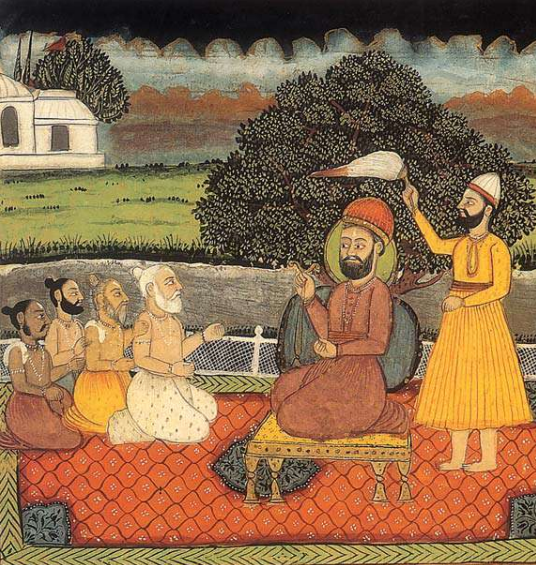
This is a picture of Baba Guru Nanak as a young man, in discussion with holy men. Answer the following questions related to Guru Nanak:
  1. Where was Baba Guru Nanak born?
  2. Who was appointed by Guru Nanak as his successor?
  3. When did Baba Guru Nanak die?
Answer
  1. Baba Guru Nanak was born in 1469 at Tailwind (Nankana Sahib in Pakistan).
  2. Baba Guru Nanak was born in 1469 at Tailwind (Nankana Sahib in Pakistan).
  3. Baba Guru Nanak died in 1539.
View full question & answer
Question 163 Marks
What did Tulsidas conceive?
Answer
  1. Tulsidas conceived God in the form of Rama.
  2. Tulsidas’s composition, the Ramcharitmanas written in Awadhi (a language of Eastern UP) is important both as an expression of his devotion and as a literary work.
View full question & answer
Question 173 Marks
Examine Kabir as a great saint of Sant movement.
Answer
  1. The most famous teacher of the Sant movement was Kabir.
  2. These were the main objectives of his teachings:-
  • To achieve inward spiritual bliss.
  • Condemnation of empty rituals.
  • To foster harmony between Hinduism and Islam.
  1. He believed in one formless God, rejected both Vedas and Quran and the supremacy of the Brahmans and Mullahs.
View full question & answer
Question 183 Marks
What was the attitude of Alvars and Nayanars towards various cults in India?
Answer
  1. The Alvars and Nayanars claimed that their compositions were as important as the Vedas.
  2. They held that their text was as significant as the four Vedas in Sanskrit that was cherished by the Brahmans.
  3. The images of their saints are worshipped side by side with those of Vishnu and his various incarnations (avtars).
  4. The Nayanars composed their devotional songs with the highest spiritual sentiments and set up Shaivism on a strong footing.
View full question & answer
Question 193 Marks
What were the major teachings of Baba Guru Nanak?
Answer
Baba Guru Nanak emphasized on the worship of one God. According to him, caste, creed or gender was irrelevant for attaining liberation. Liberation for him was the pursuit of an active life with social commitment. He gave the motto of nam, dan and isnan, which meant right worship, welfare of others and purity of conduct.
View full question & answer
Question 203 Marks
How did Sufism emerge strong in India?
Answer
  1. A large number of Sufis from Central Asia settled in Hindustan from the 11th century onwards.
  2. This process was strengthened with the establishment of the Delhi Sultanate, when several major Sufi centres developed all over the subcontinent.
View full question & answer
Question 213 Marks
How did Sufis preach?
Answer
  1. The Sufi masters held their assemblies in their Khanqahs or hospices.
  2. Devotees of all descriptions including members of the royalty and nobility, and ordinary people flocked to these khanqahs.
  3. They discussed spiritual matters, sought the blessings of the saints in solving worldly problems, or simply attended the music and dance sessions.
View full question & answer
Question 223 Marks
Who was Ramanuja? What are the main points of his preachings?
Answer
Ramanuja was a Bhakti saint. He was bom in Tamil Nadu in the 11th century. He was deeply influenced by the Alvars. The main points of his preachings are:
  • Ramanuja taught people that the best means of attaining salvation was through intense devotion to Vishnu. Vishnu in His grace helps the devotee to attain the bliss of union with Him.
  • He propounded the doctrine of Vishishtadvaita or qualified oneness in that the soul even when united with the Supreme God remained distinct.
View full question & answer
Question 233 Marks
How did people of many groups turn to the teachings of the Buddha and the Jainas?
Answer
Many people were uneasy with the idea of gods and goddesses:
  • They turned to the teachings of the Buddha or the Jainas.
  • According to them it was possible to overcome social differences and break the cycle of rebirth through personal effort.
  • Other people felt attracted to the idea of a Supreme God who could relieve them of the evils.
View full question & answer
Question 243 Marks
Describe the teaching of Saint Kabir.
Answer
  1. Kabir belived in devotion or Bhakt towards the supreme soul.
  2. He refused the Brahamanical nnorms and Islamic mysticism.
  3. He preshed the path of one god.
  4. He expressed his ideas in verses called sakhis and dohas.
  5. He was of the view that formless soul is always in search for devotion.
View full question & answer
Question 253 Marks
What did the Marathi saint poets believe in?
Answer
  1. The Marathi, saint poets rejected all forms of rituals, outward display of piety and social differences based on birth.
  2. They even rejected ideas of renunciation and preferred to live with their families. Earning their livelihood like any other person while humbly serving fellow human beings in need. The Bhakti movement now focused on humanism.
View full question & answer
Question 263 Marks
Describe Virashaivism of Basavanna.
Answer
Basavanna's Virashaivism:The connection between the Tamil Bhakti movement and temple worship is best represented in the Virashaiva movement initiated by Basavanna and his companions like Allama Prabhu and Akkamahadevi.
This movement began in Karnataka in the mid-twelfth century.
  • The Virashaivas argued strongly for the equality of all human beings and against Brahmanical ideas about caste and the treatment of women.
  • They were also against all forms of ritual and idol worship.
View full question & answer
Question 273 Marks
Write a short note on Nathpanthis, Siddhas and Yogis.
Answer
A number of religious groups criticized the rituals and other aspects of conventional religion and preached the social order using simple logical arguments. They advocated renunciation of the world. To achieve the salvation, they advocated intense training of the mind and body through practices like yogasanas. They became popular among low castes in North India.
View full question & answer
Question 283 Marks
How do we now know about the teachings of Guru Nanak?
Answer
His (Guru Nanak's) teachings were compiled by Guru Angad with certain additions. The writings of Guru Angad and his three successors, were compiled by Guru Aijan. It is now known as Guru Granth Sahib.
  • We know his teachings as nam-japna, kirt-kama and vand-chhakna which underlines the importance of right belief and worship, honest living and helping others.
  • His idea of equality had social and political implications.
View full question & answer
Question 293 Marks
What were the major beliefs and practices of the Sufis?
Answer
They rejected outward religiosity, elaborate rituals and codes of behavior demanded by Muslim religious scholars. They also, like the Nathpanthis, Siddhas and Yogis, believed that the heart can be trained to look at the world in a different way. They advocated devotion to God, union with God just like a lover seeks his beloved with a disregard for the world and compassion towards all fellow human beings Their practices were: Zikr(chanting of a name or sacred formula), Contemplation, Sama(singing), Raqs(dancing), Discussion of parables, Breath control, etc.
View full question & answer
Question 303 Marks
Who were the Nayanars and Alvars? Write about them in brief.
Answer
The Nayanars and Alvars led religious movements in south India during seventh to ninth centuries. The Nayanars were devotees of Shiva while the Alvars were the devotees of Vishnu. They came from all castes including those considered 'untouchable' like the Pulaiyar and the Panars. They preaohe gjgdent love of Shiva or Vishnu as the path to salvation. They went from place to place composing beautiful poems in praise of the deities enshrined in the villages they visited and set them to music. There were 63 Nayanars who belonged to different caste backgrounds. There were 12 Alvars who came from equally divergent backgrounds.
View full question & answer
Question 313 Marks
Briefly write the teachings of Islam.
Answer
Islam propagated strict monotheism or submission to one God:
  • It rejected idol worship.
  • Simplified the rituals of worship into collective prayers.
  • They developed holy law Shariat.
View full question & answer
Question 323 Marks
What were the teachings of the saints of Maharashtra?
Answer
These saints rejected all forms of ritualism, outward display of piety and social differences based on birth. In fact they even rejected the idea of renunciation and preferred to live with their families, earning their livelihood like any other person, while humbly serving fellow human beings in need.
View full question & answer
Question 333 Marks
Briefly write about Kabir.
Answer
Kabir lived in about 15th-16th century. Brought up in a Julaha (weaver ) family he lived near the city of Benares. His collection of verses known as sakhis and pads are sung by wandering bhajan singers. Some of these are part of Granth Sahib, Panch Vani and Bijak.
View full question & answer
Question 343 Marks
How did Mirabai express her devotion for Lord Krishna?
Answer
  1. Mirabai was a devotee of Lord Krishna.
  2. For expressing her intense devotion, she composed many bhajans.
  3. Mirabai’s bhajans openly challenged the norms of upper castes and also became popular with masses.
View full question & answer
Question 353 Marks
Briefly write about the Nayanar and Alvar saints.
Answer
There were 63 Nayanars belonging to different castes- potters, peasants, 'untouchable', hunters, soldiers, Brahmanas etc. The best known were Manikkavasagar, Appar, Sambandar and Sundarar. Their songs are compiled in Tevaram and Tiruvacakam.
There were 12 Alvars from divergent backgrounds. The most known were Periyalar, his daughter Andal ana Nammalvar. Their songs were compliled in Divya Prabandham.
View full question & answer
Question 363 Marks
Explain the teachings of Guru Nanak.
Answer
The ideas of Guru Nanak had a huge impact on people from the very beginning. He emphasized the importance of worship of one God. He insisted that caste, creed or gender was irrelevant for attaining liberation. He himself used the terms nam, dan and isnan for the essence of his teaching, which actually meant right worship, welfare of others and purity of conduct. His teachings are now remembered as nam-japna, kirt-karna and vand-chhakna, which also underline the importance of right belief and worship, honest living, and helping others.
View full question & answer
Question 373 Marks
How did Sufi saints promote universal brotherhood?
Answer
  1. The Sufi saints preached love of mankind and universal brotherhood.
  2. They were against all distinctions of caste, colour, creed and sect.
  3. The Hindus as well as the Muslims were offered food prepared in one and the same kitchen.
View full question & answer
Question 383 Marks
Why did people turn to the teachings of the Buddha or the Jainas during the medieval period?
Answer
The belief that social privileges came from birth in a “noble” family or a “high” caste was the subject of many learned texts. Many people were uneasy with such ideas and turned to the teachings of the Buddha or the Jainas according to which it was possible to overcome social differences and break the cycle of rebirth through personal effort.
View full question & answer
Question 393 Marks
What were the teachings of Ramanuja?
Answer
Ramanuja was born in Tamil Nadu in the eleventh century. He was deeply influenced by the Alvars. He was an exponent of the doctrine of Vishistadavita or qualified non- dualism. He advocated that the best means of attaining salvation was through intense devotion to Vishnu. According to Ramanuja's teachings, Lord Narayana or Bhagavan is the Supreme Being. He believed that Vishnu helped devotees to attain the bliss of union with Him. Later his teachings inspired the Bhakti cult in North India.
View full question & answer
Question 403 Marks
What were dharmsal?
Answer
The places where Sikh congregation and religious gatherings of the followers of Guru Nanak were held were called Dharamsalas. These were also the places for feeding the poor. Eventually, every Sikh home became a Dharamsala. Now it is known as Gurdwara.
View full question & answer
Question 413 Marks
What were the evils prevalent in the Hindu religion?
Answer
  1. The idea that all human beings are not equal at birth.
  2. Likewise, the belief that social privileges came from birth in a noble family or a higher caste.
View full question & answer
Question 423 Marks
What did Sufis believe in? What were their methods?
Answer
  1. The Sufis believed that the heart can be trained to look at the world in a different way.
  2. They developed the methods of training using zikr (chanting of a name or sacred formula), contemplation, sama (singing), raqs (dancing), discussion of parables, breathe control, etc. under the guidance of a pir or master.
View full question & answer
Question 433 Marks
How people of the subcontinent used to perform religious rituals or worship?
Answer
People of the subcontinent used to perform rituals or worship by singing bhajans, Kirtans, qawwalis or by Jap (repeating the name of God and Goddess in silence). The devotion to God has given the legacy of bhakti and sufi movements since 8th century.
View full question & answer
Question 443 Marks
How did the idea of one supreme God evolve?
Answer
  1. One attractive idea was the idea of a supreme God who could relieve humans from such bondage of birth and rebirth, if approached with devotion or Bhakti.
  2. This idea of Bhagvadgita grew popular in this era.
View full question & answer
Question 453 Marks
Who ordered the execution of Guru Arjan and why?
Answer
The Mughal emperor Jahangir ordered the execution of Guru Arjan Dev. By the beginning of the seventeenth century, the town of Ramdaspur (Amritsar) developed around the central Gurdwara, also called Harmandar Sahib (Golden Temple). It was like a state with self-governing. The Mughal emperor saw this development as a potential threat against his rule. So he ordered the execution.
View full question & answer
Question 463 Marks
Why did Bhakti Movement become popular in the $15^{th}$ Century CE?
Answer
  • Due to foreign invasion.
  • Many invaders spread their culture forcibly in India.
  • There was a wave of enlightenment perched common people.
  • A lot of poetry, dohas and bhajans became popular among masses which contribute spread of Bhakt Movement.
View full question & answer
Question 473 Marks
How did the songs of the saints become popular?
Answer
  • A unique feature of most of the saints is that their works were composed in regional languages and could be sung.
  • They became immensely popular and were handed down orally from generation to generation.
  • Usually the poorest, most deprived communities and women transmitted these songs, often adding their own experiences.
  • Thus these songs are as much a creation of the saints as of generations of people who sang them. They have become a part of our living popular culture.
View full question & answer
Question 483 Marks
How did the followers of Guru Nanak increase?
Answer
  • The number of Guru Nanak's followers increased through the sixteenth century under his successors.
  • They belonged to a number of castes but traders, agriculturists, artisans and craftsmen predominated. This may have something to do with Gum Nanak's insistence that his followers must be householders and should adopt productive and useful occupations.
  • They were also expected to contribute to the general funds of the community of followers.
View full question & answer
Question 493 Marks
What were the main reforms brought about by Bhakti and Sufi Movements?
Answer
  1. Bhakt and Sufi Movement gained popularity among low caste of the society.
  2. Bhakt saints rejected the idea of caste, place of birth andher prevalent social divisions.
  3. Both of them were aimed at attainment of salvation through devotion to one god.
  4. Sufi saints preached the path of love and attained of salvation.
  5. Social discrimination were put to an end by many scholars and religious leaders.
View full question & answer
Question 503 Marks
What measures were adopted by the Sufi saints to seek God?
Answer
Sufis rejected the elaborate rituals and codes of behaviour. They sought God like a lover who seeks his beloved, not caring for the world.
  • They composed poems expressing their feelings. Rich literature of fables anecdotes developed.
  • Sufies like Ghazzali, Rumi and Sadi from Central Asia believed that heart can be trained to look at the world in a different way.
  • They developed Elaborate methods of training using Zikr (chanting of a name), sama (singing), raqs ( dancing), contemplation, discussions, breath control etc.
  • Thus emerged the Silsilas genealogy of Sufi masters. Each of them followed a different tariqa (method) of ritual practice.
View full question & answer