Questions

LONG ANS. QUESTIONS(5 Mark)

🎯

Test yourself on this topic

10 questions · timed · auto-graded

Question 15 Marks
Sea water continuously strike at the rocks and its formation its formation keeps changing. Comment.
Answer
The erosion deposition of the sea waves gives rise to coastal landforms. Seawaves continuously strike at the rocks. Crake develop. Over time they become larger and wider. Thus, hollow like caves on the rocks. They are called sea caves. As these cavities become bigger and bigger only the roof the caves remain, thus forming sea arches. Further, erosion breaks the roof and only walls are left. These wall like features are called stacks. The steep rocky coast rising almost vertically above sea water is called sea cliff. The sea waves deposit sediments along the shores forming beaches.
View full question & answer
Question 25 Marks
Suggest some safety measures one should take during and after the earthquake.
Answer
During an Earthquake:
  • Sage Spot – Under a kitchen counter, table or desk, against an inside corner or wall.
  • Stay Away from – Fire places, areas around chimney, Windows that shatter including mirrors and pictures frames.
  • Be Prepared – Spread awareness amongst your friends your friends and family member and face any disaster confidently.
After an Earthquake:
  • Check water, gas, and electric lines for damage. If any are damaged, shut of the valves.
  • Stay away from damaged areas.
  • If you’re at school or work, follow the emergency plan or the instructions of the person in charge.
View full question & answer
Question 35 Marks
Explain the work of a river.
Answer
The running water in the river erodes the landscape. When the river tumbles at steep angle over very hard rocks or down a deep valley side it forms a waterfall. While entering the plain the river twists and turns and forms large bends which are known as meanders. Due to continuous erosion and deposition along the sides of the meander, the ends of the meander loop come closer and closer. In due course of time the meander loop cuts off from the river and forms a cut-off lake, which is also called ox-bow lake. Sometimes, the river overflows its banks causing flood in the neighboring areas. As it floods, it deposits layers of fine soil and other material called sediments along its banks. As a result- fertile floodplain is formed. The raised banks are called levees.
As the river approaches the sea, the speed of the flowing water decreases and the river begins to break up into several streams known as distributaries. Then a time comes when the river becomes very slow and it begins to deposit its load. Each distributary forms its own mouth. The collection of sediments from all the mouths forms a delta, which is a triangular landmass.
View full question & answer
Question 45 Marks
Examine the features of the work of a wind.
Answer
The features of work of wind are as follows:-
  1. Mushroom rocks:- An active agent of erosion and deposition in the deserts is wind. The rocks in the shape of a mushroom seen in desert are called mushroom rocks.
  2. Sand dunes:- When the wind blows, it lifts and transports sand from one place to another. When it stops blowing, the sand falls and gets deposited in low, hill-like structures. These are called sand dunes.
  3. Loess:- When the grains of sand are very fine and light, the wind can carry it over very long distances. When such sand is deposited in large areas, it is called loess.
View full question & answer
Question 55 Marks
Give an account of the work of sea waves.
Answer
Work of sea waves:
  1. The erosion and deposition of the sea waves gives rise to coastal landforms. Sea waves continuously strike at the rocks. Cracks develop. Over time they become larger and wider. Thus, hollow like caves are formed on the rocks. They are called sea caves.
  2. As these cavities become bigger and bigger only the roof of the caves remain, thus forming sea arches.
  3. Further, erosion breaks the roof and only walls are left. These walls like features are called stacks.
  4. The steep rocky coast rising almost vertically above sea water is called sea cliff.
  5. The sea waves deposit sediments along the shores forming beaches.
View full question & answer
Question 65 Marks
Examine the features formed due to the work of a river.
Answer
The work of a river creates the following features:-
  1. Waterfall:- The running water in the river erodes the landscape. When the river tumbles at a steep angle over hard rocks or down a steep valleyside, it forms a waterfall.
  2. Meanders:- If the river enters the plain, it twists and turns, forming large bends called meanders.
  3. Oxbow lake:- Due to continuous erosion and deposition along the sides of the meander, the ends of the meander loop come closer and closer. In due course of time, the meander loop cuts off from the river and forms a cut-off lake called oxbow lake.
  4. Floodplain:- When the river overflows its banks, it leads to flooding of the neighbouring area. As it floods, it deposits layers of fine soil and sediments along its banks. They form a fertile plain called floodplain.
  5. Levees:- The raised banks along the river are called levees.
  6. Distributaries:- When the river approaches the sea, the speed of the flowing water decreases and the river begins to break up into a number of streams called distributaries.
  7. Delta:- The river becomes so slow that it begins to deposit its load. Each distributary forms its own mouth. The collection of sediments from all the mouths forms a delta.
View full question & answer
Question 75 Marks
Write a note on the work of sea-waves.
Answer
Work of Sea Waves:
  • Erosion and deposition of the sea waves form coastal land forms.
  • Sea waves continuously strike at the rocks.
  • Cracks develop.
  • In course of time they become larger and wider.
  • Hollow like caves are formed on the rocks.
  • They are called sea caves.
  • As caves become bigger and bigger only the roofs of the caves remain. This leads to formation of Sea arches.
  • Continuous erosion breaks the roofs and only walls are left.
  • These wall- like features are called stacks.
  • The steep rocky coast rising almost vertically above sea water is called sea cliff.
  • The sea waves deposit sediments along the shores.
  • This leads to formation of sea beaches.
View full question & answer
Question 85 Marks
What are the two types of the earth's forces?
Answer
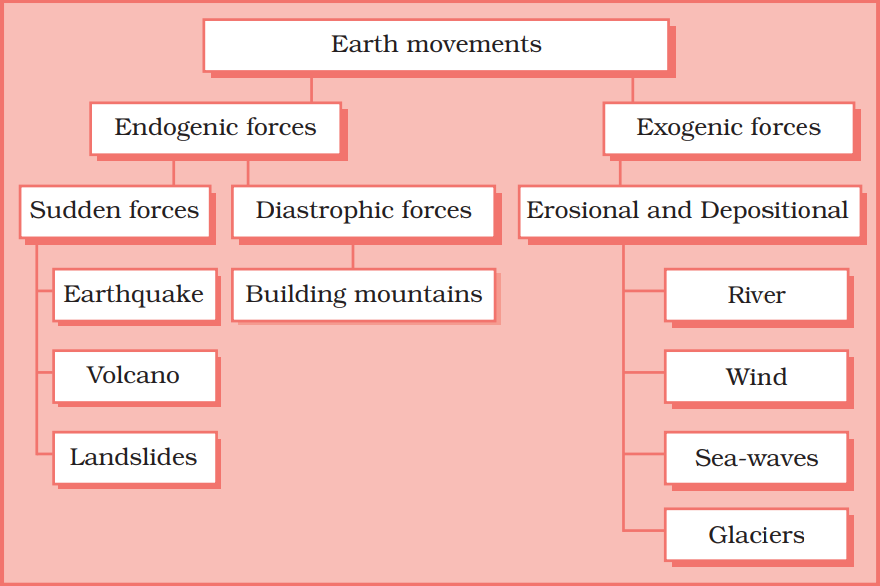
  • The earth's movements are divided on the basis of the forces which cause them.
  • The forces which act in the interior of the earth are called endogenic forces.
  • The forces that work on the surface of the earth are called exogenic forces.
  • Endogenic forces sometimes produce sudden movements.
  • At other times they produce slow movements.
  • Sudden movements are earthquakes and volcanoes.
  • They cause mass destruction over the surface of the earth.
​​​​​​​
View full question & answer
Question 95 Marks
i
Glacier
a
Sea shore.
ii
Meanders
b
Mushroom rock.
iii
Beach
c
River of ice.
iv
Sand dunes
d
Rivers.
v
Waterfall
e
Vibrations of earth.
vi
Earthquake
f
Sea cliff.
 
 
g
Hard bed rock.
 
 
h
Deserts.
Answer
i
Glacier
c
River of ice.
ii
Meanders
d
Rivers.
iii
Beach
a
Sea shore.
iv
Sand dunes
h
Deserts.
v
Waterfall
f
Sea cliff.
vi
Earthquake
e
Vibrations of earth.
View full question & answer
Question 105 Marks
Describe the work of a river.
Answer
Work of a River:
  • Running water in the river erodes the landscape.
  • When the river tumbles at steep angle over very hard rocks or down a steep valley side, it forms a waterfall.
  • When the river enters the plain it twists, turns and forms large bends. These bends are known as meanders.
Due to continuous erosion and deposition along the sides of the meander, the ends of the meander loop come closer and closer.
  • In due course of time the meander loop cuts-off from the river and forms a cut-off lake.
  • It is called an ox-bow lake.
  • At times the river overflows its banks.
  • This leads to the flooding of the neighbouring areas.
  • The flood water deposits layers of fine soil and other material.
  • They are called sediments, along its banks.
  • This leads to the formation of a flat fertile land called a flood plain.
  • The raised banks are called levees.
As the river approaches the sea, the speed of the running water decreases.
  • The river begins to break up into a number of streams. They are called distributaries.
  • Now the river becomes so slow that it begins to deposit its load.
  • Each distributary forms its own mouth.
  • The collection of sediments from all the mouths forms a delta, the triangular shaped land mass.
View full question & answer
LONG ANS. QUESTIONS(5 Mark) - Social Science STD 7 Questions - Vidyadip