Questions

LONG ANS. QUESTIONS(5 Mark)

🎯

Test yourself on this topic

6 questions · timed · auto-graded

Question 15 Marks
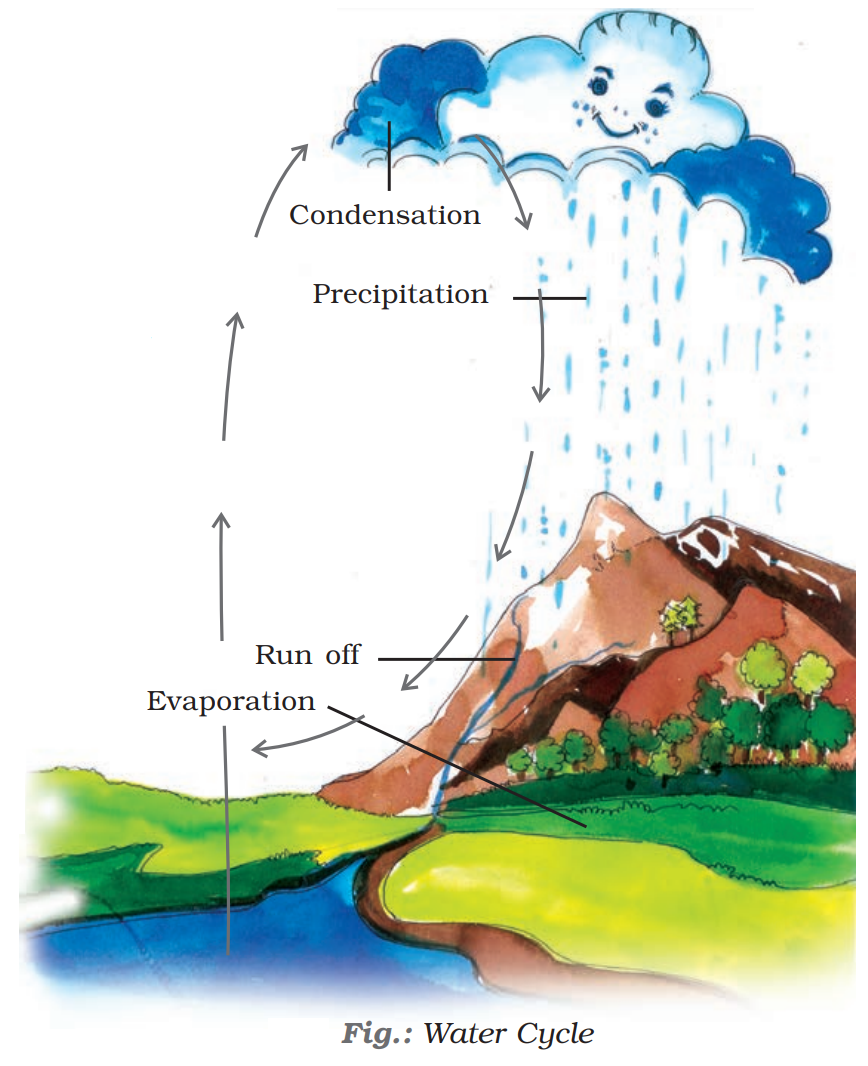
Explain water cycle with a neat and labelled diagram.
Answer
The sun's heat causes evaporation of water, flowing down to stream or drains into water vapour. When the water vapour cools down, it condenses and forms clouds. These clouds, when become too heavy to float, start falling on the land or sea in the form of rain, snow or sleet. Thus, the process by which water continuously changes its form and circulates between oceans, atmosphere and land is known as the water cycle.
View full question & answer
Question 25 Marks
What is tsunami? Explain with the help of an example.
Answer
  1. During a storm, the winds blowing at a very high speed form huge waves.
  2. These waves can cause tremendous destruction.
  3. An earthquake, a volcanic eruption or underwater landslide can shift large amounts of ocean water. As a result, a huge tidal wave called tsunami, that may be as high as 15m, is formed.
  4. The largest tsumani ever measured was 150m high.
  5. These waves travel at a speed of more than 700km per hour.
  6. The tsunami of 2004 caused wide spread damage in the coastal areas of India.
  7. The Indira Point in the Andaman and Nicobar Islands got submerged after the tsunami.
View full question & answer
Question 35 Marks
How do we classify ocean movements? Explain.
Answer
  • When the water on the surface of the ocean rises and falls alternately, they are called waves. Waves are formed when winds scrape across the ocean surface. The stronger the wind blows, the bigger the wave becomes.
  • The rhythmic rise and fall of ocean water twice in a day is known as a tide. Tides may be high or low. It is high tide when water covers much of the shore by rising to its highest level. It is low tide when water falls to its lowest level and recedes from the shore. Tides are caused due to the strong gravitational pull exerted by the sun and moon on the earth's surface. High tides help in navigation and fishing. The rise and fall of water due to tides is being used to generate electricity in some places.
  • Ocean currents. These are streams of water flowing constantly on the ocean surface in definite directions. The ocean currents may be warm such as the Gulf Stream and cold such as the Labrador Ocean current. The areas where the warm and cold currents meet provide the best fishing ground of the world. For example, seas around Japan and the eastern Coast of North America.
View full question & answer
Question 45 Marks
Explain the various types of ocean currents with example.
Answer
  1. The ocean currents may be warm or cold.
  2. Generally, the warm ocean currents originate from the equator and move towards the poles.
  3. The cold currents carry water from polar or higher latitudes to tropical or lower latitudes.
  4. The Labrador Ocean current is a cold current while the Gulf Stream is a warm current.
View full question & answer
Question 55 Marks
What is atmospheric pressure? Explain the relationship of temperature and pressure.
Answer
  • Air pressure is the pressure exerted by the weight of air on the Earth’s surface.
  • Air tends to exert a force on us but we don’t feel it because the air presses us on all sides and our body exerts counter pressure.
  • Atmospheric pressure is maximum at the sea level (1013.25 millibar), but it decreases with increase in height.
  • There is an inverse relationship between temperature and pressure.
If temperature is high then pressure is low. Atmospheric pressure also gets affected by the following factors:-
  1. Temperature:- Horizontally, the distribution of air pressure is influenced by temperature of air at a given place. Due to intense sunrays, surface gets heated which also heats the overlying air. After heating, the air expands in volume and becomes lighter in weight and rises up due to which low pressure area is created.
  2. Altitude:- As we move higher from the sea level, the temperature goes on decreasing. At higher altitudes air is cold. Cold air is heavy. Heavy air sinks and creates high pressure. Air moves from high pressure areas to low pressure areas.
View full question & answer
Question 65 Marks
Why was the Tsunami of December 26, 2004 very devastating?
Answer
  • The Tsunami that ravaged the South and South-east Asian coasts in December 2004 was the most devastating Tsunami in the last several hundred years.
  • The large damage caused to life and property was primarily a result of the following:
  • lack of monitoring,
  • the early warning systems, and
  • lack of knowledge among the coast dwellers of the Indian ocean.
  • The first indication that Tsunami is approaching was the rapid withdrawal of water from the coastal region.
  • It was followed by destructive wave.
  • When this happened on the coast, instead of people going to high ground, they started assembling at the coast to view the miracle.
  • It resulted in a large casualty of curious onlookers when the gigantic wave-tsunami struck.
View full question & answer