Questions

M.C.Q. [1 Marks Each]

🎯

Test yourself on this topic

7 questions · timed · auto-graded

MCQ 11 Mark
Each interior angle of a polygon is $135. $ How many sides does it have$?$
  • A
    $10$
  • $8$
  • C
    $6$
  • D
    $5$
Answer
Correct option: B.
$8$
Interior angle $=\frac{180(\text{n}-2)}{\text{n}}$
$\Rightarrow135=\frac{180(\text{n}-2)}{\text{n}}$
$\Rightarrow135\text{n}=180\text{n}-360$
$\Rightarrow360=180\text{n}-135\text{n}$
$\Rightarrow\text{n}=8$
It has $8$ sides.
View full question & answer
MCQ 21 Mark
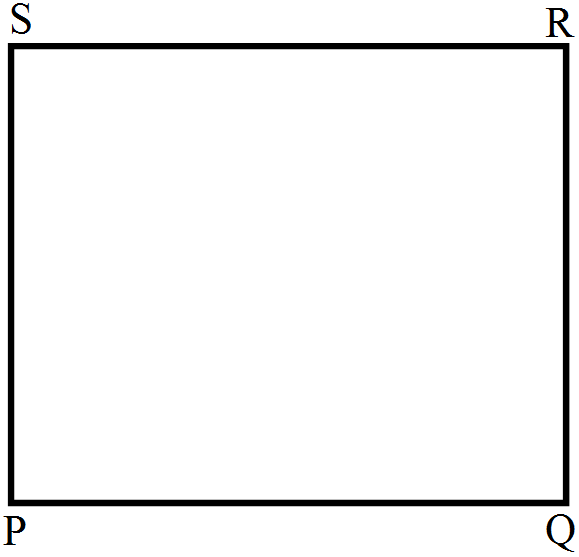
In a square $PQRS,$ if $PQ = (2x + 3)cm$ and $QR = (3x - 5)cm$ then:
  • A
    $x = 4$
  • B
    $x = 5$
  • C
    $x = 6$
  • $x = 8$
Answer
Correct option: D.
$x = 8$

All sides of a square are equal.

$PQ = QR$
$(2x + 3) = (3x - 5)$
$⇒ 2x - 3x = -5 - 3$
$⇒ x = 8\ cm$
View full question & answer
MCQ 31 Mark
How many diagonals are there in a hexagon$?$
  • A
    $6$
  • B
    $8$
  • $9$
  • D
    $10$
Answer
Correct option: C.
$9$
Hexagon has six sides.
Number of diagonals $=\frac{\text{n}(\text{n}-3)}{2}$ (where n is the number of sides)
$=\frac{6(6-3)}{2}$
$=9$
View full question & answer
MCQ 41 Mark
The length of a rectangle is $8\ cm$ and each of its diagonals measures $10\ cm.$ The breadth of the rectangle is:
  • A
    $5\ cm$
  • $6\ cm$
  • C
    $7\ cm$
  • D
    $9\ cm$
Answer
Correct option: B.
$6\ cm$
 Let the breadth of the rectangle be $x\ cm.$
Diagonal $= 10\ cm$
Length $= 8\ cm$
The rectangle is divided into two right triangles.
Diagonal$^2=$ Length$^2 +$ Breadth$^2$
$ 10^2=8^2+x^2 $
$ 100-64=x^2 $
$ x^2=36 $
$x = 6\ cm$
Breadth of the rectangle $= 6\ cm$
View full question & answer
MCQ 51 Mark
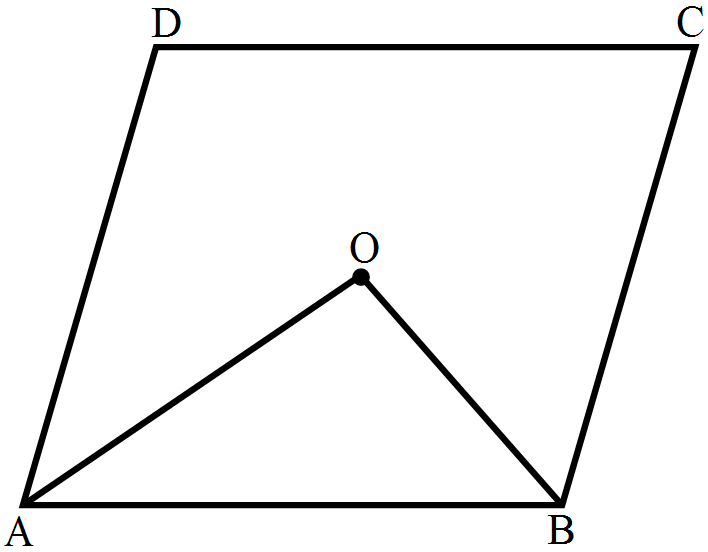
The bisectors of two adjacent angles of a parallelogram intersect at:
  • A
    $30^\circ$
  • B
    $45^\circ$
  • C
    $60^\circ$
  • $90^\circ$
Answer
Correct option: D.
$90^\circ$


We know that the opposite sides and the angles in a parallelogram are equal.
Also, its adjacent sides are supplementary, i.e. sum of the sides is equal to $180.$
Now, the bisectors of these angles form a triangle, whose two angles are:
$\frac{\text{A}}{2}\ \text{and}\ \frac{\text{B}}{2}\ \text{or}\ \frac{\text{A}}{2}=\Big(90-\frac{\text{A}}{2}\Big)$
Sum of the angles of a triangle is $180^\circ .$
$\frac{\angle\text{A}}{2}+90-\frac{\angle\text{A}}{2}+\angle\text{O}=180^\circ$
$\angle\text{O}=180-90$
$\angle\text{O}=90^\circ$
Hence, the two bisectors intersect at right angles.
View full question & answer
MCQ 61 Mark
Mark against the correct answer: Two opposite angles of a parallelogram are $(3x - 2)^\circ $ and $(50 - x)^\circ .$ The measures of all its angles are:
  • A
    $97^\circ , 83^\circ , 97^\circ , 83^\circ$
  • $37^\circ , 143^\circ , 37^\circ , 143^\circ$
  • C
    $76^\circ , 104^\circ , 76^\circ , 104^\circ$
  • D
    None of these.
Answer
Correct option: B.
$37^\circ , 143^\circ , 37^\circ , 143^\circ$
Opposite angles of a parallelogram are equal.
$\therefore 3x - 2 = 50 - x$
$\Rightarrow 3x + x = 50 + 2$
$\Rightarrow 4x = 52$
$\Rightarrow x = 13$
Therefore, the first and the second angles are:
($3x - 2)^\circ = (2 \times 13 - 2)^\circ = 37^\circ $
$(50 - x)^\circ = (50 - 13)^\circ = 37^\circ $
View full question & answer
MCQ 71 Mark
The angles of quadrilateral are in the ratio $1 : 3 : 7 : 9. $ The measure of the largest angle is:
  • A
    $63^\circ$
  • B
    $72^\circ$
  • C
    $81^\circ$
  • None of these.
Answer
Correct option: D.
None of these.
Let the angles be $(x)^\circ , (3x)^\circ , (7x)^\circ $ and $(9x)^\circ (x)^\circ , (3x)^\circ , (7x)^\circ $ and $(9x)^\circ .$
Sum of the angles of the quadrilateral is 360^\circ .
$x + 3x + 7x + 9x = 360$
$20x = 360$
$x = 18$
Angles:
$(3x)^\circ = (3 \times 18) = 54^\circ $
$(7x)^\circ = (7 \times 18)^\circ = 126^\circ $
$(9x)^\circ = (9 \times 18)^\circ = 162^\circ $
View full question & answer