Questions

2 Marks Questions

🎯

Test yourself on this topic

12 questions · timed · auto-graded

Question 12 Marks
If you have a spinning wheel with $3$ green sectors, $1$ blue sector and $1$ red sector, what is the probability of getting a green sector? What is the probability of getting a non blue sector?
Answer
There are in all $3 + 1 + 1 = 5$ outcomes of the event probability of getting a green sector. [Getting a green sector has $3$ outcomes as there are in all $3$ green sectors]
$ = \frac{3}{5}$
Getting a non blue sector has $3 + 1 = 4$ outcomes as there are $3$ green sectors and $1$ red sector
$\therefore$ Probability of getting a non blue sector $ = \frac{{3 + 1}}{5} = \frac{4}{5}$
View full question & answer
Question 22 Marks
Numbers $1$ to $10$ are written on ten separate slips (one number on one slip), kept in a box and mixed well. One slip is chosen from the box without looking into it. What is the probability of getting a 1-digit number?
Answer
Total outcomes $= 10$
one-digit number $= 9$
We know that, Probability of an event $=\frac{\text { Favourable outcomes }}{\text { total outcomes }}$
$\therefore$Probability of getting a one-digit number $=\frac{9}{10}$
View full question & answer
Question 32 Marks
Numbers $1$ to $10$ are written on ten separate slips (one number on one slip), kept in a box and mixed well. One slip is chosen from the box without looking into it. What is the probability of getting a number greater than $6$?
Answer
Getting a number greater than $6$ has four outcomes as there are four numbers $(7, 8, 9$ and $10)$ greater than $6$
Probability of getting a number greater than
$6= \frac{4}{{10}} = \frac{2}{5}$
View full question & answer
Question 42 Marks
Numbers $1$ to $10$ are written on ten separate slips (one number on one slip), kept in a box and mixed well. One slip is chosen from the box without looking into it. What is the probability of getting a number less than $6$?
Answer
There are all $10$ outcomes of the event. Getting a number less than $6$ has five outcomes as there are five numbers $(1, 2, 3, 4,$ and $5 )$ less than $6$.
So the probability of getting a number less than $6 = \frac{5}{{10}} = \frac{1}{2}$
View full question & answer
Question 52 Marks
Numbers $1$ to $10$ are written on ten separate slips (one number on one slip), kept in a box and mixed well. One slip is chosen from the box without looking into it. What is the probability of getting a number 6?
Answer
There are all $10$ outcomes of the event. Getting a number $6$ has one outcome only.
So the probability of getting a number $6 = \frac{1}{{10}}$.
View full question & answer
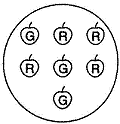
Question 62 Marks
Find the Probability of getting a red apple.
Answer
Let the probability of red apples be $n$
$n =$ No of favourable outcome/No of the possible outcome
No of red apple $= 4$
No of possible outcome$=7$
P(n) $ = \frac{4}{7}$ [$\because $ There are in all $7$ apples cut of which $4$ are red.]
View full question & answer
Question 72 Marks
Find the probability of getting an ace from a well shuffled deck of $52$ playing cards ?
Answer
Probability of getting an ace from a well shuffled deck of $52$ playing cards $ = \frac{4}{{52}} = \frac{1}{{13}}$ [$\because $ There are in all $4$ ace cards]
View full question & answer
Question 82 Marks
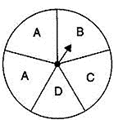
Find the probability of the pointer stopping on $D$ in
Answer
There are in all $5$ months of the event. The pointer stopping on $D$ has only $1$ outcome
$\therefore$ The probability of the pointer stopping and $D$ $ = \frac{1}{5}$
View full question & answer
Question 92 Marks
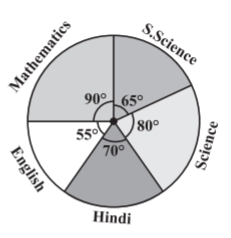
The adjoining pie chart gives the marks scored in an examination by a student in Hindi, English, Mathematics, Social Science and Science. If the total marks obtained by the students were $540$, answer the question.

Examine whether the sum of the marks obtained in Social Science and Mathematics is more than that in Science and Hindi. (Hint: Just study the central angles).
Answer
From the graph it is clear that
Sum of the central angles for Social Science and Mathematics.
$= 65^\circ + 90^\circ $
$= 155^\circ $
Sum of the central angles for Science and Hindi.
$= 80^\circ + 70^\circ $
$= 150^\circ $
Hence, the sum of the marks obtained in Social Science and Mathematics is more than in Science and Hindi.
View full question & answer
Question 102 Marks
The adjoining pie chart gives the marks scored in an examination by a student in Hindi, English, Mathematics, Social Science and Science. If the total marks obtained by the students were $540$, answer the question.

How many more marks were obtained by the student in Mathematics than in Hindi?
Answer
We have,
Marks obtained by the students in Mathematics
$ = \frac{{90^\circ }}{{360^\circ }} \times 540 $
$ = 135$
Marks obtained by the students in Hindi $ = \frac{{70^\circ }}{{360^\circ }} \times 540 $
$= 105$
Therefore, the student obtained $135 – 105 = 30$ marks more in Mathematics than in Hindi.
View full question & answer
Question 112 Marks
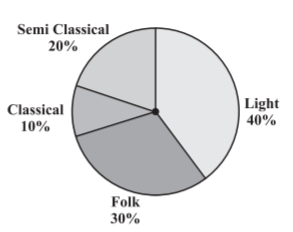
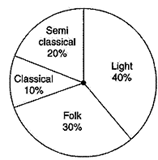
A survey was made to find the type of music that a certain group of young people liked in a city. The adjoining pie chart shows the findings of this survey.

From this pie chart answer. If a cassette company were to make $1000\ CD’s$, how many of each type would they make?
Answer


Suppose that $x$ young people were surveyed. Then, the number of young people who liked classical music $= 10%$ of $x$
$ = x \times \frac{{10}}{{100}}$
$ = \frac{x}{{10}}$
According to the question,
$\frac{x}{{10}} = 20$
$\therefore x = 20 \times 10$
$\therefore$ $x = 200$ hence, $200$ young people were surveyed.
View full question & answer
Question 122 Marks
A bag has $4$ red balls and $2$ yellow balls. (The balls are identical in all respects other than colour). A ball is drawn from the bag without looking into the bag. What is probability of getting a red ball? Is it more or less than getting a yellow ball?
Answer
There are in all $(4 + 2 =) 6$ outcomes of the event.
Getting a red ball consists of $4$ outcomes.
Therefore, the probability of getting a red ball is $\frac {4}{6} = \frac {2}{3}$ .
In the same way the probability of getting a yellow ball = $\frac {2}{3} = \frac {1}{3}$.
Therefore, the probability of getting a red ball is more than that of getting a yellow ball.
View full question & answer