Questions

2 Marks Questions

🎯

Test yourself on this topic

16 questions · timed · auto-graded

Question 12 Marks
A car takes $2$ hours to reach a destination by travelling at the speed of $60\ km/h$. How long will it take when the car travels at the speed of $80\ km/h$?
Answer
Let it take $x$ hours. We have the following table.
Speed (in km/h) $60$ $80$
Number of hours $2$ $x$
Lesser the speed, more the number of hours to reach the destination.
Hence, $60$ $\times$ $2 = 80$ $\times$ $x$
$\therefore$ $x = \frac{{60 \times 2}}{{80}}$
$\therefore$ $x = \frac{3}{2}$
$\therefore$ $x = 1\frac{1}{2}$
Thus, $1\frac{1}{2}$ hours would be taken.
View full question & answer
Question 22 Marks
A factory requires $42$ machines to produce a given number of articles in $63$ days. How many machines would required to produce the same number of articles in $54$ days ?
Answer
Suppose that x machines would be required. We have the following table.
Number of machines $42$ $x$
Number of days $63$ $54$
Lesser the number of machines, more will be the number of days to produce the same number of articles.
So, this is a case of inverse proportion.
Hence, $42$ $\times$ $63 = x$ $\times$ $54$
$\therefore$ $x = \frac{{42 \times 63}}{{54}}$
$\therefore$ $x = 49$
Hence, $49$ machines would be required.
View full question & answer
Question 32 Marks
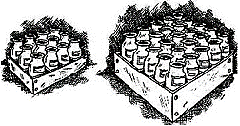
A batch of bottles were packed in $25$ boxes with $12$ bottles in each box. If the same batch is packed using $20$ bottles in each box, how many boxes would be filled?
Answer
Suppose that $x$ boxes would be filled. We have the following table.
Number of bottles $12$ $20$
Number of boxes $25$ $x$
Lesser the number of bottles more will be number of boxes required to be filled. So, this is a case of inverse proportion.
Hence, $12$ $\times$ $25 = 20$ $\times$ $x$
$\therefore$ $x = \frac{{12 \times 25}}{{20}}$
$\therefore$ $x = 15$
Hence, $15$ boxes would be filled.
View full question & answer
Question 42 Marks
A contractor estimates that $3$ persons could rewire Jasminder's house in $4$ days. If, he uses $4$ persons instead of three, how long should they take to complete the job ?
Answer
Suppose that they take $x$ days to complete the job. We have the following table.
Number of persons $3$ $4$
Number of days $4$ $x$
More the number of persons, lesser will be the number of days required to complete the job. So, this is a case of inverse proportion.
Hence, $3 \times 4 = 4 \times x$
$\therefore $ $x = \frac{{3 \times 4}}{4}$
$\therefore x = 3$
Hence, they would take $3$ days to complete the job.
View full question & answer
Question 52 Marks
A farmer has enough food to feed $20$ animals in his cattle for 6 days. How long would the food last if there were 10 more animals in his cattle ?
Answer
Suppose that the food would last for $x$ days. We have the following table.
Number of animals $20$ $20 + 10 = 30$
Number of days $6$ $x$
We note that more the number of animals, lesser will be the number of days for which the food will last. Therefore, this is a case of inverse proportion.
So, $20 \times 6 = 30 \times x$
$\therefore$ $x = \frac{{20 \times 6}}{{30}}$
$\therefore$ $x = 4$
Hence, the food would last for $4$ days.
View full question & answer
Question 62 Marks
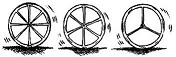
Rehman is making a wheel using spokes. He wants to fix equal spokes in such a way that the angles between any pair of consecutive spokes are equal. Help him by completing the following table.
.
Numbers of spokes $4$ $6$ $8$ $10$ $12$
Angle between a pair of consecutive spokes $90^\circ $ $60^\circ $
Are the number of spokes and the angles formed between the pairs of consecutive spokes in inverse proportion?
Answer
According to given information, the table can be completed as follows:
Numbers of spokes $4$ $6$ $8$ $10$ $12$
Angle between a pair of consecutive spokes $90^\circ $ $60^\circ $ $45^\circ $ $36^\circ$ $30^\circ$
Yes! The number of spokes and the angles formed between the pairs of consecutive spokes are in inverse proportion [$\because$ $4$ $\times$ $90^\circ = 6$ $\times$ $60^\circ = 8$ $\times$ $45^\circ = 10$ $\times$ $36^\circ = 12$ $\times$ $30^\circ$]
View full question & answer
Question 72 Marks
A school has $8$ periods a day each of $45$ minutes duration. How long would each period be, if the school has $9$ periods a day, assuming the number of school hours to be the same ?
Answer
Let each period be $x$ minutes long.
We have the following table
Number of periods $8$ $9$
Length of each period
(in minutes)
$45$ $x$
We note that more the number of periods, lesser would be the length of each period.
Therefore, this is a case of inverse proportion.
So, $ = 8 \times 45 = 9 \times x$
$\therefore$ $x = \frac{{8 \times 45}}{9}$
$\therefore$ $x = 40$
Hence, each period would be $40$ minutes long.
View full question & answer
Question 82 Marks
Two persons could fit new windows in a house in $3$ days. How many persons would be needed to fit the windows in one day?
Answer
Let $x$ persons be needed
We have the following table.
Number of days $3$ $1$
Number of persons $2$ $x$
Clearly, more the number of persons, faster would they do the job. So, the number of persons and number of days vary in inverse proportion.
So, $3 \times 2 = 1 \times x$
$\therefore$ $x = 6$
Thus, $6$ persons would be needed.
View full question & answer
Question 92 Marks
Two persons could fit new windows in a house in $3$ days. One of the persons fell ill before the work started. How long would the job take now?
Answer
Let the job would take $x$ day.
We have the following table
Number of persons $2$ $2 – 1 = 1$
Number of days $3$ $x$
Clearly, less the number of persons, for more days they would do the job. So, the number of persons and number of days vary in inverse proportion
So, $2 \times 3 = 1 \times x$
$\therefore$ $x = 6$
Thus, the job would now take $6$ days.
View full question & answer
Question 102 Marks
Following are the car parking charges near a railway station up to
$4$ hours Rs. $60$
$8$ hours Rs. $100$
$12$ hours Rs. $140$
$24$ hours Rs. $180$
Check if the parking charges are in direct proportion to the parking time.
Answer
$\frac{4}{60}=\frac{1}{15}$
$\frac{8}{100}=\frac{2}{25}$
$\frac{12}{140}=\frac{3}{35}$
$\frac{24}{180}=\frac{2}{15}$
Hence, the parking charges are not in direct proportional to the parking time.
View full question & answer
Question 112 Marks
If $15$ workers can build a wall in $48$ hours, how many workers will be required to do the same work in $30$ hours?
Number of hours $48$ $30$
Number of workers $15$ $y$
Answer
It is given the number of workers employed to build the wall in $30$ hours be $y$
Obviously more the number of workers, faster will they build the wall.
so, the number of hours and number of workers vary in inverse proportion.
So $48$ $\times$ $15 = 30$ $\times$ $y$
$y =$ $\frac{48 \times 15}{30}$ or $y = 24$
i.e., to finish the work in $30$ hours, $24$ workers are required.
View full question & answer
Question 122 Marks
There are $100$ students in a hostel. Food provision for them is for $20$ days. How long will these provisions last, if $25$ more students join the group?
Number of students $100$ $125$
Number of days $20$ $y$
Answer
Suppose the provisions last for $y$ days when the number of students is $125$.
Note that more the number of students, the sooner would the provisions exhaust. Therefore, this is a case of inverse proportion.
So, $100 × 20 = 125 × y$
or $\frac{100 \times 20}{125}$ $= y$ or $16 = y$
Thus, the provisions will last for $16$ days, if $25$ more students join the hostel.
View full question & answer
Question 132 Marks
6 pipes are required to fill a tank in $1$ hour $20$ minutes. How long will it take if only $5$ pipes of the same type are used?
Number of pipes $6$ $5$
Time (in minutes) $80$ $x$
Answer
Lesser the number of pipes, more will be the time required by it to fill the tank. So, this is a case of inverse proportion.
Hence, $80 × 6 = x × 5 $
or $\frac{80\times 6} {5} =x$
or $x = 96$
Thus, time taken to fill the tank by $5$ pipes is $96$ minutes or $1$ hour $36$ minutes.
View full question & answer
Question 142 Marks
The scale of a map is given as $1:30000000$. Two cities are $4\ cm$ apart on the map. Find the actual distance between them.
Answer
Let the map distance be $x\ cm$ and actual distance be $y\ cm$, then $1:30000000 = x : y$
or $\frac{1}{3 \times 10^{7}}=\frac{x}{y}$
Since $x = 4$ so, $\frac{1}{3 \times 10^{7}}=\frac{4}{y}$
or $y =$ $4 \times 3\times 10^{7}$ = $12\times 10^{7} cm$ $= 1200\ km$.
Thus, two cities, which are $4\ cm$ apart on the map, are actually $1200\ km$ away from each other.
View full question & answer
Question 152 Marks
A train is moving at a uniform speed of $75\ km/hour$. Find the time required to cover a distance of $250\ km$.
Answer
Let the time required to cover a distance of $250\ km$ is $x$ hrs.
Now, distance = speed $\times$ time
$250 = 75$ $\times$ $x$
$x =$ $\frac {250}{75}$ $= 3.33$ hrs $= 3$ hr $20$ min
Thus, the time required to cover a distance of $250\ km$ is $3$ hr $20$ min
View full question & answer
Question 162 Marks
A train is moving at a uniform speed of $75\ km/hour$. How far will it travel in $20$ minutes?
Answer
Let the distance travelled (in km) in $20$ minutes be $x$.
Time $= 20$ min = $\frac {20}{60}$ hr
Speed $= 75\ km/hr$
Now, distance = speed $\times$ time
$x = 75$ $\times$ $\frac {20}{60}$ $= 25$
So, the train will cover a distance of $25\ km$ in $20$ minutes.
View full question & answer