Questions

3 Marks Question

🎯

Test yourself on this topic

11 questions · timed · auto-graded

Question 13 Marks
If a box of sweets is divided among $24$ children, they will get $5$ sweets each. How many would each get, if the number of the children is reduced by $4?$
Answer
Suppose that each would get x sweets.
Thus, we have the following table.
Number of children $24$ $24 – 4 = 20$
Number of sweets $5$ $x$
Lesser the number of children, more will be the number of sweets each would get. So, this is a case of inverse proportion.
Hence, $24 \times 5 = 20 \times x$
$\therefore x = \frac{{24 \times 5}}{{20}}$
$\therefore x = 6$
Hence, each would get 6 sweets.
View full question & answer
Question 23 Marks
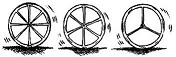
Rehman is making a wheel using spokes. He wants to fix equal spokes in such a way that the angles between any pair of consecutive spokes are equal. Help him by completing the following table.
.
Numbers of spokes $4$ $6$ $8$ $10$ $12$
Angle between a pair of consecutive spokes $90^\circ $ $60^\circ $
How many spokes would be needed, if the angle between a pair of consecutive spokes is $40^\circ ?$
Answer
As per the information given, the table can be completed as follows:
Numbers of spokes $4$ $6$ $8$ $10$ $12$
Angle between a pair of consecutive spokes $90^\circ $ $60^\circ $ $45^\circ $ $36^\circ $ $30^\circ $
Let x spokes be needed
Lesser the number of spokes, more will be the angle between a pair of consecutive spokes.
So, this is a case of inverse proportion.
Hence, $4 \times 90^0 = x \times 40^0 [\because x_1y_1= x_2y_2]$
$\therefore x = \frac{{4 \times 90^o}}{{40^o}}$
$\therefore x = 9$
Hence, $9$ spokes would be needed for an angle of $40^\circ $
View full question & answer
Question 33 Marks
Rehman is making a wheel using spokes. He wants to fix equal spokes in such a way that the angles between any pair of consecutive spokes are equal. Help him by completing the following table.
.
Numbers of spokes $4$ $6$ $8$ $10$ $12$
Angle between a pair of consecutive spokes $90^\circ $ $60^\circ $
Calculate the angle between a pair of consecutive spokes on a wheel with $15$ spokes?
Answer
As per the information given:
Numbers of spokes $4$ $6$ $8$ $10$ $12$
Angle between a pair of consecutive spokes $90^\circ $ $60^\circ $ $45^\circ $ $36^\circ $ $30^\circ $
Let the angle between a pair of consecutive spokes on a wheel with 15 spokes be $x^\circ $. Lesser the number of spokes, more will be the angle between a pair of consecutive spokes.
So, this is a case of inverse proportion.
Hence, $4 \times 90 = 15 \times x$
$\left[\because {{x_1}{y_1} = {x_2}{y_2}} \right]$
$\therefore x = \frac{{4 \times 90}}{{15}}$
$\therefore x = 24$
Hence, the angle between a pair of consecutive spokes on a wheel with $15$ spokes is $24^\circ .$
View full question & answer
Question 43 Marks
In a Television game show, the prize money of ₹$1,00,000$ is to be divided equally amongst the winners. Complete the table and find whether the prize money given to an individual winner is directly or inversely proportional to the number of winners:
No. of winners $1$ $2$ $4$ $5$ $8$ $10$ $20$
Prize for each winner (in ₹) $1,00,000$ $50,000$ ... ... ... ... ...
Answer
Here the number of winners and prize money are in inverse proportion because when winners are increasing, prize money is decreasing.
When the number of winners are $4,$ each winner will get $= \frac{100000}{4} = Rs. 25,000$
When the number of winners are $5,$ each winner will get $= \frac{100000}{5} = Rs. 20,000$
When the number of winners are $8,$ each winner will get $= \frac{100000}{8} = Rs. 12,500$
When the number of winners are $10,$ each winner will get $= \frac{100000}{10} = Rs. 10,000$
When the number of winners are $20$, each winner will get $= \frac{100000}{20} = Rs. 5,000$
View full question & answer
Question 53 Marks
Rashmi has a road map with a scale of $1 \ cm$ representing $18 \ km$. She drives on a road for $72 \ km$. What would be her distance covered in the map ?
Answer
Let the distance covered in the map be $x \ cm$. Then,
$1 : 18 = x : 72$
$\therefore \frac{1}{{18}} = \frac{x}{{72}}$
$\therefore x = \frac{{72}}{{18}}$
$\therefore x = 4$
Hence, the distance covered in the map would be $4 \ cm.$
View full question & answer
Question 63 Marks
Suppose $2 \ kg$ of sugar contains $9 \times 10^6$ crystals. How many sugar crystals are there in $1.2 \ kg$ of sugar?
Answer
Let x be the sugar crystals in $1.2 \ kg$ of sugar
The information given in the question can be formulated in a table as follows:
Sugar Weight $2$ kg $1.2 \ kg$
No. of crystals $9 \times 10^6$ $x$
The above information is in direct proportion:
Therefore,
${2 \over \left(9 \times 10^{6}\right)}={1.2\over x}$
$x = 5.4 \times 10^6$ crystals
View full question & answer
Question 73 Marks
Suppose $2 \ kg$ of sugar contains $9 \times 10^6$ crystals. How many sugar crystals are there in $5 \ kg$ of sugar?
Answer
Let the number of sugar crystals in $5 kg$ of sugar be $x.$
The given information in the form of a table is as follows.
Amount of sugar (in kg) $2$ $5$
Number of crystals $9 × 10^6$ $x$
The amount of sugar and the number of crystals it contains are directly proportional to each other. Therefore, we obtain
$\frac{2}{{9 \times {{10}^6}}} = \frac{5}{x}$
$x = \frac{{5 \times 9 \times {{10}^6}}}{2} = 2.25 \times {10^7}$
Hence, the number of sugar crystals is 2.25 $\times$ $10^7$.
View full question & answer
Question 83 Marks
A machine in a soft drink factory fills $840$ bottles in six hours. How many bottles will it fill in five hours ?
Answer
Let it fill x bottles in five hours. We put the given information in the form of a table as shown below :
Number of bottles filled $840$ $x$
Number of hours $6$ $5$
More the numbers of hours, more the number of bottles filled would be. So, the number of bottles filled and the number of hours are directly proportional to each other.
So, $\frac{{{x_1}}}{{{x_2}}} = \frac{{{y_1}}}{{{y_2}}}$
$\therefore \frac{{840}}{{{x_2}}} = \frac{6}{5}$
$\therefore 6x_2= 840 \times 5$
$\therefore x_2=$
$\frac{{840 \times 5}}{6}$
$\therefore x_2= 700$
Hence, $700$ bottles will be filled.
View full question & answer
Question 93 Marks
A loaded truck travels $14 \ km$ in $25$ minutes. If the speed remains the same, how for can it travels in $5$ hours ?
Answer
Two quantities x and y which vary in direct proportion have the relation
$x = ky$ or $\frac{x}{y} = k$
Here, $k = \frac{{number\;of\;km\;it\;can\;travel}}{{time\;in\;hours}}$
$ = \frac{{14}}{{\left( {\frac{{25}}{{60}}} \right)}} = \frac{{14 \times 60}}{{25}}$
$ = \frac{{168}}{5}$
Now, x is the distance travelled in $5$ hours
Using the relation $x = ky,$ we obtain
$x = \frac{{168}}{5} \times 5$
$x = 168$
Hence, it can tavel $168 km.$
View full question & answer
Question 103 Marks
The weight of $12$ sheets of thick paper is $40$ grams, how many sheets of the same paper would weigh $2\frac{1}{2}$ kilograms?
Answer
Let the number of sheets which weigh $2\frac{1}{2}$ kg be $x$. We put the above information in the form of a table as shown below:
Number of sheets $12$ $x$
Weight of sheets (in grams) $40$ $2500$
More the number of sheets, the more would their weight be. So, the number of sheets and their weights are directly proportional to each other.
So, $\frac{12}{40}=\frac{x}{2500}$
or $x = \frac{12 \times 2500}{40}$
or $x = 750$
Thus, $750$ sheets of the same paper would weigh $2\frac{1}{2}$ kg.
View full question & answer
Question 113 Marks
An electric pole, $14$ metres high, casts a shadow of $10$ metres. Find the height of a tree that casts a shadow of $15$ metres under similar conditions.
Answer
Let the height of the tree be x metres. We can form a table as shown below:
Height of the object (in metres) $14$ $x$
Length of the shadow (in metres) $10$ $15$
Note that more the height of an object, the more would be the length of its shadow.
Hence, this is a case of direct proportion.
Thus, $\frac{14}{10}=\frac{x}{15}$
or $x = \frac{14}{10}\times15$
or $x = 21$
Thus, height of the tree is $21 m.$
View full question & answer
3 Marks Question - MATHS STD 8 Questions - Vidyadip