Find the square root of the following correct to three places of decimal: $2\frac{1}{2}$
Answer
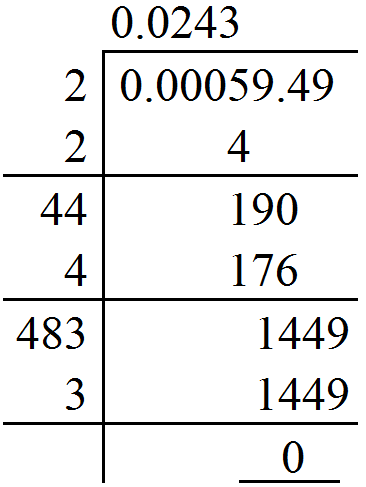
We can find the square root up to four decimal places by expanding $2\frac{1}{2}$ into decimal form up to eight digits to the right of the decimal point as shown below, $2\frac{1}{2}=2.50000000$ But,
this is the same with the value $2.5$ in problem (ix).
Hence, the square root of $2\frac{1}{2}$ is $1.581$.
We know, $\sqrt{38\frac{11}{25}}=\sqrt{\frac{961}{25}}=\frac{\sqrt{961}}{\sqrt{25}}$ Now, let us compute the square roots of the numerator and the denominator separately. $\sqrt{961}=31$ $\sqrt{25}=5$ $\therefore\sqrt{38\frac{11}{25}}=\frac{31}{5}$
Find the least number which must be subtracted from the following numbers to make tham a perfact square: $4401624$
Answer
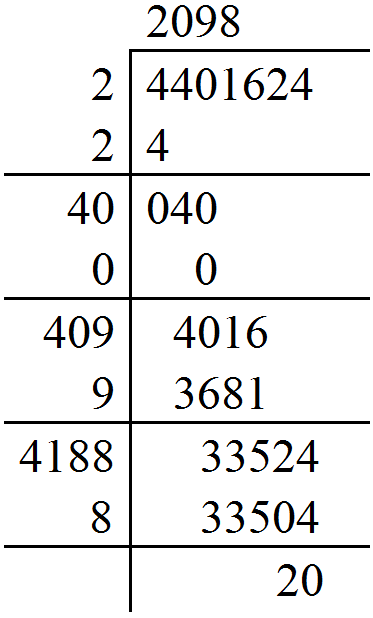
Using the long division method,
We can see that $4401624$ is $20$ more than $2098^2$. Hence,$20$ must be subtracted from $4401624$ to get a perfect square.
Find the least number which must be subtracted from the following numbers to make tham a perfact square: $194491$
Answer
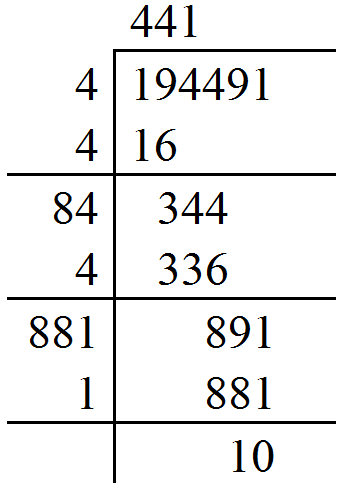
Using the long division method,
We can see that $194491$ is $10$ more than $441^2$. Hence, $10$ must be subtracted from $194491$ to get a perfact square.
Write the possible unit's digits of the square root of the following numbers. these numbers are odd square roots$? 998001$
Answer
The unit digit of the number $998001$ is $1.$ So, the possible unit digits are $1$ or $9.$ Note that $998001$ is equal to $(3^3× 37)^2$.
Hence, the square root is an odd number.
Which of the following triplets are pythagorean$? (14, 35, 38)$
Answer
A triplet $(a, b, c)$ is called Pythagorean if the sum of the squares of the two smallest numbers is equal to the square of the biggest number.
The two smallest numbers are $12$ and $35.$ The sum of their squares is,
$12^2+35^2=1369$, which is not equal to $38^2=1444$
Hence, $(12, 35, 38)$ is not a Pythagorean triplet.