Question 13 Marks
In trapezium $HARE, EP$ and $RP$ are bisectors of $\angle\text{E}\ \text{and}\ \angle\text{R}$ respectively. Find $\angle\text{HAR}\ \text{and}\ \angle\text{EHA.}$
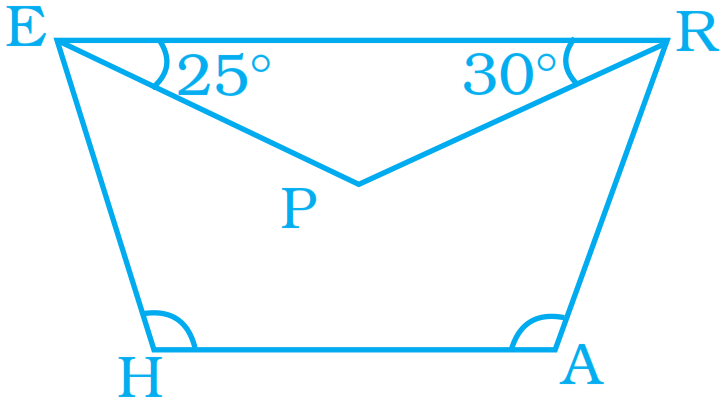
AnswerAs $EP$ and $PR$ are angle bisectors of $\angle\text{REH}\ \text{and}\ \angle\text{ARE}$ respectively.Since, $HARE$ is a trapezium, Therefore, $\angle\text{E}+\angle\text{H}=180^\circ\ \text{and}\ \angle\text{R}+\angle\text{A}=180^\circ$
$\Rightarrow\angle\text{PER}+\angle\text{PEH}+\angle\text{H}=180^\circ\ $ and $\angle\text{ERP}+\angle\text{PRA}+\angle\text{RAH}=180^\circ$
$\Rightarrow25^\circ+25^\circ+\angle\text{H}=180^\circ\ \text{and}\ 30^\circ+30^\circ\angle\text{A}=180^\circ$
$\Rightarrow50^\circ+\angle\text{H}=180^\circ\ \text{and}\ 60^\circ+\angle\text{A}=180^\circ$
$\Rightarrow\angle\text{H}=130^\circ\ \text{and}\ \text{A}=120^\circ\text{i.e.,}$
$\Rightarrow\angle\text{H}=130^\circ\ \text{and}\ \angle\text{HAR}=120^\circ.$
View full question & answer→Question 23 Marks
Find the measure of each angle of a regular octagon.
AnswerNumber of sides $(n)$ in octagon $= 8$
Now, the sum of interior angles of a regular octagon $= (n - 2) \times 180^\circ$
$= (8 - 2) \times 180^\circ$
$= 6 \times 180^\circ= 1080^\circ$
Since, the octagon is regular, measure of each angle $=\frac{1080^\circ}{8}=135^\circ$
View full question & answer→Question 33 Marks
Is it possible to construct a quadrilateral $A B C D$ in which $A B=3 cm, B C=4 cm, C D=5.4 cm, D A=5.9 cm$ and diagonal $A C=8 cm$ ? If not, why?
AnswerNo, Given measures are $A S=3 cm, SC =4 cm, C D=5.4 cm$, $DA =59 cm$ and $AC =8 cm$
Here, we observe that $A S+S C=3+4=7 cm$ and $A C=8 cm$
i.e. the sum of two sides of a triangle is less than the third side, which is absurd.
Hence, we cannot construct such a quadrilateral.
View full question & answer→Question 43 Marks
$A B C D$ is a parallelogram. The bisector of angle $A$ intersects $C D$ at $X$ and bisector of angle $C$ intersects $A B$ at $Y$. Is $A X C Y$ a parallelogram? Give reason.
AnswerGiven, $ABCD$ is a parallelogram So, $\angle\text{A}=\angle\text{C}$ [opposite angles of a parallelogram are equal] $\therefore\frac{\angle\text{A}}{2}=\frac{\angle\text{C}}{2}$ [dividing both the sides by 2] $\angle1=\angle2$ But $\angle2=\angle3$ $\therefore\angle1=\angle\text3$ But they are pairs of corresponding angles.$\therefore\text{AX}\ ||\ \text{YC}\dots(\text{i})$
$\text{AY}\ ||\ \text{XC}\dots(\text{ii})\ [\text{AB}\ ||\ \text{DC}]$ From Eqs. $(i)$ and $(ii)$, we get $AXCY$ is a parallelogram.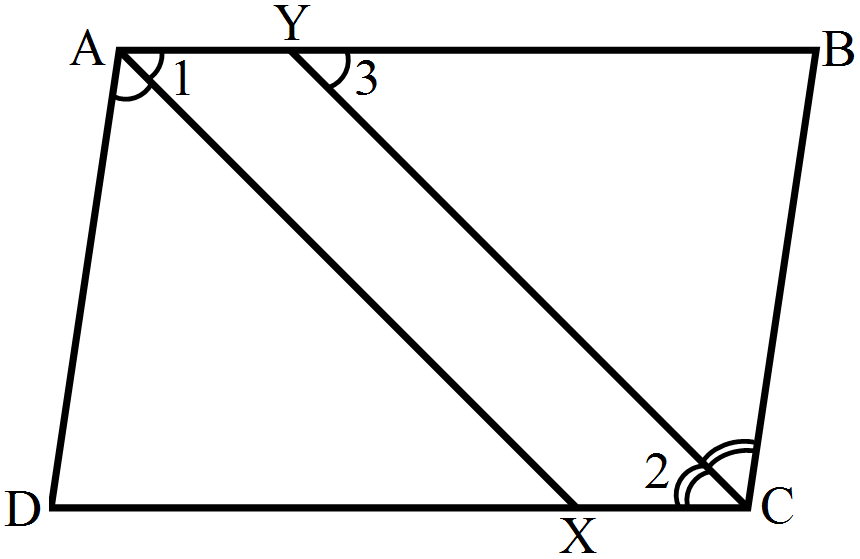
View full question & answer→Question 53 Marks
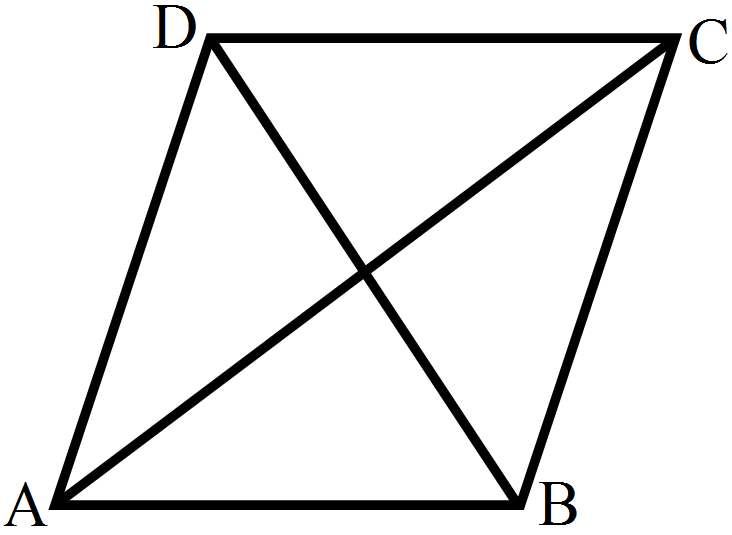
The diagonals of a rhombus are $8\ cm$ and $15\ cm$. Find its side.
AnswerGiven, $Ac = 15cm BD = 8cm$
Since, the diagonals of a rhombus bisect each other at $90^\circ$ ,
therefore, in the $\triangle\text{AOB}$,
we have $\text{AB}^{2}=\text{OA}^{2}+\text{OB}^{2}$
$\Rightarrow\text{AB}^{2}=\Big(\frac{15}{2}\Big)^{2}+\Big(\frac{8}{2}\Big)$
$=(7.5)^{2}+(4)^{2}=56.25+16$
$\Rightarrow\text{AB}^{2}\ 72.25$
$\Rightarrow\text{AB}\sqrt{72.25}$
$\Rightarrow\text{AB}\ 8.5\text{cm}$
Since, it is a rhombus, the length of each side is $8.5\ cm.$
View full question & answer→Question 63 Marks
Find the measure of each angle of a regular polygon of $20$ sides?
AnswerThe sum of interior angles of an n polygon $= (n - 2) \times 180^\circ $
Here, $n = 20,$
then Sum $= (20 - 2) \times 180^\circ = 18 \times 180^\circ = 3240^\circ $
The measure of each interior angle $\frac{3240}{20}=162^\circ$
View full question & answer→Question 73 Marks
Of the four quadrilaterals square, rectangle, rhombus and trapezium one is somewhat different from the others because of its design. Find it and give justification.
Answer In square, rectangle and rhombus, opposite sides are parallel and equal. Also, opposite angles are equal, i.e., they all are parallelograms. But in trapezium, there is only one pair of parallel sides, i.e., it is not a parallelogram. Therefore, trapezium has different design.
View full question & answer→Question 83 Marks
$ABCD$ is a parallelogram. Find the value of $x, y $and $z.$
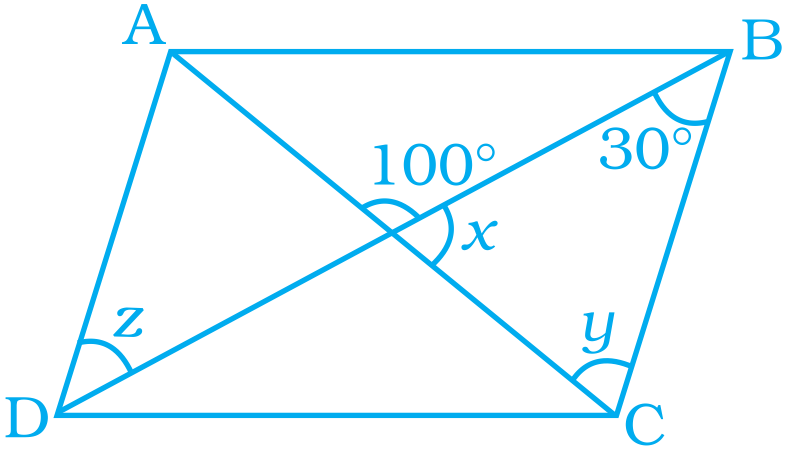
AnswerGiven, in a parallelogram $A B C D$, In the $\triangle OBC , $
$\Rightarrow y+30^{\circ}=100^{\circ}$ [exterior angle property of triangle]
$\Rightarrow y=100^{\circ}-$
$30^{\circ}=70^{\circ}$ By the angle sum property of a triangle,
$\Rightarrow x+y+30^{\circ}=180^{\circ} $
$\Rightarrow x+70^{\circ}+30^{\circ}=180^{\circ} $
$\Rightarrow x=180^{\circ}-100^{\circ}=$
$80^{\circ}$ Since, $A D \| B C$ and $B D$ is transversal, therefore $\angle ADO =\angle OBC$ [alternate interior angles] $$
$\Rightarrow z =30^{\circ}$
View full question & answer→Question 93 Marks
The adjacent angles of a parallelogram are $(2x - 4)^\circ $ and $(3x - 1)^\circ $. Find the measures of all angles of the parallelogram.
AnswerSince, the adjacent angles of a parallelogram are supplementary. $(2 x-4)^{\circ}+(3 x-1)^{\circ}=180^{\circ} $
$\Rightarrow 5 x-5^{\circ}=180^{\circ} $
$\Rightarrow 5 x= 185^{\circ} $
$\Rightarrow x =\frac{185^{\circ}}{5}=37^{\circ}$
Thus, the adjacent angles are $2 x -4=2 \times 37^{\circ}-4=74-4=70^{\circ} \& 3 x -1=3 \times 37^{\circ}-1= 111-1 =110^{\circ}$
Hence, the angles are $70^{\circ}, 110^{\circ}, 70^{\circ}, 110^{\circ}$
View full question & answer→Question 103 Marks
A playground is in the form of a rectangle $ATEF$. Two players are standing at the points $F$ and $B$ where $EF = EB$. Find the values of $X$ and $Y.$
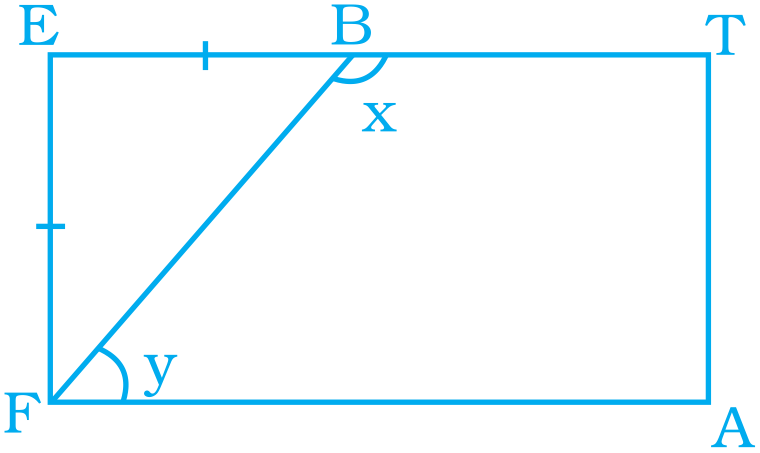
AnswerGiven, a rectangle $ATEF$ in which $EF = PB$. Then, $\triangle\text{FEB}$ is an isosceles triangle.
Therefore,
By the angle sum property of triangle, we have
$\angle\text{EFB}+\angle\text{EBF}+\angle\text{FEB}=180^\circ$
$\Rightarrow\angle\text{EFB}+\angle\text{EBF}+90^\circ=180^\circ$
$\Rightarrow\angle\text{EFB}+\angle\text{EBF}+90^\circ=180^\circ$
$\Rightarrow2\angle\text{EFB}=90^\circ$
$\angle\text{EFB}=45^\circ\ \text{and}\ \angle\text{FBF}=45^\circ$
Now, $\angle\text{x}=180^\circ-45^\circ=135^\circ$
And $\angle\text{EFB}+\angle\text{y}=90^\circ$
$\angle\text{y}=90^\circ-45^\circ=45^\circ.$
View full question & answer→Question 113 Marks
Is it possible to construct a quadrilateral $ROAM$ in which $RO = 4cm, OA = 5cm, \angle\text{O}=120^\circ,\angle\text{R}=105^\circ\ \text{and}\ \angle\text{A}=135^\circ$? If not, why?
AnswerGiven measures are $OA = 5cm,$
$\angle\text{O}=120^\circ,\angle\text{R}=105^\circ\ \text{and}\ \angle\text{A}=135^\circ$
Here, $\angle\text{A}+\angle\text{R}+\angle\text{A}$
$= 120^\circ+ 105^\circ + 135^\circ = 360^\circ$
i.e., the sum of three angles of a quadrilateral is $360^\circ $
This is impossible, as the total sum of angles is $360^\circ $ in a quadrilateral. Hence, this quadrilateral cannot be constructed.
View full question & answer→Question 123 Marks
In the given parallelogram $YOUR$, $\angle\text{RUO}=120^\circ\text{and}\ \text{OY}$ is extended to point $S$ such that $\angle\text{SRY}=50^\circ.\text{Find}\angle\text{YSR}.$
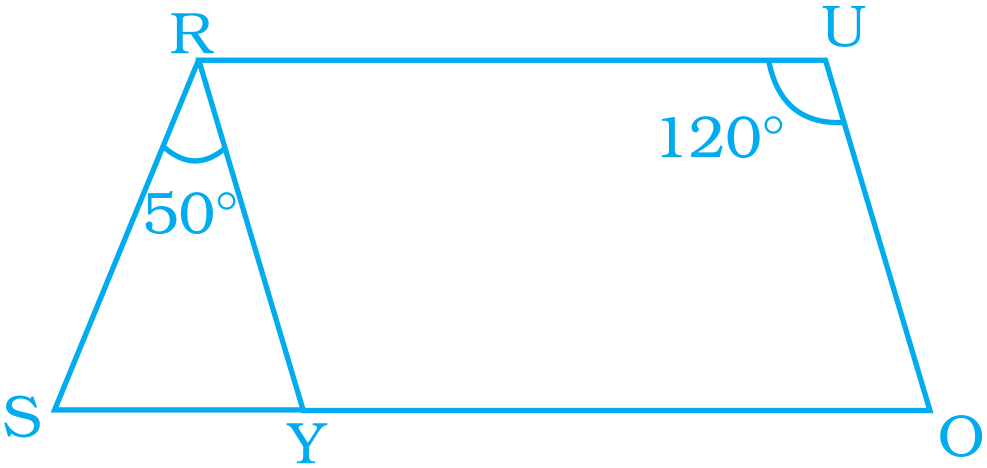
AnswerGiven, $\angle\text{RUO}=120^\circ\ \text{and}\ \angle\text{SRY}=50^\circ$
$\angle\text{RYO}=\angle\text{SYR}=180^\circ-\text{RYO}$
Now, $\angle\text{SYR}=180^\circ-\angle\text{RYO}$
$=180^\circ-120^\circ=60^\circ$
$\text{In}\triangle\text{SRY},$
By the angle sum property of a triangle, $\angle\text{SYR}+\angle\text{RYS}+\angle\text{YSR}=180^\circ$
$\Rightarrow50^\circ+60^\circ+\angle\text{YSR}=180^\circ$
$\Rightarrow\angle\text{YSR}=180^\circ-(50^\circ+60^\circ)=70^\circ.$
View full question & answer→Question 133 Marks
Find the values of $X$ and $Y$ in the following parallelogram.
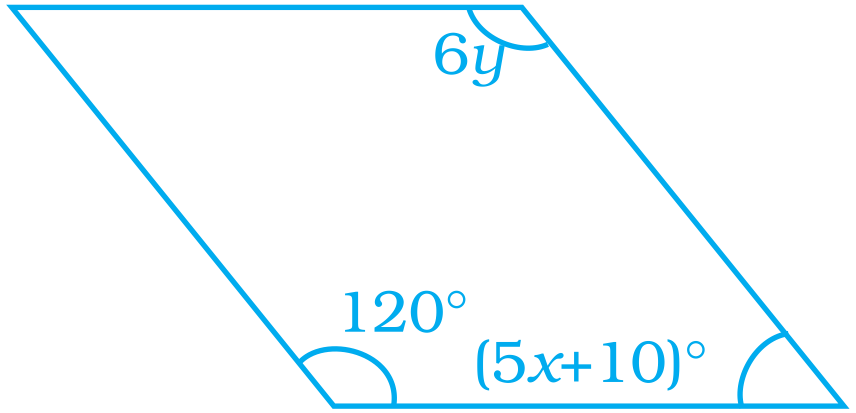
AnswerIn a parallelogram, adjacent angles are supplementary $\therefore120^\circ+(5\text{x}+10)^\circ=180^\circ$
$\Rightarrow5\text{x}+10^\circ+120^\circ=180^\circ$
$\Rightarrow5\text{x}=180^\circ-130^\circ$
$\Rightarrow5\text{x}=50^\circ$
$\Rightarrow\text{x}=10^\circ$ Also, opposite angles are equal in a parallelogram. Therefore, $6\text{y}=120^\circ\Rightarrow\text{y}=20^\circ$
View full question & answer→Question 143 Marks
$ABCDE$ is a regular pentagon. The bisector of angle A meets the side $CD$ at $M$. Find $\angle\text{AMC}.$
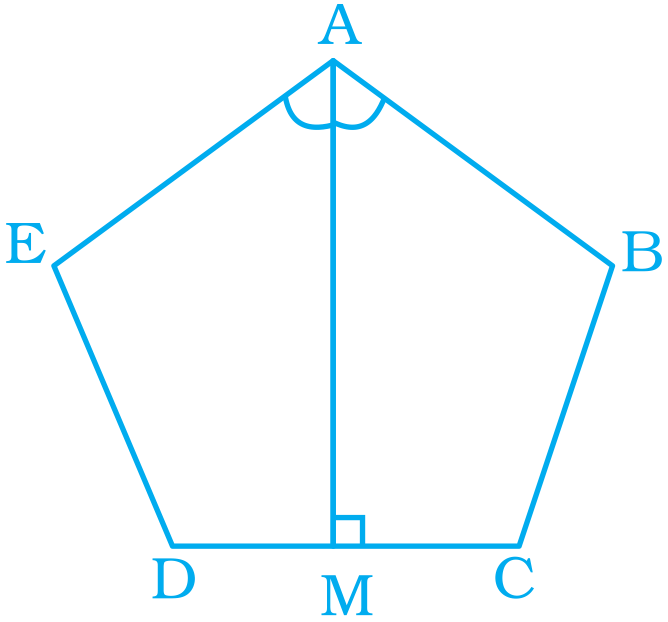
AnswerGiven, a pentagon $ABCDE.$ The line segment $AM$ is the bisector of the $\angle\text{A}$.
Now, since the measure of each interior angle of a regular pentagon is $108^\circ $
$\therefore\angle\text{BAM}=\frac{1}{2}\times108^\circ=54^\circ$ By the angle sum property of a quadrilateral, we have (in quadrilateral ABCM) $\angle\text{BAM}+\angle\text{ABC}+\angle\text{BCM}+\angle\text{AMC}=360^\circ$
$\Rightarrow54^\circ+108^\circ+108^\circ+\angle\text{AMC}=360^\circ$
$\Rightarrow\angle\text{AMC}=360^\circ-270^\circ$
.$\Rightarrow\angle\text{AMC}=90^\circ.$
View full question & answer→Question 153 Marks
Quadrilateral $EFGH$ is a rectangle in which J is the point of intersection of the diagonals. Find the value of $X$ if $JF = 8X + 4$ and $EG = 24X - 8.$
AnswerGiven, $EFGH$ is a rectangle in which diagonals are intersecting at the point J. We know that, the diagonals of a rectangle bisect each other & are equal.
Then, $EG = 2 \times JF $
$\Rightarrow 24x - 8 = 2(8x + 4) $
$\Rightarrow 24x - 8 = 16x + 8 $
$\Rightarrow 24x - 16x = 8 + 8 $
$\Rightarrow 8x = 16 $
$\Rightarrow x = 2$

View full question & answer→Question 163 Marks
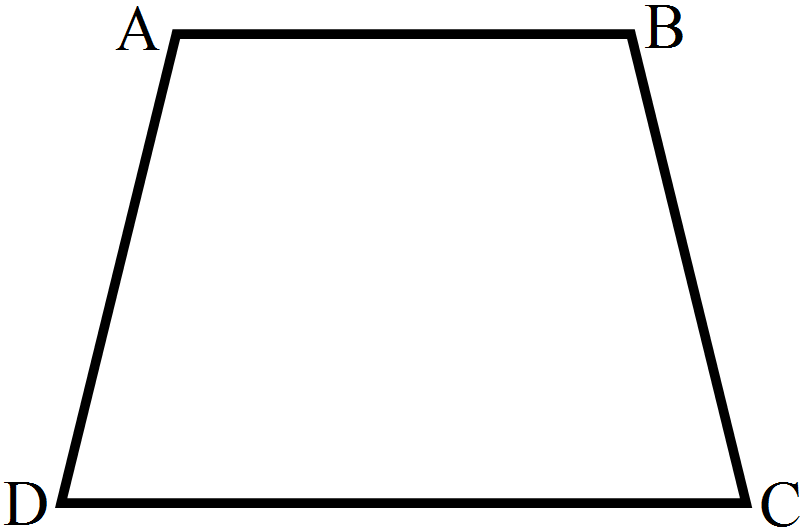
$ABCD$ is a trapezium such that $AB\|CD$, $\angle\text{D},\angle\text{A}:\angle\text{D}=2:1,\angle\text{B}:\angle\text{C}=7:5$ Find the angles of the trapezium.
AnswerLet $ABCD$ is a trapezium, where $AB \| CD$
Let the angles $A$ and $D$ be of measures $2x$ and $x$, respectively
Then, $2x + x = 180^\circ$
$\Rightarrow 3x = 180^\circ$
$\Rightarrow\text{x}=\frac{180^\circ}{3}=60^\circ$
$\Rightarrow\angle\text{A}=2\times60^\circ=120^\circ,\angle\text{D}=60^\circ$
Again, let the angles $B$ and $C$ be $7x$ and $5x$ respectively
Then, $7x + 5x = 180^\circ$
$\Rightarrow 12x = 180^\circ$
$\Rightarrow x = 15$
Thus, $\angle\text{B}=7\times15=105^\circ$
And $\angle\text{C}=5\times5=75^\circ$
View full question & answer→Question 173 Marks
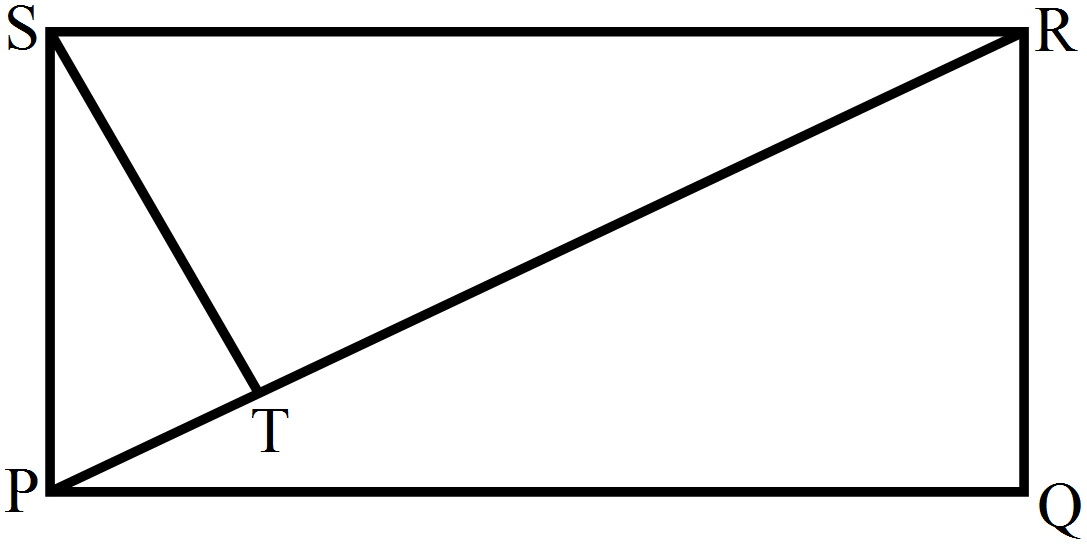
$PQRS$ is a rectangle. The perpendicular $ST$ from $S$ on $PR$ divides $\angle\text{S}$ in the ratio $2 : 3$. Find $\angle\text{TPQ}$
AnswerGiven, $\text{ST}\bot\text{PR}$ and $ST$divides $\angle\text{S}$ in the ratio $2 : 3$
So, sum of ratio $= 2 + 3 = 5$ Now, $\angle\text{TSP}=\frac{2}{5}\times90^\circ=36^\circ,$
$ \angle\text{TSR}=\frac{3}{5}\times90^\circ=54^\circ$
Also, by the angle sum property of a triangle,
$\Rightarrow\text{TSP}=180-(\angle\text{STP}+\angle\text{TSP})$
$\Rightarrow180-(90^\circ+36^\circ)=54^\circ$
We know that, $=180-\angle\text{SPQ}=90^\circ$
$\Rightarrow\angle\text{TPQ}+\angle\text{TPQ}=\ 90^\circ$
$\Rightarrow50^\circ\ \angle\text{TPQ}=90^\circ$
$\Rightarrow\angle\text{TPQ}=90^\circ-54^\circ=36^\circ $
View full question & answer→Question 183 Marks
In parallelogram $MODE$, the bisector of $\angle\text{M}\ \text{and}\ \angle\text{O}$meet at $Q$, find the measure of $\angle\text{MQO}.$
AnswerLet $MODE$ be a parallelogram and $Q$ be the point of intersection of the bisector of $\angle\text{M}\ \text{and}\ \angle\text{O}.$
Since, $MODE$ is a parallelogram
$\therefore\angle\text{EMO}+\angle\text{DOM}=180^\circ$ [adjacent angles are supplementary]
$\Rightarrow\frac{1}{2}\angle\text{EMO}+\frac{1}{2}\text{DOM}=90^\circ$ [dividing both sides by $2]$ 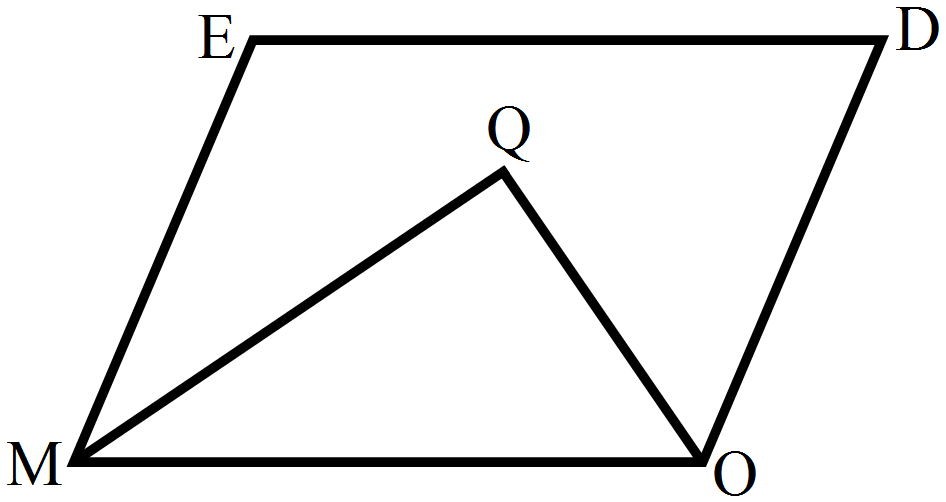
$\Rightarrow\angle\text{QMO}+\angle\text{QOM}=90^\circ\dots(\text{i})$
Now, $\triangle\text{MOQ},$
$\angle\text{MQO}+\angle\text{MQO}=180^\circ$ [angle sum property of triangle]
$\Rightarrow90^\circ+\angle\text{MQO}=180^\circ$ [from eq.$(i)]$
$\therefore\angle\text{MQO}=180^\circ-90^\circ=90^\circ.$ View full question & answer→Question 193 Marks
In a quadrilateral $PQRS, \angle\text{P}=50^\circ,\angle\text{Q}=50^\circ,\angle\text{R}=50^\circ,\text{Find}\angle\text{S}$. Is this quadrilateral convex or concave?
AnswerGiven, a quadrilateral $PQRS$, where
$\angle\text{P}=50^\circ,\angle\text{Q}=50^\circ,\angle\text{R}=60^\circ$
Now, by the angle sum property of a quadrilateral, we have
$\angle\text{P}+\angle\text{Q}+\angle\text{R}+\angle\text{S}=360^\circ$
$\Rightarrow50^\circ+50^\circ+60^\circ\angle\text{S}=360^\circ$
$\Rightarrow\angle\text{S}=360^\circ-160^\circ$
$\Rightarrow\angle\text{S}=200^\circ$
Since, one interior angle of the given quadrilateral is obtuse, therefore the quadrilateral is concave.
View full question & answer→Question 203 Marks
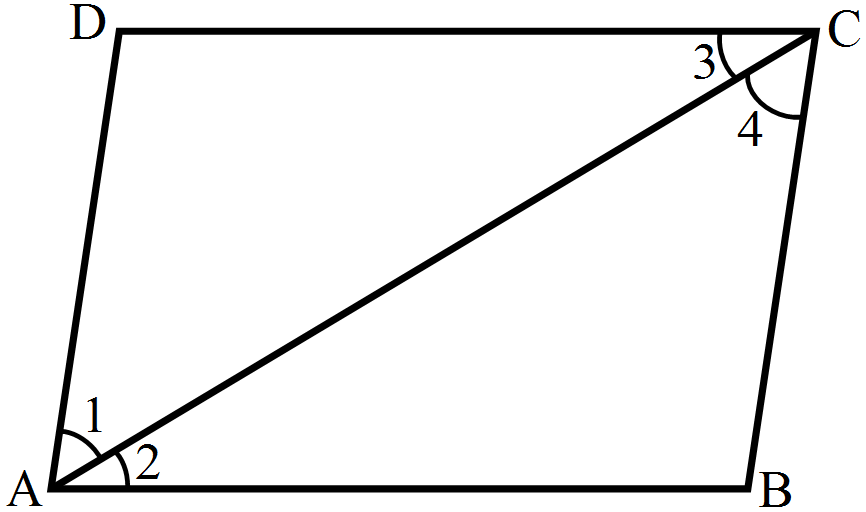
A diagonal of a parallelogram bisects an angle. Will it also bisect the other angle? Give reason.
AnswerConsider a parallelogram $ABCD$. Given, $\angle1=\angle2$
Since, $ABCD$is a parallelogram $AB\|CD$ and $AC$ is a transversal.
$\therefore\angle1=\angle4\dots(\text{i})$ [alternate angles]
Similarly,$\angle2=\angle3\dots(\text{ii})$ [alternate angles]
But given, $\angle1=\angle2$
$\therefore\angle3=\angle4$ [from Eqs. $(i) \& (ii)$]
View full question & answer→Question 213 Marks
A Rangoli has been drawn on a flor of a house. $ABCD$ and $PQRS$ both are in the shape of a rhombus. Find the radius of semicircle drawn on each side of rhombus $ABCD.$
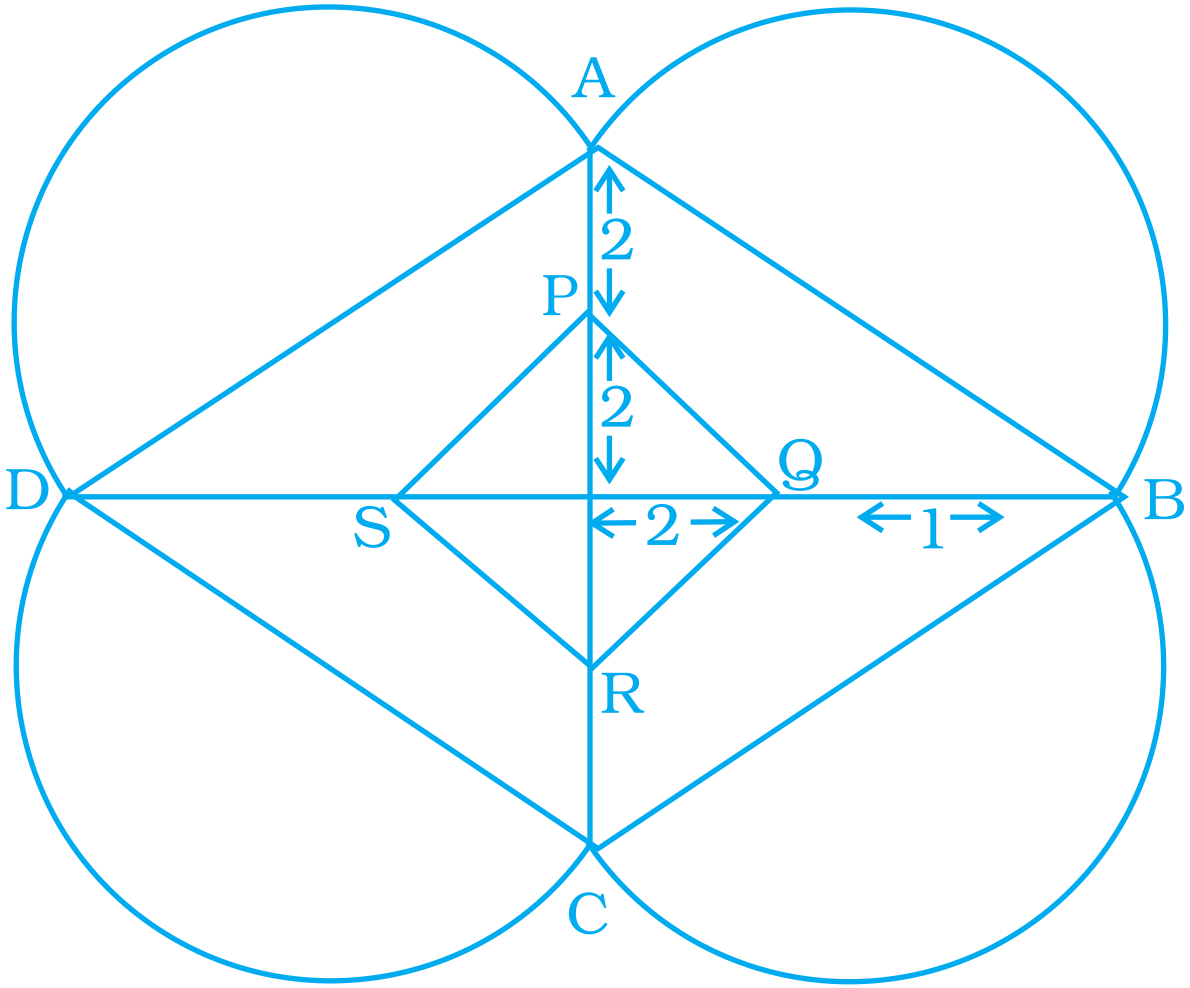
AnswerIn rhombus $ABCD$, $\text{AO}=\text{OP}=+\text{PA}=2+2=4\ \text{units}$ and $\text{OB}=\text{OQ}=+\text{OB}=2+1=3\ \text{units}$
We know that, diagonals of rhombus bisect each other at $90^\circ $
Now, $\text{In}=\triangle\text{OAB},\ \text{AB}^{2}=(\text{OA})^{2}+\text{OB}^{2}$
$\Rightarrow(\text{AB})^{2}=(4)^{2}+(3)^{2}=25$
.$\Rightarrow\text{AB}=\sqrt{25}$
$\Rightarrow\text{AB}=5\ \text{units}$
Since, AB is diameter of semi-circle
$\therefore$ Radius = Diameter/ 2 $\text{AB}^{2}=\frac{5}{2}=2.5\text{units}.$
Hence, radius of the semi-circle is $2.5$ units.
View full question & answer→Question 223 Marks
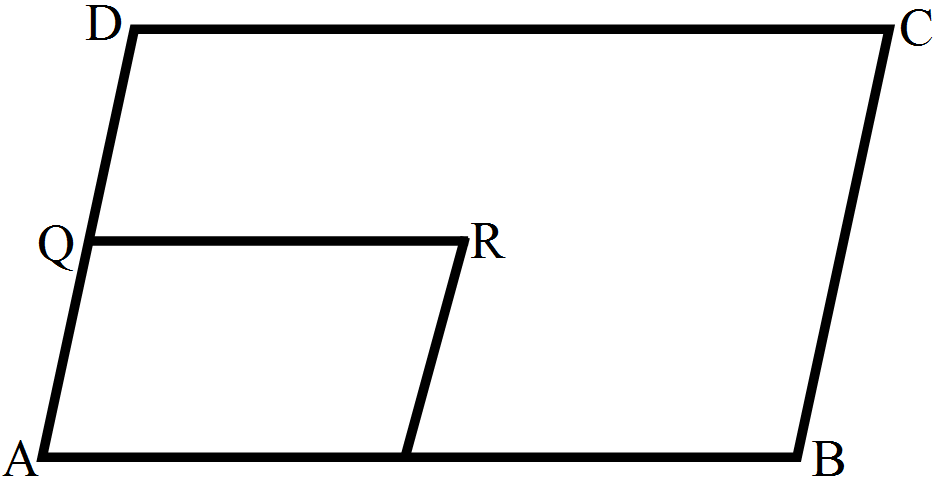
$ABCD$ is a parallelogram. Points $P$ and $Q$ are taken on the sides $AB$ and $AD$ respectively and the parallelogram $PRQA$ is formed. If $\angle\text{C}=45^\circ,\text{Find}\ \angle\text{R}.$
AnswerLet $ABCD$ be a parallelogram. where $\angle\text{C}=45^\circ$
Since, $ABCD$ is a parallelogram. $\angle\text{A}=\angle\text{C}$ [opposite angles of parallelogram are equal]
Again, since PRQA is a parallelogram $\angle\text{A}=\angle\text{R}$
$\Rightarrow\angle\text{R}=45^\circ\ [\angle\text{A}=\angle\text{C}=45^\circ]$
View full question & answer→Question 233 Marks
In the following figure of a ship, $ABDH$ and $CEFG$ are two parallelograms. Find the value of $x.$
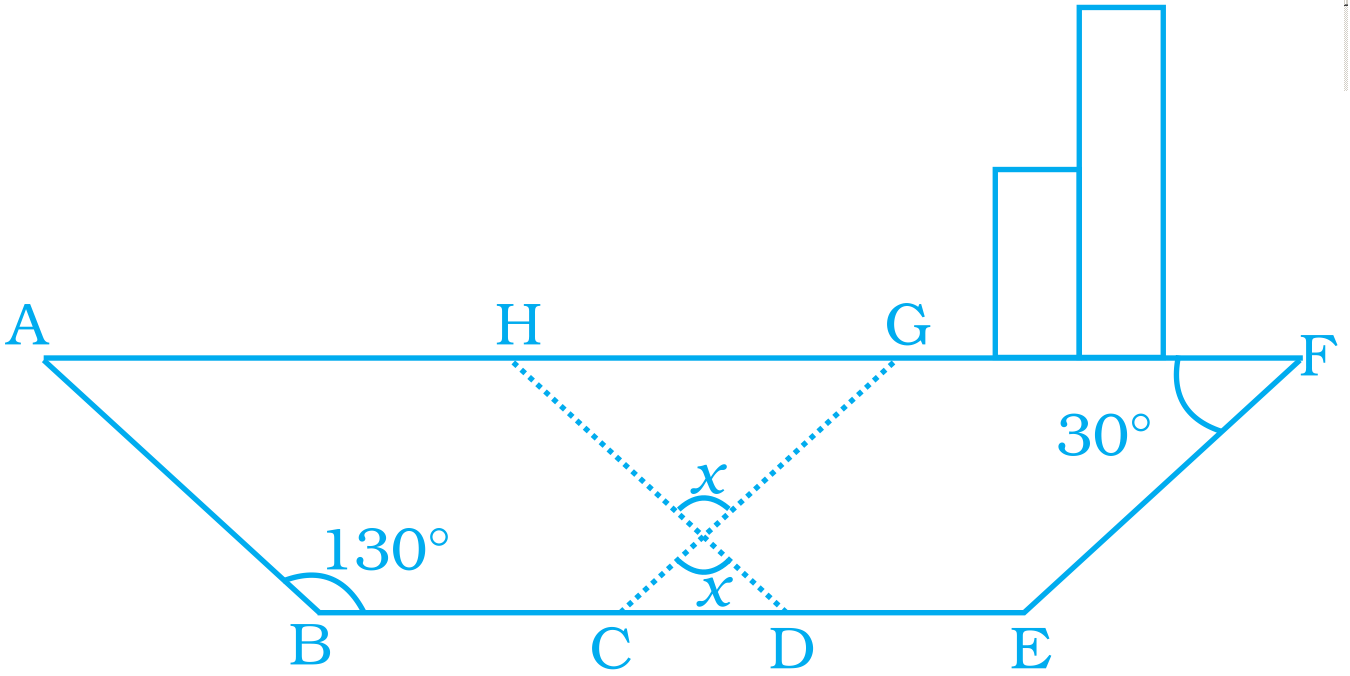
AnswerWe have two parallelograms $ABDH$ and $CEFG$
Now, in $ABDH$. $\therefore\angle\text{ABD}=\text{AHD}=130^\circ$ And $\angle\text{GHD}=180^\circ-\angle\text{AHD}=180^\circ-130^\circ$
$\Rightarrow50^\circ=\angle\text{GHO}$
Also, $\angle\text{EFG}+\angle\text{FGC}=180^\circ$
$\Rightarrow30^\circ\angle\text{FGC}=180^\circ$
$\Rightarrow\angle\text{FGC}=180^\circ-30^\circ=150^\circ$ And $\angle\text{HGC}+\angle\text{FGC}=180^\circ$
$\therefore\angle\text{HGC}=180^\circ-\angle\text{FGC}=180^\circ-150^\circ=30^\circ=\angle\text{HOG}=180^\circ$ In $\triangle\text{HGO}$, by using angle sum property,
$\angle\text{OHG}+\angle\text{HGO}+\angle\text{HOG}=180^\circ$
$\Rightarrow50^\circ+30^\circ+\text{x}=180^\circ$
$\Rightarrow\text{x}=180^\circ-80^\circ=100^\circ$
View full question & answer→Question 243 Marks
In a quadrilateral $HOPE, PS$ and $ES$ are bisectors of $\angle\text{P}\ \text{and}\ \angle\text{E}$ respectively. Give reason.
View full question & answer→Question 253 Marks
A line l is parallel to line m and a transversal p interesects them at $X, Y$ respectively. Bisectors of interior angles at $X$ and $Y$ interesct at $P$ and $Q$. Is $PXQY$ a rectangle? Given reason.
AnswerSticks can be taken as the diagonals of a quadrilateral.
Now, since they are bisecting each other, therefore the shape formed by joining their end points will be a parallelogram.
Hence, it may be a rectangle or a square depending on the angle between the sticks.
View full question & answer→Question 263 Marks
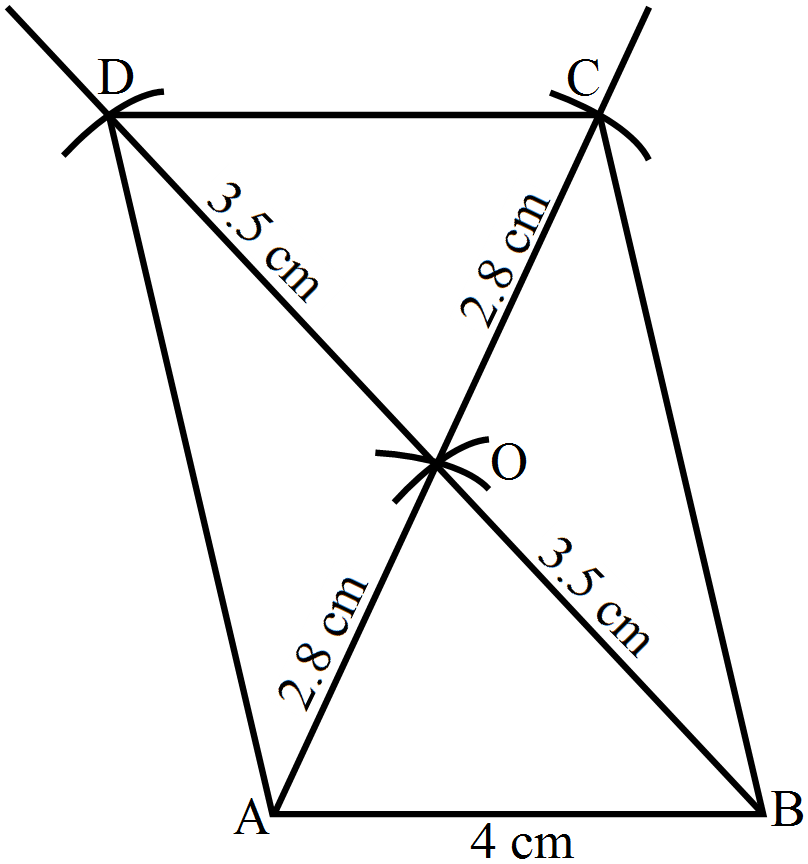
Construct a parallelogram when one of its side is $4\ cm$ and its two diagonals are $5.6\ cm$ and $7\ cm$. Measure the other side.
AnswerSteps of construction:
1. Draw $A B=4 cm$.
2. With A as centre $\&$ radius $2.8 \ cm$ , draw an arc.
3. With $B$ as centre \& radius $3.5 \ cm$ , draw an arc cutting the previous arc at $O$.
4. Join $O A=O B$.
5. Produce $A O$ to $C$ such that $O C=A O$ and produce $B O$ to $D$ such that $O D=B D$.
6. Join $A D, B C$ and $C D$.
Thus, $ABCD$ is the required parallelogram & other side $= 5cm.$
View full question & answer→Question 273 Marks
In parallelogram $FIST,$ find $\angle\text{SFT},\angle\text{OST}\ \text{and}\ \angle\text{STO}.$

AnswerGiven, $\angle\text{FIS}=60^\circ$
Now, $\angle\text{FTS}=\angle\text{FIS}=60^\circ$
Now, FT is parallel to $IS$ and $TI$ is a transversal,
therefore, $\angle\text{FTO}=\angle\text{SIO}=25^\circ$
$\therefore\angle\text{STO}+\angle\text{FTS}+=\angle\text{FTO}=60^\circ-25^\circ=35^\circ$ Also, $=\angle\text{FOT}+\angle\text{SOT}=180^\circ$
$\Rightarrow110^\circ+\angle\text{SOT}=180^\circ$
$\Rightarrow\angle\text{SOT}=180^\circ-110^\circ=70^\circ$
$\text{In}\triangle\text{TOS},\ \angle\text{TSO}+\angle\text{OTS}+\angle\text{TOS}=180^\circ$
$\therefore\ \angle\text{OST},=180-(70^\circ+35^\circ)=75^\circ$
$\text{In}\triangle\text{FOT},\ \angle\text{FOT}+\angle\text{FTO}+\angle\text{OFT}=180^\circ$
$\Rightarrow\angle\text{SFT}= \angle\text{OFT}=180^\circ-(\angle\text{FOT}+\text{FTO})$
$=180^\circ-(110^\circ+25^\circ)=45^\circ.$
View full question & answer→Question 283 Marks
Construct a quadrilateral $\text{NEWS}$ in which $\text{NE} = 7\ cm, \text{EW} = 6\ cm,$
$\angle\text{N}=60^\circ,\angle\text{E}=110^\circ,\text{and}\angle\text{S}=85^\circ.$
AnswerFourth angle $= 360^\circ - (60^\circ + 110^\circ + 85^\circ ) = 360^\circ - 255^\circ = 105^\circ $
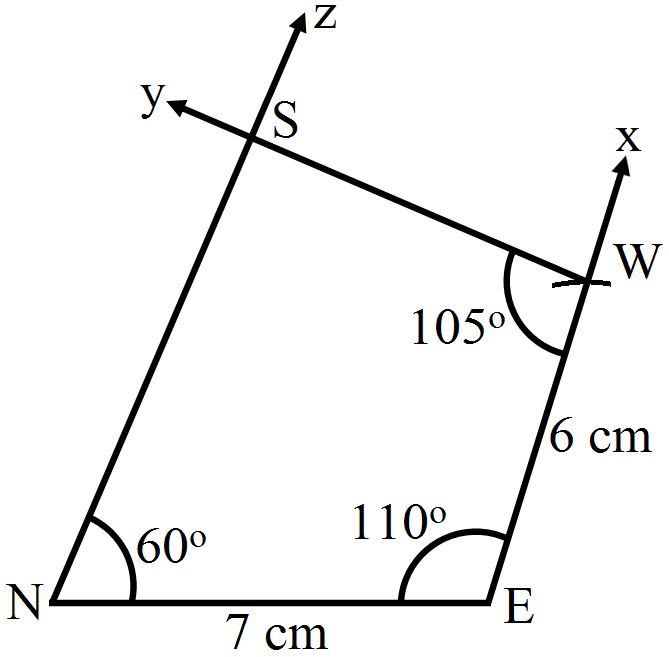
Steps of construction:
$1.$ Draw $\text{NE} = 7\ cm$
$2.$ Make $\angle\text{NE}=70^\circ$
$3.$ With $E$ as centre radius $6\ cm,$ draw an arc cutting $\text{EX}$ at $W.$
$4.$ Make $\angle\text{NEX}=110^\circ$
$5.$ Make $\angle\text{ENZ}=60^\circ$ ,
so that $\text{NZ}$ and $\text{WY}$ intersect each other at point $S.$
Thus, $\text{NEWS}$ is the required quadrilateral. View full question & answer→Question 293 Marks
In the following figure, $FD \| BC \| AE$ and $AC \| ED$. Find the value of $x.$
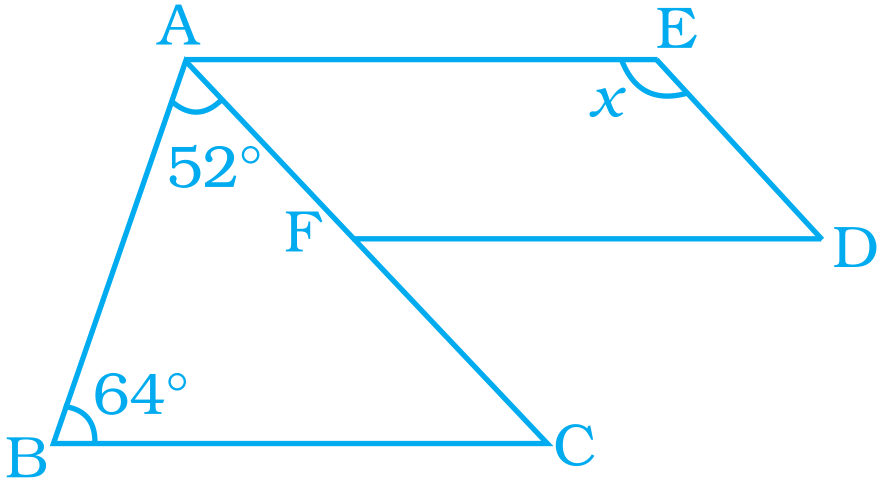
AnswerProduce DF such that it intersects $AB$ at $G$ In $\triangle\text{ABC},$
$\angle\text{A}+\angle\text{B}+\angle\text{C}=180^\circ$
$\Rightarrow52^\circ64^\circ+\angle\text{C}=180^\circ$
$\angle\text{C}=180^\circ-(52^\circ+64^\circ)$
$= 180^\circ − 116^\circ = 64^\circ$
Now, we see that, $\| BC$ and $DG \| AE$
$\therefore\angle\text{ACB}=\angle\text{AFG}$
$\Rightarrow64^\circ=\angle\text{AFG}$
Also, $\angle\text{GFD}$ is a straight line. $\angle\text{GFA}=\angle\text{AFD}=180^\circ$
$\Rightarrow64^\circ+\angle\text{AFD}=180^\circ$
$\Rightarrow\angle\text{AFD}= 180^\circ − 64^\circ = 116^\circ$
Also, $FD \| AE$ and $AF \| ED$
So, $AEDF$ is a parallelogram. $\angle\text{AFD}=\angle\text{AED}$
$\Rightarrow\angle\text{AED}=\text{x}=116^\circ.$
View full question & answer→Question 303 Marks
Find maximum number of acute angles which a convex, a quadrilateral, a pentagon and a hexagon can have. Observe the pattern and generalise the result for any polygon.
AnswerIf an angle is acute, then the corresponding exterior angle is greater than $90^\circ $. Now, suppose a convex polygon has four or more acute angles. Since, the polygon is convex, all the exterior angles are positive, so the sum of the exterior angle is at least the sum of the interior angles. Now, supplementary of the four acute angles, which is greater than $4 \times 90^\circ = 360^\circ $ However, this is impossible. Since, the sum of exterior angle of a polygon must equal to 360° and cannot be greater than it. It follows that the maximum number of acute angle in convex polygon is $3.$
View full question & answer→Question 313 Marks
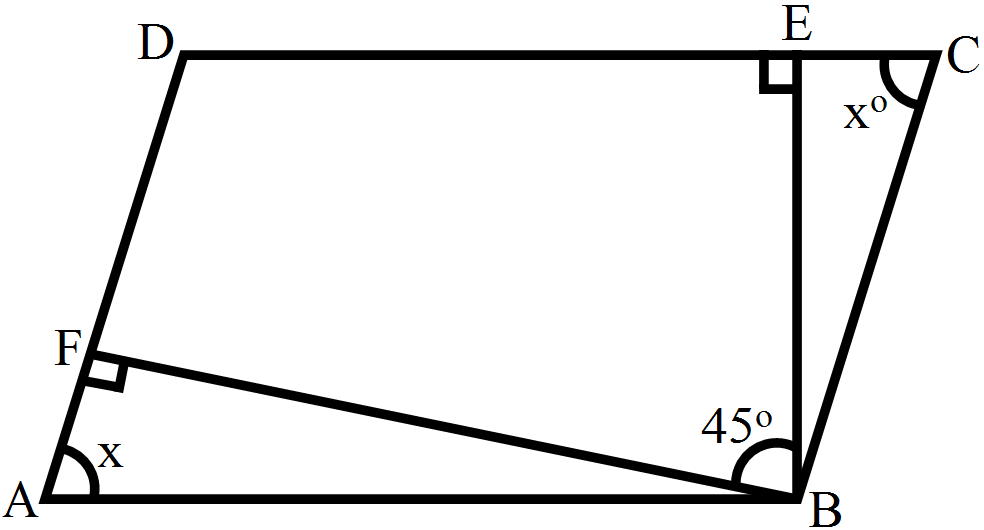
The angle between the two altitudes of a parallelogram through the vertex of an obtuse angle of the parallelogram is $45^\circ $. Find the angles of the parallelogram.
AnswerLet $ABCD$ be a parallelogram, where $BE$ and $BF$ are the perpendiculars through the vertex $B$ to the sides $DC$ and $AD, $respectively.
Let $\angle\text{A}=\angle\text{C}=\text{x},\angle\text{B}=\angle\text{D}=\text{y}$ [opposites angles are equal in parallelogram]
Now, $\angle\text{A}+\angle\text{B}=180^\circ$
$\Rightarrow \text{x}+\angle\text{ABF}+\angle\text{FBF}+\angle\text{EBC}=180^\circ$
$\Rightarrow\text{x} + 90^\circ \text{− x} + 45 + 90^\circ- \text{x} = 180^\circ$
$\Rightarrow-\text{ x} = 180^\circ - 225$
$\Rightarrow\text{x}=135^\circ$
$\Rightarrow\angle\text{B}=45^\circ+45^\circ+45^\circ=135^\circ$
$\Rightarrow\angle\text{D}=135^\circ$
Hence, the angles are $45^{\circ}, 135^{\circ}, 45^{\circ}, 135^{\circ}$
View full question & answer→Question 323 Marks
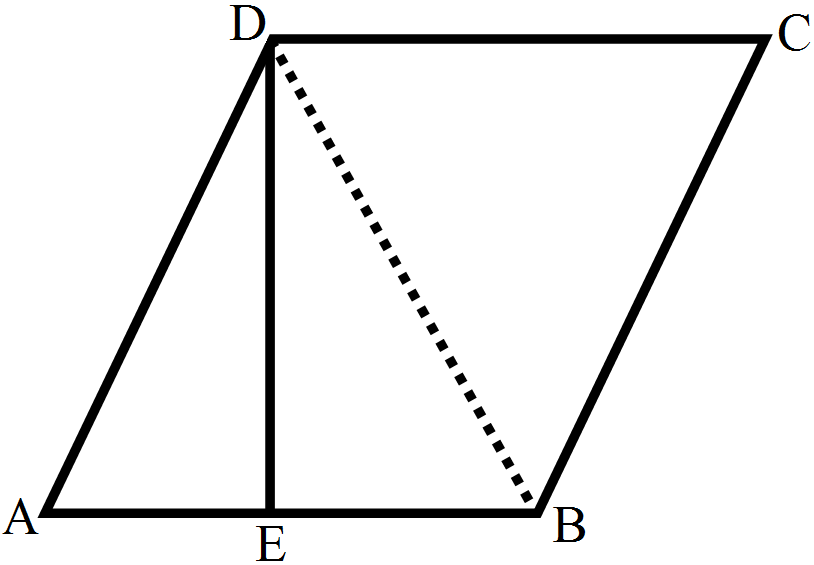
$ABCD$ is a rhombus such that the perpendicular bisector of $AB$ passes through $D$. Find the angles of the rhombus. Hint: Join $BD$. Then $\triangle\text{ABC}$ is equilateral.
AnswerLet $ABCD$ be a rhombus in which $DE$ is perpendicular bisector of $AB$ Join $BD$.
Then, in $\triangle\text{AED}\ \text{and}\ \triangle\text{BED},$
we have $\text{AE}=\text{EB} \text{ED}=\text{ED}$
$\angle\text{AED}=\angle\text{DEB}=90^\circ$ Then, by $SAS$ rule, $\triangle\text{AED}\cong\angle\text{ADB}$
$\therefore\text{AD}=\text{DB}=\text{AB}$
Thus,$\triangle\text{ADB}=60^\circ$ is an equilateral triangle. $\therefore\angle\text{DAB}=\angle\text{DAB}=\angle\text{ADB}=60^\circ$
$\Rightarrow\angle\text{DCB}=60^\circ$
Now, $\Rightarrow60^\circ+\angle\text{DAB}+\angle\text{ABC}=180^\circ$
$\Rightarrow60^\circ+\angle\text{ABD}+\angle\text{DBC}=180^\circ$
$\Rightarrow60^\circ+60^\circ+\angle\text{DBC}=180^\circ$
$\Rightarrow\angle\text{DBC}=60^\circ$
$\therefore\angle\text{ABC}=\angle\text{DBC}=60^\circ+60^\circ=120^\circ$
$\therefore\angle\text{ADC}=120^\circ$
Hence, the angles of the rhombus are $60^\circ , 120^\circ , 60^\circ , 120^\circ .$
View full question & answer→Question 333 Marks
In parallelogram $PQRS, O$ is the mid point of $SQ$. Find $\angle\text{S},\angle\text{R},\text{PQ},\text{QR}$ and diagonal $PR.$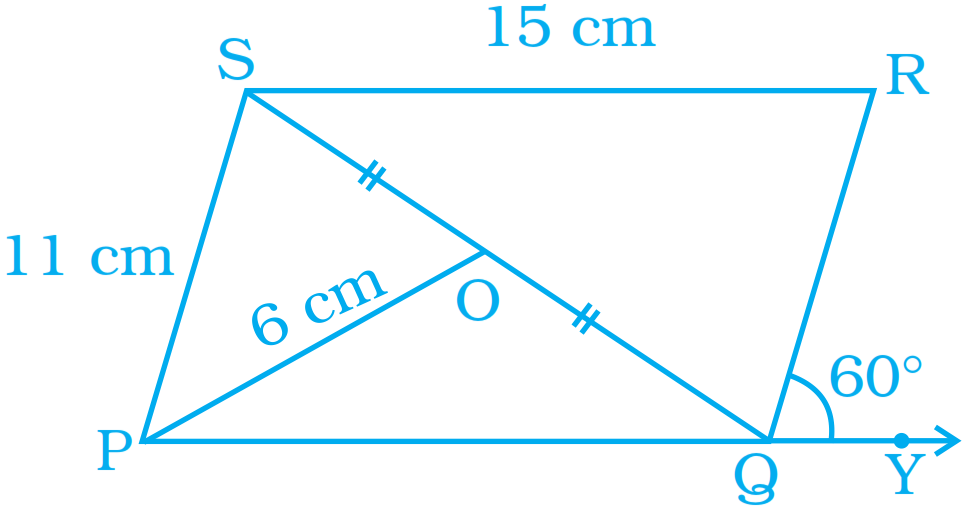
AnswerGiven, $\angle\text{RQY}=60^\circ$
$\therefore\angle\text{RQZ}=120^\circ$
$\therefore\angle\text{S}=120^\circ$ By the angle sum property of a quadrilateral, $\Rightarrow\angle\text{P}+\angle\text{Q}+\angle\text{R}+\angle\text{S}=360^\circ$
$\Rightarrow\angle\text{P}+\angle\text{R}=120^\circ+120^\circ=360^\circ$
$\Rightarrow\angle\text{P}+\angle\text{R}=120^\circ$
$\Rightarrow2\angle\text{P}=120^\circ$
$\Rightarrow\angle\text{P}=60^\circ$
$\Rightarrow\angle\text{P}+\angle\text{R}=60^\circ$ Also, $\text{SR}=15\text{cm}$
$\therefore\ \text{PQ}=15\text{cm}$ And $\text{PS}=11\text{cm}$
$\therefore\ \text{QR}=11\text{cm}$ And $\text{PR}=2\times\text{PO}=2\times6=12.$
View full question & answer→Question 343 Marks
In kite $WEAR, \angle\text{WEA}=70^\circ\text{and}\angle\text{ARW}=80^\circ.\ $Find the remaining two angles.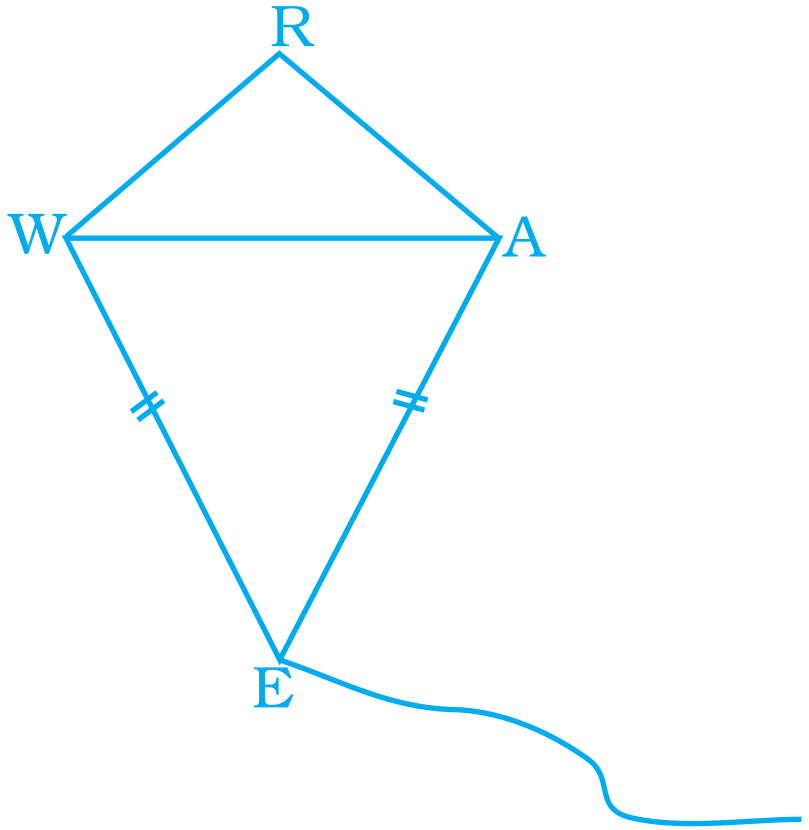
AnswerGiven, in a kite $WEAR$, $\angle\text{WEA}=70^\circ,\angle\text{ARM}=80^\circ$
Now, by the interior angle sum property of a quadrilateral,
$\angle\text{RWE}+\angle\text{WEA}+\angle\text{EAR}+\angle\text{ARW}=360^\circ$
$\Rightarrow\angle\text{RWE}+70^\circ+\angle\text{EAR}+80^\circ=360^\circ$
$\Rightarrow\angle\text{RWE}+\angle\text{EAR}+360^\circ-150^\circ$
$\Rightarrow\angle\text{RWA}+\angle\text{RAW}+210^\circ\ \ \dots(\ \text{i})$
Now, $\angle\text{RWA}+\angle\text{RAW}\ \ \dots(\text{ii})\ [\text{RW}=\text{RA}]$
& $\angle\text{AWE}+\angle\text{WAE}\ \ \dots(\text{iii})\ [\text{WE}=\text{AE}]$
On adding eqs. $(ii)$ and
$(iii)$, we get $\angle\text{RWA}+\angle\text{AWE}+\angle\text{RAW}+\angle\text{WAE}$
$\Rightarrow\angle\text{RWE}=\angle\text{RAE}$
From eq.$(i),$
$2\angle\text{RWE}=120^\circ$
$\Rightarrow\angle\text{RWE}=150^\circ$
$\Rightarrow\angle\text{RWE}=\angle\text{RAE}=150^\circ.$
View full question & answer→Question 353 Marks
A line l is parallel to line m and a transversal p interesects them at $X, Y$ respectively. Bisectors of interior angles at $X$ and $Y$ interesct at $P$ and $Q.$ Is $PXQY$ a rectangle? Given reason.
AnswerGiven, $\angle\text{MST}=40^\circ$
$\text{In}\triangle\text{MST},$ By the angle sum property of a triangle, $\angle\text{TMS}+\angle\text{MST}+\angle\text{STM}=180^\circ$
$\Rightarrow\angle\text{STM}=180^\circ-(90^\circ+40^\circ)=50^\circ$
$\therefore\angle\text{SON}=\angle\text{STM}=50^\circ$ Now, in the $\triangle\text{ONS},$
$\angle\text{ONS}+\angle\text{OSN}+\angle\text{SON}=180^\circ$
$\angle\text{OSN}=180^\circ-(90^\circ+50^\circ)$
$=180^\circ-140^\circ=40^\circ$ Moreover, $\angle\text{SON}+\angle\text{TSO}=180^\circ$
$\Rightarrow\angle\text{SON}+\angle\text{TSM}+\angle\text{NSM}+\angle\text{OSN}=180^\circ$
$\Rightarrow50^\circ+40^\circ+\angle\text{NSM}+40^\circ=180^\circ$
$\Rightarrow90^\circ+40^\circ\angle\text{NSM}=180^\circ.$
View full question & answer→