Questions

3 Marks Question

🎯

Test yourself on this topic

4 questions · timed · auto-graded

Question 13 Marks
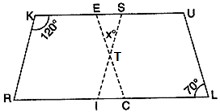
In the below figure both $RISK$ and $CLUE$ are parallelograms. Find the values of $x.$
Answer
Risk is a parallelogram
$\therefore \angle RIS = \angle RKS = 120^\circ $
$Also, \angle RIS + \angle ISK = 180^\circ $
$ \Rightarrow 120^\circ + \angle ISK = 180^\circ $
$ \Rightarrow \angle ISK = 180^\circ – 120^\circ $
$ \Rightarrow \angle ISK = 60^\circ $
$ \because CLUE$ is a parallelogram
$\therefore \angle CES = \angle CLU = 70^\circ $
In triangle $EST,$
$x^\circ + \angle TSE + \angle TES = 180^\circ $ [By angle sum property of a triangle]
$\Rightarrow x^\circ + \angle ISK + \angle CES = 180^\circ $
$ \Rightarrow x^\circ + 60^\circ + 70^\circ = 180^\circ $ [From ($1)$ and $(2)]$
$\Rightarrow x^\circ + 130^\circ = 180^\circ $
$ \Rightarrow x^\circ = 180^\circ – 130^\circ = 50^\circ $
$ \Rightarrow x = 50^\circ $
View full question & answer
Question 23 Marks
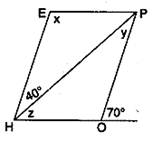
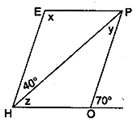
The adjacent figure $HOPE$ is a parallelogram. Find the angle measures $x, y$ and $z.$ State the properties you use to find them.
Answer
$x = 180^\circ – 70^\circ = 110^\circ $ [ Opposite angles are equal; Sum of angles on a straight line $= 180^\circ ]$
$y = 40^\circ $ [ Vertically opposite angles are equal]
$40^\circ + z + x = 180^\circ $ [ Angle Sum Property]
$\Rightarrow 40^\circ + z +110^\circ = 180^\circ $
$ \Rightarrow z + 150^\circ = 180^\circ $
$ \Rightarrow z = 180^\circ – 150^\circ $
$ \Rightarrow z = 30^\circ $.
View full question & answer
Question 33 Marks
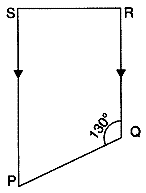
Find the measure of $\angle P$ and $\angle S$. If $\overline {SP} \parallel \overline {RQ} $ in the figure. $($If you find $m\angle R$, is there more than one method to find $m\angle P ?)$
Answer
$i.$ Method :
$ii. \because \mathrm { SP } \| \mathrm { RQ } $
$ \therefore m \angle P + m \angle Q = 180^\circ $
$ \Rightarrow m \angle P + 130^\circ = 180^\circ $
$m \angle P = 180^\circ - 130^\circ $
$m \angle P = 50^\circ $
$m \angle R = 90^\circ $
$iii.$​​​​​​​ Method :
$m \angle R = 90^\circ $
$m \angle S = 90^\circ $
$m \angle Q = 130^\circ $
By angle sum property of a quadrilateral.
$iv. m \angle P + m \angle Q + m \angle R + m \angle S = 360^\circ $
$ \Rightarrow m \angle P + 130^\circ + 90^\circ + 90^\circ = 360^\circ $
$ \Rightarrow m \angle P + 310^\circ = 360^\circ $
$ \Rightarrow m \angle P = 360^\circ - 310^\circ $
$ \Rightarrow m \angle P = 50^\circ .$
View full question & answer
Question 43 Marks
What is the sum of the measures of the angles of a convex quadrilateral? Will this property hold if the quadrilateral is not convex?
(Make a non-convex quadrilateral and try!)
Answer
Let $ABCD$ is a convex quadrilateral, then we draw a diagonal $AC$ which divides the quadrilateral in two triangles.
$\angle \mathrm{A}+\mathrm{B}+\angle \mathrm{C}+\angle \mathrm{D}$
$= \angle 1+\angle 6+\angle 5+\angle 4+\angle 3+\angle 2$
$= (\angle 1+\angle 2+\angle 3)+(\angle 4+\angle 5+\angle 6)$
$= 180^{\circ}+180^{\circ}$ [By Angle sum property of triangle]
$= 360^{\circ}$
Hence, the sum of measures of the triangles of a convex quadrilateral is $360^{\circ}$.
Yes, if quadrilateral is not convex then, this property will also be applied.
View full question & answer
3 Marks Question - MATHS STD 8 Questions - Vidyadip