Questions

5 Marks Questions

🎯

Test yourself on this topic

11 questions · timed · auto-graded

Question 15 Marks
The four angles of a quadrilateral are as $3 : 5 : 7 : 9$. Find the angles.
Answer
Sum of four angles of a quadrilateral $= 360^\circ$ and ratio in angles $= 3 : 5 : 7 : 9$
Let first angles $= 2x$
Then second angle $= 5x$
third angle $= 7x$ and
fourth angle $= 9x 3x + 5x + 7x + 9x = 360^\circ$
 $\Rightarrow 24x = 369^\circ$
$\Rightarrow\text{x}=\frac{360}{24}=15^\circ$
First angle$= 3x = 3 \times 15^\circ = 45^\circ$
Second angle $= 5x = 5 \times 15^\circ = 75^\circ$​​​​​​​
Third angle $= 7x = 7 \times 15^\circ = 105^\circ$
Fourth angle $= 9x = 9 \times 15^\circ = 135^\circ$
View full question & answer
Question 25 Marks
In a convex hexagon, prove that the sum of all interior angles is equal to twice the sum of its exterior angles formed by producing the sides in the same order.
Answer


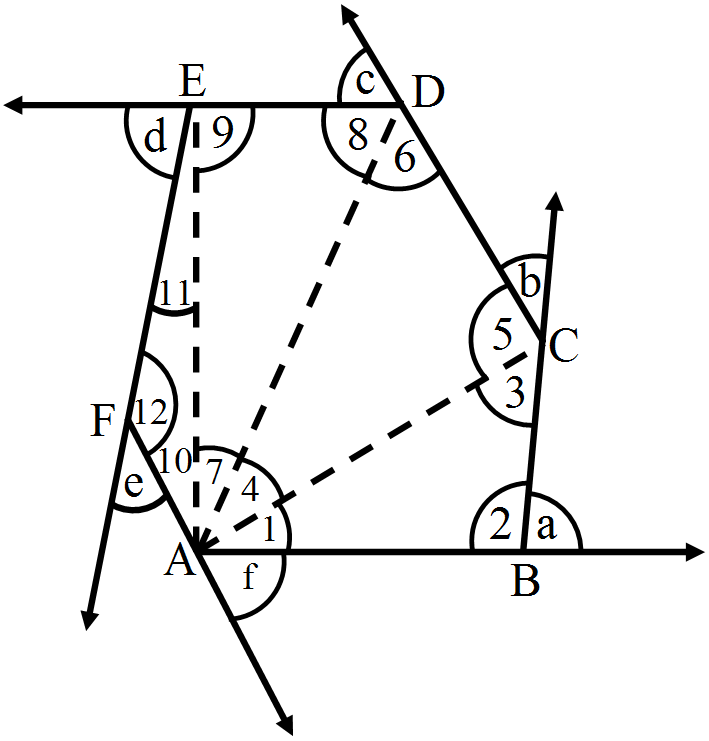
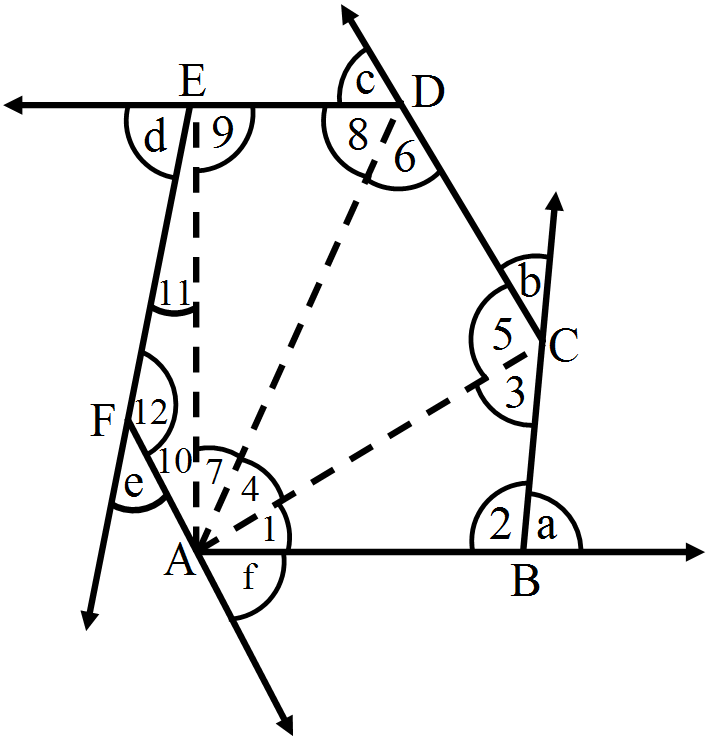
In a convex hexagon $ABCDEF$, its sides $AB, BG, CD, DE, EF$ and $FA$ are produced in order forming exterior angles $a, b, c, d, e, f$
$\angle\text{a}+\angle\text{b}+\angle\text{c}+\angle\text{d}+\angle\text{e}+\angle\text{f}=4$ right angles (By definition)
By joining $AC, AD,$ and $AE, 4$ triangles $ABC, ACD, ADE$ and $AEF$ are formed
$\text{In}\ \triangle\text{ABC}$,
$\angle1+\angle2+\angle3=180^\circ=2$ right angle (Sum of angles of a triangle)$ …… (i)$
Similarly,
$\text{In}\ \triangle\text{ACD}$,
$\angle4+\angle5+\angle6=180^\circ=2$ right angles
$\text{In}\ \triangle\text{ADE}$,
$\angle1+\angle8+\angle9=2$ right angles $…(iii)$
$\text{In}\ \triangle\text{AEF}$,
$\angle10+\angle11+\angle12=2$ right angles $…(iv)$
Joining $(i), (ii), (iii)$ and $(iv)$
$\angle1+\angle2+\angle3+\angle4+\angle5+\angle6+\\\angle7+\angle8+\angle9+\angle10+\angle11+\angle12=8$ right angles
$\Rightarrow\angle2+\angle3+\angle5+\angle6+\angle8+\angle9+\\\angle11+\angle12+\angle1+\angle4+\angle7+\angle10=8$ right angles
$\Rightarrow\angle\text{B}+\angle\text{C}+\angle\text{D}+\angle\text{E}+\angle\text{f}+\angle\text{A}=8$ right angles
$\Rightarrow\angle\text{A}+\angle\text{B}+\angle\text{C}+\angle\text{D}+\angle\text{E}+\angle\text{f}=2$
$\Big(\angle\text{a}+\angle\text{b}+\angle\text{c}+\angle\text{d}+\angle\text{e}+\angle\text{f}\Big)$
Sum of all interior angles $= 2$(The sum of exterior angles)
Hence proved.
View full question & answer
Question 35 Marks
Determine the number of sides of a polygon whose exterior and interior angles are in the ratio $1 : 5.$
Answer
Ratio in exterior angle and interior angles of a regular polygon $= 1 : 5$ But
sum of interior and exterior angles $= 180^\circ$ (Linear pair)
$\therefore\text{Exterior angle}=\frac{180^\circ\times1}{1+5}$
$=\frac{180^\circ\times1}{6}=30^\circ$
$=\frac{180^\circ\times1}{6}=30^\circ$ and
Interior angles $=\frac{180^\circ\times5}{6}=150^\circ$
Let number of sides of the polygon $= n$
$\therefore\frac{2\text{n}-4}{\text{n}}\times90^\circ=150^\circ$
$\Rightarrow\frac{2\text{n}-4}{\text{n}}=\frac{150}{90}=\frac{5}{3}$
By Cross multiplication: $6n – 12 = 5n$
$\Rightarrow 6n – 5n = 12$
$ \Rightarrow n = 12$
Number of sides of polygon is $12$.
View full question & answer
Question 45 Marks
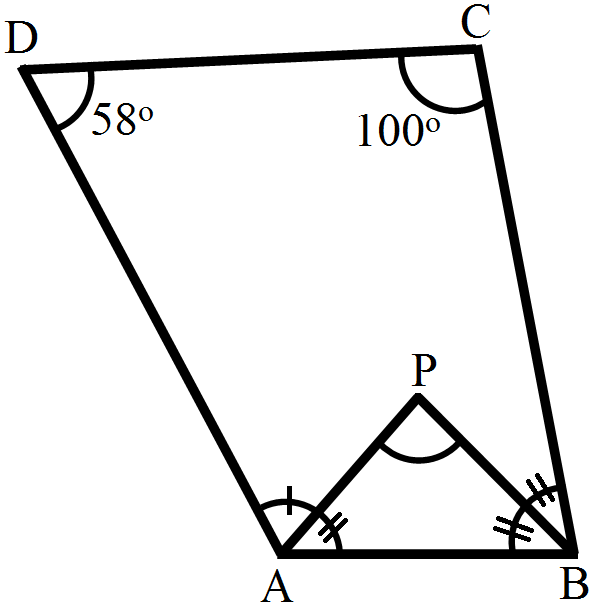
In the figure, the bisectors of $\angle\text{A}$ and $\angle\text{B}$ meet at a point $P$. If $\angle\text{C}=100^\circ$ and $\angle\text{D}=50^\circ$, find the measure of $\angle\text{APB}$.
Answer


In quadrilateral $ABCD$,
$\angle\text{D}=50^\circ$
$\angle\text{C}=100^\circ$
$PA$ and $PB$ are the bisectors of $\angle\text{A}$ and $\angle\text{B}$.
In quadrilateral $ABCD$,
$\angle\text{A}+\angle\text{B}+\angle\text{C}+\angle\text{D}=360^\circ$ (Sum of angles of a quadrilateral)
$\Rightarrow\angle\text{A}+\angle\text{B}+100^\circ+50^\circ=360^\circ$
$\Rightarrow\angle\text{A}+\angle\text{B}+150^\circ=360^\circ$
$\Rightarrow\angle\text{A}+\angle\text{B}=360^\circ-150^\circ=210^\circ$
and
$\frac{1}{2}+\angle\text{A}+\frac{1}{2}+\angle\text{B}=\frac{210}{2}$
$=105^\circ$
($PA$ and $PB$ are bisector of $\angle\text{A}$ and $\angle\text{B}$ respectively)
$\angle\text{PAB}+\angle\text{PBA}=105^\circ$
$\Rightarrow\angle\text{PAB}+\angle\text{PBA}+\angle\text{APB}=180^\circ$ (Sum of angles of a triangle)
$\Rightarrow105^\circ+\angle\text{APB}=180^\circ$
$\Rightarrow\angle\text{APB}=180^\circ-105^\circ=75^\circ$
$\angle\text{APB}=75^\circ$
View full question & answer
Question 55 Marks
In a convex hexagon, prove that the sum of all interior angles is equal to twice the sum of its exterior angles formed by producing the sides in the same order.
Answer


In a convex hexagon $ABCDEF$, its sides $AB, BG, CD, DE, EF$ and $FA$ are produced in order forming exterior angles $a, b, c, d, e, f$
$\angle\text{a}+\angle\text{b}+\angle\text{c}+\angle\text{d}+\angle\text{e}+\angle\text{f}=4$ right angles (By definition)
By joining $AC, AD,$ and $AE, 4$ triangles $ABC, ACD, ADE$ and $AEF$ are formed
$\text{In}\ \triangle\text{ABC}$,
$\angle1+\angle2+\angle3=180^\circ=2$ right angle (Sum of angles of a triangle) $…… (i)$
Similarly,
$\text{In}\ \triangle\text{ACD}$,
$\angle4+\angle5+\angle6=180^\circ=2$ right angles
$\text{In}\ \triangle\text{ADE}$,
$\angle1+\angle8+\angle9=2$ right angles$ …(iii)$
$\text{In}\ \triangle\text{AEF}$,
$\angle10+\angle11+\angle12=2$ right angles $…(iv)$
Joining $(i), (ii), (iii)$ and $(iv)$
$\angle1+\angle2+\angle3+\angle4+\angle5+\angle6+\angle7+\angle8+\angle9+\angle10+\angle11+\angle12=8$ right angles
$\Rightarrow\angle2+\angle3+\angle5+\angle6+\angle8+\angle9+\angle11+\angle12+\angle1+\angle4+\angle7+\angle10=8$ right angles
$\Rightarrow\angle\text{B}+\angle\text{C}+\angle\text{D}+\angle\text{E}+\angle\text{f}+\angle\text{A}=8$ right angles
$\Rightarrow\angle\text{A}+\angle\text{B}+\angle\text{C}+\angle\text{D}+\angle\text{E}+\angle\text{f}=2\Big(\angle\text{a}+\angle\text{b}+\angle\text{c}+\angle\text{d}+\angle\text{e}+\angle\text{f}\Big)$
Sum of all interior angles $= 2$(The sum of exterior angles)
Hence proved.
View full question & answer
Question 65 Marks
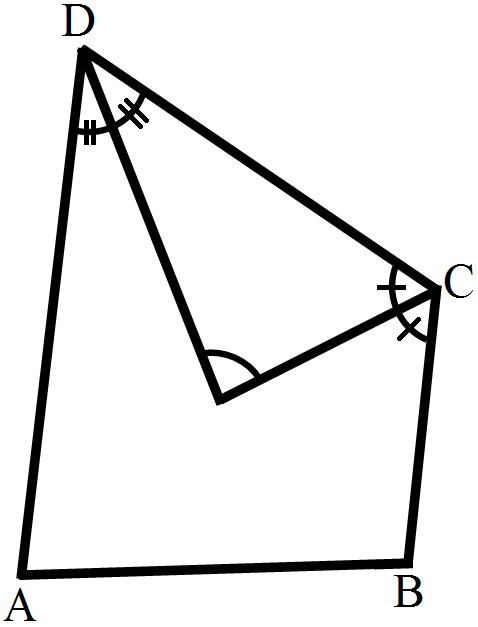
In a quadrilateral $ABCD, CO$ and $DO$ are the bisectors of $\angle\text{C}$ and $\angle\text{D}$ respectively. Prove that $\angle\text{COD}=\frac{1}{2}(\angle\text{A}+\angle\text{B})$.
Answer


In quadrilateral $ABCD$,
$\angle\text{A}+\angle\text{B}+\angle\text{C}+\angle\text{D}=360^\circ$
(Sum of angle of a quadrilateral)
$\Rightarrow\frac{1}{2}\angle\text{A}+\frac{1}{2}\angle\text{B}+\frac{1}{2}\angle\text{C}+\frac{1}{2}\angle\text{D}=180^\circ$
(Dividing by $2$)$....(i)$
But in $\triangle\text{COD},$
$\frac{1}{2}\angle\text{C}+\frac{1}{2}\angle\text{D}+\angle\text{COD}=180^\circ$
(Sum of angle of a triangle)$.......(ii)$
From $(i)$ and $(ii)$,
$\frac{1}{2}\angle\text{A}+\frac{1}{2}\angle\text{B}+\frac{1}{2}\angle\text{C}+\frac{1}{2}\angle\text{D}\\=\frac{1}{2}\angle\text{C}+\frac{1}{2}\angle\text{D}+\angle\text{COD}$
$\Rightarrow\angle\text{COD}=\frac{1}{2}\angle\text{A}+\frac{1}{2}\angle\text{B}$
$\Rightarrow\angle\text{COD}=\frac{1}{2}\big(\angle\text{A}+\angle\text{B}\big)$
Hence proved
View full question & answer
Question 75 Marks
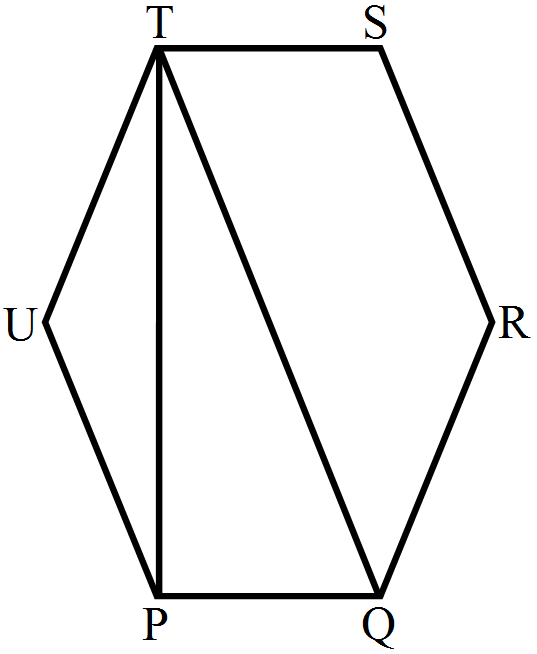
$PQRSTU$ is a regular hexagon. Determine each angle of $\triangle\text{PQT}$.
Answer


$\therefore$ If each interior angle $=\frac{2\text{n}-4}{\text{n}}\times90^\circ$
$=\frac{2\times6-4}{\text{6}}\times90^\circ$
$=\frac{8}{\text{6}}\times90^\circ=120^\circ$
In $\triangle\text{PUT},\text{PU}=\text{UT}$
$\angle\text{UPT}=\angle\text{UTP}$
But $\angle\text{UPT}+\angle\text{UTP}=180^\circ-\angle\text{U}$
$=180^\circ-120^\circ=60^\circ$
$\angle\text{UPT}=\angle\text{UTP}=30^\circ$
$\angle\text{TPQ}=120^\circ-30^\circ=90^\circ$ ($QT$ is diagonal which bisect $∠Q$ and $∠T$)
$\angle\text{PQT}=\frac{120}{2}=60^\circ$
Now in $\triangle\text{PQT}$,
$\angle\text{TPQ}+\angle\text{PQT}+\angle\text{PTQ}=180^\circ$ (Sum of angles of a triangle)
$\Rightarrow90^\circ+60^\circ+\angle\text{PTQ}=180^\circ$
$\Rightarrow150^\circ+\angle\text{PTQ}=180^\circ$
$\Rightarrow\angle\text{PTQ}=180^\circ-150^\circ=30^\circ$
Hence in $\triangle\text{PQT}$,
$\angle\text{P}=90^\circ$
$\angle\text{Q}=60^\circ$
and
$\angle\text{T}=30^\circ$
View full question & answer
Question 85 Marks


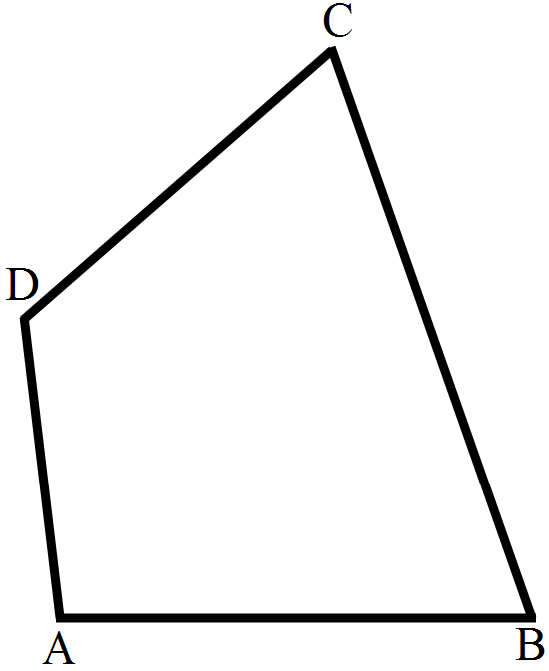
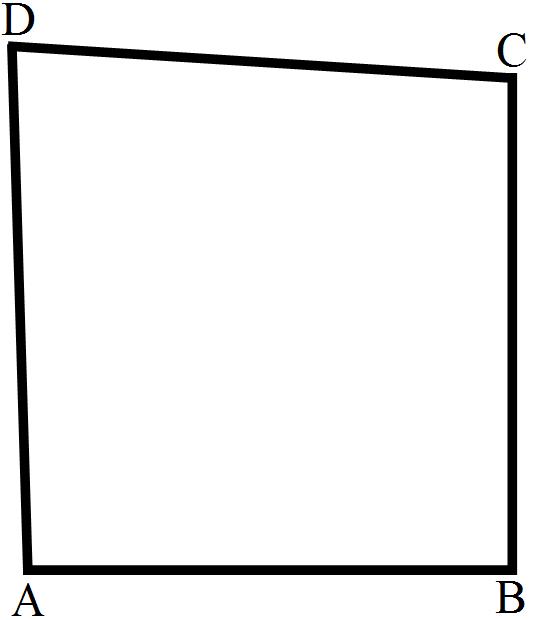
In the figure, $\text{ABCD}$ is a quadrilateral.
$i.$ Name a pair of adjacent sides.
$ii.$ Name a pair of opposite sides.
$iii.$ How many pairs of adjacent sides are there?
$iv.$ How many pairs of Opposite sides are there?
$v.$ Name a pair of adjacent angles.
$vi.$ Name a pair of opposite angles.
$vii.$ How many pairs of adjacent angles are there?
$viii.$ How many pairs of opposite angles are there?
Answer
In the figure, $\text{ABCD}$ is a quadrilateral,
$i.$ Pairs of adjacent sides are $\text{AB, BC, BC, CD, CD, DA, DA, AB.}$
$ii.$ Pairs of opposite sides are $\text{AB}$ and $\text{CD, BC}$ and $\text{AD}$.
$iv.$ There are four pairs of adjacent sides.
$iv.$ There are two pairs of opposite sides.
$v.$ Pairs of adjacent angles are $\angle\text{A}$, $\angle\text{B}$, $\angle\text{B}$, $\angle\text{C}$, $\angle\text{C}$, $\angle\text{D}$, $\angle\text{D}$, $\angle\text{A}$.
$vi.$ Pairs of opposite angles are $\angle\text{A}$ and $\angle\text{C}$, $\angle\text{B}$ and $\angle\text{D}$.
$vii.$ There are four pairs of adjacent angles.
$viii.$There are two pairs of opposite angles.
View full question & answer
Question 95 Marks
In a quadrilateral $ABCD$, the angles $A, B, C$ and $D$ are in the ratio $1 : 2 : 4 : 5$. Find the measure of each angle of the quadrilateral.
Answer


Sum of angles $A, B, C$ and $D$ of a quadrilateral $= 360^\circ $
$\angle\text{A}+\angle\text{B}+\angle\text{C}+\angle\text{D}=360^\circ$
But $\angle\text{A}=\angle\text{B}=\angle\text{C}=\angle\text{D}=1:2:4:5$
Let $\angle\text{A}=\text{x}$
Then $\angle\text{B}=2\text{x}$
$\angle\text{C}=4\text{x}$
$\angle\text{D}=5\text{x}$
$\text{x}+2\text{x}+4\text{x}+5\text{x}=360^\circ$
$\Rightarrow​​12\text{x}=360^\circ$
$\Rightarrow​​\text{x}=\frac{360}{12}=30^\circ$
$\angle\text{A}=\text{x}=30^\circ$
$\angle\text{B}=2\text{x}$
$=2\times30^\circ=60^\circ$
View full question & answer
Question 105 Marks
The sum of the interior angles of a polygon is three times the sum of its exterior angles. Determine the number of sides of the polygon.
Answer
Let number of sides of a regular polygon $= n$
Each interior angle $=\frac{2\text{n}-4}{\text{n}}$
right angles Sum of all interior angles $=\frac{2\text{n}-4}{\text{n}}\times\text{n}$
right angles $= (2n - 4)$ right angles But sum of exterior angles = 4 right angles
According to the condition, $(2n - 4) = 3 \times 4$ (In right angles)
$\Rightarrow 2n – 4 = 12 $
$\Rightarrow 2n = 12 + 4 = 16$
$ \Rightarrow n = 8$ 
Number of sides of the polygon $= 8$
View full question & answer
Question 115 Marks
The sides of a quadrilateral are produced in order. What is the sum of the four exterior angles?
Answer


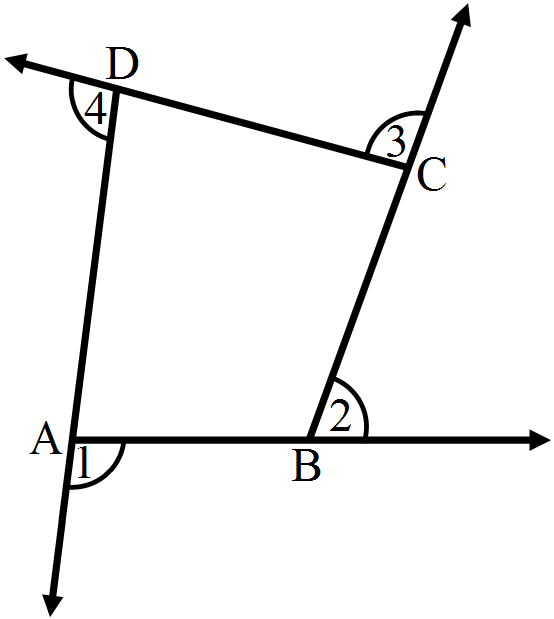
The sides of a quadrilateral $ABCD$ are produced in order, forming exterior angles $\angle1$, $\angle2$, $\angle3$ and $\angle4$.
Now,
$\angle\text{DAB}+\angle1=180^\circ$ (Linear pair) ……(i)
Similarly,
$\angle\text{ABC}+\angle2=180^\circ$
$\angle\text{BCD}+\angle3=180^\circ$
and
$\angle\text{CDA}+\angle4=180^\circ$
Adding, we get
$\angle\text{DAB}+\angle1+\angle\text{ABC}+\angle2+\angle\text{BCD}+\angle3+\angle\text{CDA}+\angle4$
$=180^\circ+180^\circ+180^\circ+180^\circ$
$=720^\circ$
$\Rightarrow\angle\text{DAB}+\angle\text{ABC}+\angle\text{BCD}+\angle\text{CDA}+\angle1+\angle2+\angle3+\angle4$
$=720^\circ$
But
$\angle\text{DAB}+\angle\text{ABC}+\angle\text{CDA}+\angle\text{ADB}=360^\circ$
(Sum of angles of a quadrilateral)
$360^\circ+\angle1+\angle2+\angle3+\angle4=720^\circ$
$\Rightarrow\angle1+\angle2+\angle3+\angle4$
$=720^\circ-360^\circ=360^\circ$
Sum of exterior angles $= 360^\circ $
View full question & answer
5 Marks Questions - MATHS STD 8 Questions - Vidyadip