Questions · Page 1 of 5

M.C.Q. [I MARKS]

🎯

Test yourself on this topic

50 questions · timed · auto-graded

MCQ 11 Mark
Which of the following feature will help you in distinguishing a plant cell from an animal cell?
  • Cell wall.
  • B
    Cell membrane.
  • C
    Mitochondria.
  • D
    Nucleus.
Answer
Correct option: A.
Cell wall.
A cell wall is the distinguishing feature between a plant cell and animal cell. It is thick wall made up of cellulose around cell membrane that exclusively present only in plant cell.
View full question & answer
MCQ 21 Mark
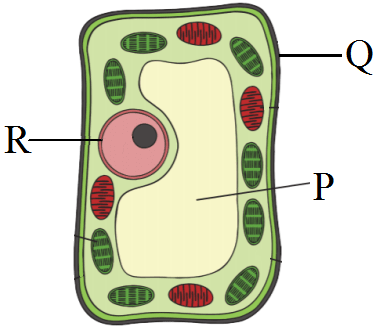
Refer to the given figure and select the incorrect statement$(s)$.
$(i)$
The part labelled $P$ is found in plant cell only.
$(ii)$
The part labelled $Q$ is cell wall, which provides rigidity to a plant cell.
$(iii)$
The part labelled $R$ is the controlling centre.
$(iv)$
The part labelled $R$ gets its shape from part labelled $P$.
  • A
    $(iv)$ only
  • $(i)$ and $(iv)$ only
  • C
    $(ii)$ and $(iii)$ only
  • D
    $(iii)$ only
Answer
Correct option: B.
$(i)$ and $(iv)$ only
The given figure is of plant cell. The part labelled $P$ is vacuole. It is found not only in plant cells, but is also found in animal cells. The part labelled $R$ (nucleus) has its own shape. Its shape is not dependent on the shape of vacuole although its position may depend upon the vacuole. $Q$ is cell wall which provides rigidity to plant cell.
View full question & answer
MCQ 31 Mark
Of the following parts of a cell listed below, name the part that is common to plant cell, animal cell and a bacterial cell.
  • A
    Chloroplast.
  • B
    Cell wall.
  • Cell membrane.
  • D
    Nucleus.
Answer
Correct option: C.
Cell membrane.

Cell membrane is the common part of every cell. It encloses the protoplasm, protects the cell, gives the cell its shape and control the entry and exit of substances.

View full question & answer
MCQ 41 Mark
In an animal cell, which among the following organelles has its own $DNA$?
  • A
    Chloroplast
  • Mitochondria
  • C
    Chromoplast
  • D
    Leucoplast
Answer
Correct option: B.
Mitochondria
Mitochondria and plastids are semi autonomous cell organelles since they possess their own $DNA$ and ribosomes. Chloroplasts, chromoplasts and leucoplasts are types of plastids and are absent in animal cells.
View full question & answer
MCQ 51 Mark
Choose the correct statement with respect to unicellular organisms.
  • A
    In unicellular organisms, tissues work in coordination to perform different functions.
  • B
    Unicellular organisms do not require food.
  • Unicellular organisms respire and reproduce.
  • D
    AH unicellular organisms move by cilia.
Answer
Correct option: C.
Unicellular organisms respire and reproduce.
The organisms which are made of single cell are called unicellular organisms. The single cell behaves as a complete organism performing basic functions such as respiration, reproduction, nutrition, movement, etc.
View full question & answer
MCQ 61 Mark
Which one of the following terms is not a part of the nucleus?
  • Ribosome
  • B
    Nucleolus
  • C
    Chromosome
  • D
    Gene
Answer
Correct option: A.
Ribosome

Rbosome is not a part of nucleus. They are found floating in the cytosol or attached to the endoplasmic reticulum. Nucleus is the largest organelle in cell that contains thread-like structure is called chromosomes on which genes are present. Nucleolus is the round irregular structures present inside nucleus.

View full question & answer
MCQ 71 Mark
Green colour of leaves is due to the presence of the pigment.
  • Chlorophyll.
  • B
    Mitochondria.
  • C
    Ribosomes.
  • D
    Chloroplast.
Answer
Correct option: A.
Chlorophyll.
The pigment chlorophyll present in the chloroplasts, which is responsible for green colour of leaves. It can absorb solar energy for photosynthesis.
View full question & answer
MCQ 81 Mark
Cells present in living organism differ in:
  • A
    Numbers
  • B
    Shape
  • C
    Size
  • All of these
Answer
Correct option: D.
All of these
View full question & answer
MCQ 91 Mark
Which of the following is the correct combination?
  • Lysosomes - Intracellular digestion
  • B
    Microtubules - Respiration.
  • C
    Mitochondria - Cell secretion.
  • D
    Golgi complex - Energy.
Answer
Correct option: A.
Lysosomes - Intracellular digestion
In a cell the following organelles perform the following functions. Intracellular digestion - lysosome, intracellular respiration mitochondira, intracellular movement - microtubules, cell secretion - golgi complex.
View full question & answer
MCQ 101 Mark
$............$ is the largest cell.
  • A
    Human nerve cell
  • Egg of an ostrich
  • C
    Egg of blue whale
  • D
    Bacterial cell
Answer
Correct option: B.
Egg of an ostrich
View full question & answer
MCQ 111 Mark
The organelles which provide energy for all activities of a cell are:
  • A
    Chloroplasts.
  • Mitrochondria.
  • C
    Golgi bodies.
  • D
    Ribosomes.
Answer
Correct option: B.
Mitrochondria.
Mitochondria is the site of cellular respiration or oxidation of food in a cell. It uses glucose and oxygen to produce energy. Hence, it is knowns as “Powerhouse of the cell”.
View full question & answer
MCQ 121 Mark
Identify the correct statement about cells.
  • A
    All the cells have nucleus.
  • B
    Cells of an organ have similar structure.
  • Cells of a tissue have similar structure.
  • D
    Shape of all types of cells is round.
Answer
Correct option: C.
Cells of a tissue have similar structure.
A tjssue is a group of similar cells that work together to perform a particular function. The other statements in correct form are:
$-$Only eukaryotic cells have well$-$defined nucleus.
$-$An organ is a collection of differentfissues.
$-$Shape of a cell depends on its function.
View full question & answer
MCQ 131 Mark
Which of the following statements is correct?
  • A
    Plant cells have small vacuoles.
  • B
    An animal cell has cell wall around it.
  • C
    A plant cell does not have plastids.
  • None of these.
Answer
Correct option: D.
None of these.
View full question & answer
MCQ 141 Mark
The thread-like structures present in the nucleus are:
  • A
    Nucleolus.
  • Chromosomes.
  • C
    Genes.
  • D
    Ribosomes
Answer
Correct option: B.
Chromosomes.
Chromosomes are the thread-like structures present in the nucleus. They contain genes that function to transfer the characteristics from the parents to the offsprings.
View full question & answer
MCQ 151 Mark
Which of the following statements is the correct definition of a cell?
  • A
    The cell is the smallest part of a living being.
  • B
    The cell is the part that can be seen only under a microscope.
  • C
    The cell is the starting point in the life of all organisms.
  • The cell is the structural and functional unit of life.
Answer
Correct option: D.
The cell is the structural and functional unit of life.
View full question & answer
MCQ 161 Mark
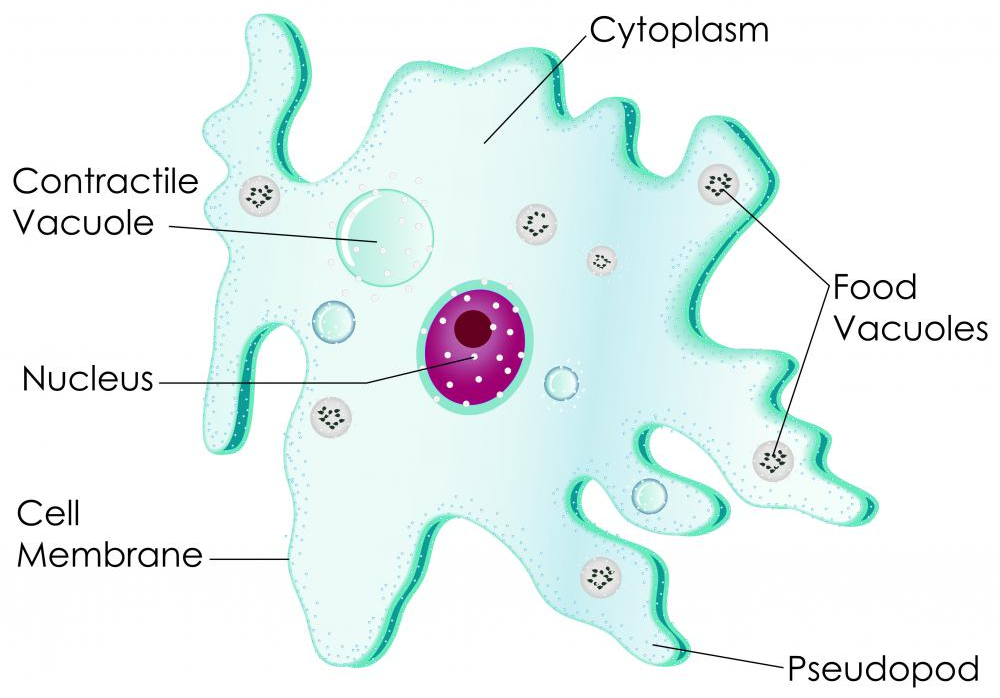
Projections of different lengths protruding out of the body of Amoeba is called.
  • A
    Walking legs
  • B
    Legs
  • Pseudopodia
  • D
    Needle
Answer
Correct option: C.
Pseudopodia
View full question & answer
MCQ 171 Mark
Which of the following is the main difference between onion peel cells and human cheek cells?
  • A
    Presence of mitochondria in onion peel cells.
  • Presence of cell wall in onion peel cells.
  • C
    Absence of plasma membrane in cheek cells.
  • D
    Absence of endoplasmic reticulum in cheek cells.
Answer
Correct option: B.
Presence of cell wall in onion peel cells.
Onion peel cells are plant cells.
View full question & answer
MCQ 181 Mark
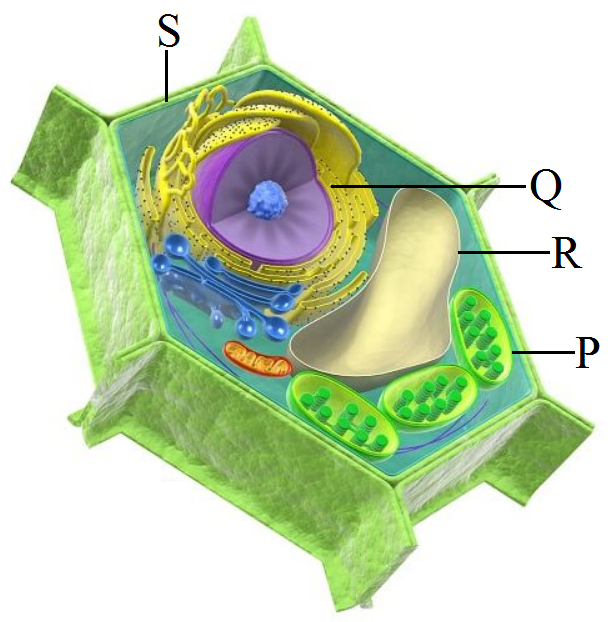
Select the option which correctly match the marked parts $P, Q, R$ and $S$ in the given figure with the functions given below.
$(i)$
Oxidation of food during cell respiration
$(ii)$
Storage and secretion of substances from the cell
$(iii)$
Allow minerals to pass through
$(iv)$
Transport of substances within cell.
  • A
    $P-(iv), Q-(iii), R-(ii), S-(i)$
  • B
    $P-(i), Q-(iv), R-(iii), S-(ii)$
  • C
    $P-(iii), Q-(ii), R-(iv), S-(i)$
  • $P-(iii), Q-(ii), R-(i), S-(iv)$
Answer
Correct option: D.
$P-(iii), Q-(ii), R-(i), S-(iv)$
In the given figure, $P, Q, R$ and $S$ refer to plasma membrane, Golgi complex, mitochondria and endoplasmic reticulum respectively.
View full question & answer
MCQ 191 Mark
Which of the following is/ are the green plastids?
  • A
    Carotenoids
  • B
    Xanthophyll
  • Chloroplasts
  • D
    All the above
Answer
Correct option: C.
Chloroplasts
The green plastids present in plant cells are chloroplasts. Chloroplasts contain green colored pigment called chlorophyll.
View full question & answer
MCQ 201 Mark
Which one of the following is a liquid connective tissue?
  • A
    Bone
  • Blood
  • C
    Pancreas
  • D
    Liver
Answer
Correct option: B.
Blood

The blood is a liquid connective tissue.

View full question & answer
MCQ 221 Mark
Which of the following are prokaryotes?
  • A
    Protozoa.
  • B
    Blue – green algae.
  • C
    Fungi.
  • Bacteria.
Answer
Correct option: D.
Bacteria.
Organisms which do not have true nucleus are called prokaryotes. Bacteria and blue green algae are examples of prokaryotes.
View full question & answer
MCQ 231 Mark
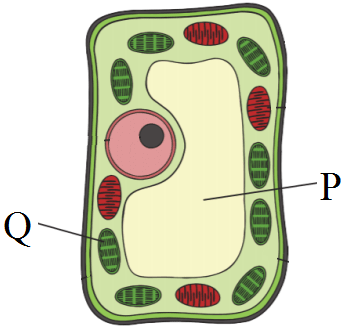
In the given figure, showing the ultrastructure of a plant cell, identify the parts marked as $P$ and $Q$ and select the correct option regarding these.
$(i)$
Part $P$ helps in osmoregulation.
$(ii)$
Cellular respiration occurs in part $Q$.
$(iii)$
Synthesis of sugars occurs in part $Q$.
$(iv)$
Part $P$ provides colour to flowers and fruits.
  • A
    $(i)$ and $(ii)$ only
  • $(i)$ and $(iii)$ only
  • C
    $(iii)$ and $(iv)$ only
  • D
    $(ii)$ and $(iv)$ only
Answer
Correct option: B.
$(i)$ and $(iii)$ only
$P$ in the given figure is vacuole which helps in osmoregulation. $Q$ is chloroplast, which carries out photosynthesis and synthesises sugar.
View full question & answer
MCQ 241 Mark
Which of the following statements is correct?
  • A
    Plant cells have small vacuoles.
  • B
    An animal cell has chloroplast.
  • C
    An animal cell has cell wall around it.
  • None of these.
Answer
Correct option: D.
None of these.
View full question & answer
MCQ 251 Mark
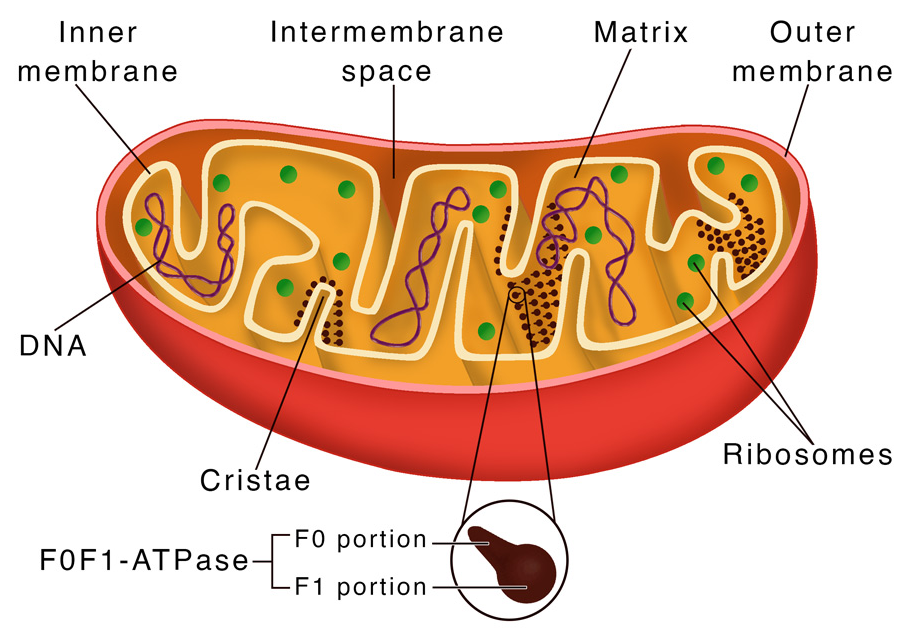
I am a double-membraned cell organelle. I produce energy-rich molecules called $ATP$. I have my own genetic material. Who am $I$?
  • A
    Cell membrane
  • B
    Nucleus
  • Mitochondrion
  • D
    Plastid
Answer
Correct option: C.
Mitochondrion

Mitochondria are double-membraned cell organelle present in the cytoplasm. They have their own genetic material. They produce $ATP$, which are energy-rich molecules. Since they produce energy rich molecules, they are called the 'power house' of the cell.
View full question & answer
MCQ 261 Mark
Which of the following is the non-living part of the plant cell?
  • A
    Nucleus
  • B
    Cytoplasm
  • C
    Mitochondrion
  • Cell wall
Answer
Correct option: D.
Cell wall
Cell wall is the non - living part of the plant cell.
View full question & answer
MCQ 271 Mark
Nucleus is separated from cytoplasm by:
  • Nuclear membrane
  • B
    Nucleoplasm
  • C
    Organs
  • D
    Cell membrane
Answer
Correct option: A.
Nuclear membrane
View full question & answer
MCQ 281 Mark
Which energy molecules is synthesized during cellular respiration to release energy in the organisms?
  • A
    $ADP$
  • $ATP$
  • C
    $NADP$
  • D
    $NADPH$
Answer
Correct option: B.
$ATP$
$ATP$
View full question & answer
MCQ 291 Mark
Which one of the following represents parts of an animal cell?
  • A
    Chloroplast, Cell wall, Vacuole, Cell membrane, Nucleus.
  • B
    Cell membrane, Nucleus, Vacuole, Mitochondria, Cell wall.
  • Cell membrane, Nucleus, Vacuole, Mitochondria, Ribosome.
  • D
    Cell wall, Chloroplast, Mitochondria, Cell membrane, Nucleus.
Answer
Correct option: C.
Cell membrane, Nucleus, Vacuole, Mitochondria, Ribosome.
View full question & answer
MCQ 301 Mark
Which among the following is not the function of lysosomes?
  • A
    Breaking down of food particles.
  • Perform photosynthesis.
  • C
    Protection against the pathogens.
  • D
    Digest worn-out cells.
Answer
Correct option: B.
Perform photosynthesis.
Lysosomes break down and digest food particles in a cell. They also help the cell to protect itself from pathogens, by forming a complex along with the pathogen, called phagosome. They also aid in recycling proteins and digest worn-out cells. Hence, they are known as the 'suicidal bags'. But they do not aid in photosynthesis.
View full question & answer
MCQ 311 Mark

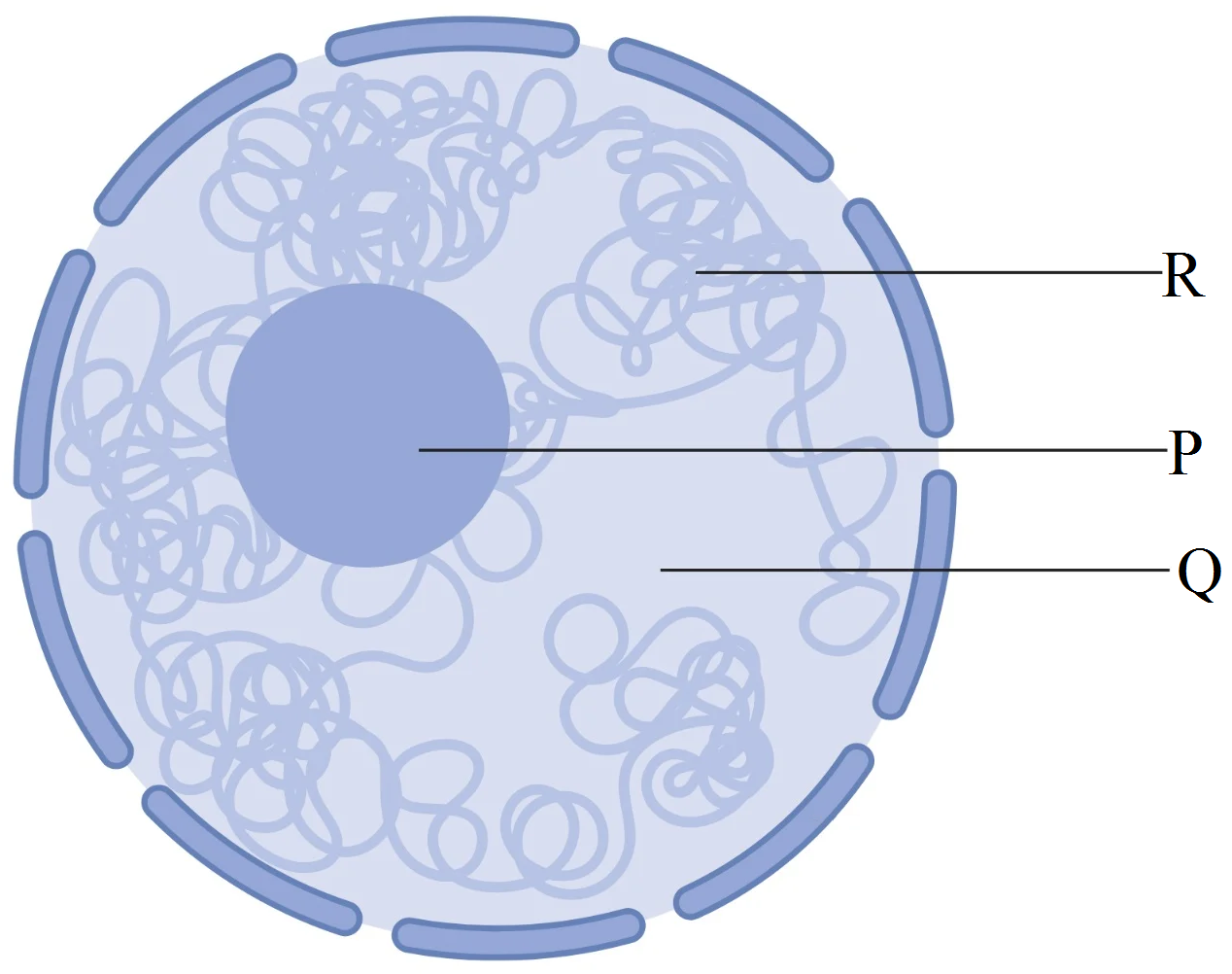
Refer to the given figure and select the correct statement regarding it.
$(i)$ $P$ is an important site for protein synthesis.
$(ii)$ $R$ transfers the characteristics of a cell that are formed during cell division.
$(iii)$ $Q$ is a dense fluid like agranular substance.
$(iv)$ $P$ contains $DNA$ while $R$ contains $RNA$.
  • $(i)$ and $(ii)$ only
  • B
    $(i), (ii)$ and $(iv)$ only
  • C
    $(i), (ii)$ and $(iii)$ only
  • D
    $(iii)$ and $(iv)$ only
Answer
Correct option: A.
$(i)$ and $(ii)$ only
In the given figure, $P, Q$ and $R$ represent nucleolus, nucleoplasm and chromatin respectively. Nucleoplasm is a dense fluid like granular substance. Nucleolus contains $RNA$ while chromatin contains $DNA$.
View full question & answer
MCQ 321 Mark
The circulatory system consists of lungs, auricle, ventricle and veins. It carries blood and other materials form one part of the body to the other parts. Which one of the following carries deoxygenated blood from body to right atrium?
  • A
    Artery
  • B
    Capillary tube
  • Veins
  • D
    Vessels
Answer
Correct option: C.
Veins
View full question & answer
MCQ 331 Mark
Single celled organisms are called.
  • Unicellular.
  • B
    Multi-cellular.
  • C
    Both of these.
  • D
    None of these.
Answer
Correct option: A.
Unicellular.
View full question & answer
MCQ 341 Mark
An organelle, spherical in structure contains the genetic material is:
  • A
    Mitochondria
  • B
    Cell wall
  • C
    Ribosome
  • Nucleus
Answer
Correct option: D.
Nucleus
View full question & answer
MCQ 351 Mark
Match the following:
 
Column $A$
 
Column $B$
$(I)$
Laminaria
$[A]$
Protozoa
$(II)$
Paramecium
$[B]$
Bacteria
$(III)$
Penicillium
$[C]$
Algae
$(IV)$
Streptococcus
$[D]$
Fungi
  • A
    $(I - D), (II - A), (III - B), (IV - C)$
  • B
    $(I - C), (II - D), (III - A), (IV - B)$
  • C
    $(I - D), (II - C), (III - B), (IV - A)$
  • $(I - E), (II - A), (III - D), (IV - B)$
Answer
Correct option: D.
$(I - E), (II - A), (III - D), (IV - B)$
View full question & answer
MCQ 361 Mark
Which of the following is called the energy currency of the cell?
  • A
    $MTP$
  • B
    $FTP$
  • $ATP$
  • D
    All of these
Answer
Correct option: C.
$ATP$
$ATP$ is also called energy currency of the cell.
View full question & answer
MCQ 371 Mark
A group of similar cells combine to form:
  • Tissue
  • B
    Organ
  • C
    Organisms
  • D
    Organelles
Answer
Correct option: A.
Tissue
View full question & answer
MCQ 381 Mark
Cell walls is found in:
  • Plant cells only
  • B
    Animal cells only
  • C
    Both $(a)$ and $(b)$
  • D
    None of them
Answer
Correct option: A.
Plant cells only
View full question & answer
MCQ 391 Mark
Cells which lack nuclear membrane are:
  • A
    Eukaryotic cells
  • Prokaryotic cells
  • C
    Single cells
  • D
    Multicells
Answer
Correct option: B.
Prokaryotic cells
View full question & answer
MCQ 401 Mark
Which of the following is absent in an animal cell?
  • A
    Cytoplasm
  • B
    Nucleus
  • C
    Cell membrane
  • Cell wall
Answer
Correct option: D.
Cell wall
A cell wall and vacuole are absent in animal cells.
View full question & answer
MCQ 411 Mark
Refer to the given terms.
$(i)$
$\text{RBC}$
$(ii)$
$\text{WBC}$
$(iii)$
Blood
$(iv)$
Muscle
$(v)$
Blood vessels
$(vi)$
Brain
$(vii)$
Heart
$(viii)$
Lung
$(ix)$
Sperm
$(x)$
Kidney
Select the option which correctly classifies the given terms into cell, tissue and organ.
  • Cell
    Tissue
    Organ
    $(i), (ii), (ix)$
    $(iii), (iv)$
    $(v), (vi), (vii), (viii), (x)$
  • B
    Cell
    Tissue
    Organ
    $(i), (ii), (iii), (x)$
    $(iv), (v)$
    $(vi), (vii), (viii), (ix)$
  • C
    Cell
    Tissue
    Organ
    $(i), (ii), (iv), (ix)$
    $(iii), (v), (vi)$
    $(vii), (viii), (x)$
  • D
    Cell
    Tissue
    Organ
    $(i), (ii), (ix)$
    $(iii), (iv), (v)$
    $(vi), (vii), (viii), (x)$
Answer
Correct option: A.
Cell
Tissue
Organ
$(i), (ii), (ix)$
$(iii), (iv)$
$(v), (vi), (vii), (viii), (x)$
View full question & answer
MCQ 421 Mark
Which organelle is called the "suicide bag" of the cell?
  • A
    Golgi apparatus
  • Lysosomes
  • C
    Plastids
  • D
    Mitochondria
Answer
Correct option: B.
Lysosomes
Lysosomes are called "suicide bags" of the cell because they have hydrolytic enzymes stored in them. These enzymes are used to digest complex molecules in a cell. When released into the cytoplasm, these enzymes can "digest" or destroy the cell itself. Therefore, they are called "suicide bags".
View full question & answer
MCQ 431 Mark
We breathe in or out air with the help of windpipe called trachea. The trachea does not collapse during the breathing process, because it is made up of ring of soft bones called:
  • A
    Ribs
  • B
    Cardiac muscles
  • Cartilage
  • D
    None of these
Answer
Correct option: C.
Cartilage
View full question & answer
MCQ 441 Mark
In a living cell, chromatin is present in:
  • Cytoplasm.
  • B
    Chloroplasts.
  • C
    Nucleus.
  • D
    Vacuole.
Answer
Correct option: A.
Cytoplasm.
Chromatin material is a tangled fibrous mass. The chromatin material condenses to form chromosomes during cell division.
View full question & answer
MCQ 451 Mark
What are pseudopodia?
  • A
    Vacuole of amoeba.
  • B
    Heart of amoeba.
  • C
    Eye of amoeba.
  • False feet of amoeba.
Answer
Correct option: D.
False feet of amoeba.

Amoeba have pseudopodia, which are projections of varying lengths protruding out of its body. Amoeba does not have a regular shape and uses pseudopodia for locomotion and digestion.
View full question & answer
MCQ 461 Mark
Which of the following feature will help you in distinguishing a plant cell from an animal cell?
  • A
    A cell wall
  • Cell membrane
  • C
    Mitochondria
  • D
    Nucleus
Answer
Correct option: B.
Cell membrane
A cell wall is the distinguishing feature between a plant cell and animal cell. It is thick wall made up of cellulose around cell membrane that exclusively present only in plant cell.
View full question & answer
MCQ 471 Mark
The most important function of cell membrane is that it:
  • Controls the entry and exit of materials from cell.
  • B
    Controls only the entry of materials into cells.
  • C
    Controls only the exit of materials into cells.
  • D
    Allows entry and exit of materials without any control.
Answer
Correct option: A.
Controls the entry and exit of materials from cell.

The cell membrane controls the entry (movement into the cell) and exit (movement out of the cell) of materials. It also protects and gives shape to the cell.

View full question & answer
MCQ 481 Mark
Which organelle is called the "powerhouse of the cell"?
  • A
    Nucleus
  • Mitochondrion
  • C
    Golgi apparatus
  • D
    Endoplasmic reticulum
Answer
Correct option: B.
Mitochondrion

The mitochondrion is called the "powerhouse of the cell" because it is responsible for producing energy-rich $ATP$ molecules. Cells use $ATP$ for all their energy needs.

View full question & answer
MCQ 491 Mark
Which one of the following statements is correct?
  • A
    Unicellular organisms do not reproduce.
  • B
    In Unicellular organism’s tissues work in coordination to perform different functions.
  • Unicellular organisms respire and reproduce.
  • D
    Unicellular organisms do not require food.
Answer
Correct option: C.
Unicellular organisms respire and reproduce.
View full question & answer
MCQ 501 Mark
Several small coloured bodies in the cytoplasm of the cells of Tradescantia leaf are called $..........$
  • A
    Organelle
  • Plastids
  • C
    Vacuoles
  • D
    Mitochondria
Answer
Correct option: B.
Plastids
View full question & answer