Questions · Page 1 of 5

M.C.Q. [I MARKS]

🎯

Test yourself on this topic

50 questions · timed · auto-graded

MCQ 11 Mark
Which of the following statements is $NOT$ true?
  • A
    Spontaneous combustion takes place without any apparent cause.
  • The luminous zone of a flame has high temperature.
  • C
    Carbon dioxide gas causes global warming.
  • D
    The calorific value of a fuel is expressed in $kJ/ kg^{−1}.$
Answer
Correct option: B.
The luminous zone of a flame has high temperature.
St is not the luminous zone but the non- luminous zone of the flame that has a very high temperature.
View full question & answer
MCQ 21 Mark
Which of the following factors are essential to ignite a fire?
  • A
    Fuel
  • B
    Air (oxygen).
  • All of these.
  • D
    Heat
Answer
Correct option: C.
All of these.

To ignite a fire we need a combustible substance, fuel and heat energy. Burning is a chemical process that oxidizes a substance. Oxygen is necessary for combustion to occur. Hence all the three factors: air, fuel and heat are required for combustion to take place.

View full question & answer
MCQ 31 Mark
The given table lists some substances as per their burning tendencies.
Produce a flame
Do not produce a flame
Molten wax
Kerosene oil
Camphor
Charcoal
Which of the following substances is incorrectly categorized?
  • A
    Charcoal
  • B
    Camphor
  • Kerosene oil
  • D
    Molten wax
Answer
Correct option: C.
Kerosene oil

Substances that vaporize give a flame. Kerosene oil undergoes the process of burning along with the production of flame.

View full question & answer
MCQ 41 Mark
The most common element used as fire extinguisher is:
  • $CO_2$
  • B
    Oxygen
  • C
    Phosphorous
  • D
    Oxygen
Answer
Correct option: A.
$CO_2$
$CO_2$
View full question & answer
MCQ 51 Mark
How has the use of $CNG$ in automobiles reduced the pollution in cities?
  • A
    It produces less amount of sulphur dioxide and chlorine.
  • It does not leave any residue or smoke after burning in the engine.
  • C
    It produces large amount of carbon dioxide.
  • D
    It is used in compressed form.
Answer
Correct option: B.
It does not leave any residue or smoke after burning in the engine.

$CNG$ does not produce any pollutant.

View full question & answer
MCQ 61 Mark
A piece of paper wrapped around an aluminium pipe does not catch fire easily. Which of the following reasons supports the above information?
  • A
    Paper is non-combustible in nature.
  • B
    Aluminium is non-combustible in nature.
  • C
    Aluminium pipe does not attain its ignition temperature.
  • Paper wrapped around the pipe does not attain its ignition temperature.
Answer
Correct option: D.
Paper wrapped around the pipe does not attain its ignition temperature.

Both aluminium and paper are combustible substances. When heat is supplied to the paper, it is transferred to the aluminium pipe by conduction. In the presence of aluminium, the ignition temperature of paper is not achieved. Therefore, it does not catch fire easily. It is important to note that attaining the ignition temperature is a prerequisite for combustion to take place.

View full question & answer
MCQ 71 Mark
The calorific value of ‘hydrogen’ is:
  • A
    $50,000\ kJ/ kg.$
  • B
    $55,000\ kJ/ kg.$
  • $1,50,000\ kJ/ kg.$
  • D
    $6,000\ kJ/ kg.$
Answer
Correct option: C.
$1,50,000\ kJ/ kg.$
$1,50,000\ kJ/ kg.$
View full question & answer
MCQ 81 Mark
Which of the following is the main cause of global warming?
  • A
    Nitrogen dioxide
  • B
    Sulphur dioxide
  • Carbon dioxide
  • D
    Ozone
Answer
Correct option: C.
Carbon dioxide

Burning of fuels releases carbon dioxide in air in the environment. Increased percentage of carbon dioxide in air is causing global warming. Carbon dioxide gas in the air trap sun’s heat rays by producing greenhouse effect.

View full question & answer
MCQ 91 Mark
Which of the following is not used in making matchsticks these days?
  • A
    Potassium chlorate
  • White phosphorus
  • C
    Antimony trisulphide
  • D
    Red phosphorus
Answer
Correct option: B.
White phosphorus

White phosphorus undergoes spontaneous combustion. Hence it is not used in making matchsticks now days.

View full question & answer
MCQ 101 Mark
Sakshi took a piece of four substances $W, X, Y,$ and $Z$. She tried to bum each of them by bringing a lighted matchstick near them. She observed that $Y$ and $Z$ bum readily, whereas $W$ bums readily only after sustained heating. However, $X$ does not bum at all. Among the given substances taken by Sakshi, which substance has the highest ignition temperature?
  • A
    $W$
  • $X$
  • C
    $Y$
  • D
    $Z$
Answer
Correct option: B.
$X$
The ignition temperature of a substance is the lowest temperature at which a substance catches fire. On bringing a lighted matchstick near the substances $W, X, Y,$ and $Z,$ the ignition temperature of $X$ is not reached. However, the ignition temperature of $W, Y,$ and $Z$ are reached. Hence, while $X$ does not burn, $W, Y,$ and $Z$ burn readily. Thus, the ignition temperature of $X$ would be the highest among the substances taken by Sakshi.
View full question & answer
MCQ 111 Mark
Which of the following statements is $NOT$ true?
  • A
    $CO_2$ is the best fire extinguisher.
  • Global warming can cause acid rain.
  • C
    Burning of coal and diesel releases sulphur dioxide gas.
  • D
    $L.P.G.$ has higher calorific value than biogas.
Answer
Correct option: B.
Global warming can cause acid rain.
Global warming may cause glaciers to melt, which may lead to a rise in the sea level and thus submerge low lying areas.
View full question & answer
MCQ 121 Mark
Which of the following fuels is used for running automobiles?
  • A
    $CNG$
  • B
    Petrol
  • Both $(a)$ and $(b)$
  • D
    Wood
Answer
Correct option: C.
Both $(a)$ and $(b)$
View full question & answer
MCQ 131 Mark
The ignition temperature of sodium is very _____$i$____. To prevent its _____$ii$_______ combustion, it is stored under _______$iii$______,. The information in which alternative completes the given statements?
  • $i$-low, $ii$-rapid, $iii$-Kerosene.
  • B
    $i$-low, $ii$-spontaneous, $iii$-Kerosene.
  • C
    $i$-high, $ii$-rapid, $iii$- water.
  • D
    $i$-high, $ii$-spontaneous, $iii$-water.
Answer
Correct option: A.
$i$-low, $ii$-rapid, $iii$-Kerosene.
The minimum temperature at which a substance catches fire is called ignition temperature. The ignition temperature of sodium is very low. Hence, it catches fire easily at room temperature. It reacts vigorously with oxygen at room temperature. To prevent its spontaneous combustion, it is stored under kerosene.
View full question & answer
MCQ 141 Mark
What does the incomplete combustion of a fuel give?
  • $CO$
  • B
    $CO_2$
  • C
    $SO_2$
  • D
    Oxides of nitrogen
Answer
Correct option: A.
$CO$
When a fuel (carbon) undergoes incomplete combustion, carbon monoxide is formed. It is a poisonous gas and fatal, if inhaled.
View full question & answer
MCQ 151 Mark
Which of the following is an example of inflammable substance?
  • A
    Iron
  • B
    Glass
  • $LPG$
  • D
    Stone
Answer
Correct option: C.
$LPG$
$LPG$
View full question & answer
MCQ 161 Mark
Which of the following gases is responsible for global warming?
  • A
    Carbon monoxide
  • Carbon dioxide
  • C
    Nitrogen
  • D
    Ozone
Answer
Correct option: B.
Carbon dioxide

Carbon dioxide is a product of combustion of various fuels. An increased concentration of carbon dioxide in the atmosphere is said to be the reason for global warming. Carbon dioxide traps heat and this trapped heat increases the average temperature of the Earth, thereby causing global warming.

View full question & answer
MCQ 171 Mark
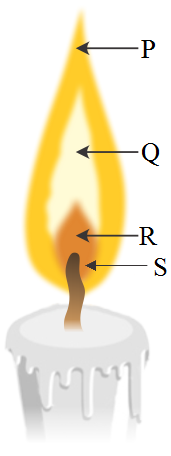
Different zones of a candle flame are marked by the letters $\text{P, Q, R}$ and $\text{S}$.

Which of the following statements are correct?
$i. P$ is the luminous zone and is the hottest part of candle flame.
$ii.$ In zone $Q$, there is inadequate supply of oxygen.
$iii.$ Zone $R$ contains unburnt wax vapours produced by melting of wax.
$iv.$ In $S$ zone, carbon monoxide burns with a blue flame.
  • A
    $(i)$ and $(ii)$ only
  • $(ii), (iii)$ and $(iv)$ only
  • C
    $(ii)$ and $(iv)$ only
  • D
    $(i), (ii)$ and $(iii)$ only
Answer
Correct option: B.
$(ii), (iii)$ and $(iv)$ only
$P-$Non$-$luminous zone, hottest part of the flame.
$Q -$ Luminous zone or zone of incomplete combustion due to inadequate supply of oxygen.
$R -$ Dark zone or zone of no combustion, covers the area surrounding the wick containing unburnt wax vapours produced by melting of wax.
$S -$ Blue zone, where carbon monoxide burns with a blue colour.
View full question & answer
MCQ 181 Mark
Which of the following fuels has the lowest calorific value?
  • A
    Kerosene
  • B
    $CNG$
  • Biogas
  • D
    $LPG$
Answer
Correct option: C.
Biogas
Biogas
View full question & answer
MCQ 191 Mark
Which of the following fuels has the highest calorific value?
  • A
    Natural gas
  • B
    Liquefied petroleum gas
  • Coal gas
  • D
    Hydrogen gas
Answer
Correct option: C.
Coal gas
Hydrogen gas has the highest calorific value.
View full question & answer
MCQ 201 Mark
Baking soda constitutes:
  • A
    Hydrogen chloride
  • B
    Sodium oxide
  • Sodium bicarbonate
  • D
    Oxygen
Answer
Correct option: C.
Sodium bicarbonate
Sodium bicarbonate
View full question & answer
MCQ 211 Mark
Which of the following cannot be used to extinguish the fire caused by electricity?
  • A
    Carbon dioxide.
  • B
    Sand
  • Blanket
  • D
    Water
Answer
Correct option: C.
Blanket

Water being a good conductor of electricity can cause electric shock to the person tring to put off the fire caused by any electrical appliance. Hence, fire caused by electrical appliances should not be put off using water.

View full question & answer
MCQ 221 Mark
Match column I with column II and select the correct option from the codes given below.
 
Column I
 
Column II
$P.$
Rusting
$(i)$
Explosion
$Q.$
Burning of Paper
$(ii)$
Spontaneous combustion
$R.$
Sodium
$(iii)$
Rapid combustion
$S.$
Fire crackers
$(iv)$
Slow combustion
  • A
    $P-(ii), Q-(iii), R-(i), S-(iv).$
  • B
    $P-(i), Q-(iii), R-(ii), S-(iv).$
  • C
    $P-(iii), Q-(ii), R-(i), S-(ii).$
  • $P-(iv), Q-(iii), R-(ii), S-(i).$
Answer
Correct option: D.
$P-(iv), Q-(iii), R-(ii), S-(i).$
View full question & answer
MCQ 231 Mark
If a goldsmith wants to make jewellery of gold and silver, then he has to melt them. To do this, he will use the ___$i$____ zone of the flame as this zone is the ____$ii$____ zone of the flame. The information in which alternative completes the given statement?
  • A
    $i$-Innermost, $ii$-Hottest.
  • B
    $i$-Innermost, $ii$-Moderately hot.
  • C
    $i$-Outermost, $ii$-Moderately hot.
  • $i$-Outermost, $ii$-Hottest.
Answer
Correct option: D.
$i$-Outermost, $ii$-Hottest.
The flame of a candle contains three different zones: outermost zone, middle zone, and innermost zone. The outermost zone of the flame is the hottest part of the flame, and the innermost zone of the flame is the least hot part. The middle zone is moderately hot. As gold and silver melts at a very high temperature, a goldsmith has to blow the outermost zone, which is the hottest part of the flame, to melt gold and silver.
View full question & answer
MCQ 241 Mark
A temperature at which the substance burns is called:
  • A
    Melting
  • B
    Boiling temperature
  • Kindling temperature
  • D
    Evaporation
Answer
Correct option: C.
Kindling temperature
View full question & answer
MCQ 251 Mark
How is synthetic petrol produced?
  • A
    From petroleum
  • B
    From wood
  • From coal
  • D
    From $L.P.G$.
Answer
Correct option: C.
From coal
The Bergius Process is a very simple process for converting brown coal completely into crude oil. It was invented by $Dr.$ Friedrich Bergius. In this process, brown coal, also known as lignite is powdered and mixed with heavy oil and heated with hydrogen under high pressure of about $200-250$ atm. And a temperature of about $748K$ in the presence of iron oxide as catalyst. The vapours on condensation give a liquid resembling crude oil. This is called synthetic petrol, which on fractional distillation gives petrol (gasoline).
View full question & answer
MCQ 261 Mark
Mohan is writing some statements, choose the correct statements and help him:
  • A
    Phosphorus is the only non-metal which catch fire if exposed to air.
  • B
    The lowest temperature at which a substance catches fire is called its ignition temperature.
  • C
    Combustion is a chemical process in which a substance reacts with oxygen to give off heat.
  • All the above.
Answer
Correct option: D.
All the above.

Here, all the statements are correct. Hence, your answer will be option $[d]$.

View full question & answer
MCQ 271 Mark
Which of the following is a non- combustible substance?
  • A
    Coke
  • Diamond
  • C
    Coal
  • D
    Wood
Answer
Correct option: B.
Diamond
Diamond is a non-combustible substance.
View full question & answer
MCQ 281 Mark
The total amount of heat produced by a fuel having a calorific value of $20 kJ/kg^{-1}$ was found to be $50,000$ joules. How much fuel was burnt?
  • A
    $2500kg$
  • B
    $50kg$
  • C
    $25kg$
  • $2.5kg$
Answer
Correct option: D.
$2.5kg$
$1kg$ of fuel when burnt gives $20,000$ joules of heat energy. $50,000$ joules of heat energy will be produced by $2.5kg$ of fuel as given below. $1kg$ fuel produces $20kJkg^{−1}$ heat? fuel produces $50kJkg^{−1}$ heat.
$=\frac{50,000}{20,000} =2.5\text{kg}$
View full question & answer
MCQ 291 Mark
The burning of LPG is an example of:
  • Rapid combustion
  • B
    Spontaneous combustion
  • C
    Slow combustion
  • D
    Explosion
Answer
Correct option: A.
Rapid combustion
Rapid combustion
View full question & answer
MCQ 301 Mark
Coal burns to produce:
  • A
    Calcium bicarbonate
  • B
    Magnesium
  • Carbon dioxide
  • D
    Oxygen
Answer
Correct option: C.
Carbon dioxide
Carbon dioxide
View full question & answer
MCQ 311 Mark
Which of the following faels is the most efficient among the given fuels?
  • A
    Type of fuel Energy produced (kJ) Amount taken
    $P$ $55000$ $1kg$
  • B
    Type of fuel Energy produced (kJ) Amount taken
    $Q$ $90000$ $2kg$
  • Type of fuel Energy produced (kJ) Amount taken
    $R$ $150000$ $1kg$
  • D
    Type of fuel Energy produced (kJ) Amount taken
    $S$ $55000$ $3 kg$
Answer
Correct option: C.
Type of fuel Energy produced (kJ) Amount taken
$R$ $150000$ $1kg$
An efficient fuel is the one that produces a large amount of energy on burning.
The efficiency of a fuel is determined by its calorific value, which is the amount of heat produced on complete combustion of $1kg$ of fuel.
Fuel $R$ produces $150000kJ$ of energy on its combustion of mass of $1kg$.
Hence, its calorific value is $150000 kJ/ kg$, which is the highest among the given fuels.
Hence, fuel $R$ is the most efficient fuel.
View full question & answer
MCQ 321 Mark
What is a major cause of global warming?
  • A
    Gaseous nitrogen oxides released by petrol engines.
  • B
    Oxides of sulphur and nitrogen dissolved in rain water.
  • C
    Emission of sulphur dioxide on combustion of coal.
  • Release of carbon dioxide on combustion of fuels.
Answer
Correct option: D.
Release of carbon dioxide on combustion of fuels.

On combustion, almost every fuel releases carbon dioxide in the environment. The increased concentration of carbon dioxide is believed to capture the reflected rays, thereby increasing the temperature of the Earth. Hence, it leads to global warming.

View full question & answer
MCQ 331 Mark
A heap of green leaves is lying in one corner of a park. The green leaves in the heap burn with difficulty because:
  • A
    They contain a tough material called cellulose.
  • They contain a lot of water.
  • C
    They contain a green pigment chlorophyll.
  • D
    They do not get sufficient oxygen for burning.
Answer
Correct option: B.
They contain a lot of water.

The green leaves contain a lot of water. This water does not allow the green leaves to get heated to their ignition temperature and makes burning of green leaves difficult.

View full question & answer
MCQ 341 Mark
The given table lists some fuels with their calorific values:
Fuel
Calorific Value
Diesel
$45000$
$LPG$
$55000$
Petrol
$45000$
Which of the given fuels is the most efficient?
  • A
    Petrol
  • B
    Diesel
  • $LPG$
  • D
    $CNG$
Answer
Correct option: C.
$LPG$
Calorific value is the amount of heat produced on complete combustion of one kg of fuel. The higher the value, the greater is the efficiency of the fuel. Among the given fuels, $LPG$ has a maximum calorific value. Hence, it is the most efficient.
View full question & answer
MCQ 351 Mark
A chemical process in which a substance reacts with oxygen to give off heat is called:
  • A
    Conduction
  • B
    Conjunction
  • Combustion
  • D
    Confusion
Answer
Correct option: C.
Combustion
Combustion
View full question & answer
MCQ 361 Mark
The substances which have very low ignition temperature and can easily catch fire with a flame are called:
  • Inflammable substances
  • B
    Flaming substance
  • C
    Fire proof substance
  • D
    None of the above
Answer
Correct option: A.
Inflammable substances
View full question & answer
MCQ 371 Mark
Which of the following is not a combustible substance?
  • A
    Camphor.
  • Straw.
  • C
    Glass.
  • D
    Alcohol.
Answer
Correct option: B.
Straw.
Those substances which do not burn are called non-combustible substance. Some of the non-combustible substances are stone, glass, cement, soil, sand, iron nails, etc
View full question & answer
MCQ 381 Mark
Which of the following tables correctly represents the substance with the type of combustion?
  • Substance Type of combustion
    $LPG$ Rapid
    Phosphorus Spontaneous
    Dynamite Explosion
  • B
    Substance Type of combustion
    $LPG$ Spontaneous
    Glass Explosion
    Dynamite Rapid
  • C
    Substance Type of combustion
    Phosphorus Explosion
    $LPG$ Rapid
    Dynamite Spontaneous
  • D
    Substance Type of combustion
    $LPG$ Spontaneous
    Glass Rapid
    Dynamite Explosion
Answer
Correct option: A.
Substance Type of combustion
$LPG$ Rapid
Phosphorus Spontaneous
Dynamite Explosion
Substance
Type of combustion
$LPG$
Rapid
Phosphorus
Spontaneous
Dynamite
Explosion
Explanation:
$LPG$ undergoes rapid combustion. When a burning matchstick is taken near the gas stove containing $LPG$, the gas catches fire easily. The gas burns rapidly producing heat and light. Phosphorus bursts into flames when kept in air at room temperature. It is an example of spontaneous combustion in which the material suddenly bursts into flames without any external ignition. Dynamite when ignited explodes with the evolution of heat, light, and sound. Large amount of gas is also liberated in the process.
View full question & answer
MCQ 391 Mark
Which of the following are required essentially for producing fire?
  • A
    Glass, coal, water
  • B
    Fuel, coal, straw
  • C
    Fire, wood, burner
  • Fuel, air, heat
Answer
Correct option: D.
Fuel, air, heat
Fuel, air, heat
View full question & answer
MCQ 401 Mark
Which of the following is a combustible?
  • A
    Stone piece
  • Wood
  • C
    Glass
  • D
    None of these
Answer
Correct option: B.
Wood
Wood
View full question & answer
MCQ 411 Mark
In which of the following sentences are incorrect?
  • A
    A chemical process in which a substance reacts with oxygen to give off heat, is called combustion.
  • B
    When the clothes of a person catch fire, the person is covered with the blanket to extinguish fire.
  • C
    The lowest temperature at which a substance catches fire is called, its ignition temperature.
  • The substances which give very high ignition, temperature and can easily catch fire with a flame, are called inflammable substances.
Answer
Correct option: D.
The substances which give very high ignition, temperature and can easily catch fire with a flame, are called inflammable substances.

The substances which give very low ignition, temperature and can easily catch fire with a flame, are called inflammable substances.

View full question & answer
MCQ 421 Mark
Which of the following reactions takes place in soda-acid type fire extinguisher?
  • A
    $\text{C}{\text{a}}\text{CO}_3\xrightarrow{\Delta}\text{C}\text{a}\text{O}+\text{CO}_2$
  • B
    $2\text{N}\text{a}\text{HCO}_3\xrightarrow\Delta\text{N}\text{a}_2\text{CO}_3+\text{H}_2\text{O}+\text{CO}_2$
  • $2\text{N}\text{a}\text{HCO}_3+\text{H}_2\text{SO}_4\rightarrow\text{N}\text{a}_2\text{SO}_{4}+2\text{H}_2\text{O}+2\text{CO}_2$
  • D
    $\text{C}\text{a}\text{CO}_3+\text{H}_2\text{SO}_4\rightarrow\text{C}\text{a}\text{SO}_4+\text{H}_2\text{O}+\text{CO}_2$
Answer
Correct option: C.
$2\text{N}\text{a}\text{HCO}_3+\text{H}_2\text{SO}_4\rightarrow\text{N}\text{a}_2\text{SO}_{4}+2\text{H}_2\text{O}+2\text{CO}_2$
View full question & answer
MCQ 431 Mark
Consider the given diagram $X$ and $Y$ in the given figure represent
  • Sulphur oxides and nitrogen oxides.
  • B
    Silicon oxides and nitrogen oxides.
  • C
    Sulphur oxides and chlorine gas.
  • D
    Silicon oxides and chlorine gas.
Answer
Correct option: A.
Sulphur oxides and nitrogen oxides.

Smoke from industries has large quantities of nitrogen oxides and sulphur oxides. These oxides combine with water vapour present in atmosphere to form acid droplets that remain suspended in the atmosphere. When it rains, these droplets mix with rain water and cause acid rains.

View full question & answer
MCQ 441 Mark
The calorific value of a fuel is expressed in a unit called
  • A
    Kilojoule per litre.
  • B
    Kilojoule per gram.
  • Kilogram per mililitre.
  • D
    Kilojoule per kilogram.
Answer
Correct option: C.
Kilogram per mililitre.

The calorific value of a fuel is expressed in the unit of kilojoule per kilogram $(kJ/kg)$,

View full question & answer
MCQ 451 Mark
Inspite of the danger involved with hydrogen, it is used for some applications. Where is it used?
  • A
    Rocket fuel.
  • B
    Oxyhydrogen flame.
  • C
    Car fuel.
  • All of the above.
Answer
Correct option: D.
All of the above.

Though hydrogen is a highly combustible gas, because of its high calorific value, it is used as rocket fuel, for cutting and welding metals in the form of oxyhydrogen flame and as a car fuel under stringent safety conditions.

View full question & answer
MCQ 461 Mark
Hydrogen gas has the highest calorific value i.e., $150kJ/ kg^{−1}$, yet it is not used as a fuel. Why?
  • A
    It is explosive in nature.
  • B
    It causes storage problem.
  • C
    It causes transportation problem.
  • All of the above.
Answer
Correct option: D.
All of the above.
The availability of hydrogen is less and also forms an explosive mixture with air or oxygen and causes explosion if it leaks out. Its storage and transport are difficult.
View full question & answer
MCQ 471 Mark
Which of the following substances has the lowest ignition temperature?
  • A
    Kerosene
  • Spirit
  • C
    Diesel
  • D
    Mustard oil
Answer
Correct option: B.
Spirit

Spirit/ petrol has the lowest ignition temperature and can catch fire easily.

View full question & answer
MCQ 481 Mark
In which of the following statements is or are correct?
  • A
    A physical process in which a substance reacts with oxygen to give off heat is called combustion.
  • B
    Water is the best extinguisher for fire involving electrical equipment.
  • Alcohol, cng and lpg are inflammable substances.
  • D
    Increased concentration of nitrogen in air is believed to cause global warming.
Answer
Correct option: C.
Alcohol, cng and lpg are inflammable substances.
Alcohol, cng and lpg are inflammable substances. The substances which have very low ignition temperature and can easily catch fire with a flame are called inflammable substances. Some of the examples, of inflammable substances are petrol, alcohol, liquefied petroleum gas (lpg), compressed natural gas and biogas. These inflammable substances have very low ignition temperature.
View full question & answer
MCQ 491 Mark
Consider the following statements and choose the incorrect statement$(s)$:
  • A
    The burning of magnesium in air to produce heat and light is a combustion process.
  • B
    When charcoal burns, then the carbon of charcoal combines with oxygen of air to form carbon dioxide.
  • C
    A combustible substance is also called a fuel.
  • Those substances which can undergo combustion are called non-combustible substances.
Answer
Correct option: D.
Those substances which can undergo combustion are called non-combustible substances.
View full question & answer
MCQ 501 Mark
Match the entries in Column$-l$ with those in Column-ll correctly.
 
Column - I
 
Column - II
$(a)$
Dark inner zone
$(i)$
Hottest part (No carbon)
$(b)$
Blue zone
$(ii)$
Partial combustion
$(c)$
Luminous zone
$(iii)$
Unburnt vapours of wax
$(d)$
Non-luminous zone
$(iv)$
Complete combustion
  • A
    $a-1, b-2, c-3, d-4$
  • B
    $a-2, b-3, c-4, d-1$
  • $a-3, b-4, c-2, d-1$
  • D
    $a-4, b-1, c-2, d-3$
Answer
Correct option: C.
$a-3, b-4, c-2, d-1$
The correct combination is a $- 3, b - 4, c - 2, d - 1$
$(i)$ Dark inner zone -Unburnt vapours of wax.
$(ii)$ Blue zone - Complete combustion.
$(iii)$ Luminous zone ? Partial combustion.
$(iv)$ Non-luminous zone - Hottest part. (no carbon)
View full question & answer