Questions · Page 1 of 6

M.C.Q. [I MARKS]

🎯

Test yourself on this topic

50 questions · timed · auto-graded
MCQ 11 Mark
The image formed by a plane mirror is always:
  • A
    Real
  • B
    Rrect
  • C
    Virtual
  • Both $(b)$ and $(c)$
Answer
Correct option: D.
Both $(b)$ and $(c)$
View full question & answer
MCQ 21 Mark
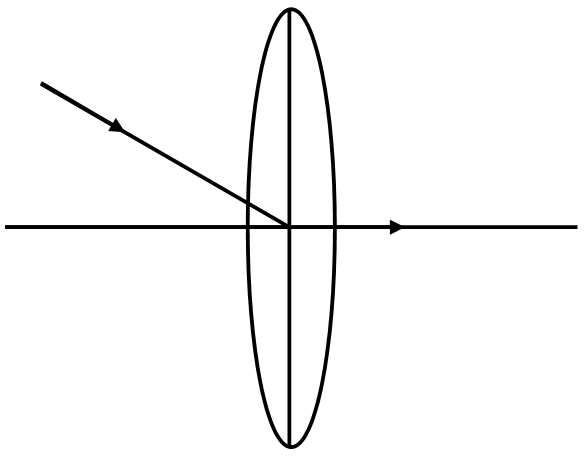
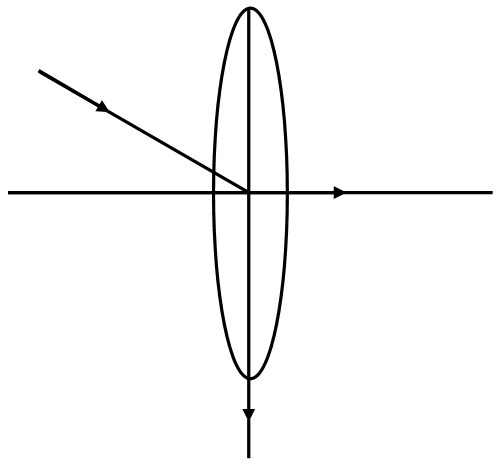
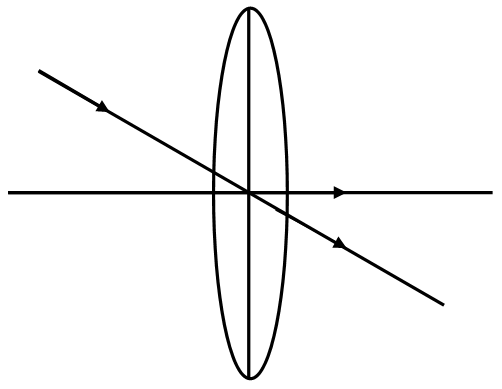
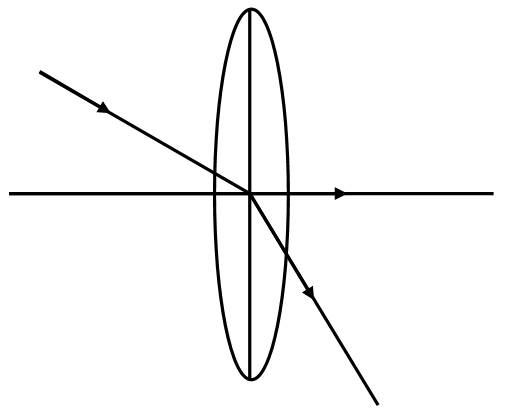
Which of the following diagrams correctly represents the ray of light passing through the optical centre?
  • B
  • C
  • D

      
Answer
Correct option: A.
View full question & answer
MCQ 31 Mark
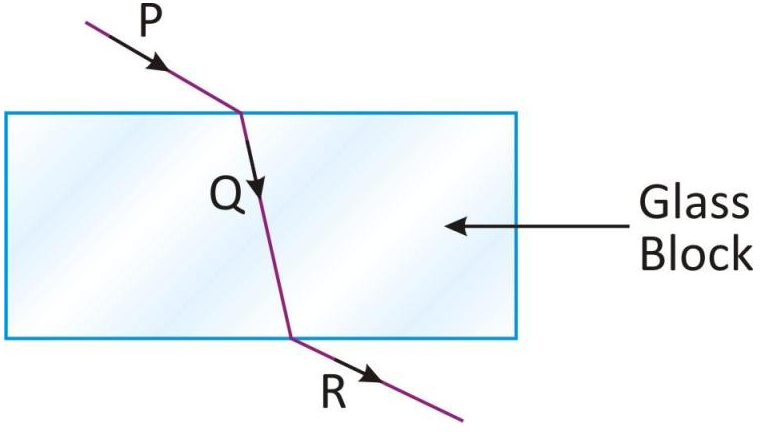
The diagram shows a ray $\text{PQR}$ travelling through a glass slab. Which option in the table gives the correct name for all three rays?
  • A
    $P$ $Q$ $R$
    Incident ray Emergent ray Refracted ray
  • $P$ $Q$ $R$
    Incident ray Refracted ray Emergent ray
  • C
    $P$ $Q$ $R$
    Emergent ray Incident ray Refracted ray
  • D
    $P$ $Q$ $R$
    Emergent ray Refracted ray Incident ray
Answer
Correct option: B.
$P$ $Q$ $R$
Incident ray Refracted ray Emergent ray
View full question & answer
MCQ 41 Mark
The part of light which is returned back into the same medium is called.
  • Reflected light
  • B
    Refracted light
  • C
    Both $(a)$ and $(b)$
  • D
    Neither $(a)$ nor $(b)$
Answer
Correct option: A.
Reflected light
View full question & answer
MCQ 51 Mark
A long vertical pin placed at $40\ cm,$ in front of a concave mirror gives an image at the same position. The focal length of the mirror in meters is:
  • $0.2m$
  • B
    $0.4m$
  • C
    $0.6m$
  • D
    $0.8m$
Answer
Correct option: A.
$0.2m$
View full question & answer
MCQ 61 Mark
A fish is raising vertically to the surface of water in a lake uniformly at the rate of $2\text{ms}^{-1}$ observes a bird diving vertically towards the water at a rate $4\text{ms}^{-1}$ vertically above it. The refractive index of water is $\frac{4}{3}$. The actual velocity of the bird is.
  • $\frac{3}{2}$
  • B
    $\frac{2}{3}$
  • C
    $\frac{4}{3}$
  • D
    $\frac{3}{4}$
Answer
Correct option: A.
$\frac{3}{2}$
Velocity of fish is $\mu$= $2\text{ms}^{-1}$ Velocity of bird $($w.r.t fish$)$ is $\text{V}$ = $4\text{ms}^{-1}$ Refractive index of water.
$\mu$ $=$$\frac{4}{3}$
Actual velocity of bird $= \frac{\text{V}-\mu}{\mu}=\frac{4-2}{\frac{4}{3}}=\frac{3}{4}\times2=\frac{3}{2}$
View full question & answer
MCQ 71 Mark
The deficiency of one of the following in the diet of a person for a considerable time can lead to a disease called night blindness. This one is:
  • A
    Vitamin $b$
  • B
    Vitamin $d$
  • Vitamin $a$
  • D
    Vitamin $c$
Answer
Correct option: C.
Vitamin $a$

 The deficiency of one of the following in the diet of a person for a considerable time can lead to a disease called night blindness. This one is “vitamin a”. The impaired dark adaptation of eyes is called as night blindness. People with this impairment can hardly see in dim environment or during night time. This due to vitamin deficiency is mostly treatable with vitamin supplement. Vitamin a helps in transfer of nerve impulses into image to retina. Some of the food with vitamin a are eggs, cod liver oil, yellow and orange fruits and vegetables and so on.

View full question & answer
MCQ 81 Mark
Which part of the human eye contracts and relaxes in order to adjust the focal length of the lens?
  • A
    Iris
  • B
    Pupil
  • C
    Blind spot
  • Ciliary muscles
Answer
Correct option: D.
Ciliary muscles
To accommodate near and far vision, the ciliary muscles of the eye contract and expand respectively. This contraction and expansion is to respectively decrease and increase the focal length of the lens.
View full question & answer
MCQ 91 Mark
The deficiency of one of the following in the diet of a person for a considerable time can lead to a disease called night blindness. This one is:
  • A
    Vitamin $B.$
  • B
    Vitamin $D.$
  • Vitamin $A.$
  • D
    Vitamin $C.$
Answer
Correct option: C.
Vitamin $A.$

 Vitamin $A$ deficiencies occur from fat malabsorption, liver disorders and inadequate food intake.

View full question & answer
MCQ 101 Mark
Statement I: The radius of curvature and focal length of convex mirror are $80\ cm$ and $40\ cm.$
Statement II: The relation between radius of curvature and focal length is $R = 2f.$
  • Both Statements are true, Statement$-II$ is the correct explanation of Statement$-I.$
  • B
    Both Statements are true, Statement$-II$ is not correct explanation of Statement$-I.$
  • C
    Statement$-I$ is true. Statement$-II$ is false.
  • D
    Statement$-I$ is false. Statement$-II$ is true.
Answer
Correct option: A.
Both Statements are true, Statement$-II$ is the correct explanation of Statement$-I.$
$ R = 2f$ Both Statements are true, Statement$-II$ is the correct explanation of Statement$-I.$
View full question & answer
MCQ 121 Mark
If you hold a pen in your right hand and stand in front of the mirror, the pen will be in the left hand in the image. This phenomenon is called:
  • Lateral inversion
  • B
    Diffraction
  • C
    Reflection
  • D
    Inversion
Answer
Correct option: A.
Lateral inversion
View full question & answer
MCQ 131 Mark
Part of the eye which controls the light entering is called:
  • Iris.
  • B
    Cornea.
  • C
    Lens.
  • D
    Retina.
Answer
Correct option: A.
Iris.
Iris is a dark muscular structure behind the cornea, which controls the amount of light entering into the eye.
View full question & answer
MCQ 141 Mark
If light falls perpendicularly on a plane mirror, what will be the angle in which it will be reflected$?$
  • A
    $45$ degrees
  • $90$ degrees
  • C
    $180$ degrees
  • D
    $360$ degrees
Answer
Correct option: B.
$90$ degrees
View full question & answer
MCQ 151 Mark
Light passing through a prism splits into seven colours. This is called.
  • Dispersion
  • B
    Dissolution
  • C
    Division
  • D
    None of the above.
Answer
Correct option: A.
Dispersion
View full question & answer
MCQ 161 Mark
Part of the eye which controls the entering of light is called
  • Iris
  • B
    Cornea
  • C
    Lens
  • D
    Retina
Answer
Correct option: A.
Iris
Iris is a dark muscular structure behind the cornea, which controls the amount of light entering into the eye.
View full question & answer
MCQ 171 Mark
Which of the following parts of the eye has enormous number of photo$-$sensitive cells?
  • A
    Iris
  • B
    Pupil
  • Retina
  • D
    Cornea
Answer
Correct option: C.
Retina
The image of an object is formed on the retina of the eye. It is a delicate membrane, which contains a large number of light sensitive cells. These light sensitive cells are called cones. They transform the light signal into electrical signal, which is then sent to the brain.
View full question & answer
MCQ 181 Mark
The number of images formed of an object placed between two plane mirrors inclined at right angles to each other is:
  • A
    Two
  • B
    Five
  • C
    One
  • Three
Answer
Correct option: D.
Three

The relationship between no. of images and angle of mirror is
$\text{Images}=\Big(\frac{360^\circ}{\text{angle between the mirrors}}\Big)-1$
$\text{Images}=\Big(\frac{360^\circ}{90^\circ}\Big)-1$
Images $= 4 – 1$
Images $= 3$

View full question & answer
MCQ 191 Mark
There are $11$ letters in the word EXAMINATION. How many letters of this word are not changed when the word is seen in a plane mirror$?$
  • A
    $11$
  • B
    $5$
  • $8$
  • D
    $9$
Answer
Correct option: C.
$8$
 The letters that are not changed when the word is seen by reflection are: $X, A, M, I, A, T, I, O$ i.e. $8$ letters.
View full question & answer
MCQ 201 Mark
The change in converging power of an eye-lens is caused by the action of:
  • A
    Iris.
  • Ciliary muscles.
  • C
    Optic nerve.
  • D
    Retina.
Answer
Correct option: B.
Ciliary muscles.
The ciliary muscle fibers affect the zonular fibers in eye and thus change the lens shape and thus changes the converging power.
View full question & answer
MCQ 211 Mark
Beam of light striking the reflecting surface is ca:
  • Incident ray
  • B
    Reflected ray
  • C
    Refracted ray
  • D
    Normal ray
Answer
Correct option: A.
Incident ray
View full question & answer
MCQ 221 Mark
For a concave mirror when object is placed at infinity the image is formed at.
  • A
    Pole
  • Principal focus
  • C
    Centre of curvature
  • D
    Infinity
Answer
Correct option: B.
Principal focus
View full question & answer
MCQ 231 Mark
The bouncing back of light into the same medium is called:
  • A
    Refraction
  • Reflection
  • C
    Dispersion
  • D
    Diffraction
Answer
Correct option: B.
Reflection
View full question & answer
MCQ 241 Mark
Four statements about the blind spot of the human eye: $I$ It is devoid of photosensitive cells. $II$ No image is formed at the blind spot. $III$ It connects the optic nerves to the retina. $IV$ Its malfunctioning makes a person blind. Which of the given statements is incorrect$?$
  • A
    $I$
  • B
    $II$
  • C
    $III$
  • $IV$
Answer
Correct option: D.
$IV$

 Blindness is caused primarily because of the defect in the cornea. Hence, statement $IV$ is incorrect.

View full question & answer
MCQ 251 Mark
What happens in lateral inversion?
  • A
    The right side of the object will be on the right side of the image.
  • B
    The left side of the object will be on the left side of the image.
  • C
    The top of the object will be the bottom of the object.
  • The right side of the object will be on the left side of the image.
Answer
Correct option: D.
The right side of the object will be on the left side of the image.
The image formed by the plane mirror is laterally inverted i.e., the right side of the object appears on the left side of the image and left side of the object appears on the right side of the image.
View full question & answer
MCQ 261 Mark
The phenomenon of breaking up of light into its seven constituent colours is known as$.......$
  • A
    Reflection of light.
  • B
    Refraction of light.
  • Dispersion of light.
  • D
    Radiation of light.
Answer
Correct option: C.
Dispersion of light.
View full question & answer
MCQ 271 Mark
Which of the following statement is correct:
  • A
    Angle of incidence is never equal to angle of reflection.
  • B
    Angle of incidence is always greater than angle of reflection.
  • C
    Angle of incidence is always smaller than angle of reflection.
  • Angle of incidence is always equal to angle of reflection.
Answer
Correct option: D.
Angle of incidence is always equal to angle of reflection.
View full question & answer
MCQ 281 Mark
The bending of a light which passes from one medium to other medium is.
  • A
    Reflection
  • Refraction
  • C
    Attraction
  • D
    Repulsion
Answer
Correct option: B.
Refraction
View full question & answer
MCQ 291 Mark
Statement $I:$ The plane containing the incident ray and the normal is called plane of incidence.
Statement $II:$ The plane containing the incident ray and the normal is called plane of reflection.
  • A
    Both Statements are true, Statement$-II$ is the correct explanation of Statement$-I.$
  • Both Statements are true. Statement$-II$ is not correct explanation of Statement$-I.$
  • C
    Statement$-I$ is true, Statement$-II$ is false.
  • D
    Statement$-I$ is false. Statement$-II$ is true.
Answer
Correct option: B.
Both Statements are true. Statement$-II$ is not correct explanation of Statement$-I.$
View full question & answer
MCQ 301 Mark
Let the incident ray be fixed. Now, if a plane mirror is rotated through an angle of $20^\circ$ about an axis lying in its plane, then the reflected ray turns through an angle.
  • A
    $60^\circ$
  • $40^\circ$
  • C
    $10^\circ$
  • D
    $30^\circ$
Answer
Correct option: B.
$40^\circ$
View full question & answer
MCQ 311 Mark
The ray that comes back from the surface after reflection is called:
  • Reflected Ray.
  • B
    Normal.
  • C
    Incident Ray.
  • D
    Refracted Ray.
Answer
Correct option: A.
Reflected Ray.
View full question & answer
MCQ 321 Mark
Which of the following is not a part of the human eye?
  • A
    Retina
  • Auditory nerve
  • C
    Optic nerve
  • D
    Ciliary muscle
Answer
Correct option: B.
Auditory nerve
Auditory nerve is not a part of the human eye. Explanation: auditory nerve is a nerve bundle that transmits sound from cochlea to the brain. Cochlea is a auditory sense organ found at the back of each ears.
View full question & answer
MCQ 331 Mark
In the human eye, light is converted into electrical signals by the.
  • Retina
  • B
    Cornea
  • C
    Blind spot
  • D
    Optical nerves
Answer
Correct option: A.
Retina
View full question & answer
MCQ 341 Mark
Which of the following is a non$-$luminous object?
  • A
    Sun.
  • B
    Star.
  • Moon.
  • D
    Fire.
Answer
Correct option: C.
Moon.
Non$-$luminous objects are those that are themselves not capable of producing their own light but can reflect light from another source. Moon reflects sunlight and hence is non$-$luminous.
View full question & answer
MCQ 351 Mark
The characteristics of an eye disease are given below.
$i.$ Eye sight becomes foggy.
$ii.$ Eye lens becomes cloudy.
$iii.$ There is a loss of vision.
In which of the following are the above characteristics observed?
  • A
    Myopia
  • B
    Presbyopia
  • C
    Hypermetropia
  • Cataract
Answer
Correct option: D.
Cataract
Cataract occurs in old age due to the given characteristics and can be cured by introducing a new artificial lens.
View full question & answer
MCQ 361 Mark
According to the laws of reflection, which of the following statements is correct?
  • A
    The angle of incidence is greater than the angle of reflection.
  • B
    The angle of incidence is less than the angle of reflection.
  • The angle of incidence is equal to the angle of reflection.
  • D
    The angle of incidence is not equal to the angle of reflection.
Answer
Correct option: C.
The angle of incidence is equal to the angle of reflection.
According to the laws of reflection, the angle of incidence is always equal to the angle of reflection.
View full question & answer
MCQ 371 Mark
Image of our face in a plane mirror.
  • Is a virtual image.
  • B
    Is a real image.
  • C
    Cannot be taken on the screen.
  • D
    Both $(b)$ and $(c).$
Answer
Correct option: A.
Is a virtual image.
View full question & answer
MCQ 381 Mark
The defect of vision in which the eye$-$lens of a person gets progressively cloudy resulting in blurred vision is called :
  • A
    Myopia.
  • B
    Night blindness.
  • Cataract.
  • D
    Hypermetropia.
Answer
Correct option: C.
Cataract.
Cataract is the clouding of the lens of human eye, that lies behind the iris and pupil. It leaves to a blurred vision or decrease in vision.
View full question & answer
MCQ 391 Mark
The image of an object formed by a plane mirror is:
  • Virtual
  • B
    Real
  • C
    Diminished
  • D
    Upside$-$down
Answer
Correct option: A.
Virtual
The image formed by a plane mirror is virtual or unreal and it is also created behind the mirror. The image formed in a plane mirror is the same distance behind the mirror and the same size as the object as the object in front of it. And the image formed by a plane mirror is erect and always laterally inverted.
View full question & answer
MCQ 401 Mark
The incident ray and the reflected ray from a mirror are mutually perpendicular to each other. The angle of incidence is:
  • A
    $90^\circ$
  • $45^\circ$
  • C
    $22.5^\circ$
  • D
    $30^\circ$
Answer
Correct option: B.
$45^\circ$
View full question & answer
MCQ 411 Mark
If a person wants to see an enlarged image of the object by using a convex lens then the lens must be held.
  • Close to the object so that the object lies within the focal length of the lens.
  • B
    Far from the object so that the object lies beyond $2F.$
  • C
    At infinity.
  • D
    Far from the object so that the object lies at $2F.$
Answer
Correct option: A.
Close to the object so that the object lies within the focal length of the lens.

  When the object is placed within the focal length of the lens, the image is formed on the same side as the object. It is virtual, erect and magnified.
View full question & answer
MCQ 421 Mark
The light ray passes in homogeneous medium.
  • Straight line
  • B
    Curved line
  • C
    Un identified
  • D
    Zig$-$zag mode
Answer
Correct option: A.
Straight line
View full question & answer
MCQ 431 Mark
For the myopic eye, the defect is cured by:
  • A
    Convex lens.
  • Concave lens.
  • C
    Cylindrical lens
  • D
    None of these.
Answer
Correct option: B.
Concave lens.
Myopia can be corrected by using spectacles with concave lenses of the required power.
View full question & answer
MCQ 441 Mark
Which of the following changes occur when you walk out of bright sunshine into a poorly lit room?
  • The pupil becomes larger.
  • B
    The lens becomes thicker.
  • C
    The ciliary muscle relaxes.
  • D
    The pupil becomes smaller.
Answer
Correct option: A.
The pupil becomes larger.
When a person walks out of bright sunshine into a poorly lit room, the pupil dilates and becomes larger to allow maximum light to enter the eye and thus helps in viewing things easily in a poorly lit room.
View full question & answer
MCQ 451 Mark
The range of vision of a normal human eye lies between.
  • A
    $25m$ and infinity.
  • B
    $2.5m$ and $5\ km.$
  • C
    $2.5\ cm$ and $5\ km.$
  • $25\ cm$ and infinity.
Answer
Correct option: D.
$25\ cm$ and infinity.
 The minimum object distance till which a normal human eye can see an object without any strain is known as the least distance of distinct vision. For the normal human eye this distance is $25\ cm.$ A person with normal vision can see objects that are very far away (or at infinity). Hence, the range of vision for a normal human eye lies between $25\ cm$ and infinity.
View full question & answer
MCQ 461 Mark
Statement $I:$ Real images are always inverted.
Statement $II:$ Virtual images are always erect.
  • A
    Both Statements are true, Statement$-II$ is the correct explanation of Statement$-I.$
  • Both Statements are true, Statement$-II$ is not correct explanation of Statement$-I.$
  • C
    Statement$-I$ is true, Statement$-II$ is false.
  • D
    Statement$-I$ is false, Statement$-II$ is true.
Answer
Correct option: B.
Both Statements are true, Statement$-II$ is not correct explanation of Statement$-I.$
View full question & answer
MCQ 471 Mark
The property that which a light a ray passes obliquely from one medium into another it bends at interface is.
  • Reflection
  • B
    Refraction
  • C
    Interference
  • D
    Polarization
Answer
Correct option: A.
Reflection
The ratio of sine of angle of incidence to the sine of angle of refraction is called refractive index.
View full question & answer
MCQ 481 Mark
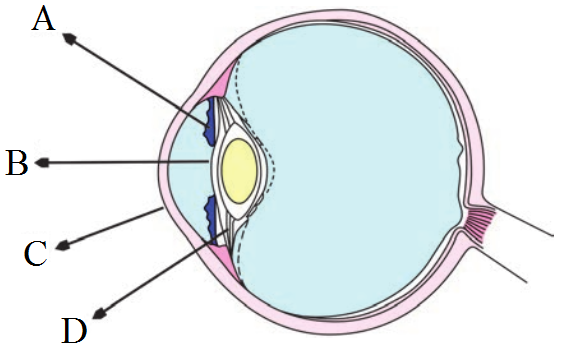
In the figure of the human eye, the cornea is represented by the letter.
  • A
    $A.$
  • $B.$
  • C
    $C.$
  • D
    $D.$
Answer
Correct option: B.
$B.$
  The transparent front part of the eye is cornea labelled as $C\ ($this is a thin layer$).$
View full question & answer
MCQ 491 Mark
In a periscope, how are the reflecting mirrors arranged?
  • A
    Perpendicular to each other.
  • Parallel to each other.
  • C
    At an angle of $90^\circ.$
  • D
    At an angle of $60^\circ.$
Answer
Correct option: B.
Parallel to each other.
The two reflecting, plane mirrors arranged in a periscope are parallel to each other. The light ray from the object is incident on the first plane mirror at an angle of $45^\circ$ and the reflected ray is incident on the second mirror at $45^\circ$ and is then reflected at $45^\circ$, which finally reaches the retina of the eye.
View full question & answer
MCQ 501 Mark
While sitting on the first bench, Mutum finds it difficult to read what is written on the blackboard. However, he can clearly see the same when he sits on the last bench. It can be concluded that Mutum is suffering from.
  • A
    Myopia
  • B
    Cataract
  • C
    Astigmatism
  • Hypermetropia
Answer
Correct option: D.
Hypermetropia
View full question & answer