Questions

questions in short. [2 marks ]

🎯

Test yourself on this topic

48 questions · timed · auto-graded

Question 12 Marks
What is metamorphosis? Give examples.
Answer
The transformation of the larva into an adult through drastic changes is called metamorphosis. It is a biological process which involves sudden and abrupt changes in the body structure of the animal by cell growth and differentiation. It is generally observed in amphibians and insects. Example: Frogs, butterflies, etc.
View full question & answer
Question 22 Marks
What is metamorphosis? Give two examples of metamorphosis.
Answer
The transformation of the larva into an adult through drastic changes is called metamorphosis. Metamorphosis occurs in frog and silk moth.
View full question & answer
Question 32 Marks
Give two differences between a zygote and a foetus.
Answer
$1.$ Zygote is made up of a single cell while foetus is made up of many cells.
$2.$ Zygote is formed by the fertilization of sperm and ovum, foetus is formed by the repeated divisions of the zygote.
View full question & answer
Question 42 Marks
Explain the importance of reproduction in organisms.
Answer
The importance of reproduction in organisms is:
$i.$ Reproduction is essential for the continuation of a species.
$ii.$ Reproduction ensures the continuation of similar kinds of individuals, generation after generation.
View full question & answer
Question 52 Marks
What are the two general methods of reproduction in organisms?
Answer
There are two methods of reproduction:
$1.$ Sexual reproduction.
$2.$ Asexual Reproduction.
View full question & answer
Question 62 Marks
Mention the functions of albumin in egg.
Answer
Albumin in an egg functions to protect the embryo against external shock by forming a layer around it. It also provides nutrition to the growing embryo.
View full question & answer
Question 72 Marks
Give the time taken by an embryo to develop into chick.
Answer
An embryo takes around $21$ days to completely develop into a chick. It is depicted by the hatching of egg that has been fertilized, and the emergence of chick from it.
View full question & answer
Question 82 Marks
A unicellular organism $P$ lives in pond water. The organisms $P$ has no fixed shape, its shape keeps on changing. It moves and catches its prey with the help of organs $Q$ which keep on appearing and disappearing. The organisms $P$ reproduces by a process $R.$ Another organisms $S$ also reproduces by this process. Name $P, Q, R$ and $S.$
Answer
$P$ is Amoeba; $Q$ is Pseudopodia; $R$ is Binary fission; $S$ is Paramecium.
View full question & answer
Question 92 Marks
What is the difference between viviparous animals and oviparous animals?
Answer
Difference between viviparous animals and oviparous animals:
Viviparous animals Oviparous animals
The animals which give birth to young ones are called viviparous animals The animals which lay eggs are called oviparous animals.
Examples: human, cow. Example: Hens and frog.
View full question & answer
Question 102 Marks
Testes produce male germ cells. What are these cells called? Name its parts.
Answer
The male gametes produced by testes are called sperms. These are small in size, single cells, with all the usual cell components.
The sperms have three parts:
$-$Head.
$-$Middle piece.
$-$Tail.
View full question & answer
Question 112 Marks
Name some animals which reproduce by budding.
Answer
Animals which reproduce by budding are:
$i.$ Hydra.
$ii.$ Sea anemone.
$iii.$ Corals.
$iv.$ Sponges.
$v.$ Starfish.
View full question & answer
Question 122 Marks
What are viviparous animals? Give two examples of viviparous animals.
Answer
The animals which give birth to young ones are called viviparous animals. Human beings and cow are examples of viviparous animals.
View full question & answer
Question 132 Marks
What is the importance of reproduction?
Answer
Reproduction is important for organisms because it ensures the continuity of life on earth. It is the means of multiplication and perpetuation of a species. It also creates variations among the population.
View full question & answer
Question 142 Marks
Explain what happens after a hen lays a fertilised egg.
Answer
After a fertilized egg is layer, the embryo takes around three weeks to develop into a chick. It requires the warmth provided by the hen sitting on it, to develop into a chick. As it develops completely, the egg hatches and the chick comes out.
View full question & answer
Question 152 Marks
List the various types of asexual reproduction.
Answer
There are five types of asexual reproduction. They are:
$i.$ Budding.
$ii.$ fission.
$iii.$ Fragmentation.
$iv.$ Spore formation.
$v.$ Vegetative reproduction.
View full question & answer
Question 162 Marks
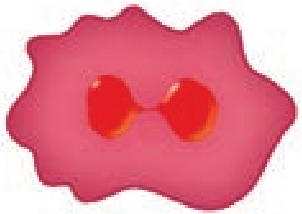
What does figure represent?
Answer
The .figure represents binary fission with a dividing nucleus parent in Amoeba. The singlecelled parent Amoeba divides to form two daughter cells that develop into two independent Amoebae.
View full question & answer
Question 172 Marks
Write two ways by which $\text{AIDS}$ is transmitted.
Answer
$\text{AIDS}$ is a sexually transmitted disease, which can be transmitted by:
$-$Unprotected sexual intercourse.
$-$Through infected needle or syringe.
View full question & answer
Question 182 Marks
In which type of reproduction, gametes are involved?
Answer
Gametes are involved in sexual mode of reproduction. The plants reproducing by sexual mode have both male and female reproductive parts and the animals have organs which produce gametes. In both cases, fusion of gametes is required for reproduction.
View full question & answer
Question 192 Marks
List modes of reproduction present in animals.
Answer
There are two modes of reproduction present in animals:
$i.$ Asexual reproduction.
$ii.$ Sexual reproduction.
View full question & answer
Question 202 Marks
In sexual reproduction, does fertilisation take place or not?
Answer
Fertilisation has to take place for sexual reproduction to occur. It is one of the most vital steps in sexual reproduction. Fertilisation is the process of fusion of male and female gametes, to produce a new generation.
View full question & answer
Question 212 Marks
Why do fishes and frogs produce enormous number of gametes?
Answer
Fishes and frogs fertilise externally producing enormous number of gametes because some eggs may be lost due to environmental agents like flowing water, wind, etc. and this increases the chances of fertilisation.
View full question & answer
Question 222 Marks
What is the name of the reproductive process?
$1.$ Which involves two parents?
$2.$ Which involves only one parents?
Answer
$1.$ In sexual reproduction, two parents are involved.
$2.$ In asexual reproduction, only one parent is involved.
View full question & answer
Question 232 Marks
Define budding.
Answer
Budding is a form of asexual reproduction, where new individuals develop from bulges or outgrowths on the parent body. These bulges are called buds, and hence the process is called budding. Being an asexual form of reproduction, it requires only one parent for the process.
View full question & answer
Question 242 Marks
Why do female frogs (or female fish) lay hundreds of eggs$?$
Answer
The female frogs (or female fish) lay hundreds of eggs because there are fewer chances of surviving in that environment, so from $100$ even if $5-10$ survive, their species will survive.
View full question & answer
Question 252 Marks
Which of the following are oviparous animals and which are viviparous animals? Frog, Human being, Sparrow, Lizard, Cow, Dog, hen, Fish, Butterfly, Cat.
Answer
Oviparous animals: Frog, sparrow, lizard, hen, fish, butterfly.
Viviparous animals: Human being, dog, cat.
View full question & answer
Question 262 Marks
Are all mammals viviparous?
Answer
All mammals except platypus and echidnas are viviparous, that is they give birth to young ones.
View full question & answer
Question 272 Marks
What do you understand by viviparous animals?
Answer
The animals that give birth to young ones directly, that is they do not pay eggs are called viviparous animals. The development of embryo, in this case, takes place inside the parental body, generally, of mothers.
View full question & answer
Question 282 Marks
What do you understand by foetus?
Answer
In the life inside uterus of the mother that is in intrauterine life, when the body parts of an embryo can be identified and differentiated, like the eyes, ears, hands, legs, etc. the embryo is called foetus. A mother gives delivery to a fully grown foetus.
View full question & answer
Question 292 Marks
Amoeba is a unicellular organism. How does a single cell produce its copies?
Answer
Amoeba exhibits asexual mode of reproduction. It reproduces by binary fission, where a single organism, divides to form two new organisms or progeny.
View full question & answer
Question 302 Marks
In which of the following animals the embryo develop fully inside the mother’s body and in which they develop fully in the eggs laid by mother?
Cow, Ostrich, Frog, Lizard, Deer, Cat, Snake, Tiger, Dog, Hen.
Answer
Viviparous animals: Cow, deer, cat, tiger, dog.
Oviparous animals: Ostrich, frog, lizard, snake, hen.
View full question & answer
Question 312 Marks
Write the name of an animal which is hermaphrodite.
Answer
Snail is hermaphrodite animal, as it has both male and female reproductive organs.
View full question & answer
Question 322 Marks
A is an insect which breeds in ponds of stagnant water. The egg of this insect produces a worm like form $B$ which is entirely different in appearance from the adult insects. The form $B$ undergoes a change $C$ and gets converted into insects $A.$ The female of insects $A$ is a carrier of protozoan $D$ which spreads a disease in humans.
$1.$ What are $A, B, C,$ and $D?$
$2.$ Name another insect which also undergoes change $C.$
Answer
$1. A$ is Mosquito; $B$ is Larva; $C$ is Metamorphosis; $D$ is plasmodium.
$2.$ Butterfly is another insect which also undergoes metamorphosis.
View full question & answer
Question 332 Marks
Which cell do organelles find only in plant cells?
Answer
Plastids, such as chloroplasts are four only in plant cells. Also, the plant cells have vacuoles and cell wall.
View full question & answer
Question 342 Marks
Which of the following organisms reproduces by sexual and which by asexual method? Amoeba, Cats Humans, Hydra, Birds.
Answer
Sexual method: Cats, humans, birds.
Asexual method: Amoeba and Hydra.
View full question & answer
Question 352 Marks
Name two animals which undergo metamorphosis and two which do not.
Answer
Frog and silk moth undergo metamorphosis whereas cow and hen do not undergo metamorphosis.
View full question & answer
Question 362 Marks
Do all organisms give birth to young ones?
Answer
No There are two modes of reproduction in organisms– asexual and sexual. The animals reproducing by sexual reproduction only give birth to young ones. Those reproducing by asexual mode adopt different methods but don’t give birth to young ones directly
View full question & answer
Question 372 Marks
Implantation is important for development of embryo. What happens during this process?
Answer
Implantation is the stage in pregnancy where the rapidly growing and dividing embryo gets attached to the wall of uterus of the mother.
View full question & answer
Question 382 Marks
Which of the following animals undergo metamorphosis and which do not? Cow, Butterfly, Silk moth, Humans, Frog, Housefly, Sparrow, Hen, Mosquito, Money.
Answer
Butterfly, silk moth, frog, housefly and mosquito undergo metamorphosis while cow, human, hen and monkey do not undergo metamorphosis.
View full question & answer
Question 392 Marks
Give the stages of growth in silkworm.
Answer
There are four stages in the lifecycle of a silkworm:
$i.$ Ova or egg.
$ii.$ Larva, with five instars.
$iii.$ Pupae.
$iv.$ Imago or adult.
View full question & answer
Question 402 Marks
Name the organs of the female reproductive system in humans.
Answer
The female reproductive organs include a pair of ovaries, fallopian tubes, and a cervix.
View full question & answer
Question 412 Marks
Name one animal each which reproduces:
$1.$ By binary fission, and
$2.$ By budding.
Answer
$1.$ Amoeba reproduces by common asexual method called binary fission.
$2.$ Budding is asexual method of reproduction in hydra.
View full question & answer
Question 422 Marks
Define foetus. After how many weeks of development, a human embryo is said to become a foetus?
Answer
The stage of the embryo in which all the body parts can be identified is called a foetus. A human embryo becomes a foetus after about 8 weeks of pregnancy.
View full question & answer
Question 432 Marks
What is the basic difference between asexual and sexual reproduction?
Answer
Difference between asexual and sexual reproduction:
Asexual reproduction Sexual reproduction
In this type of reproduction, the offspring arises from a single parent. The offspring arises from two parents of different sexes.
Example: Hydra, Amoeba, etc. Example: Frog, human beings, etc.
View full question & answer
Question 442 Marks
Is binary fission, sexual or asexual?
Answer
Binary fission is an asexual mode of reproduction because it involves production of progeny from one single organism only, and no gametes are formed.
View full question & answer
Question 452 Marks
Give details of two different ways in which a zygote develops in case of internal fertilisation.
Answer
The two different ways in which zygote develops following an internal fertilisation is:
By oviparity: Where the fertilized zygote after being coated with protective layers, is laid out as an egg, and the further development of the zygote takes place outside the body of the mother. Example: Hen.
By viviparity: Where the fertilized zygote gets implanted in the maternal body, and the development takes place inside the mother’s body. In this, the mother gives birth to young ones.
View full question & answer
Question 462 Marks
Which type of reproduction:
$1.$ Involves gametes?
$2.$ Does not involve gametes?
Answer
$1.$ Sexual reproduction involves gametes.
$2.$ Asexual reproduction does not involve gametes.
View full question & answer
Question 472 Marks
What is a clone? Name one famous clone.
Answer
The organisms which are produced asexually are genetically identical to the parent and are called clones. Dolly was born on 5th July 1996 and was the first mammal to be cloned.
View full question & answer
Question 482 Marks
What are oviparous animals? Give two examples of oviparous animals.
Answer
Those animals which lay eggs are called oviparous animals. Examples - Hens and frog.
View full question & answer
questions in short. [2 marks ] - Science STD 8 Questions - Vidyadip