Questions · Page 1 of 4

M.C.Q. [I MARKS]

🎯

Test yourself on this topic

50 questions · timed · auto-graded

MCQ 11 Mark
Phases of the Moon occur because:
  • A
    We can see only that part of the Moon which reflects light towards us.
  • B
    Our distance from the Moon keeps changing.
  • C
    The shadow of the Earth covers only a part of the Moon's surface.
  • The thickness of the Moon's atmosphere is not constant.
Answer
Correct option: D.
The thickness of the Moon's atmosphere is not constant.
The size of the illuminated part of the moon visible from the Earth increases each day after the new moon day. After the full moon day, the sunlit part of the moon visible from the Earth decreases in size every day. This process leads to the phases of the Moon.
View full question & answer
MCQ 21 Mark
Which of the following is not a planet of the sun?
  • Sirius
  • B
    Mercury
  • C
    Saturn
  • D
    Earth
Answer
Correct option: A.
Sirius
The brightest star in the night sky is sirius which is located close to the orion constellation. Except sirius, all planets are members of solar system.
View full question & answer
MCQ 31 Mark
Which of the following is not a member of the solar system?
  • A
    An asteroid
  • B
    A satellite
  • A constellation
  • D
    Earth
Answer
Correct option: C.
A constellation
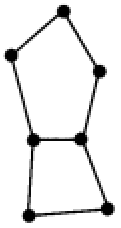
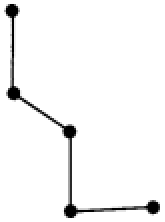
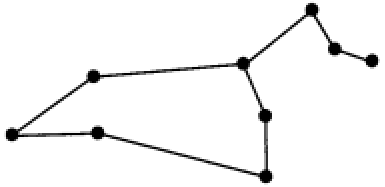
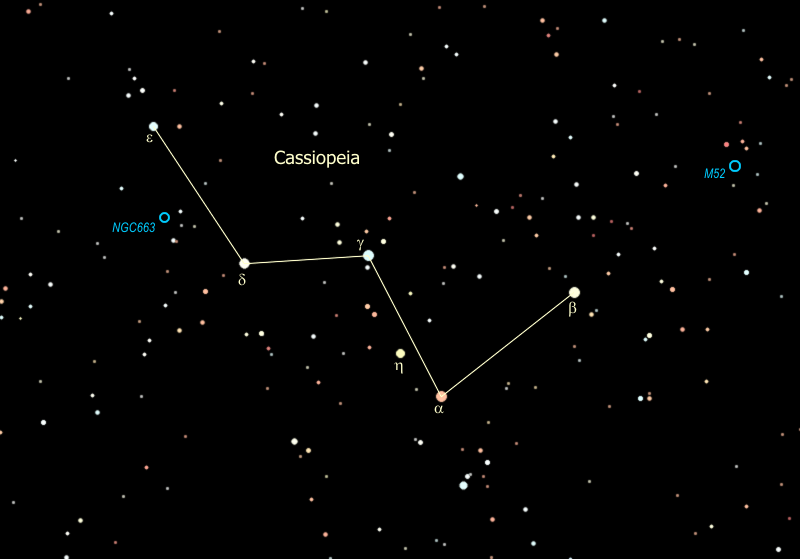
The group of stars which appears to form some recognizable shape or pattern is known as constellation. Some of the important are: ursa major, orion, cassiopeia, leo major. Constellations are not the part of the solar family. Rest of all, are the member of solar family.
View full question & answer
MCQ 41 Mark
Match the Column $I$ with Column $II$ and select the correct option from the codes given below.
 
Column $I$
 
Column $II$
$(a)$
Made of ice and rocky material
$(i)$
Orion
$(b)$
Chunks of rocks that have never managed to come together as planet
$(ii)$
Meteors
$(c)$
Shooting stars in the sky
$(iii)$
Asteroids
$(d)$
The hunter
$(iv)$
Comets
  • A
    $(a)-(i), (b)-(ii), (c)-(iii), (d)-(iv)$
  • $(a)-(iv), (b)-(iii), (c)-(ii), (d)-(i)$
  • C
    $(a)-(iii), (b)-(ii), (c)-(i), (d)-(iv)$
  • D
    $(a)-(ii), (b)-(i), (c)-(iv), (d)-(iii)$
Answer
Correct option: B.
$(a)-(iv), (b)-(iii), (c)-(ii), (d)-(i)$
View full question & answer
MCQ 51 Mark
If plastic strips are placed in an electroscope at the place of aluminum strips then:
  • A
    Divergence of strips will take place.
  • No divergence of strips will take place.
  • C
    Partial divergence of strips will take place.
  • D
    Either $[a]$ or $[b].$
Answer
Correct option: B.
No divergence of strips will take place.
View full question & answer
MCQ 61 Mark
What is the gap between the orbit of mars and Jupiter called?
  • Asteroids
  • B
    Comets
  • C
    Meteor
  • D
    Meteorite
Answer
Correct option: A.
Asteroids
View full question & answer
MCQ 71 Mark
Which part of the earth consists of tectonic plates?
  • Crust
  • B
    Mantle
  • C
    Inner core
  • D
    Outer core
Answer
Correct option: A.
Crust
View full question & answer
MCQ 81 Mark
The earth rotates on its axis from $............$
  • A
    North to south
  • B
    South to north
  • C
    East to west
  • West to east
Answer
Correct option: D.
West to east
View full question & answer
MCQ 91 Mark
What is Halley$?$
  • A comet
  • B
    An asteroid
  • C
    A satellite of Jupiter
  • D
    A meteorite
Answer
Correct option: A.
A comet

 Halley is the name of a comet which was first observed by Halley in $1986.$ It appears once in every $76$ years.

View full question & answer
MCQ 101 Mark
The nearest planet to the Earth is:
  • Venus
  • B
    Mercury
  • C
    Jupiter
  • D
    Mars
Answer
Correct option: A.
Venus
Venus is about the same size as the Earth and is the closest planet to the Earth.
View full question & answer
MCQ 111 Mark
Stars appear to move from:
  • A
    West to East.
  • East to West.
  • C
    North to South.
  • D
    South to West.
Answer
Correct option: B.
East to West.
View full question & answer
MCQ 121 Mark
All the stars appear to move from $............$
  • A
    North to south
  • B
    South to north
  • East to west
  • D
    West to east
Answer
Correct option: C.
East to west
View full question & answer
MCQ 131 Mark
Identify the biggest constellation.
  • A
    Sirius
  • Hydra
  • C
    Andromeda
  • D
    Ursa minor
Answer
Correct option: B.
Hydra

 The largest of the $88$ recognized constellations is Hydra. It is best seen from the southern hemisphere. The smallest constellation is Crux.

View full question & answer
MCQ 141 Mark
Which of the following is not true?
  • A
    Planets rotate on their own axis.
  • B
    Planets do not emit light.
  • C
    Pome planets are gaseous and some are rocky
  • Most of the planets have rings around them.
Answer
Correct option: D.
Most of the planets have rings around them.
View full question & answer
MCQ 151 Mark
To an astronaut, the outer space appears:
  • A
    Dark blue
  • B
    White
  • Black
  • D
    Dark red
Answer
Correct option: C.
Black
The sky appears black to an astronaut because there is no atmosphere in the outer space that can scatter the sunlight.
View full question & answer
MCQ 161 Mark
Read the given statements and select the correct option.
Statement $1:$ Saturn could float if put in water.
Statement $2:$ Saturn is less dense than water.
  • Both statements $1$ and $2$ are true and statement $2$ is the correct explanation of statement $1.$
  • B
    Both statements $1$ and $2$ are true but statement $2$ is not the correct explanation of statement $1.$
  • C
    Statement $1$ is true but statement $2$ is false.
  • D
    Both statements $1$ and $2$ are false.
Answer
Correct option: A.
Both statements $1$ and $2$ are true and statement $2$ is the correct explanation of statement $1.$
View full question & answer
MCQ 171 Mark
Anuj appeared in class test but he confused to know the correct statement. Would you help him to know that?
  • A
    Venus is the closest planet to the earth and also hottest planet in solar system.
  • B
    The planet venus can be seen either as a “morning star” in the eastern sky or as an “evening star” in the western sky.
  • C
    Mercury and venus are the only two planets of the solar system which has no satellites revolving around them.
  • All the above.
Answer
Correct option: D.
All the above.
Here, all the statements are correct.
View full question & answer
MCQ 181 Mark
When a glass rod is rubbed with a silk cloth, then the charge on the silk cloth is:
  • A
    Positive charge
  • Negative charge
  • C
    Neutral charge
  • D
    Uniform charge
Answer
Correct option: B.
Negative charge
View full question & answer
MCQ 191 Mark
After the sun, the next nearest star to the earth is:
  • A
    Alpha centauri
  • B
    Pole star
  • C
    Sirius
  • Proxima centauri
Answer
Correct option: D.
Proxima centauri

 After the sun, the next nearest star to the earth is “proxima centauri”. Proximus centauri is at a distance of about out $40,000,000$ million kilometers from the earth. Light from the next nearest star, proxima centauri, takes about $4.3$ light years to reach the earth. So, the distance of proxima centauri star from the earth is $4.3$ light years.

View full question & answer
MCQ 201 Mark
In a quiz competition, you are asked a question where you have to choose the statement which is/ are correct?
  • A
    The orion constellation consists of seven or eight bright stars.
  • B
    The orion constellation is visible in the sky during the winter season in late evenings.
  • C
    The brightest star in the night sky is “sirius” which is close to the orion constellation.
  • All the above.
Answer
Correct option: D.
All the above.
Here, all the statements are correct.
View full question & answer
MCQ 211 Mark
Identify the closest star to our solar system.
  • Proxima centauri
  • B
    Sirius
  • C
    Swati
  • D
    Ashwini
Answer
Correct option: A.
Proxima centauri

The sun is a part of the solar system. Proxima Centauri is about $4.3$ light years from the earth and nearest to the solar system.

View full question & answer
MCQ 241 Mark
When an uncharged body is touched by a charged body, it acquires a similar charge. This is known as:
  • A
    Charging by induction.
  • Charging by conduction.
  • C
    Charging by radiation.
  • D
    Charging by explosion.
Answer
Correct option: B.
Charging by conduction.
View full question & answer
MCQ 251 Mark
Which is the nearest galaxy to our galaxy$?$
  • Andromeda
  • B
    $X\ 31$
  • C
    Large magellanic cloud
  • D
    Small magellanic cloud
Answer
Correct option: A.
Andromeda

The nearest galaxy to ours is Andromeda which is $2$ million light years away from us.

View full question & answer
MCQ 261 Mark
Which of the following is the correct order of planets in the solar system?
  • Mercury, Venus, Earth, Mars, Jupiter, Saturn, Uranus, Neptune.
  • B
    Earth, Mercury, Venus, Mars, Jupiter, Saturn, Uranus, Neptune.
  • C
    Venus, Mars, Earth, Mercury, Jupiter, Saturn, Uranus, Neptune.
  • D
    Mercury, Venus, Earth, Mars, Jupiter, Saturn, Neptune, Uranus.
Answer
Correct option: A.
Mercury, Venus, Earth, Mars, Jupiter, Saturn, Uranus, Neptune.
View full question & answer
MCQ 271 Mark
Consider the following statements and choose the correct one:
  • A
    Meteoroids are much smaller than asteroids and comets.
  • B
    Star has its own light but a shooting star has no light of its own.
  • C
    Meteors are the celestial bodies from the sky which we see as a bright streak of light that flashes for a moment across the sky.
  • All the above.
Answer
Correct option: D.
All the above.
Here, all the statements are correct.
View full question & answer
MCQ 281 Mark
On which planet is one day longer than a year on the Earth$?$
  • A
    Saturn
  • B
    Neptune
  • Venus
  • D
    Jupiter
Answer
Correct option: C.
Venus

Venus takes $243$ Earth days to rotate once on its axis. It takes $225$ Earth days to orbit around the Sun. So a day nearly $20$ Earth days longer than its year.

View full question & answer
MCQ 291 Mark
Which of the given planets is the brightest$?$
  • A
    Mercury
  • Venus
  • C
    Mars
  • D
    Jupiter
Answer
Correct option: B.
Venus

 Venus is brightest planet in the sky. It appears bright due to its cloudy atmosphere, which reflects almost $75$ percent of sunlight that falls on it.

View full question & answer
MCQ 301 Mark
An astronaut standing on the surface of the moon throws a ball upwards. The ball would:
  • A
    Directly fall down from the point it is released.
  • B
    Hang in space.
  • Go up and then, come back to the surface of the moon.
  • D
    Keep going up never to come back.
Answer
Correct option: C.
Go up and then, come back to the surface of the moon.
The ball will go up and then comes down because at moon, acceleration due to gravity is less than that of the earth.
View full question & answer
MCQ 311 Mark
The hottest planet of our solar system is $.............$
  • A
    Mercury
  • Venus
  • C
    Mars
  • D
    Earth
Answer
Correct option: B.
Venus
View full question & answer
MCQ 321 Mark
Why does the pole star appear to be stationary in all seasons?
  • A
    It does not rotate on its axis.
  • B
    It happens to lie on the axis of equator.
  • It happens to lie above the axis of north pole of the earth.
  • D
    It is the most distant of all the stars.
Answer
Correct option: C.
It happens to lie above the axis of north pole of the earth.
The pole star is situated in the north along the axis of rotation of the earth and so its position relating to the earth always remains the same.
View full question & answer
MCQ 341 Mark
A huge wave that occurs due to an earthquake under the sea floor is:
  • A
    Magma
  • B
    Mantle
  • Tsunami
  • D
    Cyclone
Answer
Correct option: C.
Tsunami
View full question & answer
MCQ 351 Mark
Ravi was looking for Venus in the sky at midnight. Mohan laughed at him because Venus.
  • A
    Appears $1-3$ hours after sunrise or $1-3$ hours after sunset.
  • Appears $1-3$ hours before sunrise or $1-3$ hours after sunset.
  • C
    Appears $1-3$ hours before sunrise or $1-3$ hours before sunset.
  • D
    Appears $1-3$ hours after sunrise or $1-3$ hours before sunset.
Answer
Correct option: B.
Appears $1-3$ hours before sunrise or $1-3$ hours after sunset.
View full question & answer
MCQ 361 Mark
Choose the correct option for labelling the given figure of an earthquake.
  • A
    $(a -$ Focus$), (b -$ epicentre$), (c -$ seismic waves$), (d -$ crust of earth$).$
  • B
    $(a -$ Seismic waves$), (b -$ epicentre$), (c -$ focus$), (d -$ crust of earth$).$
  • $(a -$ Crust of earth$), (b -$ epicentre$), (c -$ focus$), (d -$ seismic waves$).$
  • D
    $(a -$ Crust of earth$), (b -$ focus$), (c -$ epicentre$), (d - $ seismic waves$).$
Answer
Correct option: C.
$(a -$ Crust of earth$), (b -$ epicentre$), (c -$ focus$), (d -$ seismic waves$).$
View full question & answer
MCQ 371 Mark
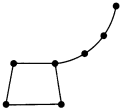
The following constellation is present in which of the following galaxies?
  • A
    Whirlpool galaxy
  • Milky way galaxy
  • C
    Starburst galaxy
  • D
    Andromeda galaxy
Answer
Correct option: B.
Milky way galaxy
View full question & answer
MCQ 381 Mark
Which of the following commonly known as shooting star?
  • A
    Asteroid
  • B
    Comet
  • Meteor
  • D
    Constellation
Answer
Correct option: C.
Meteor
View full question & answer
MCQ 391 Mark
Which of the following is the brightest non-star visible to the human eye?
  • Moon
  • B
    Venus
  • C
    Mars
  • D
    Jupiter
Answer
Correct option: A.
Moon
The moon is not a star. It is the only natural satellite visible to us on the earth.
View full question & answer
MCQ 401 Mark
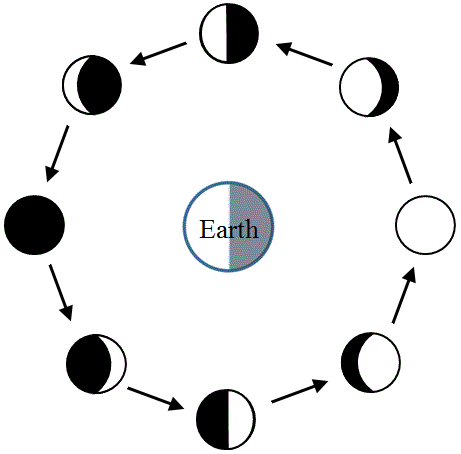
Phases of the Moon are as shown in the figure. Which of the following options shows the correct labelling $?$
  • $1 -$ Full Moon, $2 -$ Waning gibbous Moon, $3 -$ Waning crescent Moon, $4 -$ New Moon, $5 -$ Waxing crescent Moon.
  • B
    $1 -$ New Moon, $2 -$ Waxing gibbous Moon, $3 -$ Waning crescent Moon, $4 -$ Full Moon, $5 -$ Waxing crescent Moon.
  • C
    $1 -$ Waning crescent Moon, $2 -$ Waning gibbous Moon, $3 -$ Full Moon, $4 -$ New Moon, $5 -$ Waxing crescent Moon.
  • D
    $1 -$ New Moon, $2 -$ Waning gibbous Moon, $3 -$ Waning crescent Moon, $4 -$ Full Moon, $5 -$ Waxing gibbous Moon.
Answer
Correct option: A.
$1 -$ Full Moon, $2 -$ Waning gibbous Moon, $3 -$ Waning crescent Moon, $4 -$ New Moon, $5 -$ Waxing crescent Moon.
View full question & answer
MCQ 411 Mark
The tilting of the earth is responsible for
  • A
    Change of days
  • B
    Change of the sun�s rays
  • Change of the season
  • D
    None
Answer
Correct option: C.
Change of the season
View full question & answer
MCQ 421 Mark
Read the given statements and select the correct option.
Statement 1: Venus is hotter than mercury though it is far away from the Sun.
Statement 2: Cloudy atmosphere of Venus reflects almost $75$ percent of the sunlight that falls on it.
  • A
    Both statements $1$ and $2$ are true and statement $2$ is the correct explanation of statement $1.$
  • Both statements $1$ and $2$ are true but statement $2 $ is not the correct explanation of statement $1.$
  • C
    Statement $1$ is true but statement $2$ is false.
  • D
    Both statements $1$ and $2 $ are false.
Answer
Correct option: B.
Both statements $1$ and $2$ are true but statement $2 $ is not the correct explanation of statement $1.$

 Venus is hotter than mercury though it is far away from the Sun because of the high percentage of carbon dioxide in its atmosphere, which causes heating due to the greenhouse effect. Venus appears bright due to its cloudy atmosphere, which reflects almost $75$ per cent of the sunlight that falls on it.

View full question & answer
MCQ 431 Mark
What is Ceres?
  • A
    A satellite of Mars
  • B
    A satellite of Jupiter
  • An asteroid
  • D
    A meteorite that fell over Siberia in
Answer
Correct option: C.
An asteroid
Ceres is an asteroid that was first discovered and it is also the largest.
View full question & answer
MCQ 441 Mark
Which one of the following pairs is incorrect$?$
  • A
    A distorted $W$ or $M -$ Cassiopeia
  • B
    A big bear $-$ Ursa Major
  • A big lion $-$ Sirius
  • D
    A hunter $-$ Orion
Answer
Correct option: C.
A big lion $-$ Sirius
View full question & answer
MCQ 451 Mark
The brightest planet of the solar system is $...........$
  • A
    Mercury
  • Venus
  • C
    Earth
  • D
    Mars
Answer
Correct option: B.
Venus
View full question & answer
MCQ 461 Mark
An earthquake is a:
  • A
    Volcanic eruption
  • B
    Thunderstorm
  • Sudden shaking of earth
  • D
    Fast rotation of earth
Answer
Correct option: C.
Sudden shaking of earth
View full question & answer
MCQ 471 Mark
A planet which is called born sister of Earth is:
  • A
    Mercury
  • Venus
  • C
    Mars
  • D
    Jupiter.
Answer
Correct option: B.
Venus
The Earth and Venus are called sister planets because Venus is very close to the Earth and nearly of same size and density as Earth and the chemical make up is also very similar.
View full question & answer
MCQ 481 Mark
Morning star is the name given to:
  • A
    Pole star.
  • B
    Planet Jupiter.
  • C
    Star Sirius.
  • Planet Venus.
Answer
Correct option: D.
Planet Venus.
Morning star is the name given to the planet Venus because sometimes it appears in the eastern sky before sunrise.
View full question & answer
MCQ 491 Mark
Earlier we had $9$ planets in our solar system of which one name has been eliminated as per $\text{IAU}\ (2006). $ The planet is.
  • A
    Uranus
  • B
    Neptune
  • Pluto
  • D
    Earth
Answer
Correct option: C.
Pluto
View full question & answer
M.C.Q. [I MARKS] - Science STD 8 Questions - Vidyadip