Questions

3 Marks Question

🎯

Test yourself on this topic

8 questions · timed · auto-graded

Question 13 Marks
Find the area of a rhombus one side of which measures $20\ cm$ and one of whose diagonals is $24\ cm.$
Answer
Let $ABCD$ be a rhombus and let diagonals $AC$ and $BD$ intersect each other at point $O.$
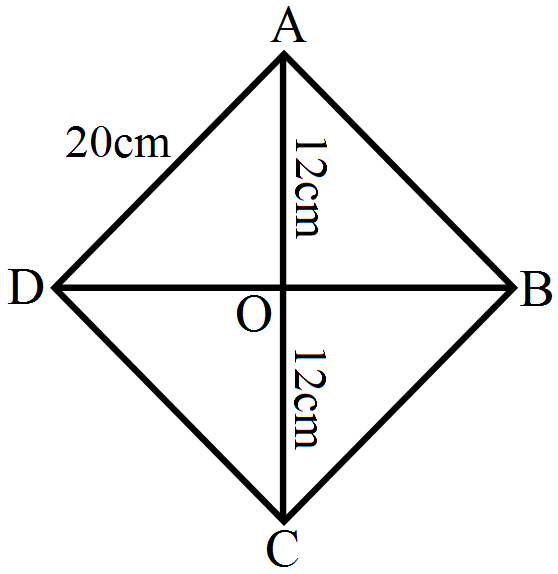
We know that diagonals of a rhombus bisect each other at right angles.
Thus, in right-angled $\triangle\text{AOD},$ by Pythagoras theorem,
$OD^2 = AD^2 - OA^2$
$= 20^2 - 12^2$
$= 400 - 144 = 256$
$\Rightarrow OD = 16\ cm$
$\Rightarrow BD = 2(OD) = 2(16) = 32\ cm$
Now, Area of rhombus $ABCD$
$=\frac{1}{2}\times\text{AC}\times\text{BD}$
$=\frac{1}{2}\times24\times32$
$=384\text{cm}^2$
View full question & answer
Question 23 Marks
If the area of an equilateral triangle is $36\sqrt{3}\text{cm}^2,$ find its perimeter.
Answer
Let a be the length of a side of an equilateral triangle.
$\therefore$ Area of an equilateral triangle $=\frac{\sqrt{3}\times\text{a}^2}{4}\text{sq}\ \text{units}$
Area of the equilateral triangle $=36\sqrt{3}\text{cm}^2\ [\text{given}]$
$\Rightarrow\frac{\sqrt{3}\times\text{a}^2}{4}=36\times\sqrt{3}$
$\Rightarrow\text{a}^2=\frac{36\times\sqrt{3}\times4}{\sqrt{3}}$
$\Rightarrow\text{a}^2=36\times4=144$
$\therefore \ \text{a}=\sqrt{144}=12\text{cm}$ Perimeter of an equilateral triangle $= 3 \times a$
Since, $a = 12\ cm,$
Perimeter $= (3 \times 12)\ cm = 36\ cm$
View full question & answer
Question 33 Marks
The area of a trapezium is $475 cm^2$ and its height is $19 cm$ . Find the lengths of its parallel sides if one side is $4 cm$ greater than the other.
Answer
Let the smaller parallel side of trapezium $= x cm$
Then, larger parallel side $= (x + 4)cm$
Now, Area of trapezium $=\frac{1}{2}\times(\text{Sum}\ \text{of}\ \text{parallel}\ \text{sides}) \times \text{Height}$
$\Rightarrow475=\frac{1}{2}\times\big[\text{x}+(\text{x}+4)\big]\times19$
$\Rightarrow25=\frac{1}{2}\times(2\text{x}+4)$
$\Rightarrow50=2\text{x}+4$
$\Rightarrow2\text{x}=46$
$\Rightarrow\text{x}=23$
$\Rightarrow\text{x}+4=23+4=27$
Thus, the lengths of two parallel sides are $23cm$ and $27cm$ respectively.
View full question & answer
Question 43 Marks
Find the area of an isoscale triangle each of whose equal sides measures $13\ cm$ and whose measures $20\ cm.$
Answer
$a = 13\ cm$ and $b = 20\ cm$
$\therefore$ Area of the triangle $=\frac{\text{b}}{4}\sqrt{4\text{a}^2-\text{b}^2}$
$=\frac{20}{4}\times\sqrt{4(13)^2-20^2}$
$=5\times\sqrt{676-400}$
$=5\times\sqrt{276}$
$=5\times16.6$
$=83.06\text{cm}^2$
View full question & answer
Question 53 Marks
The difference between the lengths of the parallel sides of a trapezium is $8\ cm$, the perpendicular distance between these sides is $24\ cm$ and the area of the trapezium is $312\ cm^2$. Find the length of each of the parallel sides.
Answer
Let the smaller parallel side $= x\ cm$
Then, longer parallel side $= (x + 8)\ cm$
Height $= 24\ cm$
Area of trapezium $= 312\ cm^2$
$\Rightarrow\frac{1}{2}\times\text{Sum}\ \text{of}\ \text{parallel}\ \text{sides}\ \times\ \text{Height}=312$
$\Rightarrow\frac{1}{2}\times(\text{x}+\text{x}+8)\times24=312$
$\Rightarrow(2\text{x}+8)\times12=312$
$\Rightarrow2\text{x}+8=26$
$\Rightarrow2\text{x}=18$
$\Rightarrow\text{x}=9\text{cm}$
$\Rightarrow\text{x}+8=9+8=17\text{cm}$
Thus, the lengths of parallel sides are $9\ cm$ and $17\ cm$ respectively.
View full question & answer
Question 63 Marks
A parallelogram and a rhombus are equal in area. The diagonals of the rhombus measure $120m$ and $44m.$ If one of the sides of the parallelogram measures $66.,$ find its corresponding altitude.
Answer
Area of parallelogram $=$ Area of rhombus
$\Rightarrow\text{Base}\times\text{Altitude}=\frac{1}{2}\times\text{Product}\ \text{of}\times\text{diagonals}$
$\Rightarrow66\times\text{Altitude}=\frac{1}{2}\times120\times44$
$\Rightarrow66\times\text{Altitude}=60\times44$
$\Rightarrow\text{Altitude}=\frac{60\times44}{66}=40\text{m}$
View full question & answer
Question 73 Marks
The shape of the cross section of a canal is a trapezium. If the canal is $10\ m$ wide at the top, $6\ m$ wide at the bottem and the area of its cross section is $640\ m^2$, find the depth of the canal.
Answer
Area of cross section $=$ Area of trapezium $= 640\ m^2$
Length of top $+$ Length of bottom $=$ sum of parallel sides $= 10\ m + 6\ m = 16\ m$
Area of cross section $=$ Area of trapezium
$=\frac{1}{2}\times\text{Sum}\ \text{of}\ \text{parallel}\ \text{sides}\ \times\ \text{Height}$
$\Rightarrow640=\frac{1}{2}\times16\times\text{Height}$
$\Rightarrow\text{Height}=\frac{640\times2}{16}=80\text{m}$
​​​​​​​depth of the canal is $80\ m.$
View full question & answer
Question 83 Marks
A rectangular plot is given for constructing a house, having a measurement of $40\ m$ long and $15m$ in the front. According to the laws, a minimum of $3\ m$ wide space should be left in the front and back each and $2\ m$ wide space on each of the other sides. Find the largest area where house can be constructed.
Answer
Length of rectangular plot $= 40m$ Width of rectangular plot $= 15m$ Keeping $3m$ wide space in the front and back, length of rectangular plot $= 40 - 3 - 3 = 34m$ Keeping 2m wide space on both the sides, width of rectangular plot $= 15 - 2 - 2 = 11m$ Thus, largest area where house can be constructed $= 34m \times 11m = 374m^2$
View full question & answer
3 Marks Question - Maths STD 9 Questions - Vidyadip