Questions

True False[1 Marks ]

🎯

Test yourself on this topic

18 questions · timed · auto-graded

Question 11 Mark
$ABCD$ is a cyclic quadrilateral such that $\angle\text{A}=90^\circ,\angle\text{B}=70^\circ,\angle\text{C}=95^\circ$ and $\angle\text{D}=105^\circ.$
Answer
 In a cyclic quadrilateral, the sum of opposite angles is $180^\circ .$
Now, $\angle\text{A}+\angle\text{C}=90^\circ+95^\circ=185^\circ\neq180^\circ$ and
$\angle\text{B}+\angle\text{D}=70^\circ+105^\circ=175^\circ\neq180^\circ$
Here, we see that, the sum of opposite angles is not equal to $180^\circ .$
So, it is not a cyclic quadrilateral.
View full question & answer
Question 21 Mark
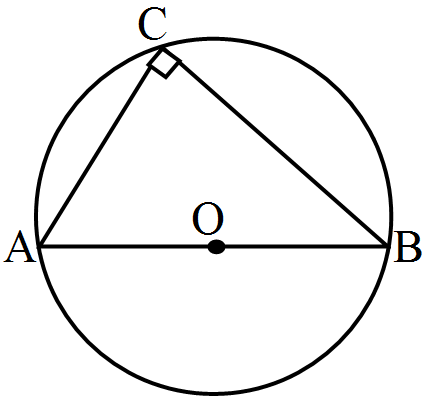
If $AOB$ is a diameter of a circle and $C$ is a point on the circle, then $\mathrm{AC}^2+\mathrm{BC}^2=A B^2$.
Answer
Since, any diameter of the circle subtends a right angle to any point on the circle. If $A O B$ is a diameter of a circle and $C$ is a point on the circle, then $\triangle A C B$ is right angled at $C$. In right angled $\triangle A C B$, [use Pythagoras theorem] $\mathrm{AC}^2+\mathrm{BC}^2=A B^2$
View full question & answer
Question 31 Mark
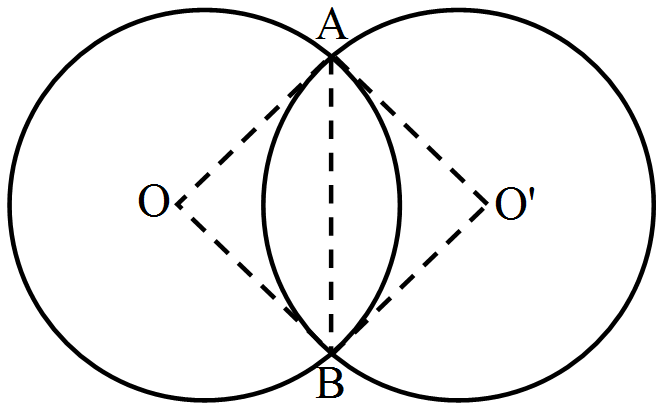
Two congruent circles with centres $O$ and $O′$ intersect at two points $A$ and $B.$ Then $\angle\text{AOB}=\angle\text{AO'B}.$
Answer

Join $AB$ and $OB, O'A$ and $BO'.$
In $\triangle\text{AOB}$ and $\triangle\text{AO'B,} OA = AO' [$both circles have same radius$] OB = BO' [$both circles have same radius$]$ and $AB = AB [$common chord$]$
$\triangle\text{AOB}=\triangle\text{AO'B} [$by $SSC$ congruence rule$]$
 $\Rightarrow\angle\text{AOB}=\angle\text{AO'B}[ $by $CPCT]$
View full question & answer
Question 41 Mark
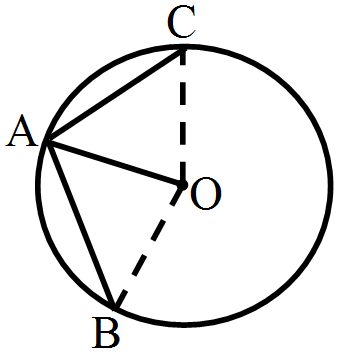
Two chords $AB$ and $AC$ of a circle with centre $O$ are on the opposite sides of $OA.$ Then $\angle\text{OAB}=\angle\text{OAC}.$
Answer
 In figure, $AB$ and $AC$ are two chords of a circle. Join $OB$ and $OC.$

In $\triangle\text{OAB}$ and $\triangle\text{OAC}, OA = OA [$common side$] OB = OC [$both are the radius of circle$]$
Here, we are not able to show that either the any angle or third side is equal and $\triangle\text{OAB}$ is,
​​​​​​​$\therefore\angle\text{OAB}\neq\angle\text{OAC}.$
View full question & answer
Question 51 Mark
A circle of radius $3\ cm$ can be drawn through two points $A, B$ such that $AB = 6\ cm$
Answer
Suppose, we consider diameter of a circle is $AB = 66m.$
Then, radius of a circle $=\frac{\text{AB}}{2}=\frac{6}{2}=3\text{cm},$ which is true.
View full question & answer
Question 61 Mark
Sector is the region between the chord and its corresponding arc.
Answer
True. Explanation: It is given that sector is the region between the chord and its corresponding arc. As we know that the region between the chord and its corresponding arc is called sector.
View full question & answer
Question 71 Mark
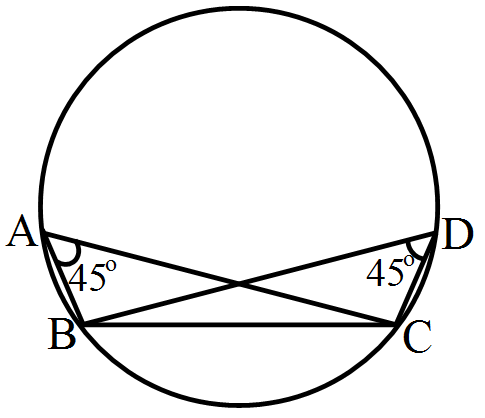
If $A, B, C$ and $D$ are four points such that $\angle\text{BAC}=45^\circ$ and $\angle\text{BDC}=45^\circ,$ then $A, B, C, D$ are concyclic.
Answer
Since, $\angle\text{BAC}=45^\circ$ and $\angle\text{BDC}=45^\circ$


As we know, angles in the same segment of a circle are equal. Hence, $A, B, C$ and $D$ are concyclic.
View full question & answer
Question 81 Mark
Through three collinear points a circle can be drawn.
Answer
False. Solution: Because, circle can pass through only two collinear points but not through three collinear points.
View full question & answer
Question 91 Mark
If a circle is divided into three equal arcs each is a major arc.
Answer
Given that if a circle is divided into three equal arcs each is a major arc.
As we know that if points $P, Q$ and $R$ lies on the given circle $C(O, r)$ in such a way that: $1\big(\widehat{\text{PQ}}\big)=1\big(\widehat{\text{QR}}\big)=1\big(\widehat{\text{RP}}\big)$
Then each arc is called major arc.
View full question & answer
Question 101 Mark
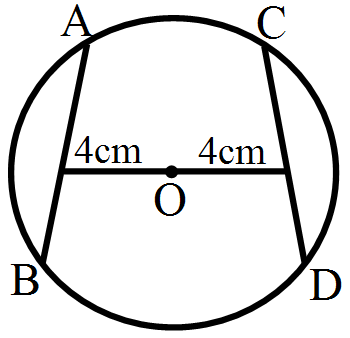
Two chords $AB$ and $CD$ of a circle are each at distances 4cm from the centre. Then $AB = CD.$
Answer
Because, the chords equidistant from the centre of circle are equal in length.
View full question & answer
Question 111 Mark
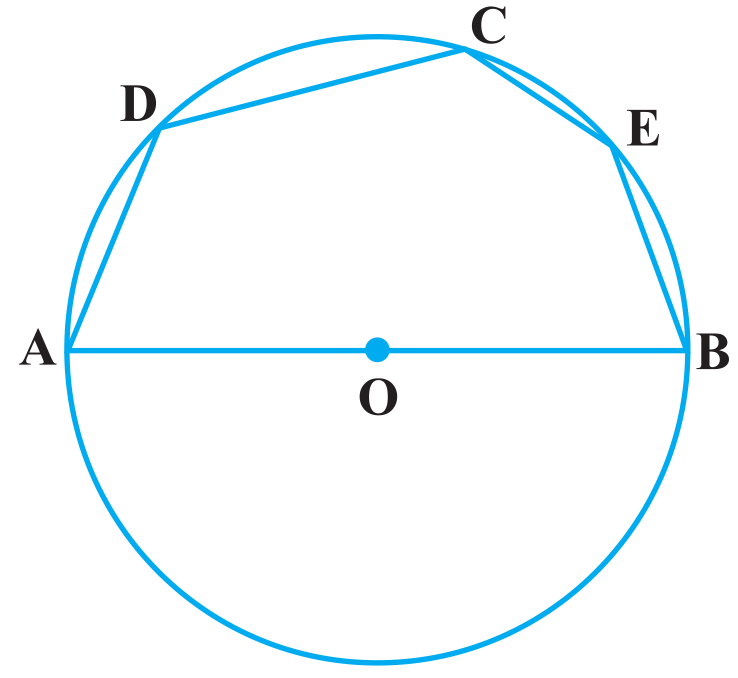
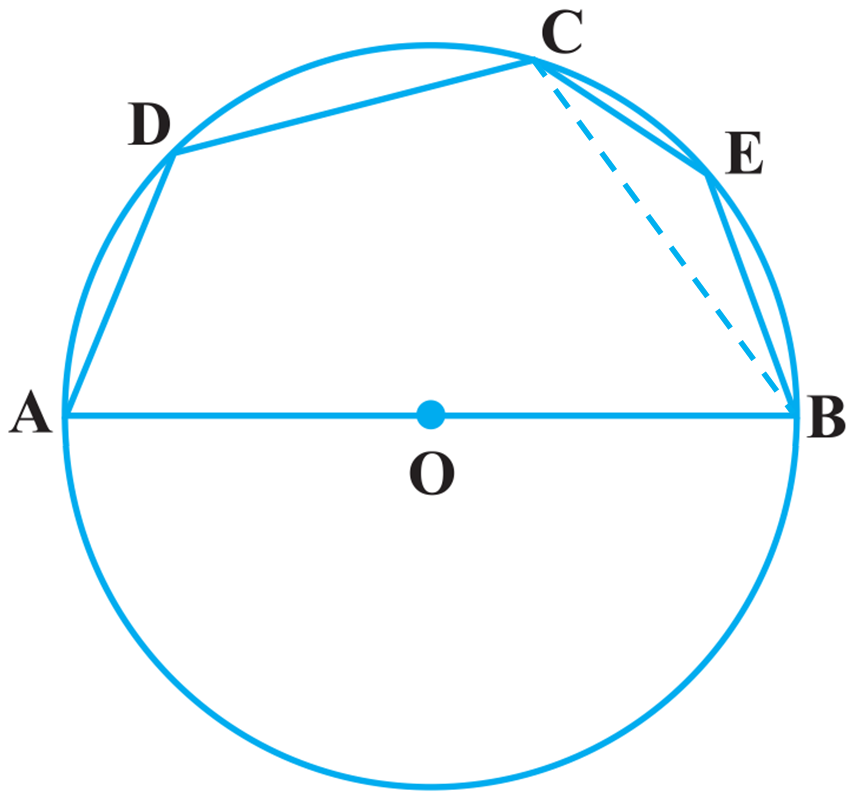
In Fig. if $AOB$ is a diameter and $\angle\text{ADC}=120^\circ,$ then $\angle\text{CAB}=30^\circ.$
Answer
  Join $CA$ and $CB.$

 Since, $ADCB$ is a cyclic quadrilateral.
$\angle\text{ADC}+\angle\text{CBA}=180^\circ [$sum of opposite angles of cyclic quadrilateral is $180^\circ ]$
$\Rightarrow\angle\text{CBA}=180^\circ-120^\circ=60^\circ\ \ [\therefore\angle\text{ADC}=120^\circ]$
In $\triangle\text{ACB,}\ \angle\text{CAB} + \angle\text{CBA} + \angle\text{ACB} = 180^\circ$
[by angle sum property of a triangle]
$\angle\text{CAB}+60^\circ+90^\circ=180^\circ$
$\big[$triangle formed from diameter to the circle is $90^\circ$
i.e., $\angle\text{ACB}=90^\circ\big]$
$\Rightarrow\angle\text{CAB}=180^\circ-150^\circ=30^\circ.$
View full question & answer
Question 121 Mark
Line segment joining the center to any point on the circle is a radius of the circle,
Answer
True.

Explanation:

Given that line segment joining the centre to any point on the circle is a radius of the circle.

As we know that line segment joining the centre to any point on the circle is a radius of the circle.

View full question & answer
Question 131 Mark
A circle has only finite number of equal chords.
Answer
False. Explanation: It is given that a circle has only finite number of equal chords. As we know that a circle having infinite number of unequal chords.
View full question & answer
Question 141 Mark
A circle is a plane figure.
Answer
True.
Explanation:
Given that a circle is a plane figure.
As we know that a circle is a collection of those points in a plane that are at a given constant distance from a fixed point in the plane.
View full question & answer
Question 151 Mark
The degree measure of a semi-circle is $180^\circ $
Answer
Given that the degree measure of a semi-circle is $180^\circ .$
As we know that the diameter ofa circle divides into two equal parts and each of these two arcs are known as semi-circle. $\widehat{\text{PQ}}$ and $\widehat{\text{QP}}$ are semi circle.
Hence, $\text{m}\big(\widehat{\text{PQ}}\big)=\text{m}\big(\widehat{\text{QP}}\big)=180^\circ$
View full question & answer
Question 161 Mark
A chord of a circle, which is twice as long is its radius is a diameter of the circle.
Answer
True. Explanation: Given that a chord of the circle, which is twice as long as its radius is diameter of the circle. As we know that a chord of a circle which is largest to others and passing through the centre of the circle and twice as long as its radius is called diameter of the circle.
View full question & answer
Question 171 Mark
The degree measure of an arc is the complement of the central angle containing the arc.
Answer
Given that the degree measure of an arc is the complement of the central angle containing the arc.
As we know that the degree measure of a minor arc is the measure of the central angle containing the arc and that of a major arc is $360^\circ $ minus the degree measure of the corresponding minor arc.
Let degree measure of an arc $\widehat{\text{PQ}}$ is $\theta$ of a given circle $C(O, r)$ is denoted by $\text{m}\big(\widehat{\text{PQ}}\big)=\theta.$
View full question & answer
Question 181 Mark
If $A, B, C, D$ are four points such that $\angle\text{BAC}=30^\circ$ and $\angle\text{BDC}=60^\circ$ then $D$ is the centre of the circle through $A, B$ and $C.$
Answer
Because, there can be many points $D,$ such that $\angle\text{BDC}=60^\circ$ and each such point cannot be the centre of the circle through $A, B$ and $C.$
View full question & answer