Questions

2 Marks Questions

🎯

Test yourself on this topic

12 questions · timed · auto-graded

Question 12 Marks
Draw a pair of vertically opposite angles. Bisect each of the two angles. Verify that the bisecting rays are in the same line.
Answer
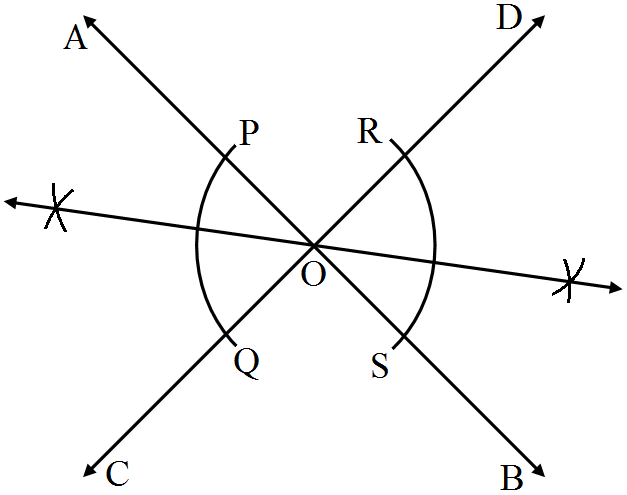

Steps of construction:
1. Draw a pair of vertically opposite angle $\angle AOC$ and $\angle DOB$.
2. Keeping $O$ as the centre and any radius draw two arcs which intersect $O A$ at $P, O C$ at $Q, O B$ at $S$ and $O D$ at $R$.
3. Keeping $P$ and $Q$ as centre and radius more than half of $P Q$ draw two arcs which intersect each other at $T$.
4. Join $TO.$
5. Keeping $R$ and $S$ as centre and radius more than half of $RS$ draw two arcs which intersect each other at $U$.
6. Join $OU.$
Therefore $TOU$ is a straight line.
View full question & answer
Question 22 Marks
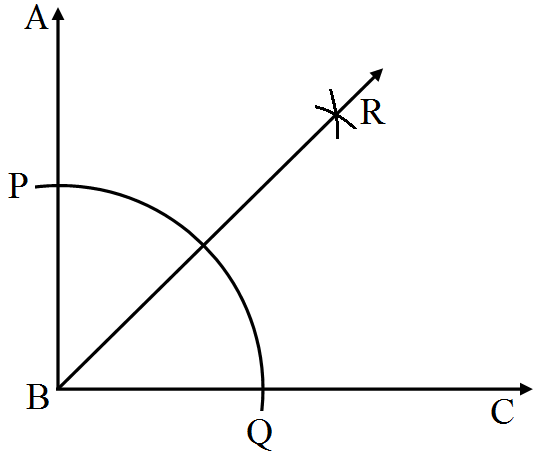
Using the protractor, draw a right angle. Bisect it to get an angle of measure $45^\circ .$
Answer


Steps of construction:
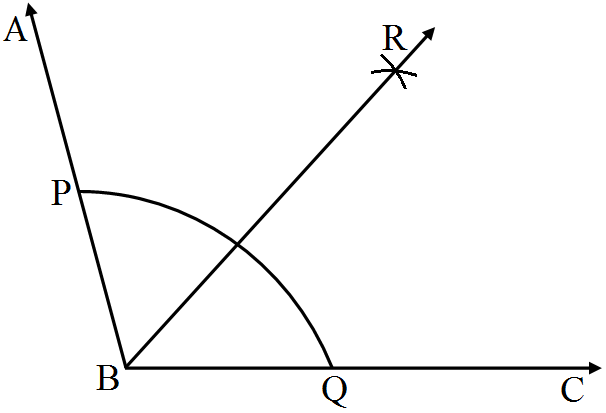
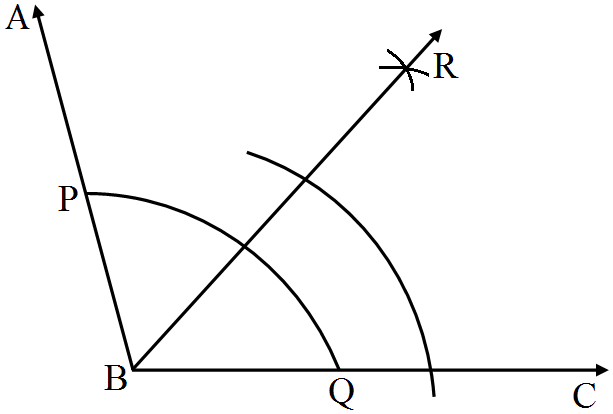
1. Draw an angle $A B C$ of $90^{\circ}$.
2. With $B$ as the centre and any radius draw an arc which intersects $A B$ at $P$ and $B C$ at $Q$.
3. With $P$ as center and radius more than half of $PQ$ draw an arc.
4. With $Q$ as center and same radius draw an arc which intersects the previous arc at $R$.
5. Join $RB.$ 
Therefore $\angle\text{RBC}=45^\circ$
View full question & answer
Question 32 Marks
Construct the following angles at the initial point of a given ray and justify the construction:
$i. 45^\circ$
$ii. 90^\circ$
Answer

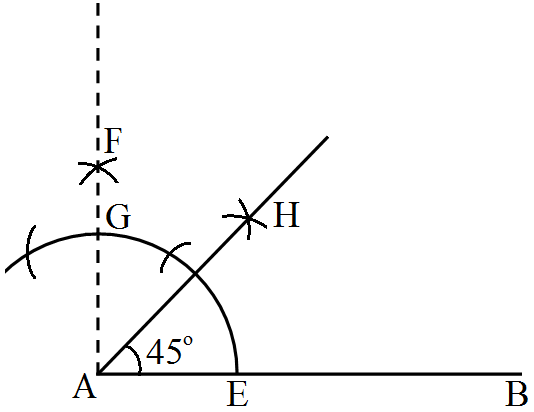
$i.$Steps of construction:
$1.$ Draw a line segment $A B$ and produce $B A$ to $C$.
$2.$ Keeping $A$ as the center and any radius draw an arc which intersects $A C$ at $D$ and $A B$ at $E$
$3.$ Keeping $D$ and $E$ as center and radius more than half of $D E$ draw arcs which intersect each other at $F$.
$4.$ Join FA which intersects the arc in $(2)$ at $G$.
$5.$ Keeping $G$ and $E$ as center and radius more than half of $G E$ draw arcs which intersect each other at $H$.
$6$. Join $HA.$
Therefore $\angle\text{HBC}=45^\circ$

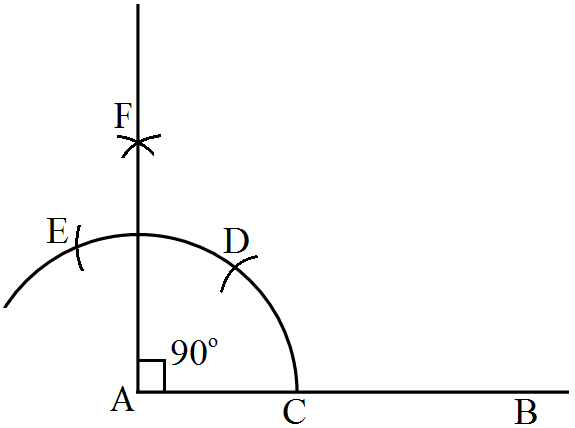
$ii.$ Steps of construction
$1.$ Draw a line segment $A B$.
$2.$ Keeping $A$ as the center and any radius draw an arc which intersects $A B$ at $C$.
$3.$ Keeping $C$ as center and the same radius draw an arc which intersects the previous arc at $D$.
$4.$ Keeping $D$ as the center and same radius draw an arc which intersects arc in $(2)$ at $E$.
$5.$ Keeping $E$ and $D$ as center and radius more than half of $ED$ draw arcs which intersect each other at $F$.
$6.$ Join $FA.$
Therefore $\angle\text{FAB}=90^\circ$
View full question & answer
Question 42 Marks
Construct the angles of the following measurements: $105^\circ $
Answer


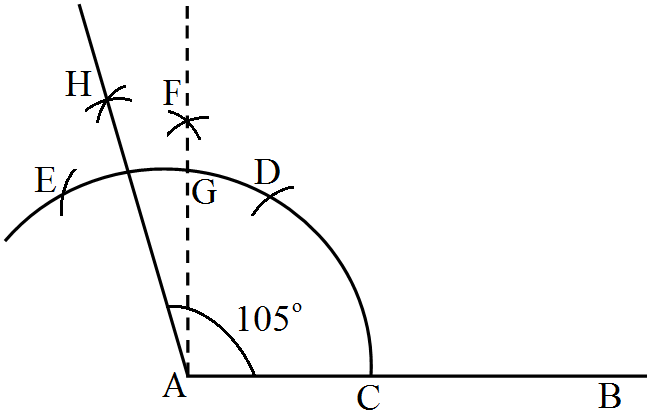
Steps of construction:
1. Draw a line segment $A B$.
2. Keeping $A$ as the centre and any radius draw an arc which intersects $A B$ at $C$.
3. Keeping $C$ as centre and the same radius draw an arc which intersects the previous arc at $D$.
4. Keeping $D$ as the centre and same radius draw an arc which intersects arc in (2) at $E$.
5. Keeping $E$ and $D$ as centre and radius more than half of $ED$ draw arcs which intersect each other at $F$.
6. Join FA which intersects arc in $(2)$ at $G.$
7. Keeping $E$ and $G$ as center and radius more than half of $EG$ draw arcs which intersect each other at $H$.
8. Join $HA..$
Therefore $\angle\text{HAB}=105^\circ $
View full question & answer
Question 52 Marks
Draw an obtuse angle. Bisect it. Measure each of the angles so obtained.
Answer


Steps of construction:
$1.$ Draw an angle $\angle\text{ABC}$ of $120^\circ .$
$2.$ With $B$ as a centre and any radius, draw an arc which intersects $AB$ at $P$ and $BC$ at $Q.$
$3.$ With $P$ as center and radius more than half of $PQ$ draw an arc.
$4.$ With $Q$ as a center and same radius draw an arc which cuts the previous arc at $R.$
$5.$ Join $BR.$
Therefore $\angle\text{ABR}=\angle\text{RBC} =60^\circ$
View full question & answer
Question 62 Marks
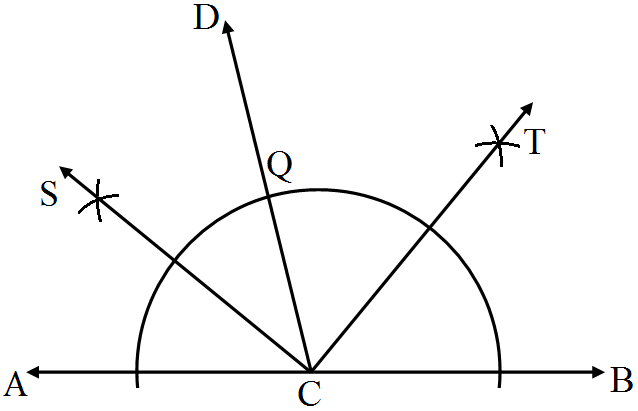
Draw a linear pair of angles. Bisect each of the two angles. Verify that the two bisecting rays are perpendicular to each other.
Answer

Steps of construction:
1. Draw two angles $D C A$ and $D C B$ forming linear pair.
2. With center $C$ and any radius draw an arc which intersects $A C$ at $P$ and $C D$ at $Q$ and $C B$ at $R$.
3. With center $P$ and $Q$ and any radius draw two arcs which intersect each other at $S$.
4. Join $SC.$
5. With $Q$ and $R$ as center and any radius draw two arcs which intersect each other at $T$.
6. Join $TC.$
Therefore $\angle\text{SCT}=90^\circ$
View full question & answer
Question 72 Marks
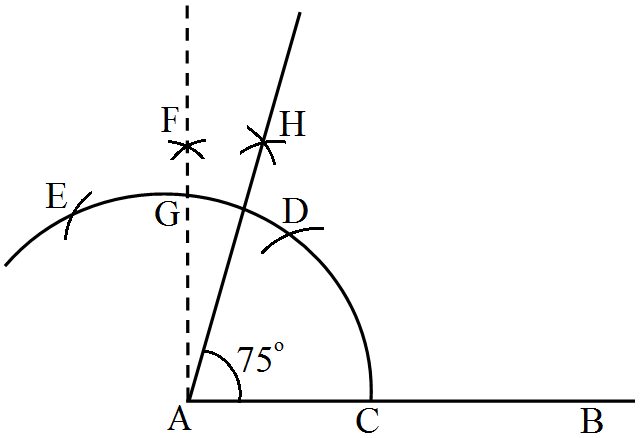
Construct the angles of the following measurements: $75^\circ $
Answer


Steps of construction:
1. Draw a line segment $A B$.
2. Keeping $A$ as centre and any radius draw an arc which intersects $A B$ at $C$.
3. Keeping $C$ as centre and the same radius draw an arc which intersects the previous arc at $D$.
4. Keeping $D$ as centre and same radius draw an arc which intersects arc in $(2)$ at $E$.
5. Keeping $E$ and $D$ as centre and radius more than half of $E D$, draw arcs intersecting each other at $F$.
6. Join FA which intersects arc in $(2)$ at $G.$
7. Keeping $G$ and $D$ as centre and radius more than half of $GD$ draw arcs intersecting each other at $H .$
8. Join $HA.$
Therefore $\angle\text{HAB}=75^\circ $
View full question & answer
Question 82 Marks
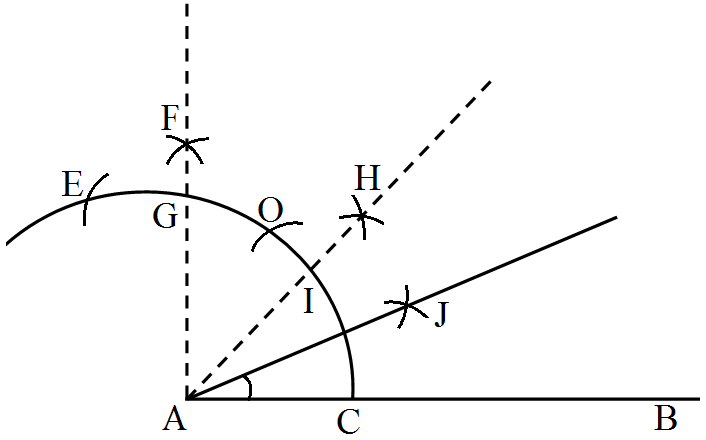
Construct the angles of the following measurements: $22\frac{1^\circ}{2}$
Answer


Steps of construction:
1. Draw a line segment $A B$.
2. Keeping $A$ as the centre and any radius draw an arc which intersects $A B$ at $C$.
3. Keeping $C$ as centre and the same radius draw an arc which intersects the previous arc at $D.$
4. Keeping $D$ as the centre and same radius draw an arc which intersects arc in $(2)$ at $E$.
5. Keeping $E$ and $D$ as centre and radius more than half of $ED$ draw arcs which intersect each at $F$.
6. Join FA which intersects arc in $(2)$ at $G.$
7. Keeping $G$ and $C$ as centre and radius more than half of $GC$ draw arcs intersecting each other at point $H .$
8. Join HA which intersects the arc in $(2)$ at a point $I.$
9. Keeping $I$ and $C$ as centre and radius more than half of $IC$ draw arcs intersecting each other at point $J.$
10. Join $JA.$
Therefore $\angle\text{JAB}=22\frac{1^\circ}{2}$
View full question & answer
Question 92 Marks
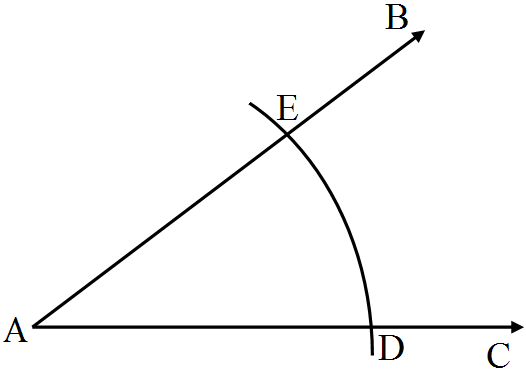
Draw an angle and label it as $\angle\text{BAC}.$ Construct another angle, equal to $\angle\text{BAC}.$
Answer

Steps of construction:
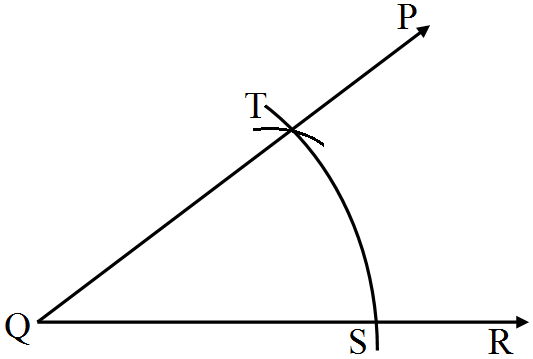
$1.$ Draw an $\angle ABC$ and a line segment $QR.$
$2.$ With center $A$ and any radius, draw an arc which intersects $\angle\text{BAC}$ at $E$ and $D$.
$3.$ With $Q$ as a centre and same radius draw an arc which intersects $QR$ at $S.$
$4.$ With $S$ as center and radius equal to $DE$, draw an arc which intersects the previous arc at $T$.
$5.$ Draw a line segment joining $Q$ and $T.$
Therefore $\angle\text{PQR}=\angle\text{BAC} $
View full question & answer
Question 102 Marks
Construct the angles of the following measurements: $30^\circ $
Answer

Steps of construction:
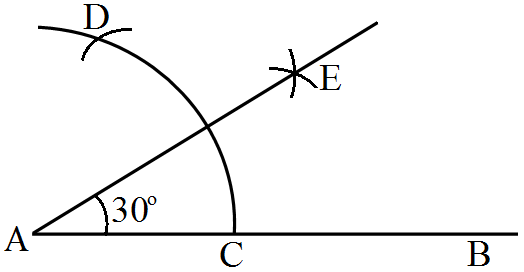
1. Draw a line segment $A B$.
2. Keeping $A$ as the centre and any radius draw an arc which intersects $A B$ at $C$.
3. Keeping $C$ as center and the same radius draw an arc which intersects the previous arc at $D$.
4. Keeping $D$ and $C$ as center and radius more than half of $D C$ draw arcs which intersect each other at $E$.
5. Join $EA.$
Therefore $\angle\text{EAB}=30^\circ $
View full question & answer
Question 112 Marks
Using your protractor, draw an angle of measure $108^\circ $. With this given angle as given, draw an angle of $54^\circ .$
Answer


Steps of construction:
1. Draw an angle $A B C$ of $108^{\circ}$.
2. With $B$ as the center and any radius draw an arc which intersects $A B$ at $P$ and $B C$ at $Q$.
3. With $P$ as center and radius more than half of $P Q$ draw an arc.
4. With $Q$ as the centre and same radius draw an arc which intersects the previous arc at $R$.
5. Join $BR.$
Therefore $\angle\text{RBC}=60^\circ$
View full question & answer
Question 122 Marks
Construct the angles of the following measurements: $15^\circ $
Answer


Steps of construction:
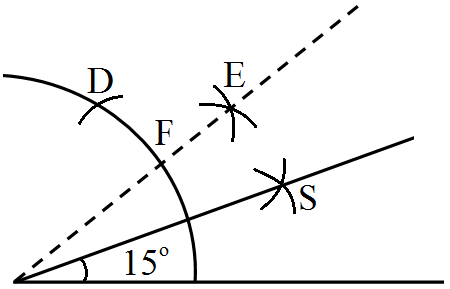
1. Draw a line segment $A B$.
2. Keeping $A$ as the centre and any radius draw an arc which intersects $A B$ at $C$.
3. Keeping $C$ as centre and the same radius draw an arc which intersects the previous arc at $D$
4. Keeping $D$ and $C$ as centre and radius more than half of $D C$ draw arcs which intersect each other at $E$.
5. Join EA which intersects arc in $(2)$ at $F$.
6. Keeping $F$ and $C$ as centre and radius more than half of $F C$ draw arcs which intersect each other at $G$.
7. Join GA.
Therefore $\angle\text{GAB}=15^\circ $
View full question & answer
2 Marks Questions - Maths STD 9 Questions - Vidyadip