Questions

M.C.Q

🎯

Test yourself on this topic

27 questions · timed · auto-graded

MCQ 11 Mark
In a histogram the class intervals or the group are taken along:
  • A
    $Y$-axis.
  • $X$-axis.
  • C
    Both of $X$-axis and $Y$-axis.
  • D
    In between $X$ and $Y$ axis.
Answer
Correct option: B.
$X$-axis.
In a histogram the class intervals or the groups are taken along the horizontal axis or $X$−axis.
View full question & answer
MCQ 21 Mark
A frequency polygon is constructed by plotting frequency of the class interval and the:
  • A
    Upper limit of the class.
  • B
    Lower limit of the class.
  • Mid value of the class.
  • D
    Any values of the class.
Answer
Correct option: C.
Mid value of the class.
Frequency polygon is the plot of frequencies vs. the mid values of the classes.
View full question & answer
MCQ 31 Mark
In the 'less than' type of ogive the cumulative frequency is plotted against:
  • A
    The lower limit of the concerned class interval.
  • The upper limit of the concerned class interval.
  • C
    The mid-value of the concerned class interval.
  • D
    Any value of the concerned class interval.
Answer
Correct option: B.
The upper limit of the concerned class interval.
In the less than type of ogive the cumulative frequency is plotted against the upper limit of the concerned class interval.
View full question & answer
MCQ 41 Mark
In a histogram the area of each rectangle is proportional to:
  • A
    The class mark of the corresponding class interval.
  • B
    The class size of the corresponding class interval.
  • Frequency of the corresponding class interval.
  • D
    Cumulative frequency of the corresponding class interval.
Answer
Correct option: C.
Frequency of the corresponding class interval.
In a histogram the area of each rectangle is proportional to the frequency of the corresponding class interval.
View full question & answer
MCQ 51 Mark
In a histogram, each class rectangle is constructed with base as:
  • A
    Frequency.
  • Class-intervals.
  • C
    Range.
  • D
    Size of the class.
Answer
Correct option: B.
Class-intervals.
In a histogram, the class rectangles are constructed with base as the class−intervals.
View full question & answer
MCQ 61 Mark
In a frequency distribution, ogives are graphical representation of:
  • A
    Frequency.
  • B
    Relative frequency.
  • Cumulative frequency.
  • D
    Raw data.
Answer
Correct option: C.
Cumulative frequency.
In a frequency distribution, ogives are graphical representation of cumulative frequency.
View full question & answer
MCQ 71 Mark
Which one of the following is not the graphical representation of statistical data:
  • A
    Bar graph.
  • B
    Histogram.
  • C
    Frequency polygon.
  • Cumulative frequency distribution.
Answer
Correct option: D.
Cumulative frequency distribution.
We know that bar graph, histogram and frequency polygons are all graphical representation of statistical data.
View full question & answer
MCQ 81 Mark
A histogram is a pictorial representation of the grouped data in which class intervals and frequency are respectively taken along:
  • A
    Vertical axis and horizontal axis.
  • B
    Vertical axis only.
  • C
    Horizontal axis only.
  • Horizontal axis and vertical axis.
Answer
Correct option: D.
Horizontal axis and vertical axis.
In a histogram the class intervals and frequencies are taken along horizontal and vertical axes respectively.
View full question & answer
MCQ 91 Mark
In a bar graph, the height of a bar is proportional to the
  • A
    width of the bar
  • B
    range of the data
  • value of the component
  • D
    number of observations in the data
Answer
Correct option: C.
value of the component
(c) value of the component
The value of a component is directly proportional to the height of corresponding bar.
View full question & answer
MCQ 101 Mark
In a bar graph, length of a bar is 6.4 cm and it represents 256 units. The number of units represented by a bar of length 5.3 cm is
  • A
    228
  • B
    196
  • 212
  • D
    224
Answer
Correct option: C.
212
(c) 212
6.4 cm represents 256 units
$\therefore \quad 1 cm$ represents $\frac{256}{6.4}$ units $\Rightarrow 5.3 cm$ represents $\frac{256}{6.4} \times 5.3=212$ units
View full question & answer
MCQ 111 Mark
In a bar graph, the height of a bar is 5 cm and it represents 40 units. The height of the bar representing 56 units is
  • A
    11.2 cm
  • B
    5.6 cm
  • 7 cm
  • D
    8 cm
Answer
Correct option: C.
7 cm
(c) 7 cm
40 units are represented by 5 cm high bar
$\therefore \quad 1$ unit will be represented by $\frac{5}{40} cm$ high bar
$\Rightarrow \quad 56$ units will be represented by $\left(\frac{5}{40} \times 56\right) cm =7 cm$ high bar
View full question & answer
MCQ 121 Mark
  • A
    26000
  • B
    27000
  • C
    31000
  • 32000
Answer
Correct option: D.
32000
(d) 32000
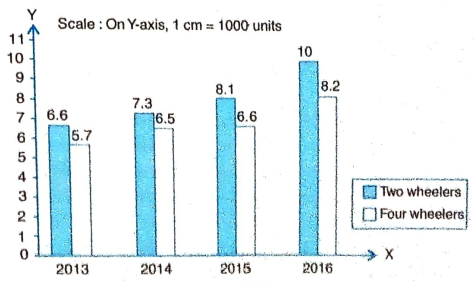
In the year 2013,
Number of two wheelers sold = 6600, Number of four wheelers sold = 5700
Difference in sale = 6600 - 5700 = 900
In the year 2014,
Number of two wheelers sold = 7300, Number of four wheelers sold = 6500
Difference in sale = 7300 - 6500 = 800
In the year 2015,
Number of two wheelers sold = 8100, Number of four wheelers sold = 6600
Difference in sale = 8100 - 6600 = 1500
In the year 2016,
Number of two wheelers sold = 10000, Number of four wheelers sold = 8200
Difference in sale = 10000 - 8200 = 1800
Now, we find that
Total number of two wheelers sold in four years = 6600 + 7300 + 8100 + 10000 = 32000
View full question & answer
MCQ 131 Mark
  • A
    1500
  • B
    1700
  • 1800
  • D
    2000
Answer
Correct option: C.
1800
(c) 1800
In the year 2013,
Number of two wheelers sold =6600, Number of four wheelers sold = 5700
Difference in sale = 6600 - 5700 = 900
In the year 2014,
Number of two wheelers sold =7300, Number of four wheelers sold = 6500
Difference in sale = 7300 - 6500 = 800
In the year 2015,
Number of two wheelers sold = 8100, Number of four wheelers sold = 6600
Difference in sale = 8100 - 6600 = 1500
In the year 2016,
Number of two wheelers sold =10000, Number of four wheelers sold = 8200
Difference in sale = 10000 - 8200 = 1800
Now, we find that the maximum difference between the sales of two wheelers and four wheelers is 1800 in the year 2016.
View full question & answer
MCQ 151 Mark
  • A
    2013
  • 2014
  • C
    2015
  • D
    2016
Answer
Correct option: B.
2014
(b) 2014
In the year 2013,
Number of two wheelers sold $=6600$, Number of four wheelers sold $=5700$
Difference in sale $=6600-5700=900$
In the year 2014 ,
Number of two wheelers sold $=7300$, Number of four wheelers sold $=6500$
Difference in sale $=7300-6500=800$
ln the year 2015 ,
Number of two wheelers sold $=8100$, Number of four wheelers sold $=6600$
Difference in sale $=8100-6600=1500$
In the year 2016 ,
Number of two wheelers sold $=10000$, Number of four wheelers sold $=8200$
Difference in sale $=10000-8200=1800$
Thus, the difference between the sales of two wheelers and four wheelers is least in the year 2014.
View full question & answer
MCQ 161 Mark
A bar graph is drawn to the scale of $1 cm=x$ units. If the length of a bar representing a quantity of 702 units is 3.6 cm , then $x=$
  • A
    165
  • B
    175
  • C
    185
  • 195
Answer
Correct option: D.
195
(d) 195
We have,
$\begin{array}{ll}& 1 cm=x \text { units } \Rightarrow 3.6 cm=3.6 x \text { units } \\
\therefore \quad & 3.6 x=702 \Rightarrow x=195\end{array}$
View full question & answer
MCQ 171 Mark
A bar graph is drawn to the scale 1 cm = k units, then a bar of length k cm represents
  • A
    1 unit
  • B
    k units
  • C
    2k units
  • $k^2$ units
Answer
Correct option: D.
$k^2$ units
(d) $k^2$ units
Since 1 cm represents $k$ units. Therefore, $k cm$ will represent $k \times k=k^2$ units.
View full question & answer
MCQ 181 Mark
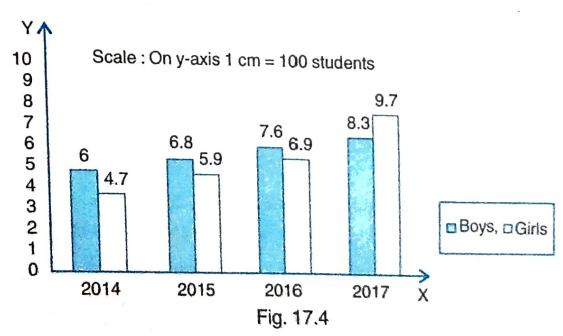
Figure 17.4, shows the bar graph of number of boys and number of girls in a school from 2014 to 2017.
Image
In which year the difference between the number of boys and the number of girls was more
  • A
    2014
  • B
    2015
  • C
    2016
  • 2017
Answer
Correct option: D.
2017
d
View full question & answer
MCQ 191 Mark
Consider the following frequency distribution:
Class interval:5-1010-1515-2525-4545-75
Frequency:61210815

To draw a histogram to represent the above frequency distribution the adjusted frequency for the class 25 - 45 is
  • A
    6
  • B
    5
  • C
    3
  • 2
Answer
Correct option: D.
2
d
View full question & answer
MCQ 201 Mark
In a histogram, each class rectangle is constructed with base as
  • A
    frequency
  • class-intervals
  • C
    range
  • D
    size of the class
Answer
Correct option: B.
class-intervals
b
View full question & answer
MCQ 211 Mark
A histogram is a pictorial representation of the grouped data in which class intervals and frequency are respectively taken along
  • A
    vertical axis and horizontal axis
  • B
    vertical axis only
  • C
    horizontal axis only
  • horizontal axis and vertical axis
Answer
Correct option: D.
horizontal axis and vertical axis
d
View full question & answer
MCQ 221 Mark
In a histogram the class intervals or the groups are taken along
  • A
    y-axis
  • x-axis
  • C
    both of x-axis and y-axis
  • D
    in between x and y axis
Answer
Correct option: B.
x-axis
b
View full question & answer
MCQ 231 Mark
In the 'less than' type of ogive the cumulative frequency is plotted against
  • A
    the lower limit of the concerned class interval
  • the upper limit of the concerned class interval
  • C
    the mid-value of the concerned class interval
  • D
    any value of the concerned class interval
Answer
Correct option: B.
the upper limit of the concerned class interval
b
View full question & answer
MCQ 241 Mark
In a histogram the area of each rectangle is proportional to
  • A
    the class mark of the corresponding class interval
  • B
    the class size of the corresponding class interval
  • frequency of the corresponding class interval
  • D
    cumulative frequency of the corresponding class interval
Answer
Correct option: C.
frequency of the corresponding class interval
c
View full question & answer
MCQ 251 Mark
A frequency polygon is constructed by plotting frequency of the class interval and the
  • A
    upper limit of the class
  • B
    lower limit of the class
  • mid value of the class
  • D
    any values of the class
Answer
Correct option: C.
mid value of the class
c
View full question & answer
MCQ 261 Mark
In a frequency distribution, ogives are graphical representation of
  • A
    frequency
  • B
    relative frequency
  • cumulative frequency
  • D
    raw data
Answer
Correct option: C.
cumulative frequency
c
View full question & answer
MCQ 271 Mark
Which one of the following is not the graphical representation of statistical data?
  • A
    Bar graph
  • B
    Histogram
  • C
    Frequency polygon
  • Cumulative frequency distribution
Answer
Correct option: D.
Cumulative frequency distribution
d
View full question & answer