Questions · Page 2 of 4

M.C.Q

MCQ 511 Mark
Euclid’s second axiom is:
  • A
    If equals be subtracted from equals, the remainders are equal.
  • B
    The things which are equal to the same thing are equal to one another.
  • C
    Things which coincide with one another are equal to one another.
  • If equals be added to equal, the whole are equal.
Answer
Correct option: D.
If equals be added to equal, the whole are equal.
View full question & answer
MCQ 521 Mark
Euclid stated that 'all right angles are equal to each other', in the form of:
  • A
    A definition.
  • An axiom.
  • C
    A postulate.
  • D
    A proof.
Answer
Correct option: B.
An axiom.
Euclid stated that 'All right angles are equal to each other' in the form of a postulate.This is Euclid's Postulate $4.$
Note: The answer in the book is option $(a)$. But if you have a look at the Euclid's postulate, the answer is a postulate.
View full question & answer
MCQ 531 Mark
A line segment has definite:
  • A
    Breadth.
  • B
    Volume.
  • Length.
  • D
    Area.
Answer
Correct option: C.
Length.
A line segment is a piece, or part, of a line in geometry.
A line segment is represented by endpoints on each end of the line segment.
A line in geometry is represented by a line with arrows at each end.
A line segment and a line are different because a line goes on forever while a line segment has a distinct beginning and end.
View full question & answer
MCQ 541 Mark
Two distinct lines:
  • A
    Always intersect
  • Either intersect or parallel
  • C
    Always have two common points
  • D
    Always parallel
Answer
Correct option: B.
Either intersect or parallel
View full question & answer
MCQ 551 Mark
The line drawn from the center of the circle to any point on its circumference is called:
  • Radius
  • B
    Diameter
  • C
    Sector
  • D
    Arc
Answer
Correct option: A.
Radius
Radius
View full question & answer
MCQ 561 Mark
Axioms are assumed:
  • A
    Theorems
  • B
    Definitions
  • C
    Universal truths specific to geometry
  • Universal truths in all branches of mathematics
Answer
Correct option: D.
Universal truths in all branches of mathematics
Axioms are assumed universal truths in all branches of mathematics and no mathematical deduction is needed to prove them.
View full question & answer
MCQ 571 Mark
A point $C$ is said to lie between the points $A$ and $B$ if.
  • A
    $AC = CB.$
  • B
    $AC + CB = AB.$
  • Point $A, C$ and $B$ are collinear.
  • D
    None of these.
Answer
Correct option: C.
Point $A, C$ and $B$ are collinear.
If direction ratios of three vectors $a, b, c$ are proportional then they are collinear.
View full question & answer
MCQ 581 Mark
Write the correct answer in the following: The number of dimension, a point has:
  • $0$
  • B
    $1$
  • C
    $2$
  • D
    $3$
Answer
Correct option: A.
$0$
A point is that which has no part i.e., no length, no breadth and no height. So, it has no dimension.
View full question & answer
MCQ 591 Mark
A polygon is a closed figure made up of:
  • A
    Three line segments only.
  • B
    Two line segments.
  • Three or more line segments.
  • D
    None of these.
Answer
Correct option: C.
Three or more line segments.
Polygons are $2-$dimensional shapes. They are made of straight lines, and the shape is "closed" (all the lines connect up). Polygon comes from the Greek words, Poly-means "many" and gon means "angle".
View full question & answer
MCQ 601 Mark
Which of the following is a false statement?
  • A
    An infinity number of lines can be drawn to pass through a given point.
  • B
    A unique line can be drawn to pass through two given points.
  • $\text{Ray }\overrightarrow{\text{AB}}=\text{ray}\ \overrightarrow{\text{BA}}.$
  • D
    A ray has one end point.
Answer
Correct option: C.
$\text{Ray }\overrightarrow{\text{AB}}=\text{ray}\ \overrightarrow{\text{BA}}.$
Option $(a)$ is true, since we can pass an infinite number of lines through a given point.
Option $(b)$ is true, since a unique line can be drawn to pass through two given points.
Consider option $(c)$.
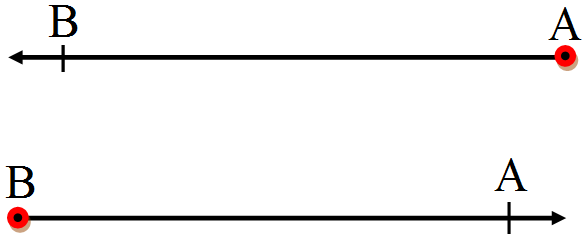
A ray is a line segment that extends indefinitely in one direction as shown below.
$\text{Ray }\overrightarrow{\text{AB}}=\text{ray}\ \overrightarrow{\text{BA}}$ is a false statement since clearly the lines extend indefinitely.

As shown in the above diagram, a ray has only one end-point. So, option $(d)$ is true.
Hence, the only false statement is option $(c)$.
View full question & answer
MCQ 611 Mark
Boundaries of solids are:
  • A
    Lines.
  • B
    Curves.
  • Surfaces.
  • D
    None of these.
Answer
Correct option: C.
Surfaces.
Boundaries of solids are surfaces.
View full question & answer
MCQ 621 Mark
Given four distinct points in a plane. How many line segments can be drawn using them when no three of them are collinear?
  • A
    $8$
  • B
    $4$
  • $6$
  • D
    $1$
Answer
Correct option: C.
$6$
If the four points are $A, B, C$ and $D$, we can draw the lines: $A-B, A-C, A-D, B-C, B-D, C-D.$
View full question & answer
MCQ 631 Mark
Write the correct answer in the following: In ancient India, the shapes of altars used for house hold rituals were:
  • Squares and circles.
  • B
    Triangles and rectangles.
  • C
    Trapeziums and pyramids.
  • D
    Rectangles and squares.
Answer
Correct option: A.
Squares and circles.
In ancient India, squares and circular altars were used for household rituals.
View full question & answer
MCQ 641 Mark
A line segment, when extended indefinitely in one direction is called $a:$
  • A
    Line.
  • Ray.
  • C
    Line segment.
  • D
    None of these.
Answer
Correct option: B.
Ray.
A ray is part of a line, has one fixed endpoint, and extends infinitely along the line from the endpoint.
View full question & answer
MCQ 651 Mark
The number of planes passing through 3 non-collinear points is:
  • A
    $4$
  • B
    $3$
  • C
    $2$
  • $1$
Answer
Correct option: D.
$1$
The number of planes passing through three non-collinear points is $1.$
View full question & answer
MCQ 661 Mark
Euclid first postulates is:
  • A straight line may be drawn from any point to any other point.
  • B
    A terminated line can be produced indefinitely.
  • C
    All right angles are equal to one another.
  • D
    None of these
Answer
Correct option: A.
A straight line may be drawn from any point to any other point.
Euclid first postulates is:
A straight line may be drawn from any point to any other point
View full question & answer
MCQ 671 Mark
Which of the following is a true statement?
  • A
    A line has a definite length.
  • B
    Only a unique line can be drawn to pass through a given point.
  • C
    Infinitely many lines can be drawn to pass through two given points.
  • If two circles are equal, then their radii are equal.
Answer
Correct option: D.
If two circles are equal, then their radii are equal.
Clearly, it is a true statement as if we consider any two equal circles, then their radii are equal.
View full question & answer
MCQ 681 Mark
The two lines which are parallel to the same line are _______ to each other.
  • A
    Perpendicular.
  • B
    Equal.
  • Parallel.
  • D
    None of these.
Answer
Correct option: C.
Parallel.
There are 3 lines $A B, C D, E F$, where $A B$ and $E F$ are parallel, and $C D$ and $E F$ are parallel.
Let line PQ cross $A B$ at $G, E F$ at $H, C D$ at $K$. On parallel lines, $A B$ and $E F$, angle $A G K=G H F$ (Alternate interior angles).
On parallel lines $A B$ and $E F$, angle $A G K=G H F$. (Alternate interior angles)
So, angle $A G K=G K D$. (Alternate interior angles)
So, $A B$ is parallel to $C D$.
View full question & answer
MCQ 691 Mark
A point C is called the mid-point of a line segment $\overrightarrow{\text{AB}}$ if.
  • A
    $C$ is an interior point of $AB.$
  • B
    $AC = CB.$
  • $C$ is an interior point of $AB$ such that $\overrightarrow{\text{AC}}=\overrightarrow{\text{CB}}.$
  • D
    $AC + CB = AB.$
Answer
Correct option: C.
$C$ is an interior point of $AB$ such that $\overrightarrow{\text{AC}}=\overrightarrow{\text{CB}}.$
A point $C$ is called the midpoint of a line segment $\overline{\text{AB}},$ if $C$ is an interior point of $AB$ such that $\overline{\text{AC}}=\overline{\text{CB}}.$

View full question & answer
MCQ 701 Mark
Axioms are assumed:
  • A
    Definitions.
  • B
    Theorems.
  • C
    Universal truths specific to geometry.
  • Universal truths in all branches of mathematics.
Answer
Correct option: D.
Universal truths in all branches of mathematics.
Axioms are assumed as universal truths in all branches of mathematics because they are taken for granted, without proof.
View full question & answer
MCQ 711 Mark
The edges of a surface are:
  • A
    Points
  • Lines
  • C
    Surface itself
  • D
    None of these
Answer
Correct option: B.
Lines
The edges of a surface are lines.
View full question & answer
MCQ 721 Mark
Write the correct answer in the following: Pythagoras was a student of:
  • Thales.
  • B
    Euclid.
  • C
    Both $A$ and $B.$
  • D
    Archimedes.
Answer
Correct option: A.
Thales.
Pythagoras $(572 BC)$ was a student of Thales. Pythagoras and his group discovered many geometric properties and developed the theory of geometry to a great extent. This process continued till $300 BC$. At that time, Euclid, a teacher of mathematics at Alexandria in Egypt, collected all the known work and arranged it in his famous treatise.
View full question & answer
MCQ 731 Mark
Write the correct answer in the following: The side faces of a pyramid are:
  • Triangles.
  • B
    Squares.
  • C
    Polygons.
  • D
    Trapeziums.
Answer
Correct option: A.
Triangles.
The side faces of a pyramid are always triangles.
View full question & answer
MCQ 741 Mark
Axiom and postulates are:
  • A
    Conclusions
  • B
    Reasons
  • Assumptions
  • D
    Questions
Answer
Correct option: C.
Assumptions
Assumptions
View full question & answer
MCQ 751 Mark
Theorems are statements which are proved using definitions $............$ previously proved statements and deductive reasoning.
  • A
    Definitions
  • Axioms
  • C
    Theorems
  • D
    Statements
Answer
Correct option: B.
Axioms
Axioms
View full question & answer
MCQ 761 Mark
The two lines which are perpendicular to the same line are _______ to each other.
  • A
    Equal.
  • Parallel.
  • C
    Perpendicular.
  • D
    None of these.
Answer
Correct option: B.
Parallel.
If a transversal cuts two different lines and if the sum of the corresponding angles is equal to $180$ degrees. Then, the two given lines are parallel to each other and here, both the lines are perpendicular to the transversal. So, the sum of angles made by them on the transversal is 180 degrees. Hence, both the given lines are parallel to each other.
View full question & answer
MCQ 771 Mark
In Indus Valley Civilisation (about $BC 3000$), the bricks used for construction work were having dimensions in the ratio of:
  • A
    $5 : 3 : 2$
  • $4 : 2 : 1$
  • C
    $4 : 3 : 2$
  • D
    $6 : 4 : 2$
Answer
Correct option: B.
$4 : 2 : 1$
In Indus Valley Civilization (about $300 BC$) the bricks used for construction work were having dimensions in the ratio is $4 : 2 : 1.$
View full question & answer
MCQ 781 Mark
Into how many chapters was the famous treatise, 'The Elements' divided by Euclid?
  • $13$
  • B
    $12$
  • C
    $11$
  • D
    $9$
Answer
Correct option: A.
$13$
The famous treatise 'The Elements' was divided into $13$ chapters by Euclid.
View full question & answer
MCQ 791 Mark
Boundaries of surfaces are:
  • A
    Lines.
  • Curves.
  • C
    Polygons.
  • D
    None of these.
Answer
Correct option: B.
Curves.
Boundaries of surfaces are curves.
View full question & answer
MCQ 801 Mark
Which one of the following statements is false?
$A.$ Only one line can pass through a single point.
$B.$ Two circles are equal when their radii are equal.
$C.$ A figure formed by line segments is called a rectilinear figure.
$D.$ A terminated line can be produced indefinitely on both the sides.
  • A
    $B$
  • B
    $C$
  • C
    $D$
  • $A$
Answer
Correct option: D.
$A$
Infinite number of lines can pass through a single point.
View full question & answer
MCQ 811 Mark
If $AB, AC, AD$ and $AE$ are parallel to a line $q$, then the points $A, B, C, D$ and $E$ are:
  • A
    Intersecting.
  • B
    Non-collinear.
  • Collinear.
  • D
    None of these.
Answer
Correct option: C.
Collinear.
Since, $AB, AC, AD$ and $AE$ are parallel to the line $‘q’$, therefore, point A is outside $'q'$ and lines $AB, AC, AD$ and $AE$ are drawn through $A$ and each line is parallel to $'q'$. But by parallel line axiom one and only line can be drawn through A parallel to the line $'q'$. This is possible only when the points $A, B, C, D$ and $E$ all lie on the same line.
View full question & answer
MCQ 821 Mark
It is known that if $a + b = 4$ then $\frac{1}{2}(a + b) = 2$. The Euclid’s axiom that illustrates this statement is:
  • A
    $VI$ axiom.
  • B
    $V$ axiom.
  • $VII$ axiom.
  • D
    $IV$ axiom.
Answer
Correct option: C.
$VII$ axiom.
Things which are halves of the same things are equal to each other.
View full question & answer
MCQ 831 Mark
A surface is that which has:
  • A
    None of these.
  • B
    Breadth only.
  • Length and breadth only.
  • D
    Length only.
Answer
Correct option: C.
Length and breadth only.
Because the surface is a $2-$dimensional structure.
View full question & answer
MCQ 841 Mark
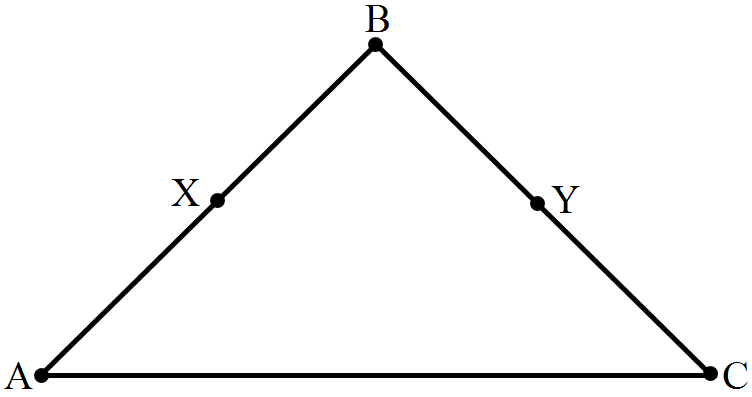
In the figure, if $AX = CY$ and $BX = BY$, then:
  • $AB = BC$
  • B
    $AB < BC$
  • C
    $AB > BC$
  • D
    None of these
Answer
Correct option: A.
$AB = BC$
We have $AX = CY$ and $BX = BY$, then we can say that $AX + BX = CY + BY$ which means $AB = BC.$
View full question & answer
MCQ 851 Mark
Maximum numbers of points that can lie on a line are:
  • Innumerable
  • B
    Two
  • C
    One
  • D
    Three
Answer
Correct option: A.
Innumerable
Innumerable
View full question & answer
MCQ 861 Mark
A pyramid is a solid figure, the base of which is:
  • A
    A triangle.
  • B
    A square.
  • A polygon.
  • D
    A circle.
Answer
Correct option: C.
A polygon.
A pyramid is a polyhedron formed by connecting of polygonal base and an apex.
Each base edge and apex forms a triangle, called the lateral face.
It is a conic solid with polygonal base.
View full question & answer
MCQ 871 Mark
Euclid divided his famous treatise $“$The Elements$”$ into:
  • A
    $12$ chapters.
  • B
    $11$ chapters.
  • C
    $9$ chapters.
  • $13$ chapters.
Answer
Correct option: D.
$13$ chapters.
Book $1$ contains Euclid's $10$ axioms.
Book $2$ is commonly called the $''$book of geometric algebra$''$.
Book $3$ deals with circles and their properties.
Book $4$ constructs the incircle and circumcircle of a triangle.
Book $5$ is a treatise on proportions of magnitudes.
Book $6$ applies proportions to geometry: similar figures.
Book $7$ deals with elementary number theory.
Book $8$ deals with proportions in number theory and geometric sequences.
Book $9$ applies the results of the preceding two books and gives the infinitude of prime numbers.
Book $10$ attempts to classify incommensurable $($in modern language, irrational$)$.
Book $11$ generalizes the results of books $1-6.$
Book $12$ studies volumes of cones, pyramids, and cylinders.
Book $13$ constructs the five regular Platonic solids.
View full question & answer
MCQ 881 Mark
A is of the same age as $B$ and $C$ is of the same age as $B$. Euclid's which axiom illustrates the relative ages of $A$ and $C?$
  • Frist axiom.
  • B
    Second exiom.
  • C
    Third axiom.
  • D
    Fourth axiom.
Answer
Correct option: A.
Frist axiom.
Euclid's first axiom states that 'Things which are equal to the same thing are equal to one another'.
That is,
$A's$ age $= B's$ age and $C's$ age $= B'$ age
$\Rightarrow A's$ age $= C's$ age
View full question & answer
MCQ 901 Mark
If $C$ lies between A and B and $AB =10 cm, AC =3 cm$, then $BC ^2=$
  • A
    $13 cm^2$
  • $49 cm^2$
  • C
    $9 cm^2$
  • D
    $7 cm^2$
Answer
Correct option: B.
$49 cm^2$
Since, $A B=10 cm, C=3 cm$, therefore $B C=A B-A C=10-3=7 cm$. Hence, $B C^2=49 cm^2$.
View full question & answer
MCQ 911 Mark
The number of end points a line has:
  • $0$
  • B
    $1$
  • C
    $2$
  • D
    None of these
Answer
Correct option: A.
$0$
A line has no endpoint. It extends in both the directions endlessly.
View full question & answer
MCQ 921 Mark
The things which coincide with one another are:
  • A
    Double the same thing.
  • B
    Unequal.
  • C
    Triple the same thing.
  • Equal.
Answer
Correct option: D.
Equal.
"The things which coincide with one another are equal" is one of the axioms given by Euclid.
Example: Segment $AB = $Segment BA, $\angle\text{A}=\angle\text{A}.$
View full question & answer
MCQ 931 Mark
Write the correct answer in the following: Euclid divided his famous treatise “The Elements” into:
  • $13$ chapters.
  • B
    $12$ chapters.
  • C
    $11$ chapters.
  • D
    $9$ chapters.
Answer
Correct option: A.
$13$ chapters.
Euclid divided his famous treatise 'The Elements' into $13$ chapters.
View full question & answer
MCQ 941 Mark
In Ancient India, Altars with combination of shapes like rectangles, triangles and trapeziums were used for:
  • A
    Household rituals.
  • Public worship.
  • C
    Both Public worship and Household rituals.
  • D
    None of these.
Answer
Correct option: B.
Public worship.
In ancient India altars whose shapes were combinations of rectangles, triangles and trapeziums were used for public worship.
View full question & answer
MCQ 951 Mark
If a straight line falling on two straight lines makes the interior angles on the same side of it taken together less than $180^\circ$ then the two straight lines, if produced indefinitely, meet on that side on which the angles taken together are:
  • A
    $180^\circ$
  • $< 180^\circ $
  • C
    $= 180^\circ$
  • D
    None of these
Answer
Correct option: B.
$< 180^\circ $
According to Euclid's fifth postulate, if a straight line crossing two straight lines makes the interior angles on the same side less than two right angles, the two straight lines, if extended indefinitely, meet on that side on which are the angles less than the two right angles.
View full question & answer
MCQ 961 Mark
A point $C$ is said to lie between the points $A$ and $B$ if:
  • A
    $AC = CB.$
  • Points $A, C$ and $B$ are collinear.
  • C
    $AC + CB = AB.$
  • D
    None of these.
Answer
Correct option: B.
Points $A, C$ and $B$ are collinear.
A point $C$ is said to lie between $A$ and $B$ if the points $A, C$ and $B$ are collinear.
View full question & answer
MCQ 971 Mark
Pythagoras was influenced by:
  • A
    Archimedes.
  • Thales.
  • C
    Euclid.
  • D
    None of these.
Answer
Correct option: B.
Thales.
Pythagoras of Samos is one of the most famous names in the history of mathematics and is recognized as the first true mathematician. When Pythagoras was $18$, he visited Miletus - an ancient Greek city on the western coast of Anatolia, where he met Thales - the first known Greek philosopher and scientist. By that time Thales was very old and is not believed to have taught Pythagoras a great deal. However, it was this meeting which triggered his interest in the science of mathematics and astronomy.
View full question & answer
MCQ 981 Mark
Two lines are said to be _______ if they intersect at a right angle.
  • A
    Parallel.
  • Perpendicular.
  • C
    Intersecting.
  • D
    None of these.
Answer
Correct option: B.
Perpendicular.
Perpendicular lines are two or more lines that intersect at a $90-$degree angle or right angle.
View full question & answer
MCQ 991 Mark
The number of planes passing through $3$ noncollinear points is:
  • $1$
  • B
    $4$
  • C
    $3$
  • D
    $2$
Answer
Correct option: A.
$1$
A unique plane passes through $3$ given noncollinear points.
View full question & answer
MCQ 1001 Mark
A is of the same age as $B$ and $C$ is of the same age as $B$. Euclid's which axiom illustrates the relative ages of $A$ and $C?$
  • First axiom.
  • B
    Third axiom.
  • C
    Fourth axiom.
  • D
    Second axiom.
Answer
Correct option: A.
First axiom.
Here $(A = B$ and $C = B), A = C$. First axiom states that the things which are equal to the same thing are equal to one another.
View full question & answer
M.C.Q - Page 2 - Maths STD 9 Questions - Vidyadip