Questions · Page 4 of 4

M.C.Q

MCQ 1511 Mark
Thales belongs to the country:
  • A
    India.
  • B
    Egypt.
  • Greece.
  • D
    Babylonia.
Answer
Correct option: C.
Greece.
Thales belongs to the country, Greece.
View full question & answer
MCQ 1521 Mark
Write the correct answer in the following:
Euclid stated that all right angles are equal to each other in the form of:
  • A
    An axiom.
  • B
    A definition.
  • A postulate.
  • D
    A proof.
Answer
Correct option: C.
A postulate.
Euclid stated that all right angles are equal to each other in the form of a postulate.
View full question & answer
MCQ 1531 Mark
A, B and C are three collinear points. How many lines can be determined by them?
  • A
    $3$
  • $1$
  • C
    $0$
  • D
    $2$
Answer
Correct option: B.
$1$
Since the three points are collinear, they lie on the same line, so only one line can be determined by them.
View full question & answer
MCQ 1541 Mark
$'$Lines are parallel if they do not intersect$’ –$ is stated in the form of:
  • A postulate
  • B
    An axiom
  • C
    A definition
  • D
    A proof
Answer
Correct option: A.
A postulate
A postulate
View full question & answer
MCQ 1551 Mark
In Indus Valley Civilisation, the bricks used for construction work were having dimensions in the ratio:
  • A
    $4 : 4 : 1$
  • B
    $4 : 3 : 2$
  • $4 : 2 : 1$
  • D
    $1 : 3 : 4$
Answer
Correct option: C.
$4 : 2 : 1$
In Indus Valley Civilization, the bricks used for construction work were having dimensions in the ratio length : breadth : thickness $= 4 : 2 : 1.$
View full question & answer
MCQ 1561 Mark
If two line segments are equal then they are called:
  • A
    Line segment
  • B
    Ray
  • Congruent
  • D
    None of these
Answer
Correct option: C.
Congruent
If two line segments are equal then they are called congruent segments.
View full question & answer
MCQ 1571 Mark
Euclid's which axiom illustrates the statement that when $x + y = 15,$ then $x + y + z = 15 + z?$
  • A
    First.
  • B
    Fourth.
  • Second.
  • D
    Third.
Answer
Correct option: C.
Second.
Second axiom states that if equals be added to equals, then wholes are equal.
View full question & answer
MCQ 1581 Mark
Write the correct answer in the following:
In Indus Valley Civilisation (about $3000 B.C.$), the bricks used for construction work were having dimensions in the ratio:
  • A
    $1 : 3 : 4$
  • $4 : 2 : 1$
  • C
    $4 : 4 : 1$
  • D
    $4 : 3 : 2$
Answer
Correct option: B.
$4 : 2 : 1$
Bricks used for construction work were having dimensions in the ratio are $4 : 2 : 1$
View full question & answer
MCQ 1591 Mark
If two circles are equal, then their radii are $...........$
  • Equal
  • B
    Diminished
  • C
    Different
  • D
    None of these
Answer
Correct option: A.
Equal
Equal
View full question & answer
MCQ 1601 Mark
The shape of base of Pyramid is:
  • A
    Triangle
  • B
    Square
  • C
    Rectangle
  • Any polygon
Answer
Correct option: D.
Any polygon
Any polygon
View full question & answer
MCQ 1621 Mark
In ancient India, the shapes of altars used for household rituals were:
  • Squares and circles.
  • B
    Triangles and rectangles.
  • C
    Rectangles and squares.
  • D
    Trpeziums and pyramids.
Answer
Correct option: A.
Squares and circles.
In ancient India, squares and circular altars were used for household rituals.
The geometry of the Vedic period originated with the construction of altars $($or voids$)$ and fireplaces for performing Vedic rites.
Square and circular altars were used for household rituals, while altars, whose shapes were combinations of rectangles, triangles and trapeziums, were required for public worship.
View full question & answer
MCQ 1631 Mark
If $\overline{\text{AB}}=\overline{\text{PQ}}$ and $\overline{\text{PQ}}=\overline{\text{XY}},$ then:
  • $\overline{\text{AB}}=\overline{\text{XY}}$
  • B
    $\overline{\text{AB}}>\overline{\text{PQ}}$
  • C
    $\overline{\text{AB}}<\overline{\text{XY}}$
  • D
    None of there
Answer
Correct option: A.
$\overline{\text{AB}}=\overline{\text{XY}}$
According to Euclid's first axiom that thing which is equal to the same thing, are equal to one another.
Hence, If two lines are equal to a third line, they will be equal in length.
View full question & answer
MCQ 1641 Mark
The number of dimensions, a line has:
  • A
    $2$
  • B
    $0$
  • $1$
  • D
    $3$
Answer
Correct option: C.
$1$
Because a line is a breathless length.
View full question & answer
MCQ 1651 Mark
Write the correct answer in the following: Boundaries of solids are:
  • Surfaces.
  • B
    Curves.
  • C
    lines.
  • D
    points.
Answer
Correct option: A.
Surfaces.
Boundaries of solids are called surfaces.
View full question & answer
MCQ 1661 Mark
The number of interwoven isosceles triangles in a Sriyantra is:
  • A
    Five.
  • B
    Seven.
  • Nine.
  • D
    Eleven.
Answer
Correct option: C.
Nine.
The Sriyantra consists of nine interwoven isosceles triangles.
View full question & answer
MCQ 1671 Mark
In ancient India, altars with combination of shapes like rectangles, triangles and trapeziums were used for:
  • A
    Household rituals.
  • Public rituals.
  • C
    Both $(a)$ and $(b).$
  • D
    None of $(a), (b)$ and $(c).$
Answer
Correct option: B.
Public rituals.
In ancient India, altars with combination of shapes like rectangles, triangles and trapeziums were used for public rituals.
View full question & answer
MCQ 1681 Mark
Write the correct answer in the following: A pyramid is a solid figure, the base of which is:
  • A
    Only a triangle.
  • B
    Only a square.
  • C
    Only a rectangle.
  • Any polygon.
Answer
Correct option: D.
Any polygon.
A pyramid is a solid figure, the base of which is any polygon.
$($A pyramid is a solid figure, the base of which is a triangle or square or some other polygon$)$
View full question & answer
MCQ 1691 Mark
If point $C$ lies between two points $A$ and $B$ such that $AC = BC$, then:
  • A
    $\text{AC}=\frac{1}{4}\text{AB}$
  • $\text{AC}=\frac{1}{2}\text{AB}$
  • C
    $\text{AC}=\frac{3}{4}\text{AB}$
  • D
    $\text{AC}=\frac{1}{3}\text{AB}$
Answer
Correct option: B.
$\text{AC}=\frac{1}{2}\text{AB}$
Point $C$ is the mid point of $AB$. Hence, $AB = AC + BC$ or, $AB = AC + AC = 2AC$ (since, $AC = BC).$
Hence, $\text{AC}=\frac{1}{2}\text{AB}.$
View full question & answer
MCQ 1701 Mark
In ancient India, the shapes of altars used for household rituals were:
  • Squares and circles
  • B
    Triangles and rectangles
  • C
    Trapeziums and pyramids
  • D
    Rectangles and squares
Answer
Correct option: A.
Squares and circles
Squares and circles
View full question & answer
MCQ 1711 Mark
The base of a Pyramid is:
  • A
    Only a triangle
  • Only a square
  • C
    Only a rectangle
  • D
    Any polygon
Answer
Correct option: B.
Only a square
Only a square
View full question & answer
MCQ 1721 Mark
A sentence which is either true or false but not both is called:
  • The statement
  • B
    Axioms
  • C
    Postulates
  • D
    None of these
Answer
Correct option: A.
The statement
A sentence which is either true or false but not both is called the statement.
View full question & answer
MCQ 1731 Mark
The line segment with one endpoint at the centre and the other at any point on the circle is called $...........$
  • A
    Diameter.
  • B
    Chord.
  • Radius.
  • D
    None of these.
Answer
Correct option: C.
Radius.
The radius of a circle is the distance from the center of the circle to any point on its circumference.
View full question & answer
MCQ 1741 Mark
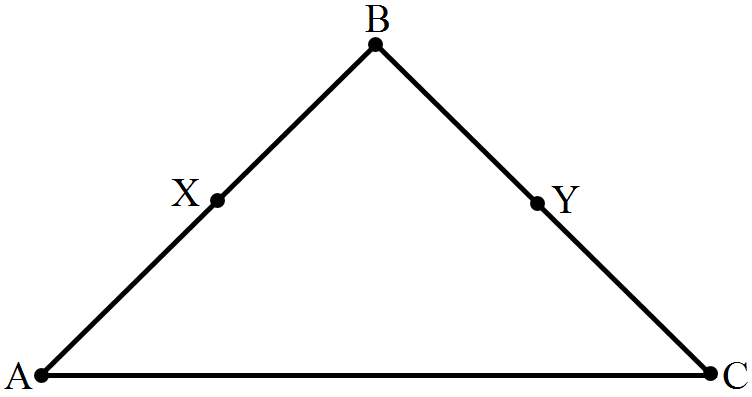
In the figure, if $AB = BC$ and $BX = BY,$ then:
  • A
    $AX > CY$
  • B
    $AX < CY$
  • $AX = CY$
  • D
    None of these
Answer
Correct option: C.
$AX = CY$
Since, $AB = BC$, we have $AX + BX = CY + BY$
and we have, $BX = BY$, hence, we can say that $AX = CY.$
View full question & answer
MCQ 1751 Mark
Which of the following is a false statement?
  • A
    An infinite number of lines can be drawn to pass through a given point.
  • B
    A unique line can be drawn to pass through two given points.
  • Ray $\overrightarrow{\text{AB}}$ = ray $\overrightarrow{\text{BA}}.$
  • D
    A ray has one endpoint.
Answer
Correct option: C.
Ray $\overrightarrow{\text{AB}}$ = ray $\overrightarrow{\text{BA}}.$
In ray $AB, A$ is fixed and in ray $BA, B$ is fixed.
View full question & answer
MCQ 1761 Mark
A point $C$ is called the midpoint of a line segment $\overrightarrow{\text{AB}}$ if:
  • A
    $\overrightarrow{\text{AC}}=\overrightarrow{\text{BC}}.$
  • $C$ is an interior point of $AB$ such that $\overrightarrow{\text{AC}}=\overrightarrow{\text{BC}}.$
  • C
    $AC + CB = AB.$
  • D
    $C$ is an interior point of $AB.$
Answer
Correct option: B.
$C$ is an interior point of $AB$ such that $\overrightarrow{\text{AC}}=\overrightarrow{\text{BC}}.$
A point $C$ is called the midpoint of line segment $\overrightarrow{\text{AB}},$ if $C$ is an interior point of $\overrightarrow{\text{AB}}$ such that $\overrightarrow{\text{AC}}=\overrightarrow{\text{BC}}.$
View full question & answer
MCQ 1771 Mark
Euclid's which axiom illustrates the statement that when $x + y = 15$ then $x + y + 2 = 15 + z?$
  • A
    Frist.
  • Second.
  • C
    Third.
  • D
    Fourth.
Answer
Correct option: B.
Second.
Euclid's second axiom states that 'If equals are added to equals, the wholes are equal'.
Hence, when $x + y = 15$, then $x + y + z = 15 + z.$
View full question & answer
MCQ 1781 Mark
It is known that if $a + b = 4$ then $2(a + b) = 8.$ The Euclid’s axiom that illustrates this statement is:
  • A
    $I$ axiom.
  • B
    $IV$ axiom.
  • $VI$ axiom.
  • D
    $III$ axiom.
Answer
Correct option: C.
$VI$ axiom.
Things which are double of the same things are equal to each other.
View full question & answer
MCQ 1791 Mark
The statement that 'the lines are parallel if they do not intersect' is in the form of:
  • A definition.
  • B
    An axiom.
  • C
    A postulate.
  • D
    A theorem.
Answer
Correct option: A.
A definition.
Lines are parallel if they do not intersect' is started in the form of a definition.
View full question & answer
MCQ 1801 Mark
Write the correct answer in the following: In Ancient India, Altars with combination of shapes like rectangles, triangles and trapeziums were used for:
  • Public worship.
  • B
    Household rituals.
  • C
    Both $A$ and $B.$
  • D
    None of $A, B, C.$
Answer
Correct option: A.
Public worship.
In ancient India altars whose shapes were combinations of rectangles, triangles and trapeziums were used for public worship.
View full question & answer
MCQ 1811 Mark
Which of the following needs a proof?
  • A
    Definition
  • B
    Postulate
  • Theorem
  • D
    Axiom
Answer
Correct option: C.
Theorem
The theorem needs a proof.
Whereas definition, axiom and postulates are self $-$ evident and do not require any proof.
View full question & answer
MCQ 1821 Mark
The three steps from solids to points are:
  • A
    Solids - lines - points - surfaces.
  • B
    Solids - points - lines - surfaces.
  • Solids - surfaces - lines - points.
  • D
    None of these.
Answer
Correct option: C.
Solids - surfaces - lines - points.
In each step, we lose one dimension. solid$-3$ dimension. surface$-2$ dimension. lines$-1$ dimension. point - has no dimension.
View full question & answer
MCQ 1831 Mark
Which of these statements do not satisfy Euclid’s axiom?
  • A
    Things which are equal to the same thing are equal to one another
  • B
    If equals are added to equals, the wholes are equal.
  • C
    If equals are subtracted from equals, the remainders are equal.
  • The whole is lesser than the part.
Answer
Correct option: D.
The whole is lesser than the part.
View full question & answer
MCQ 1841 Mark
‘Lines are parallel if they do not intersect’ is stated in the form of:
  • Definition
  • B
    Proof
  • C
    Postulate
  • D
    Axiom
Answer
Correct option: A.
Definition
$'$Lines are parallel if they do not intersect $’$ is stated in the form of definition.
The definition is a statement that gives the exact meaning of the word.
View full question & answer
MCQ 1851 Mark
Euclid’s Axiom $5$ is:
  • A
    The things which coincide with one another are equal to one another.
  • B
    If equals are subtracted from equals, the remainder are equal.
  • The whole is greater than the part.
  • D
    None of these.
Answer
Correct option: C.
The whole is greater than the part.
View full question & answer
MCQ 1871 Mark
The number of line segments determined by three collinear points is:
  • $1$
  • B
    $2$
  • C
    $4$
  • D
    $3$
Answer
Correct option: A.
$1$
If the points are collinear then only one line can pass through them as collinear means "on the same line".
View full question & answer
M.C.Q - Page 4 - Maths STD 9 Questions - Vidyadip