Questions

5 Marks Questions

Take a timed test

7 questions · self-marked practice — reveal the answer and mark yourself.

Question 15 Marks
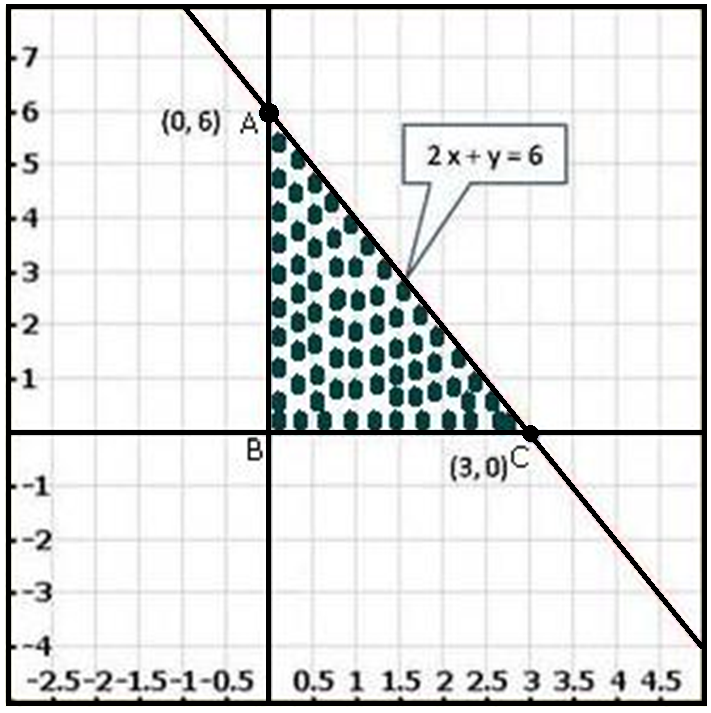
Draw the graph of the equation $2x + y = 6.$ Shade the region bounded by the graph and the coordinate axes. Also, find the area of the shaded region.
Answer
We have, $2x + y = 6$
$⇒ y = 6 - 2x ...(i)$
Putting $x = 3$ in $(i),$
we get $y = 6 - 2 × 3 = 0$
Putting $x = 0$ in $(i),$
we get $y = 6 - 2 × 0 = 6$
Thus, we obtain the following table giving coordinates of two points on the line represented by the equation $2x + y = 6.$
$X$
$3$
$0$
$y$
$0$
$6$
The graph of line $2x + y = 6:$ The area enclosed by the graph of line and the coordinate axes is shaded in the graph Now, Required area $=$ Area of the shaded region
​​​​​​​$⇒$ Required area $=$ Area of $\triangle\text{ABC}$
$⇒$ Required area $=\frac{1}{2}(\text{Base}\times\text{Height})$
$⇒$ Required area $=\frac{1}{2}(3\times6)$ =9sq. units.
View full question & answer
Question 25 Marks
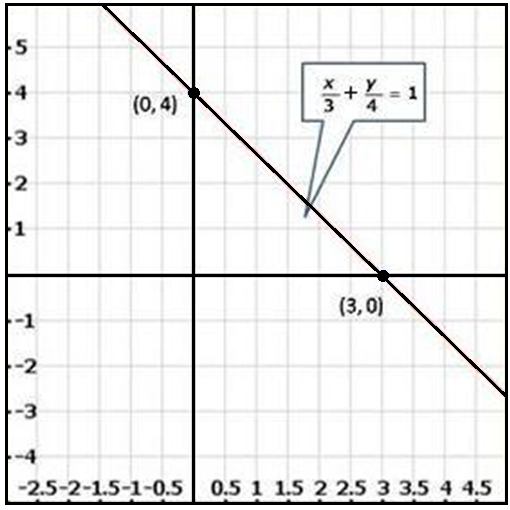
Draw the graph of the equation $\frac{\text{x}}{3}+\frac{\text{y}}{4}=1.$ Also, find the area of the triangle formed by the line and the coordinates axes.
Answer
We are given, $\frac{\text{x}}{3}+\frac{\text{y}}{4}=1$
$4x + 3y = 12$
We get, $\text{y}=\frac{12-4\text{x}}{3}$
Now, Substituting $x = 0$ in $\text{y}=\frac{12-4\text{x}}{3},$
we get $y = 4$ Substituting $x = 3$ in $\text{y}=\frac{12-4\text{x}}{3},$
we get Thus, we have the following table exhibiting the abscissa and ordinates of points on the line represented by the given equation
$x$ $0$ $3$
$y$ $4$ $0$

The region bounded by the graph is $ABC$ which form a traingle.
$AC$ at $y$ axis is the base of traingle having $AC = 4$ units on $y$ axis.
$BC$ at $x$ axis is the height of traingle having $BC = 3$ units on $x$ axis.
Therefore,
Area of traingle $ABC,$ say $A$ is given by
$\text{A}=\frac{1}{2}(\text{Base}\times\text{Height)}$
$\text{A}=\frac{1}{2}(\text{AC}\times\text{BC)}$
$\text{A}=\frac{1}{2}(\text{4}\times\text{3)}$
$\text{(AC}\times\text{BC)} \text{A}=6\text{sq. units}$
View full question & answer
Question 35 Marks
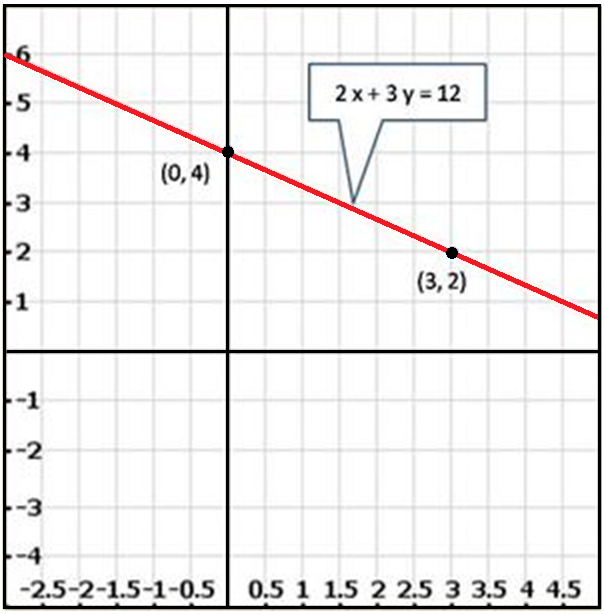
Draw the graph of the equation $2x + 3y = 12.$ From the graph, find the coordinates of the point:
$i.$ Whose $y-$coordinates is $3.$
$ii.$ whose $x-$coordinates is $-3.$
Answer
Graph of the equations $2x + 3y = 12:$
We have, $2x + 3y = 12 $
$\Rightarrow 2x = 12 - 3y$
$\Rightarrow\text{x}=\frac{12-3\text{y}}{2}$
Putting $y = 2,$ we get $\text{x}=\frac{12-3\times2}{2}=3$
Putting $y = 4,$ we get $\text{x}=\frac{12-3\times4}{2}=0$
Thus, $(3, 0)$ and $(0, 4)$ are two points on the line $2x + 3y =12.$
The graph of the line represented by the equation $2x + 3y= 12:$
$x$ $0$ $3$
$y$ $4$ $2$

$i.$ To find the coordinates of the point when $y = 3, $ we draw a line parallel to $x-$axis and passing throught $(0, 3).$
This line meets the graph of $2x + 3y = 12$ at a point $P$ from which we draw a line parallel to $y-$axis which crosses $x-$axis at $\text{x}=\frac{3}{2}.$
 So, the coordinates of the required point are $\Big(\frac{3}{2},\ 3\Big).$
$ii.$ To find the coordinates of the point when $x = -3,$ we draw a line parallel to $y-$axis and passing throught $(-3, 0).$
This line meets the graph of $2x + 3y = 12$ at a point $P$ from which we draw a line parallel to $x-$axis which crosses $y-$axis at $y = 6$.
So, the coordinates of the required point are $(-3, 6).$
View full question & answer
Question 45 Marks
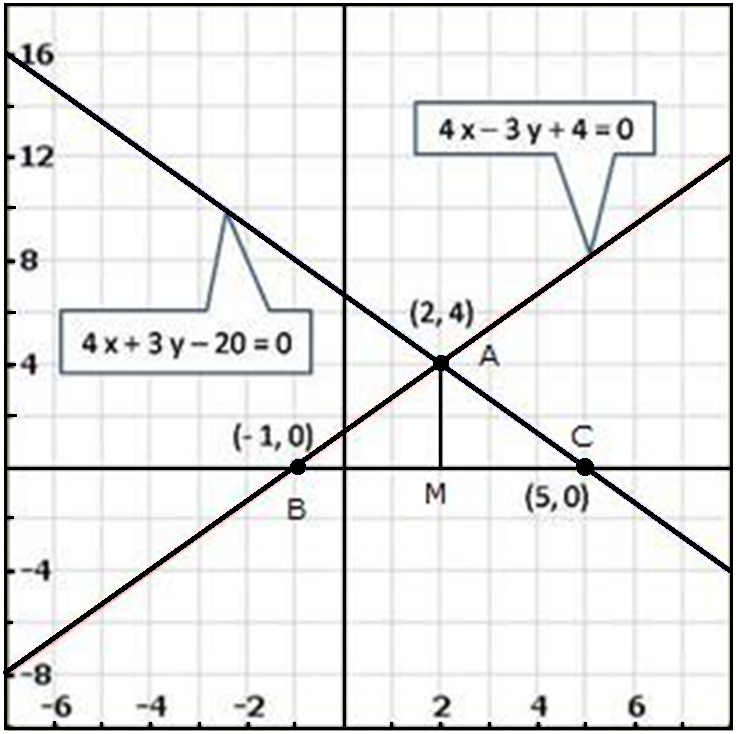
Draw the graphs of the linear equations $4x - 3y + 4 = 0$ and $4x + 3y - 20 = 0.$ Find the area bounded by these lines and $x-$axis.
Answer
We have,
$4x - 3y + 4 = 0$
$⇒ 4x = 3y - 4$
$\Rightarrow\text{x}=\frac{3\text{y}-4}{4}$
Putting $y = 0,$ we get $\text{x}=\frac{3\times0-4}{4}=-1$
Putting $y = 4,$ we get $\text{x}=\frac{3\times4-4}{4}=2$
Thus, we have the following table for the points on the line $4x - 3y + 4 = 0:$
$x$ $-1$ $2$
$y$ $0$ $4$
We have,
$4x - 3y - 20 = 0$
$⇒ 4x = 20 - 3y$
$\Rightarrow\text{x}=\frac{20-3\text{y}}{4}$
Putting $y = 0,$ we get $\text{x}=\frac{20-3\times0}{4}=5$
Putting $y = 4,$ we get $\text{x}=\frac{20-3\times4}{4}=2$
Thus, we have the following table for the points on the line $4x - 3y - 20 = 0:$
$x$ $5$ $2$
$y$ $0$ $4$

Clearly, two lines intersect at $A(2, 4).$
The graph of line $4x - 3y + 4 = 0$ and $4x - 3y - 20 = 0$ intersect with $y-$axis at $B(-1, 0)$ and $C(5, 0)$ respectively.
So, the vertices of the triangle formed by the two straight lines and $y-$axis are $A(3, 2), B(0, 4)$ and $C(0, -1).$
$\therefore\text{Area of }\triangle\text{ABC}=\frac{1}{2}(\text{Base}\times\text{Height})$
$=\frac{1}{2}(\text{BC}\times\text{AM})$
$=\frac{1}{2}(6\times4)$
$=3\times4$
$=12\text{sq.units.}$
$\therefore\text{Area of }\triangle\text{ABC}=12\text{sq. units.}$
View full question & answer
Question 55 Marks
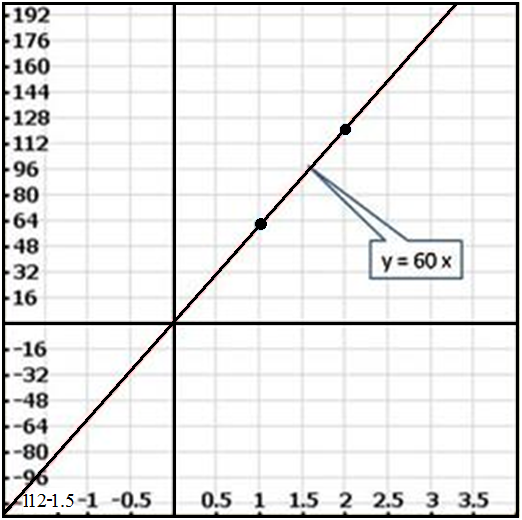
Aarushi was driving a car with uniform speed of $60\ km/ h.$ Draw distance$-$time graph. From the graph, find the distance travelled by Aarushi in:
$i. 2\frac{1}{2}$  Hours
$ii. \frac{1}{2}$ Hour
Answer
Let $x$ be the fime and $y$ be the distance travelled by Aarushi.
It is given that speed of car is $60\ km/ h$
We know that,
Speed$=\frac{\text{Distance}}{\text{Time}}$
$\Rightarrow60=\frac{\text{y}}{\text{x}}$
$\Rightarrow\text{y}=60\text{x}$
Putting $x = 1,$ we get $y = 60$
Putting $x = 2,$ we get $y = 120$
Thus, we have the following table for the points on the line $y = 60x:$
$x$ $1$ $2$
$y$ $60$ $120$
The graph of the equation $y = 60x :$

$i.$ To find the coordinates of the point when $\text{x}=2\frac{1}{2}=2.5,$ we draw a line parallel to $y-$axis and passing through $(2.5, 0).$
This line meets the graph of $y = 60x$ at a point $P$ from which we draw a line parallel to $x-$axis which crosses $y-$axis at $y = 150.$
So, the distance traveled by Aarushi in $2\frac{1}{2}$ hours is $150\ km.$
$ii.$ To find the coordinates of the point when $\text{x}=\frac{1}{2}=0.5,$ we draw a line parallel to $y-$axis and passing through $(0.5, 0).$
This line meets the graph of $y = 60x$ at a point $P$ from which we draw a line parallel to $x-$axis which crosses $y-$axis at $y = 30.$
So, the distance travelled by Aanushi in $\frac{1}{2}$ hour is $30\ km.$
View full question & answer
Question 65 Marks
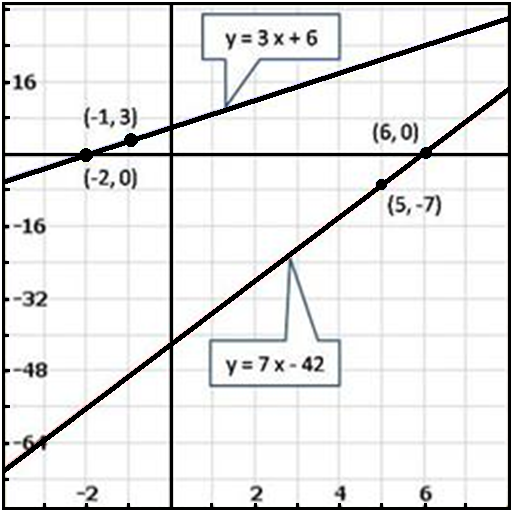
Ravish tells his doughter Aarushi, "Seven years ago, I was seven times as old as you were then. Also, three years from now, I shall be three times as old as you will be".. lf present ages of Aarushi and Ravish are $x$ and $y$ years respectively, represent this situation algebraically as well as graphically.
Answer
It is given that seven year ago Ravish was seven times as old as his daughter.
$x =$ Daughter, $y =$ Father
$\therefore 7(x - 7) = y - 7$
$⇒ 7x - 49 = y - 7$
$⇒ 7x - 42 = y ...(i)$
It is also given that after three years from now Ravish shall be three times as old as her daughter.
$3(x + 3) = y + 3$
$⇒ 3x + 9 = y + 3$
$⇒ 3x + 6 = y ...(ii)$
Now,
$y = 7x - 42 [$Using $(i)]$
Putting $x = 6,$ we get $y = 7 × 6 - 42 = 0$
Putting $x = 5,$ we get $y = 7 × 5 - 42 = -7$
Thus, we have the following table for the points on the line $7x - 42 = y:$
$x$ $6$ $5$
$y$ $0$ $-7$
We have,
$y = 3x + 6 [$Using $(ii)]$
Putting $x = -2,$ we get $y = 3 × (-2) + 6 = 0$
Putting $x = -1,$ we get $y = 3 × (-1) + 6 = 3$
Thus, we have the following table for the points on the line $y = 3x + 6:$
$x$ $-1$ $-2$
$y$ $3$ $0$
The graphs of the both linear equations are:
View full question & answer
Question 75 Marks
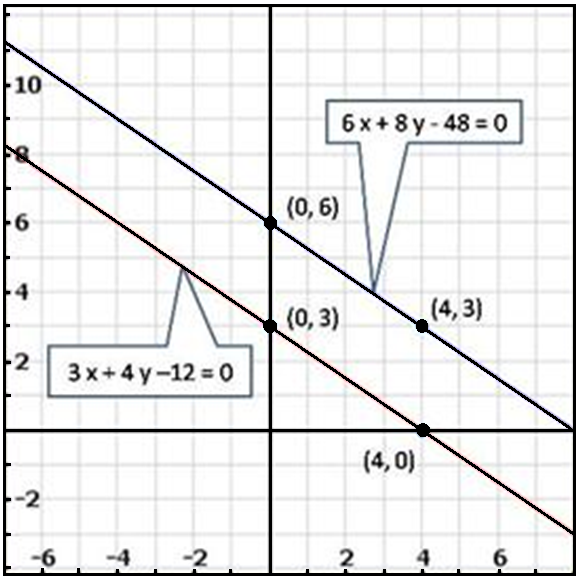
The path of a train $A$ is given by th equation $3x + 4y - 12 = 0$ and the path or another train $B$ is given by the equation $6x + 8y - 48 = 0.$ Represent this situation graphically.
Answer
We have,
$3x + 4y - 12 = 0$
$⇒ 3x = 12 - 4y$
$\Rightarrow3\text{x}=\frac{12-4\text{y}}{3}$
Putting $y = 0,$ we get $\text{x}=\frac{12-4\times0}{3}=4$
Putting $y = 3,$ we get $\text{x}=\frac{12-4\times3}{3}=0$
Thus, we have the following table for the points on the line $3x + 4y - 12 = 0:$
$x$ $4$ $0$
$y$ $0$ $3$
We have,
$6x + 8y - 48 = 0$
$⇒ 6x + 8y = 48$
$⇒ 6x = 48 - 8y$
$\Rightarrow\text{x}=\frac{48-8\text{y}}{6}$
Putting $y = 6,$ we get $\text{x}=\frac{48-8\times6}{6}=0$
Putting $y = 4,$ we get $\text{x}=\frac{48-8\times3}{6}=4$
Thus, we have the following table for the points on the line $6x + 8y - 48 = 0:$
$x$ $0$ $4$
$y$ $6$ $3$
The graphs of the path of a train $A$ and $B$ are:
View full question & answer
5 Marks Questions - Maths STD 9 Questions - Vidyadip