Questions

5 Marks Questions

🎯

Test yourself on this topic

7 questions · timed · auto-graded

Question 15 Marks
A transversal intersects two parallel lines. Prove that the bisectors of any pair of corresponding angles so formed are parallel.
Answer
Given Two lines $AB$ and $CD$ are parallel and intersected by transversal $t$ at $P$ and $0$, respectively. Also, $EP$ and $FQ$ are the bisectors of angles $\angle\text{APG}$ and $\angle\text{CQP},$respectively.
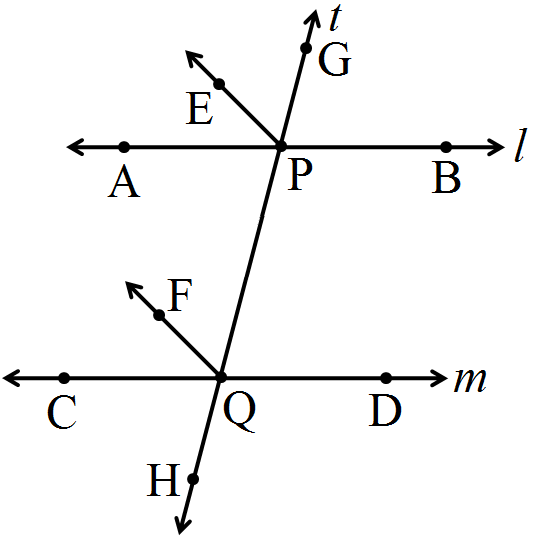

To prove $\text{EP}||\text{FQ}$ Proof Given, $\text{AB}||\text{CD}$
$\Rightarrow\angle\text{APG}=\angle\text{CQP}$ [corresponding angles]
$\Rightarrow\frac{1}{2}\angle\text{APG}=\frac{1}{2}\angle\text{CQP} [$dividing both sides by $2]$
$\Rightarrow\angle\text{EPG}=\angle\text{FQP}$ $\big[\because EP$ and $FQ$ are the bisectors of $\angle\text{APG} $ and $\angle\text{CQP},$ respectively$\big]$
As these, are the corresponding angles on the transversal line $t.$
$\text{EP}||\text{FQ}$ Hence proved.
View full question & answer
Question 25 Marks
Prove that two lines that are respectively perpendicular to two intersecting lines intersect each other. [Hint: Use proof by contradiction].
Answer
Given: Let lines $l$ and $m$ are two intersecting lines. Again, let n and p be another two lines which are perpendicular to the intersecting lines meet at point $D.$
To prove: Two lines $n$ and $p$ intersecting at a point.
Proof: Let us consider lines $n$ and $p$ are not intersecting, then it means they are parallel to each other i.e., $n || p.....(1)$ Since, lines $n$ and $p$ are perpendicular to $m$ and $l$ respectively.
​​​​​​​But from equation $(1), n || p,$ it implies that $l$ and $m.$ It is a contradiction.
Thus, our assumption is wrong.
Hence, lines $n$ and $p$ intersect at a point.
View full question & answer
Question 35 Marks
Bisectors of interior $\angle\text{B}$ and exterior $\angle\text{ACD}$ of a $\Delta\text{ABC}$ intersect at the point $T.$ Prove that,
$\angle\text{BTC}=\frac{1}{2}\angle\text{BAC}.$
Answer
Given In $AABC,$ produce $SC$ to $D$ and the bisectors of $\angle\text{ABC}$ and $\angle\text{ACD}$ meet at point $T.$ To prove $\angle\text{BTC}=\frac{1}{2}\angle\text{BAC}$
Proof In $\Delta\text{ABC},$$\angle\text{C}$ is an exterior angle.
$\therefore\angle\text{ACD}=\angle\text{ABC}+\angle\text{CAB}$
[exterior angle of a triangle is equal to the sum of two opposite angles]
$\Rightarrow\frac{1}{2}\angle\text{ACD}=\frac{1}{2}\angle\text{CAB}+\frac{1}{2}\angle\text{ABC} [$dividing both sides by $2]$
$\Rightarrow\angle\text{TCD}=\frac{1}{2}\angle\text{CAB}+\frac{1}{2}\angle\text{ABC}..(\text{i})$
$\big[\because$ is a bisector of $\angle\text{ACD}\Rightarrow\frac{1}{2}\angle\text{ACD}=\angle\text{TCD}\big]$
In $\Delta\text{BTC},$ $\angle\text{TCD}=\angle\text{BTC}+\angle\text{CBT}$
[exterior angle of a triangle is equal to the sum of two opposite interior angles
$\Rightarrow\angle\text{TCD}=\angle\text{BTC}+\frac{1}{2}\angle\text{ABC}...(\text{ii})$
$\big[\because$ BT bisects of $\angle\text{ABC}\Rightarrow\angle\text{CBT}=\frac{1}{2}\angle\text{ABC}\big]$
From Eqs. $(i)$ and $(ii) $,
$\frac{1}{2}\angle\text{CAB}+\frac{1}{2}\angle\text{ABC}=\angle\text{BTC}+\frac{1}{2}\angle\text{ABC}$
$\Rightarrow\angle\text{BTC}=\frac{1}{2}\angle\text{CAB}$
or $\angle\text{BTC}=\frac{1}{2}\angle\text{BAC}$
View full question & answer
Question 45 Marks
The angles of a triangle are in the ratio $2 : 3 : 4.$ Find the angles of the triangle.
Answer
Given: Ratio of angles is $2 : 3 : 4.$
To find: Angles of triangle.
Proof: The ratio of angles of a triangle is $2 : 3 : 4.$
Let the angles of a triangle be $\angle\text{A},$ $\angle\text{B}$ and $\angle\text{C}$
Therefore, $\angle\text{A}=2\text{x},$ then $\angle\text{B}=3\text{x}$ and $\angle\text{C}=4\text{x}.$
In $\Delta\text{ABC},\angle\text{A}+\angle\text{B}+\angle\text{C}=180^\circ$ $[\because$ sum of angles of a triangle is $180^\circ ]$
$\therefore2\text{x}+3\text{x}+4\text{x}=180^\circ$
$\Rightarrow9\text{x}=180^\circ\Rightarrow\text{x}=\frac{180^\circ}{9}=20^\circ$
$\therefore\ \angle\text{A}=2\text{x}=2\times20^\circ=40^\circ$
$\angle\text{B}=3\text{x}=3\times20^\circ=60^\circ$
And $\angle\text{C}=4\text{x}=4\times20^\circ=80^\circ$
Hense, the angles of the triangles are $40^\circ , 60^\circ $ and $80^\circ .$
View full question & answer
Question 55 Marks
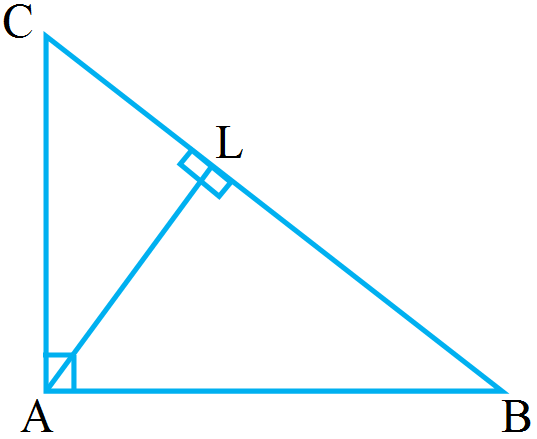
A triangle $ABC$ is right angled at $A. L$ is a point on $BC$ such that $AL \perp BC.$ Prove that $\angle\text{BAL}=\angle\text{ACB}.$
Answer
Given: $ABC$ is a triangle right angled at $A.$ $AL$ is drawn perpendicular to $BC.$ To Prove: $\angle\text{BAL}=\angle\text{ACB}$


Proof: In triangle ALB, $\angle\text{ALB}+\angle\text{BAL}+\text{ABL}=180^\circ$ | Angle sum property of a triangle $\Rightarrow90^\circ+\angle\text{BAL}+\angle\text{ABC}=180^\circ$
$\Rightarrow\angle\text{BAL}+\angle\text{ABC}=90^\circ...(1)$
In triangle $ABC,$ $\angle\text{BAC}+\angle\text{ACB}+\angle\text{ABC}=180^\circ$ | Angle sum property of a triangle $\Rightarrow90^\circ+\angle\text{ACB}+\angle\text{ABC}=180^\circ$
$\Rightarrow\angle\text{BAL}+\angle\text{ABC}=\angle\text{ACB}+\angle\text{ABC}$
$\Rightarrow\angle\text{BAL}=\angle\text{ACB}$
View full question & answer
Question 65 Marks
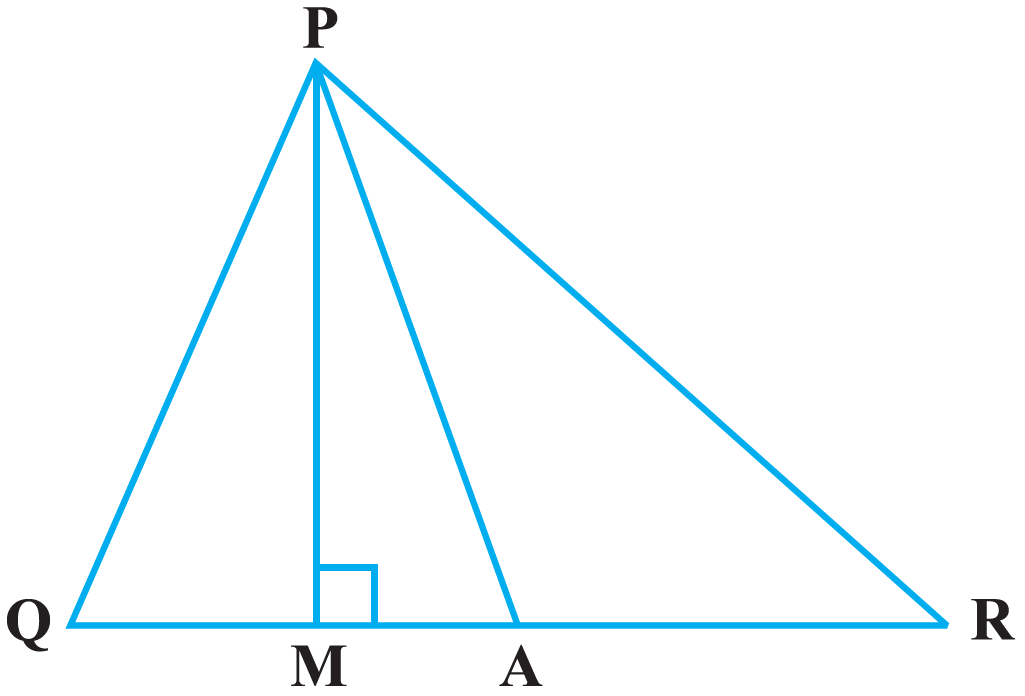
In Fig. $\angle\text{Q}>\angle\text{R}, PA$ is the bisector of $\angle\text{QPR}$ and $\text{PM}\perp\text{QR}$ Prove that $\angle\text{APM}=\frac{1}{2}(\angle\text{Q}-\angle\text{R}).$
Answer
Given In $\Delta\text{PQR},\angle\text{Q}>\angle\text{R},$PA is the bisector of $\angle\text{QPR}$ and $\text{PM}\perp\text{QR}.$ To prove $\angle\text{APM}=\frac{1}{2}(\angle\text{Q}-\angle\text{R})$ Proof Since, $PA$ is the bisector of $\angle\text{QPR}.$
$\therefore\ \angle\text{QPA}=\angle\text{APR}$ In $\Delta\text{PQM},$
$\angle\text{PQM}+\angle\text{PMQ}+\angle\text{QPM}=180^\circ...(\text{i}) [$by angle sum property of a triangle$]$ $\Rightarrow\angle\text{PQM}+90^\circ+\angle\text{QPM}=180^\circ$
$\big[\because\ \text{PM}\perp\text{QR}\Rightarrow\angle\text{PMQ}=90^\circ\big]$
$\Rightarrow\angle\text{PQM}=90^\circ-\angle\text{QPM}...(\text{ii})$ In $\Delta\text{PMR},$
$\angle\text{PMR}+\angle\text{PRM}+\angle\text{RPM}=180^\circ [$by angle sum property of a triangle$]$
$\Rightarrow90^\circ+\angle\text{PRM}+\angle\text{RPM}=180^\circ$
$\big[\because\ \text{PM}\perp\text{QR}\Rightarrow\angle\text{PMR}=90^\circ\big]$
$\Rightarrow\angle\text{PRM}=180^\circ-90^\circ-\angle\text{RPM}$
$\Rightarrow\angle\text{PRM}=90^\circ-\angle\text{RPM}..(\text{iii})$ On subtracting Eq. $(iii)$ from Eq. $(ii),$
we get $\angle\text{Q}-\angle\text{R}=(90^\circ-\angle\text{QPM})-(90^\circ-\angle\text{RPM})$
$\big[$ where $\angle\text{PQM}=\angle\text{Q}$ and $\angle\text{PRM}=\angle\text{R}\big]$
$\Rightarrow\angle\text{Q}-\angle\text{R}=\angle\text{RPM}-\angle\text{QPM}$
$\Rightarrow\angle\text{Q}-\angle\text{R}=\big[\angle\text{RPA}+\angle\text{APM}\big]-\big[\angle\text{QPA}-\angle\text{APM}\big]..(\text{iv})$
$\Rightarrow\angle\text{Q}-\angle\text{R}=\angle\text{QPAS}+\angle\text{APM}-\angle\text{QPA}+\angle\text{APM} [$by using Eq. $(i)]$
$\Rightarrow\angle\text{Q}-\angle\text{R}=2\angle\text{APM}$
$\therefore\angle\text{APM}=\frac{1}{2}(\angle\text{Q}-\angle\text{R})$
View full question & answer
Question 75 Marks
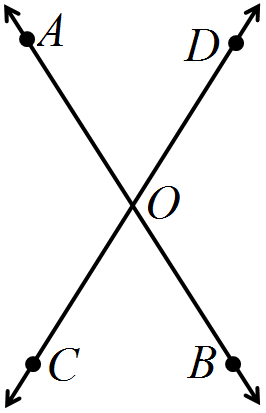
If two lines intersect, prove that the vertically opposite angles are equal.
Answer
Given Two lines $AB$ and $CD$ intersect at point $O.$
To prove:
$i. \angle\text{AOC}=\angle\text{BOD}$
$ii. \angle\text{AOD}=\angle\text{BOC}$
Proof:
$i.$ Since, ray $OA$ stands on line $CD.$
$\angle\text{AOC}+\angle\text{AOD}=180^\circ[$ linear pair axiom$].....(i)$
Since, ray $OD$ stands on line $AB.$
$\therefore\angle\text{AOD}+\angle\text{BOD}=180^\circ [$linear pair axiom$].....(ii)$

From Eqs. $(i)$ and $(ii).$
$\angle\text{AOC}+\angle\text{AOD}=\angle\text{AOD}+\angle\text{BOD}$
$\Rightarrow\angle\text{AOC}=\angle\text{BOD}$
$ii.$ Since, ray $OD$ stands on line $AB.$
$\therefore\angle\text{AOD}+\angle\text{BOD}=180^\circ[ $linear pair axiom$]...(iii)$
Since, ray $OB$ stands on line $CD.$
$\therefore\angle\text{DOB}+\angle\text{BOC}=180^\circ....(\text{iv})$
From Eqs. $(iii)$ and $(iv),$
$\angle\text{AOD}+\angle\text{BOD}=\angle\text{DOD}+\angle\text{BOC}$
$\Rightarrow\angle\text{AOD}=\angle\text{BOC}$
Hence proved.
View full question & answer
5 Marks Questions - Maths STD 9 Questions - Vidyadip