Questions

3 Marks Question

🎯

Test yourself on this topic

9 questions · timed · auto-graded

Question 13 Marks
Look at several examples of rational numbers in the form $\frac{p}{q}(q \neq 0)$, where $p$ and $q$ are integers with no common factors other than $1$ and having terminating decimal representations (expansions). Can you guess what property $q$ must satisfy?
Answer
 Let $\frac{1}{2}, \frac{1}{4}, \frac{5}{8}, \frac{17}{25}, \frac{2}{125}, \frac{13}{20}$ etc which has terminating decimal expansion. For example:
$\frac{1}{2}=\frac{1}{2^1}=0.5, \text { denominator } q=2^1$
$\frac{1}{4}=\frac{1}{2^2}=0.25 \text { denominator } q=2^2$
$\frac{5}{8}=\frac{5}{2^3}=0.625, \text { denominator } q=2^3$
$\frac{17}{25}=\frac{17}{5^2}=0.68, \text { denominator } q=5^2$
$\frac{2}{125}=\frac{2}{5^3}=0.016, \text { denominator } q=5^3$
$\frac{13}{20}=\frac{13}{2^2 \times 5}=0.65, \text { denominator } q=2^2 \times 5$
It can be observed that the terminating decimal can be obtained in a condition where prime factorization of the denominator (i.e. q) of the given fractions has $2$ or the power of $2$ or $5$ or power of $5$ or both.
View full question & answer
Question 23 Marks
What can the maximum number of digits be in the recurring block of digits in the decimal expansion of $\frac{1}{{17}}$? Perform the division to check your answer.
Answer
We need to find the number of digits in the recurring block of $\frac{1}{{17}}$
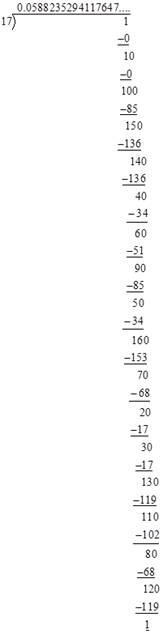
Let us perform the long division to get the recurring block of $\frac{1}{{17}}$ We need to divide $1$ by $17$, to get

We can observe that while dividing $1$ by $17$ we got the remainder as $1$, which will continue to be $1$ after carrying out $16$ continuous divisions. Therefore, we conclude that
$\frac{1}{{17}} = 0.{\text{0588235294117647}}.....{\text{ or }}$$\frac{1}{{17}} = 0.\overline {{\text{0588235294117647}}}$, which is a non-terminating decimal and recurring decimal.
View full question & answer
Question 33 Marks
You know that $\frac{1}{7}=0 . \overline{142857}$. Can you predict what the decimal expansions of $\frac { 2 } { 7 } , \frac { 3 } { 7 } , \frac { 4 } { 7 } , \frac { 5 } { 7 } , \frac { 6 } { 7 }$ are, without actually doing the long division? If so, how?
Answer
Yes, We can predict the decimal expansions of $\frac { 2 } { 7 } , \frac { 3 } { 7 } , \frac { 4 } { 7 } , \frac { 5 } { 7 } , \frac { 6 } { 7 }$, without actually doing the long division as follows :
$\frac { 2 } { 7 } = 2 \times \frac { 1 } { 7 } = 2 \times 0 . \overline { 142857 } = 0 . \overline { 285714 }$
$\frac { 3 } { 7 } = 3 \times \frac { 1 } { 7 } = 3 \times 0 . \overline { 142857 } = 0 . \overline { 428571 }$
$\frac { 4 } { 7 } = 4 \times \frac { 1 } { 7 } = 4 \times 0 . \overline { 142857 } = 0 . \overline { 571428 }$
$\frac { 5 } { 7 } = 5 \times \frac { 1 } { 7 } = 5 \times 0 . \overline { 142857 } = \overline{0.714285}$
$\frac { 6 } { 7 } = 6 \times \frac { 1 } { 7 } = 6 \times 0 . \overline { 142857 } = 0 . \overline { 857142 }$
View full question & answer
Question 43 Marks
Write in decimal form and say what kind of decimal expansion: $\frac{{36}}{{100}}$
Answer
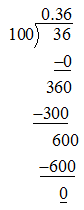
On dividing $36$ by $100$, we get

So, the answer is $0.36$, which is a terminating decimal.
View full question & answer
Question 53 Marks
Find five rational numbers between $\frac{3}{5}{\text{ and }}\frac{4}{5}$
Answer
We know that there are infinite rational numbers between any two numbers.
A rational number is the one that can be written in the form of $\frac{p}{q}$
where $p$ and $q$ are Integers and $q \ne 0$ We know that the numbers $\frac{3}{5}{\text{ and }}\frac{4}{5}$
can also be written as.$0.6$ and $0.8$ or$\eqalign{ & {3 \over 5} = {3 \over 5} \times {{20} \over {20}} = {{60} \over {100}} \cr & {4 \over 5} = {4 \over 5} \times {{20} \over {20}} = {{80} \over {100}} \cr}$
We can conclude that the numbers all lie between We need to rewrite the numbers $0.61,0.62,0.63,0.64{\text{ and }}0.65$ in $\frac{p}{q}$ form to get the rational numbers between ​$\frac{3}{5}{\text{ and }}\frac{4}{5}$​ .
So, after converting, we get $\frac{{61}}{{100}},\frac{{62}}{{100}},\frac{{63}}{{100}},\frac{{64}}{{100}}{\text{ and }}\frac{{65}}{{100}}$
We can further convert the rational numbers $\frac{{62}}{{100}},\frac{{64}}{{100}}{\text{ and }}\frac{{65}}{{100}}$ into lowest fractions.
On converting the fractions, we get $\frac{{31}}{{50}},\frac{{16}}{{25}}{\text{ and }}\frac{{13}}{{20}}$
Therefore, five rational numbers between $\frac{3}{5}{\text{ and }}\frac{4}{5}$are $\frac{{61}}{{100}},\frac{{31}}{{50}},\frac{{63}}{{100}},\frac{{16}}{{25}}{\text{ and }}\frac{{13}}{{50}}$
 
View full question & answer
Question 63 Marks
Show that $1.272727 = 1. \overline {27}$ can be expressed in the form $\frac{p}{q}$, where $p$ and $q$ are integers and $q \ne 0.$
Answer
The given number $= 1.272727....= 1. \overline {27}$
Let x = $1. \overline {27}$. Then,
$x = 1.272727.......(i)$
Multiplying both sides by $100$ we get
$100\  x = 127.272727......(ii)$
On subtracting (i) from (ii), we getLet x = $1. \overline {27}$. Then,
$99 x = (127.272727...) - (1.272727....) =127-1$
$99 x = 126$
$\mathrm x\;=\frac{126}{99}=\frac{14}{11}$
Therefore, $1. \overline {27} = 1.272727 =\frac {14}{11} = \frac pq$
Hence $1. \overline {27}$ can be expressed in $\frac {p}{q}$ form where $p=14$ and $q=11$
View full question & answer
Question 73 Marks
Find the decimal expansions of $\frac{10}{3},\frac{7}{8}$ and $ \frac{1}{7}$.
Answer

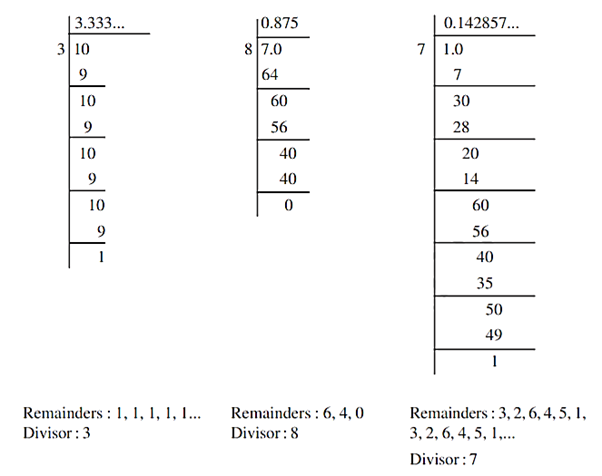
$\frac{7}{8}$, we found that the remainder becomes zero and the decimal expansion of $\frac{7}{8} = 0.875.$
We call the decimal expansion of such numbers terminating.
$\frac{10}{3}$ and $\frac{1}{7}$ , we notice that the remainders repeat after a certain stage forcing the decimal expansion to go on for ever. In other words, we have a repeating block of digits in the quotient. We say that this expansion is non-terminating recurring. 
View full question & answer
Question 83 Marks
Locate $\sqrt{2}$ on the number line.
Answer
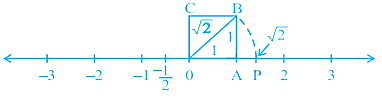
Consider a square $OABC$, with each side $1$ unit in length (see Fig.).

Then you can see by the Pythagoras theorem that $OB = \sqrt{1^{2}+1^{2}}=\sqrt{2}$.
Transfer Fig. onto the number line making sure that the vertex $O$ coincides with zero (see Fig.)

We have just seen that $OB = \sqrt{2}$.
Using a compass with centre $O$ and radius $OB$, draw an arc intersecting the number line at the point $P.$
Then P corresponds to $\sqrt{2}$ on the number line.
View full question & answer
Question 93 Marks
Find the irrational number between $\frac{1}{7}$and $\frac{2}{7}.$
Answer
Given numbers are $\frac{1}{7}$and $\frac{2}{7}.$
$\frac{1}{7}=0.142857142857 \ldots$
$\Rightarrow \frac{1}{7}=0 . \overline{142857}$
$\frac{2}{7}=2 \times \frac{1}{7}=0.285714285714 \ldots$
$\Rightarrow \quad \frac{2}{7}=0 . \overline{285714}$
To find irrational numbers between $\frac{1}{7}$ and $\frac{2}{7}$, we find numbers which are non$-$terminating and non$-$repeating.
There are infinitely many such numbers lying between $\frac{1}{7}$and $\frac{2}{7}$.
Examples:
$1. 0.150150015000150000 ...$
$2. 0.250250025000250000 ...$
etc..
View full question & answer
3 Marks Question - Maths STD 9 Questions - Vidyadip