Questions

Fill In The Blanks[1 Marks ]

Take a timed test

11 questions · self-marked practice — reveal the answer and mark yourself.

Question 11 Mark
If one pair of opposite sides are equal and parallel, then the figure is _____________. (parallelogram, rectangle, trapezium).
Answer
If one pair of opposite sides are equal and parallel, then the figure is parallelogram.
Explanation:
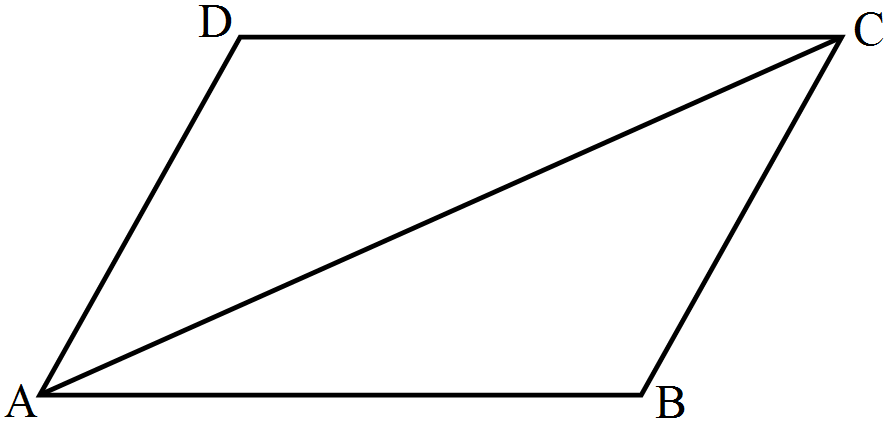
In $\triangle\text{ABC}$ and $\triangle\text{CDA}, AB = DC ($Given$) AC = AC ($Common$)$
$\angle\text{BAC}=\angle\text{DCA} ($Because $AB || CD,$ Alternate interior angle are equal$)$
So, by $SAS$ Congruence rule,
we have $\triangle\text{ABC}\cong\triangle\text{CDA}$
Also, $\angle\text{BCA}=\angle\text{DAC} ($Corresponding parts of congruent triangles are equal$)$
But, these are alternate interior angles, which are equal. $AD || BC$
Thus, $AB || CD$ and $AD || BC.$
Hence, quadrilateral $ABCD$ is parallelogram.
View full question & answer
Question 21 Mark
If in a quadrilateral only one pair of opposite sides are parallel, the quadrilateral is _____________. (square, rectangle, trapezium).
Answer
If in a quadrilateral only one pair of opposite sides are parallel, the quadrilateral is trapezium.
View full question & answer
Question 31 Mark
The figure formed by joining the mid-points of consecutive sides of a quadrilateral is ____________.
Answer
The figure formed by joining the mid-points of consecutive sides of a quadrilateral is Parallelogram.
View full question & answer
Question 41 Mark
The triangle formed by joining the mid-points of the sides of an isosceles triangle is ____________.
Answer
The triangle formed by joining the mid-points of the sides of an isosceles triangle is Isosceles.
View full question & answer
Question 51 Mark
If both pairs of opposite sides of a quadrilateral are equal, then it is necessarily a _________. (rectangle, parallelogram, rhombus).
Answer
If both pairs of opposite sides of a quadrilateral are equal, then it is necessarily a parallelogram.
Explanation:

$ABCD$ is a quadrilateral in which $AB = CD$ and $BC = DA.$
We need to show that $ABCD$ is a parallelogram.
In $\triangle\text{ACB}$ and $\triangle\text{CAD},$
we have $AC = CA ($Common$) CB = AD ($Given$) AB = CD ($Given$)$
So, by SSS criterion of congruence, we have $\triangle\text{ACB}\cong\triangle\text{CAD}$
By corresponding parts of congruent triangles property.
$\angle\text{CAB}=\angle\text{ACD}\ ....(\text{i})$ And $\angle\text{ACB}=\angle\text{CAD}$
Now lines $AC$ intersects $AB$ and $DC$ at $A$ and $C,$
such that $\angle\text{CAB}=\angle\text{ACD} [$From $(i)]$ That is, alternate interior angles are equal.
Therefore, $AB || DC.$ Similarly, $AD || BC.$
Therefore, $ABCD$ is a parallelogram.
View full question & answer
Question 61 Mark
If one angle of a parallelogram is a right angle, then it is necessarily a _____________. (rectangle, square, rhombus).
Answer
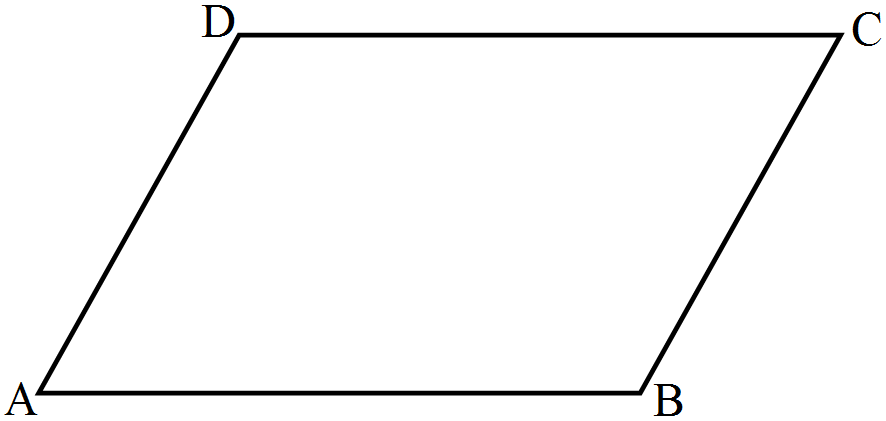
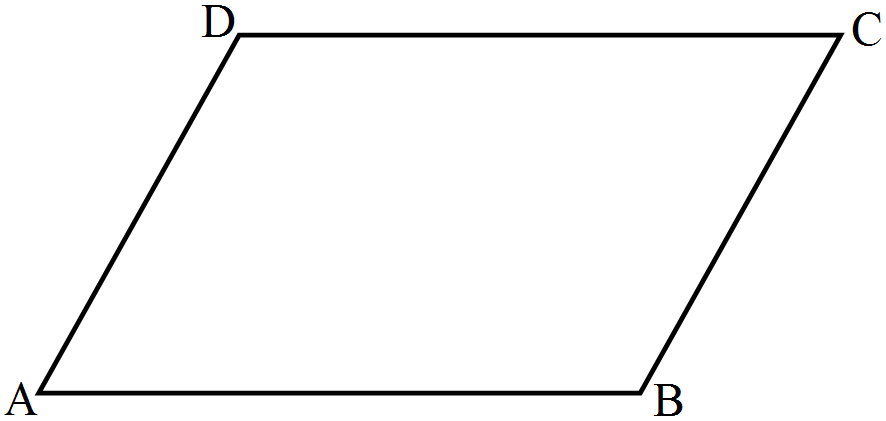
If one angle of a parallelogram is a right angle, then it is necessarily a rectangle. Explanation: We have, $\angle\text{A}=90^\circ$ In a parallelogram, opposite angles are equal. Therefore, $\angle\text{C}=90^\circ$ Similarly, $\angle\text{A}+\angle\text{D}=180^\circ$ $90^\circ+\angle\text{D}=180^\circ$ $\angle\text{D}=90^\circ$ Also, $\angle\text{B}=90^\circ$ Thus, a parallelogram with all the angles being right angle and opposite sides being equal is a rectangle.
View full question & answer
Question 71 Mark
A line drawn from the mid-point of one side of a triangle _____________ another side intersects the third side at its mid-point. (perpendicular to parallel to, to meet).
Answer
A line drawn from the mid-point of one side of a triangle parallel to another side intersects the third side at its mid-point. Explanation: This is a theorem.
View full question & answer
Question 81 Mark
If opposite angles of a quadrilateral are equal, then it is necessarily a _________. (parallelogram, rhombus, rectangle).
Answer
If opposite angles of a quadrilateral are equal, then it is necessarily a
parallelogram. Explanation:

$ABCD$ is a quadrilateral in which $\angle\text{A}=\angle\text{C}$ and $\angle\text{B}=\angle\text{D}.$
We need to show that $ABCD$ is a parallelogram.
In quadrilateral $ABCD,$ we have $\angle\text{A}=\angle\text{C}$
$\angle\text{B}=\angle\text{D}$
Therefore, $\angle\text{A}+\angle\text{B}=\angle\text{C}+\angle\text{D}\ ....(\text{i})$
Since sum of angles of a quadrilateral is $360^\circ $
$\angle\text{A}+\angle\text{B}+\angle\text{C}+\angle\text{D}=360^\circ$ From equation $(i),$
we get: $(\angle\text{A}+\angle\text{B})+(\angle\text{A}+\angle\text{B})=360^\circ$
$2(\angle\text{A}+\angle\text{B})=360^\circ$
$\angle\text{A}+\angle\text{B}=180^\circ$ Similarly, $\angle\text{C}+\angle\text{D}=180^\circ$
Now, line $AB$ intersects $AD$ and $BC$ at $A$ and $B$ respectively
Such that $\angle\text{A}+\angle\text{B}=180^\circ$
That is, sum of consecutive interior angles is supplementary.
Therefore, $AD || BC.$ Similarly, we get $AB || DC.$
​​​​​​​Therefore, $ABCD$ is a parallelogram.
 
View full question & answer
Question 91 Mark
The triangle formed by joining the mid-points of the sides of a right triangle is ____________.
Answer
The triangle formed by joining the mid-points of the sides of a right triangle is Right triangle.
View full question & answer
Question 101 Mark
Consecutive angles of a parallelogram are _____________. (supplementary, complementary).
Answer
Consecutive angles of a parallelogram are supplementary.
Explanation: Let $ABCD$ be the given parallelogram.

 Thus, $AB || DC.$ Therefore, $\angle\text{A}+\angle\text{D}=180^\circ$
 Consecutive angles $\angle\text{A}$ and $\angle\text{D}$ are supplementary.
View full question & answer
Question 111 Mark
If consecutive sides of a parallelogram are equal, then it is necessarily a _________. (kite, rhombus, square).
Answer
If consecutive sides of a parallelogram are equal, then it is necessarily a rhombus.
Explanation:

We have $ABCD$, a parallelogram with $AB = BC.$
Since $ABCD$ is a parallelogram.
Thus,$ AB = CD$ And $BC = AD$ But, $AB = BC$
Therefore,all four sides of the parallelogram are equal,
then it is a rhombus.
View full question & answer
Fill In The Blanks[1 Marks ] - Maths STD 9 Questions - Vidyadip