Questions

2 Marks Questions

Take a timed test

9 questions · self-marked practice — reveal the answer and mark yourself.

Question 12 Marks
In quadrilateral $ABCD, \angle\text{A}+\angle\text{D}=180^\circ$ What special name can be given to this quadrilateral?
Answer
In quadrilateral ABCD, $\angle\text{A}+\angle\text{D}=180^\circ$ i.e., the sum of two consecutive angles is $180^{\circ}$. So, pair of opposite side $AB$ and $CD$ are parallel.
Therefore, quadrilateral $A B C D$ is trapezium.
Hence, special name which can be given to this quadrilateral $A B C D$ is trapezium.
View full question & answer
Question 22 Marks
In $\triangle A B C, B C=8 cm$ and $C A=7 cm$. If $D$ and $E$ are respectively the mid-points of $A B$ and $B C$, determine the length of $D E$.
Answer
In $\triangle A B C, B C=8 cm$ and $C A=7 cm$. If $D$ and $E$ are respectively the mid-points of $A B$ and $B C$, $\therefore DE =\frac{1}{2} AC =\frac{1}{2} \times 7 cm=3.5 cm$ [Using the mid-point theorem]
View full question & answer
Question 32 Marks
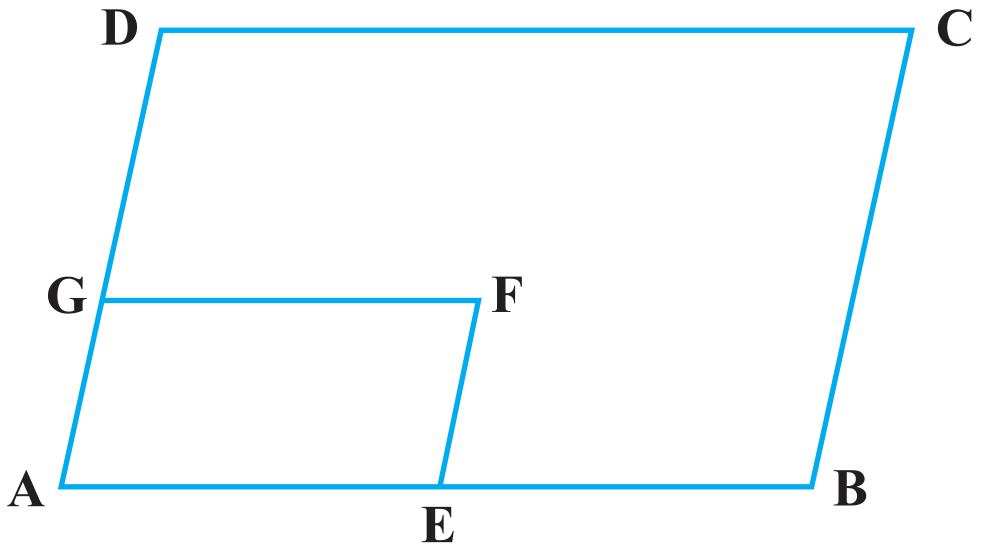
$ABCD$ and $AEFG$ are two parallelograms. If $\angle\text{C}=55^\circ,$ determine $\angle\text{F}.$
Answer
We have, $ABCD$ and $AEFG$ are two parallelograms and$\angle\text{C}=55^\circ.$ Since, $ABCD$ is a parallelogram, then opposite angles of a parallelogram are equal. $\angle\text{A}=\angle\text{C}=55^\circ\ ...(\text{i})$
Also, $AEFG$ is a parallelogram. $\therefore\ \angle\text{A}=\angle\text{F}=55^\circ$ [from eq.]
View full question & answer
Question 42 Marks
Can the angles $110^\circ , 80^\circ , 70^\circ $ and $95^\circ $ be the angles of a quadrilateral? Why or why not?
Answer
No, we know that, sum of all angles of a quadrilateral is $360^\circ .$
Here, sum of the angles $= 110^\circ + 80^\circ + 70^\circ + 95^\circ = 355^\circ \neq 360^\circ .$
So, these angles cannot be the angles of a quadrilateral.
View full question & answer
Question 52 Marks
Can all the angles of a quadrilateral be acute angles? Give reason for your answer.
Answer
No, all the angles of a quadrilateral cannot be acute angles. As, sum of the angles of a quadrilateral is $360^\circ $. So, maximum of three acute angles will be possible.
View full question & answer
Question 62 Marks
One angle of a quadrilateral is of $108^{\circ}$ and the remaining three angles are equal. Find each of the three equal angles.
Answer
One angle of a quadrilateral is of $180^{\circ}$ and let each of the three remaining equal angles be $x^0$.
As the sum of the angles of a quadrilaterral is $360^{\circ}$.
$108^{\circ}+\mathrm{x}+\mathrm{x}+\mathrm{x}=360^{\circ}$
$\Rightarrow 3 \mathrm{x}=360^{\circ}=108^{\circ}=252^{\circ}$
$\Rightarrow \mathrm{x}=\frac{252^{\circ}}{3}=84^{\circ}$
Hence, each of the three angles be $84^{\circ}$.
View full question & answer
Question 72 Marks
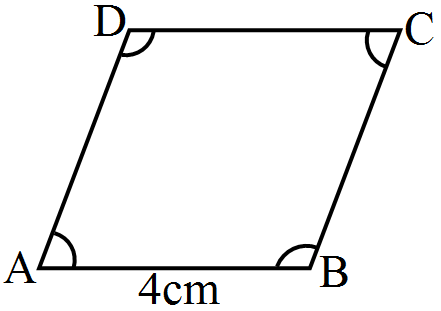
Opposite angles of a quadrilateral $ABCD$ are equal. If $AB = 4\ cm$, determine $CD.$
Answer
Given, opposite angles of a quadrilateral are equal. So, $ABCD$ is a parallelogram and we know that, in a parallelogram opposite sides are also equal. $∴\text{CD}=\text{AB}=4\text{cm}$
View full question & answer
Question 82 Marks
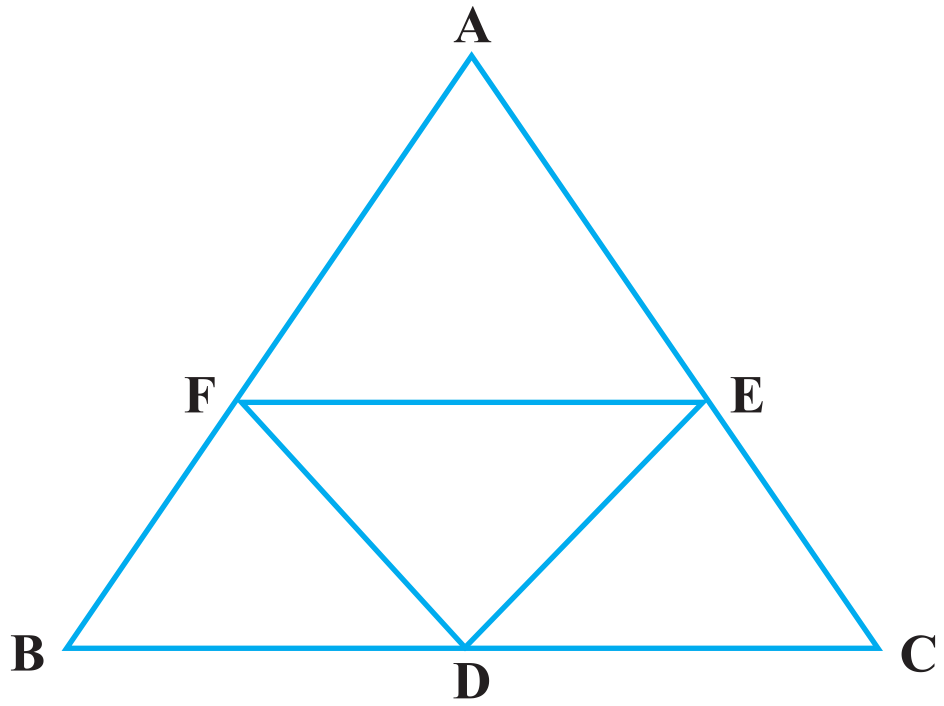
it is given that $BDEF$ and $FDCE$ are parallelograms. Can you say that $B D=C D$ ? Why or why not?
Answer
Yes, in the given figure, $BDEF$ is a parallelogram.. $\therefore$ $BD \| EF$ and $BD = EF …(i)$ Also, $FDCE$ is a parallelogram. $\therefore$ $CD\|EF$ and $CD = EF …(ii)$ From Eqs. $(i)$ and $(ii), BD = CD = EF$
View full question & answer
Question 92 Marks
Diagonals of a quadrilateral $ABCD$ bisect each other. If $\angle\text{A}=35^\circ$ determine $\angle\text{B}.$
Answer
As the diagonals of a qudrillateral $ABCD$ bisect each other, so $ABCD$ is a parallelogram. New, $ABCD$ is a parallelogram $\therefore\ \angle\text{A}+\angle\text{B}=180^\circ$ [$\because$ abjacent angles of a parallelogram are supplementary] $\therefore\ 35^\circ+\angle\text{B}=180^\circ$ $\Rightarrow\ \angle\text{B}=180^\circ-35^\circ=145^\circ$
View full question & answer