MCQ 11 Mark
Write the correct answer in the following: $ABCD$ is a rhombus such that $\angle\text{ACB}=40^\circ.$ then $\angle\text{ADB}$ is:
- A
$40^\circ$
- B
$45^\circ$
- ✓
$50^\circ$
- D
$60^\circ$
AnswerCorrect option: C. $50^\circ$
$ABCD$ is a rhombus such thet $\angle\text{ACB}=40^\circ.$
We know that diagonnals of rhombus bisect each other right angles.
In right $\Delta\text{BOC},$ we have
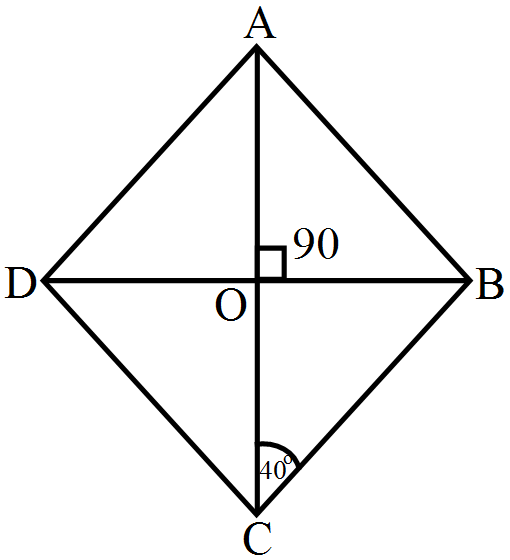
$\angle\text{OBC}=180^\circ-(\angle\text{BOC}+\angle\text{BCO})$ (angle sum property)
$=180^\circ-(90^\circ+40^\circ)=50^\circ$
$\therefore\ \angle\text{DBC}=\angle\text{OBC}=50^\circ$
Now,
$\angle\text{ADB}=\angle\text{DBC}$ [Alt. int. $\angle\text{s}$ ]
$\therefore\ \angle\text{ADB}=50^\circ[\therefore\angle\text{DBC}=50^\circ]$
Hence, $(c)$ is the correct answer. View full question & answer→MCQ 21 Mark
Write the correct answer in the following: A diagonal of a rectangle is inclined to one side of the rectangle at $25^\circ$. The acute angle between the diagonals is:
- A
$55^\circ$
- ✓
$50^\circ$
- C
$40^\circ$
- D
$25^\circ$
AnswerCorrect option: B. $50^\circ$
We know that, digonals of a rectangle are equal in length.
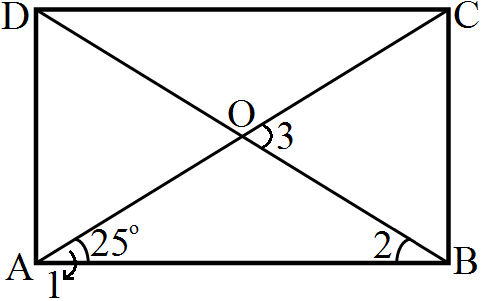
$\therefore\ \text{AD}=\text{BD}$
$\Rightarrow\ \frac{1}{2}\text{AC}=\frac{1}{2}\text{BD}$ [dividing both sides by $2$]
$\Rightarrow\ \text{OA}=\text{OB}$ [since, $O$ is the mid-point of $AC$ and $BD$]
$\Rightarrow\ \angle2=\angle1$ [angles opposite to equal sides are equal]
$=25^\circ$
$\therefore\ \angle3=\angle1+\angle2$
[exterior angle is equal to the sum of two opposite intersite interior angles]
$=25^\circ+25^\circ=50^\circ$
Hence, the acute angle between the diagonals is $50^\circ$. View full question & answer→MCQ 31 Mark
Write the correct answer in the following:
If bisectors of $\angle \text{A}$ and $\angle \text{B}$ of a quadrilateral $ABCD$ intersect each other at $P$, of $\angle \text{B}$ and $\angle \text{C}$ at $Q$, of $\angle \text{C}$ and $\angle \text{D}$ at $R$ and of $\angle \text{D}$ and $\angle \text{A}$ at S, then $PQRS$ is a:
- A
- B
- C
- ✓
Quadrilateral whose opposite angles are supplementary.
AnswerCorrect option: D. Quadrilateral whose opposite angles are supplementary.
$PQRS$ is a quadrilateral whose opposite angles are supplementary.
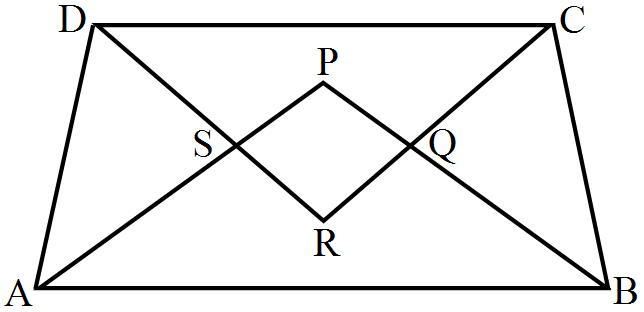
Hence, $(d)$ is the correct answer. View full question & answer→MCQ 41 Mark
Write the correct answer in the following:
If $APB$ and $CQD$ are two parallel lines, then the bisectors of the angles $APQ, BPQ, CQP$ and $PQD$ form:
Answer$PNQM$ is a rectangle.
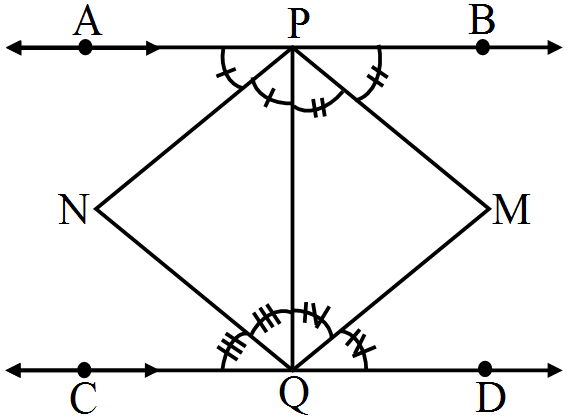
Hence, $(c)$ is the correct answer. View full question & answer→MCQ 51 Mark
Write the correct answer in the following: The quadrilateral formed by joining the mid-points of the sides of a quadrilateral $PQRS$, taken in order, is a rhombus, if:
- A
$PQRS$ is a rhombus.
- B
$PQRS$ is a parallelogram.
- C
Diagonals of $PQRS$ are perpendicular.
- ✓
Diagonals of $PQRS$ are equal.
AnswerCorrect option: D. Diagonals of $PQRS$ are equal.
If diagonals of $PQRS$ are equal.
Hence, $(d)$ is the correct answer.
View full question & answer→MCQ 61 Mark
Write the correct answer in the following: The quadrilateral formed by joining the mid-points of the sides of a quadrilateral $PQRS$, taken in order, is a rectangle, if:
- A
$PQRS$ is a rectangle.
- B
$PQRS$ is a parallelogram.
- ✓
Diagonals of $PQRS$ are perpendicular.
- D
Diagonals of $PQRS$ are equal.
AnswerCorrect option: C. Diagonals of $PQRS$ are perpendicular.
If diagonals of $PQRS$ are perpendicular.
Hence, $(c)$ is the correct answer.
View full question & answer→MCQ 71 Mark
Write the correct answer in the following: Which of the following is not true for a parallelogram?
- A
Opposite sides are equal.
- B
Opposite angles are equal.
- ✓
Opposite angles are bisected by the diagonals.
- D
Diagonals bisect each other.
AnswerCorrect option: C. Opposite angles are bisected by the diagonals.
We know that, in a parallelogram, opposite sides are equal, opposite angles are equal, opposite angles are not bisected by the diagonals and diagonals bisect each other.
View full question & answer→MCQ 81 Mark
Write the correct answer in the following: Three angles of a quadrilateral are $75^\circ , 90^\circ$ and $75^\circ$. The fourth angle is:
- A
$90^\circ$
- B
$95^\circ$
- C
$105^\circ$
- ✓
$120^\circ$
AnswerCorrect option: D. $120^\circ$
Fourth angle of the quadrilateral
$= 360^\circ - (75^\circ + 90^\circ + 75^\circ )$
$= 360^\circ - 240^\circ $
$= 120^\circ $
Hence, $(d)$ is the corrent answer.
View full question & answer→MCQ 91 Mark
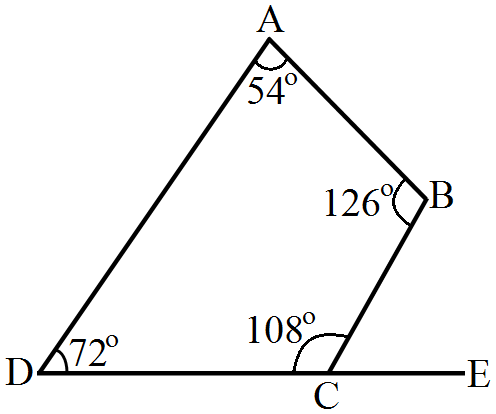
Write the correct answer in the following: If angles $A, B, C$ and $D$ of the quadrilateral $ABCD$, taken in order, are in the ratio $3 : 7 : 6 : 4$, then $ABCD$ is a:
AnswerGiven, ratio of angles of quadrilateral $ABCD$ is $3 : 7 : 6 : 4$.
Let angles of quadrilateral $ABCD$ be $3x, 7x, 6x$ and $4x$, respectively.
We know that, sum of all angles of a quadrilateral is $360^\circ$.
$3x + 7x + 6x + 4x = 360^\circ$
$\Rightarrow 20x = 360^\circ$
$\Rightarrow\frac{\text{x}=360^\circ}{20^\circ=18^\circ}$
$\therefore$ Angles of the quadrilateral are
$\angle\text{A}=3\times18=54^\circ$
$\angle\text{B}=7\times18=126^{\circ} $
$\angle\text{C}=6\times18=108^\circ$
$\angle\text{D}=4\times18=72^\circ$
From figure, $\angle\text{BCE}=180^\circ-\angle\text{BCD}$ [linear pair axiom]
$\Rightarrow\ \angle\text{BCE}=180^\circ-108^\circ=72^\circ$
Here, $\angle\text{BCE}=\angle\text{ADC}=72^\circ$
Since, the of cointerior angles,
$\therefore\ \text{BC}||AD$
Now, sum of cointerior angles,
$\angle\text{A}+\angle\text{B}=126^\circ+54^\circ=180^\circ$
$\angle\text{C}+\angle\text{D}=108^\circ+72^\circ=180^\circ$
Hence, $ABCD$ is a trapezium.
View full question & answer→MCQ 101 Mark
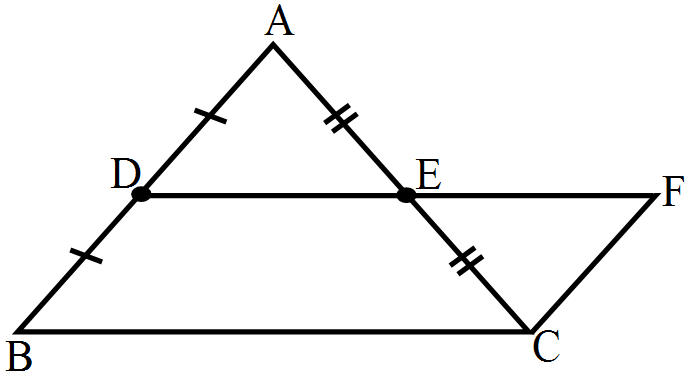
Write the correct answer in the following: $D$ and $E$ are the mid-points of the sides $AB$ and $AC$ respectively of $\Delta\text{ABC}.$ $DE$ is produced to $F.$ To prove that $CF$ is equal and parallel to $DA$, we need an additional information which is:
AnswerCorrect option: C. $\text{DE}=\text{EF}$
We need $\text{DE}=\text{EF}.$
Hence, $(c)$ is the correct answer. View full question & answer→MCQ 111 Mark
Write the correct answer in the following: The figure formed by joining the mid-points of the sides of a quadrilateral $ABCD$, taken in order, is a square only if,
- A
$ABCD$ is a rhombus.
- B
Diagonals of $ABCD$ are equal.
- ✓
Diagonals of $ABCD$ are equal and perpendicular.
- D
Diagonals of $ABCD$ are perpendicular.
AnswerCorrect option: C. Diagonals of $ABCD$ are equal and perpendicular.
If diagonal of $ABCD$ are equal and perpendicular.
Hence, $(c)$ is the correct answer.
View full question & answer→MCQ 121 Mark
Write the correct answer in the following: The diagonals $AC$ and $BD$ of a parallelogram $ABCD$ intersect each other at the point $O$. If $\angle\text{DAC}=32^\circ$ and $\angle\text{AOC}=70^\circ,$ then $\angle\text{DBC}$ is equal to:
- A
$24^\circ$
- B
$86^\circ$
- ✓
$38^\circ$
- D
$32^\circ$
AnswerCorrect option: C. $38^\circ$
Given, $\angle\text{AOB}=70^\circ$ and $\angle\text{DAC}=32^\circ$
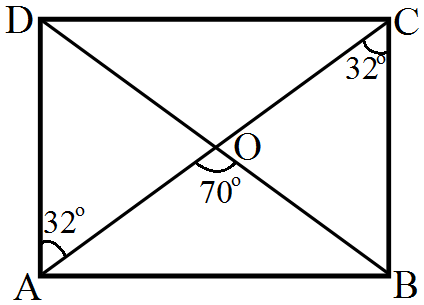
$\therefore\angle\text{ACB}=32^\circ$ [$AD||BC$ and $AC$ is transver sal]
Now, $\angle\text{AOB}+\angle\text{BOC}=180^\circ$ [linear pair axiom]
$\Rightarrow\ \angle\text{BOC}=180^\circ-\angle\text{AOB}=180^\circ-70^\circ=110^\circ$
Now, in $\Delta\text{BOC},$ we have
$\angle\text{BOC}+\angle\text{BCO}+\angle\text{OBC}=180^\circ$[by angle sum property of a tringle]
$\Rightarrow\ 110^\circ+32^\circ\angle\text{OBC}=180^\circ$ $[\because\angle\text{BCO}=\angle\text{ACB}=32^\circ]$
$\Rightarrow\ \angle\text{OBC}=180^\circ-(110^\circ+32^\circ)=38^\circ$
$\therefore\ \angle\text{DBC}-\angle\text{OBC}=38^\circ$ View full question & answer→MCQ 131 Mark
Write the correct answer in the following: $D$ and $E$ are the mid-points of the sides $AB$ and $AC$ of $\Delta\text{ABC}$ and $O$ is any point on side $BC$. $O$ is joined to $A$. If $P$ and $Q$ are the mid-points of $OB$ and $OC$ respectively, then $DEQP$ is:
AnswerSince the line segment joiing the mid-poients of any two sides of a triangle is parallel to third side and is half to it, so
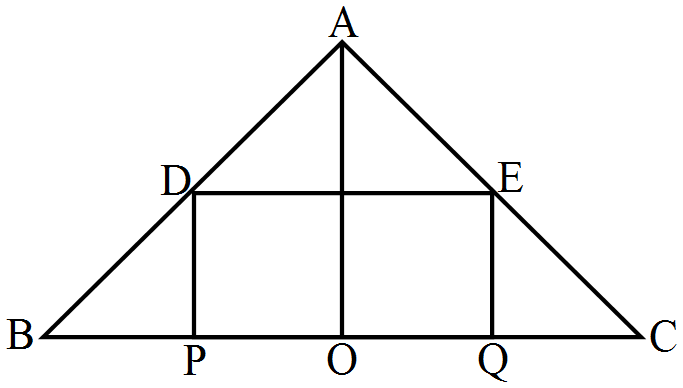
$\therefore\ \text{DE}=\frac{1}{2}\text{BC}$ and $\text{DE}||\text{BC}$
Similarly, $\text{DP}=\frac{1}{2}\text{AO}$ and $\text{DP||AO}$
And $\text{EQ}=\frac{1}{2}\text{AO}$ and $\text{EQ||AO}$
$\therefore\ \text{DP}=\text{EQ}[\therefore\text{Each}=\frac{1}{2}\text{AO}]$
And $\text{DP||EQ}[\therefore\text{Each}=\frac{1}{2}\text{AO}]$
Now, $DEQP$ is quadrilateral in which one pair of its opposite is equal and parallel.
Therefore, quadrilateral $DEQP$ is a parallelogram.
Hence, $(d)$ is the correct answer. View full question & answer→MCQ 141 Mark
Write the correct answer in the following: The figure obtained by joining the mid-points of the sides of a rhombus, taken in order, is:
AnswerThe figure will be a rectangle.
Hence, (b) is the correct answer.
View full question & answer→