Question 12 Marks
Twenty$-$seven solid iron spheres, each of radius $r$ and surface area $S$ are melted to form a sphere with surface area $S\ '$. Find the
$i.$ radius $r\ '$ of the new sphere, and
$ii.$ ratio of $S$ and $S\ '$.
AnswerVolume of $27$ solid sphere, each of radius, $r = 27 \times \frac{4}{3} \pi r^3 = 36 \pi r^3 $
According to the question,
Volume of sphere of radius $r\ ' =$ Volume of $27$ solid spheres
$\Rightarrow \frac{4}{3} \pi (r\ ')^3 = 36 \pi r^3 $
$ \Rightarrow (r\ ')^3 = 27r^3 = (3r)^3$
$ \Rightarrow r\ ' = 3r$
We have,
$S^{\prime}=4 \pi r^{\prime 2}=4 \pi(3 r)^2=36 \pi r^2 $
$ \therefore \frac{S}{S'} = \frac{4 \pi r^2}{36 \pi r^2} = \frac{1}{9} $
$ \Rightarrow S : S\ ' = 1 : 9.$
View full question & answer→Question 22 Marks
Find the volume of a sphere whose surface area is $154 cm^2$.
AnswerLet the radius of the sphere be $r cm.$
Surface area = $154 cm^2$
$\Rightarrow\ 4\pi r^2$ = 154
$\Rightarrow\ 4\times{22\over7}\times r^2=154$
$\Rightarrow\ r^2={154\times7\over4\times22}\Rightarrow {r^2={49\over4} }$
$\Rightarrow r=\sqrt{49\over4}\Rightarrow r={7\over2}$ cm
$\therefore$Volume of the sphere =${4\over3}\pi r^3$
$={4\over3}\times{22\over7}\times({7\over2})^2={539\over3}\ cm^3$
$=179{2\over3}\ cm^3$
View full question & answer→Question 32 Marks
A hemispherical tank is made up of an iron sheet $1 \ cm$ thick. If the inner radius is $1 \ m$, then find the volume of the iron used to make the tank.
Answer$\text { Inner radius of hemispherical tank }(r)=1 \mathrm{~m}=100 \mathrm{~cm}$
$\text { Thickness of sheet }=1 \mathrm{~cm}$
$\therefore \text { Outer radius of hemispherical tank }(R)=100+1=101 \mathrm{~cm}$
$\text { Volume of iron of hemisphere }=\frac{2}{3} \pi\left[\mathrm{R}^3-\mathrm{r}^3\right] \mathrm{cm}^2$
$=\frac{2}{3} \times \frac{22}{7} \times\left[(101)^3-(100)^3\right] \mathrm{cm}^2$
$=\frac{44}{21}[1030301-1000000] \mathrm{cm}^2$
$=0.06348 \mathrm{~m}^2$
View full question & answer→Question 42 Marks
The diameter of a metallic ball is $4.2 \ cm $. What is the mass of the ball, if the metal weighs $8.9 g$ per $cm ^3$ ?
AnswerDiameter of metallic ball $= 4.2 cm$
$\therefore$ Radius of metallic ball $\left( r \right)$=$\frac{4.2}{2} = 2.1 cm$
Volume of metallic ball =$\frac{4}{3}\pi {{r}^{3}}$=$\frac{4}{3}\times \frac{22}{7}\times 2.1\times 2.1\times 2.1$
=$\frac{4}{3}\times \frac{22}{7}\times \frac{21}{10}\times \frac{21}{10}\times \frac{21}{10} =38.808 c{{m}^{3}}$
Density of metal $= 8.9 g$ per $c{{m}^{3}}$
DensityxVolume=Mass
$\because$ Mass of $1 c{{m}^{3}} = 8.9 g$
$\therefore$ Mass of $38.808 c{{m}^{3}}4 =\text{ }8.9\times 38.808 = 345.3912 g = 345.39 g$ (approx.)
View full question & answer→Question 52 Marks
A right triangle $ABC$ with slides $5 \ cm, 12 \ cm$ and $13 \ cm$ is revolved about the side $12 \ cm$. Find the volume of the solid so obtained.
Answer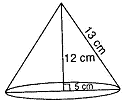
The solid obtained will be a right circular cone whose radius of the base is $5 \ cm$ . and height is $12 \ cm$
$\therefore \mathrm{r}=5 \mathrm{~cm}, \mathrm{~h}=12 \mathrm{~cm}$
$\therefore \text { Volume }=\frac{1}{3} \pi r^2 h$
$\frac{1}{3} \times \pi \times(5)^2 \times 12 \mathrm{~cm}^3$
$=100 \pi \mathrm{~cm}^3$
The volume of the solid so obtained is $100 \pi \mathrm{~cm}^3$ View full question & answer→Question 62 Marks
A conical pit of top diameter $3.5 \ cm$ is $12 \ m$ deep. What is its capacity in kilolitres?
Answer$\text { For conical pit : Diameter }=3.5 \mathrm{~cm}$
$\therefore \text { Radius }(\mathrm{r})=\frac{3.5}{2} \mathrm{~m}=1.75 \mathrm{~m}$
$\text { Depth }(\mathrm{h})=12 \mathrm{~m}$
$\therefore \text { Capacity of the conical pit }=\frac{1}{3} \pi r^2 h$
$\frac{1}{3} \times \frac{22}{7} \times(1.75)^2 \times 12 \mathrm{~m}^3$
$=38.5 \mathrm{~m}^3=38.5 \times 1000 \mathrm{l}$
$=38.5 \mathrm{kl}$.
View full question & answer→Question 72 Marks
If the volume of a right circular cone of height 9 cm is 48$\pi {~cm}^3$, find the diameter of its base.
AnswerLet the radius of the base of the right circular cone be $r cm.$
$h = 9 cm$, volume$ = 48 \pi {~cm}^3 $
$\Rightarrow {1\over3}\pi r^2h = 48 \pi $
$\Rightarrow {1\over3}r^2h=48 $
$\Rightarrow {1\over3}\times r^2\times9=48 $
$\Rightarrow r^2 = {48\times3}\over9 $
$\Rightarrow r^2 = 16 $
$\Rightarrow r = \sqrt{16} = 4 cm$
$\Rightarrow 2r = 2(4) = 8 cm. $
$\therefore $ the diameter of the base of the right circular cone is $8 \ cm.$
View full question & answer→Question 82 Marks
The height of a cone is $15 \ cm$. If its volume is $1570 cm^3$. Find the radius of the base.
AnswerLet the radius of the base of the cone be $r cm.$
$h = 15 cm$, Volume $= 1570 cm^3 $
$\Rightarrow {1\over3}\pi r^2h = 1570$
$\Rightarrow \frac{1}{3} \times 3.14 \times r^2 \times 15=1570 $
$\Rightarrow r^2={{1570\times3}\over3.14\times15} $
$ \Rightarrow r^2=100 $
$\Rightarrow r=\sqrt{100} $
$ \Rightarrow r = 10 cm.$
$\therefore $ the radius of the base of the cone is $10 cm.$
View full question & answer→Question 92 Marks
Find the capacity in litres of a conical vessel with height $12 \ cm$, slant height $13 \ cm.$
Answer$12 \mathrm{~cm}, \mathrm{l}=13 \mathrm{~cm}$
$\mathrm{r}^2+\mathrm{h}^2=\mathrm{l}^2$
$\Rightarrow \mathrm{r}^2+(12)^2=(13)^2$
$\Rightarrow \mathrm{r}^2+144=169$
$\Rightarrow \mathrm{r}^2=169-144$
$\Rightarrow \mathrm{r}^2=25$
$\Rightarrow \mathrm{r}=\sqrt{25}$$\Rightarrow \mathrm{r}=5 \mathrm{~cm}$
$\therefore \text { Capacity }=\frac{1}{3} \pi r^2 h$
$=\frac{1}{3} \times \frac{22}{7} \times(5)^2 \times 12$
$=\frac{2200}{7} \mathrm{~cm}^3=\frac{2200}{7000} l$
$=\frac{11}{35} l$
View full question & answer→Question 102 Marks
Find the capacity in litres of a conical vessel with radius $7 \ cm$, slant height $25 \ cm.$
Answer$\mathrm{r}=7 \mathrm{~cm}, \mathrm{l}=25 \mathrm{~cm} .$
$\mathrm{r}^2+\mathrm{h}^2=\mathrm{l}^2$
$\Rightarrow(7)^2+\mathrm{h}^2=(25)^2$
$\Rightarrow \mathrm{~h}^2=(25)^2-(7)^2$
$\Rightarrow \mathrm{~h}^2=625-49$
$\Rightarrow \mathrm{~h}^2=576$
$\Rightarrow \mathrm{~h}=\sqrt{576}$
$\Rightarrow \mathrm{~h}=24 \mathrm{~cm}$
$\therefore \text { Capacity }=\frac{1}{3} \pi r^2 h$
$=\frac{1}{3} \times \frac{22}{7} \times(7)^2 \times 24$
$=1232 \mathrm{~cm}^3=1.232 \mathrm{~l}$
View full question & answer→Question 112 Marks
A right circular cylinder just encloses a sphere of radius $r$. Find

$i.$ surface area of the sphere.
$ii.$ curved surface of the cylinder.
$iii.$ ratio of the area obtained in $(i)$ and $(ii).$ Answer$i.$ Surface area of the sphere =$4\pi r^2$
$ii.$ For cylinder
Radius of the base $= r$
Height $= 2r$
$\therefore$ Curved surface area of the cylinder $= 2\pi rh=2\pi (r)(2r)=4\pi r^2$
$iii.$ Ratio of the areas obtained in $(i)$ and $(ii)$
$={{surface\ area\ of\ the\ sphere}\over{curved\ surface\ area\ of\ the\ cylinder}}$
$={{4\pi r^2}\over{4\pi r^2}}={1\over1}=1:1$
View full question & answer→Question 122 Marks
Find the radius of sphere whose surface area is $154 \mathrm{~cm}^2$.
AnswerLet the radius of the sphere be rcm .
Surface area $=154 \mathrm{~cm}^2$
$\Rightarrow 4 \pi r^2=154$
$\Rightarrow 4 \times \frac{22}{7} \times r^2=154$
$\Rightarrow r^2=\frac{154 \times 7}{4 \times 22}=\frac{49}{4}$
$\Rightarrow r=\sqrt{\frac{49}{4}}=\frac{7}{2}$
$\Rightarrow \mathrm{r}=3.5 \mathrm{~cm}$
$\therefore$ the radius of the sphere is $3.5 \ cm .$
View full question & answer→Question 132 Marks
A hemispherical bowl made of brass has inner diameter $10.5 \ cm$. Find the cost of tin-plating it on the inside at the rate of $₹16$ per $100\text{cm}^{2}$.
AnswerInner diameter of bowl $= 10.5 cm$
$\therefore $ Inner radius of bowl $\left( r \right)=\frac{10.5}{2} = 5.25 cm$
Now, Inner surface area of bowl = $2\pi {{r}^{2}}$
$=2\times \frac{22}{7}\times 5.25\times 5.25$
$=2\times \frac{22}{7}\times \frac{21}{4}\times \frac{21}{4}$
=$\frac{693}{4}c{{m}^{2}}$
$\because $ Cost of tin-plating per$ 100\text{ }c{{m}^{2}} = ₹ 16$
$\therefore $ Cost of tin-plating per$ 1\text{ }c{{m}^{2}}=\frac{16}{100}$
$\therefore $ Cost of tin-plating per $\frac{693}{4}c{{m}^{2}}=\frac{16}{100}\times \frac{693}{4} = ₹27.72$
View full question & answer→Question 142 Marks
The radius of a spherical balloon increases from $7 \ cm$ to $14 \ cm$ as air is being pumped into it. Find the ratio of surface areas of the balloon in the two cases.
AnswerCase I: $r=7 \mathrm{~cm}$
Surface area $=4 \pi r^2$
$=4 \times \frac{22}{7} \times(7)^2=616 \mathrm{~cm}^2$
Case II : $\mathrm{r}=14 \mathrm{~cm}$
Surface area $=4 \pi r^2$
$=4 \times \frac{22}{7} \times(14)^2=2464 \mathrm{~cm}^2$
$\therefore$ Ratio of surface area of the balloon $=616: 2464$
$=1: 4$
View full question & answer→Question 152 Marks
The slant height and base diameter of a conical tomb are $25 \ m$ and $14 \ m$ respectively. Find the cost of white washing its curved surface at the rate of $₹ 210$ per $100 \mathrm{~m}^2$.
AnswerSlant height $(l)=25 \mathrm{~m}$
Base diameter $(\mathrm{d})=14 \mathrm{~m}$
$\therefore$ Base radius $(\mathrm{r})=\frac{14}{2} \mathrm{~m}=7 \mathrm{~m}$
$\therefore$ Curved surface area of the tomb $=\pi r l$
$=\frac{22}{7} \times 7 \times 25=550 \mathrm{~m}^2$
$\therefore$ Cost of white-washing the curved surface of the tomb at the rate of Rs. $210$ per $100 \mathrm{~m}^2$
$=\frac{210}{100} \times 550=\text { Rs. } 1155$
View full question & answer→Question 162 Marks
Find the total surface area of a cone, if its slant height is $21 \ m$ and diameter of its base is $24 \ m.$
AnswerSlant height $(l) = 21 m$
Diameter of base $= 24 m$
$\therefore$ Radius of base $(r) = 24\over2m = 12 m$
$\therefore $ Total curved surface area of the cone =$\pi r(l+r)$
= $22\over7\times 12 \times (21 + 12)$
=${22\over7}\times12\times33={8712\over7}$
=$1244{4\over7}\ m^2$
View full question & answer→Question 172 Marks
The hollow sphere, in which the circus motorcyclist performs his stunts, has a diameter of $7 \ m$. Find the area available to the motorcyclist for riding.
AnswerWe are given,
The diameter of the sphere $= 7 m$
Therefore, the radius is $3.5 m$
So, the riding space available for the motorcyclist is the surface area of the ‘sphere’ which is given by
$4\pi r^2 = 4 \times \frac {22}7 \times 3.5 \times 3.5 m^2$
= $154 m^2$
View full question & answer→Question 182 Marks
The height of a cone is $16 \ cm$ and its base radius is $12 \ cm$. Find the curved surface area and the total surface area of the cone (Use $\pi = 3.14).$
AnswerWe are given that,
Here, $\mathrm{h}=16 \mathrm{~cm}$ and $\mathrm{r}=12 \mathrm{~cm}$.
So, from $l^2=h^2+r^2$, we have
$l=\sqrt{16^2+12^2} \mathrm{~cm}=20 \mathrm{~cm}$
So, curved surface area $=\pi r l$
$=3.14 \times 12 \times 20 \mathrm{~cm}^2=753.6 \mathrm{~cm}^2$
Further, total surface area $=\pi r l+\pi r^2$
$=(753.6+3.14 \times 12 \times 12) \mathrm{cm}^2$
$=(753.6+452.16) \mathrm{cm}^2$
$=1205.76 \mathrm{~cm}^2$
View full question & answer→Question 192 Marks
Hameed has built a cubical water tank with lid for his house, with each other edge $1.5 \ m$ long. He gets the outer surface of the tank excluding the base, covered with square tiles of side $25 \ cm$. Find how much he would spend for the tiles if the cost of tiles is $₹ 360$ per dozen.

AnswerSince Hameed is getting the five outer faces of the tank covered with tiles, he would need to know the surface area of the tank, to decide on the number of tiles required.
Edge of the cubic tank, $a=1.5 m=150 cm$
So, surface area of the tank $=5 \times 150 \times 150 cm^2$.
Area of each square title $=\frac{\text { surface area of the tank }}{\text { area of each title }}=\frac{5 \times 150 \times 150}{25 \times 25}=180$
Cost of 1 dozen tiles, i.e., cost of $12$ tiles $= Rs. 360$
Therefore, cost of one tile $=$ Rs $\frac{360}{12}= Rs. 30$
So the cost of 180 tiles $=180 \times$ Rs. $30= Rs. 5400$
View full question & answer→Question 202 Marks
A shot-put is a metallic sphere of radius $4.9 \ cm$ . If the density of the metal is $7.8 g$ per $\mathrm{cm}^3$, find the mass of the shot-put.
AnswerSince the shot-putt is a solid sphere made of metal and its mass is equal to the product of its volume and density, we need to find the volume of the sphere.
Now, volume of the sphere is given by $=\frac{4}{3} \pi r^3$
$=\frac{4}{3} \times \frac{22}{7} \times 4.9 \times 4.9 \times 4.9 \mathrm{~cm}^3$
$=493 \mathrm{~cm}^3 \text { (nearly) }$
Further, mass of $1 \mathrm{~cm}^3$ of metal is$ 7.8 g .$
Therefore, mass of the shot-putt will be $=7.8 \times 493 \mathrm{~g}$ $=3845.44 \mathrm{~g}=3.85 \mathrm{~kg}$ (nearly)
View full question & answer→Question 212 Marks
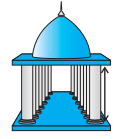
The pillars of a temple are cylindrically shaped if each pillar has a circular base of radius $20\ cm$ and height $10 \ m$. How much concrete mixture would be required to build $14$ such pillars?
AnswerRadius of base of cylinder $= 20\ cm$
Height of pillar $= 10\ m = 1000\ cm$
Volume of each cylinder = $\pi {{r}^{2}}h$
$=\frac{22}{7}\times 20\times 20\times 1000\text{ }c{{m}^{3}}$
$=\frac{8800000}{7}\text{ }c{{m}^{3}}$
$=\frac{8.8}{7}{{m}^{3}}\left[ \therefore 1000000c{{m}^{3}}=1{{m}^{3}} \right]$
$\therefore$ Volume of $14$ pillars = volume of each cylinder $\times$ 14
$=\frac{8.8}{7}\times 14c{{m}^{3}}=17.6{{m}^{3}}$
So 14 pillars would need $17.6{{m}^{3}}$ of concrete mixture
View full question & answer→