MCQ 511 Mark
The curved surface area of a right circular cylinder of radius $1\ cm$ and height $1\ cm$ is:
- A
$3\pi\text{cm}^2$
- B
$\pi\text{cm}^2$
- ✓
$2\pi\text{cm}^2$
- D
$4\pi\text{cm}^2$
AnswerCorrect option: C. $2\pi\text{cm}^2$
The curved surface area of cylinder $=2\pi\text{rh}$
$=2\pi\times1\times1$
$=2\pi\text{cm}^2$
View full question & answer→MCQ 521 Mark
In a cylindrical drum of radius $4.2m$ and height $3.5m,$ the number of full bags of wheat can be emptied if the space required for wheat in each bag is $2.1$ cu m, is:
Answer Let the number of bags be $n$
Volume of drum $= n($volume of each bag$)$
$\pi\text{R}^2\text{h}=\text{n}(2.1)$
$\pi\text{R}^2\text{h}=\text{n}(2.1)$
$\frac{22}{7}\times(4.2)^2\times35=\text{n}(2.1)$
$\text{n}=\frac{\frac{22}{7}\times(4.2)^2\times35}{2.1}$
$=92$
View full question & answer→MCQ 531 Mark
Directions: In the following questions, the Assertions $(A)$ and Reason(s) $(R) $have been put forward. Read both the statements carefully and choose the correct alternative from the following:
Assertion: A cylinder and right circular cone are having the same base and same height the volume of cylinder is three times the volume of cone.
Reason: If the radius of cylinder is doubled and height is halved the volume will be doubled.
- A
Both Assertion and reason are correct and reason is correct explanation for Assertion.
- ✓
Both Assertion and reason are correct but reason is not correct explanation for Assertion.
- C
Assertion is correct but reason is false.
- D
Both Assertions and reason are false.
AnswerCorrect option: B. Both Assertion and reason are correct but reason is not correct explanation for Assertion.
Both Assertion and reason are correct but reason is not correct explanation for Assertion.
View full question & answer→MCQ 541 Mark
Write the correct answer in the following: The lateral surface area of a cube is $256m^2$. The volume of the cube is:
- ✓
$512\ m^3$
- B
$64\ m^3$
- C
$216\ m^3$
- D
$256\ m^3$
AnswerCorrect option: A. $512\ m^3$
Given, lateral surface area of a cube $= 256m^2$
We know that, lateral surface area of a cube $= 4 × ($Side$)^2$
$\Rightarrow256=4\times(\text{Side})^2$
$\Rightarrow(\text{Side})^2=\frac{256}{4}=64$
$\Rightarrow\text{Side}=\sqrt{64}=8\text{m}$
$[$taking positive square root because side is always a positive quantity$]$
Now, volume of a cube $= ($Side$)^3= (8)^3= 8 × 8 × 8 = 512m^3$
Hence, the volume of the cube is $512m^3.$
View full question & answer→MCQ 551 Mark
The maximum volume of a cone that can be carved out of a solid hemisphere of radius $‘r’$ is:
- ✓
$\frac{1}{3}\pi\text{r}^3$
- B
$\frac{1}{3}\pi\text{r}^2\text{h}$
- C
$\pi\text{r}^3$
- D
$\frac{2}{3}\pi\text{r}^3$
AnswerCorrect option: A. $\frac{1}{3}\pi\text{r}^3$
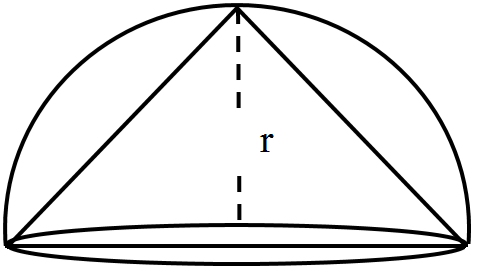
Volume of cone $=\frac{1}{3}\pi\text{r}^2\text{h}$
Here height of the carved out cone $=$ Radius of the hemisphere
$\therefore$ Volume of cone $\frac{1}{3}\pi\text{r}^3\times\text{r}=\frac{1}{3}\pi\text{r}^3$
View full question & answer→MCQ 561 Mark
A right circular cylinder and a right circular cone have the same radius and the same volume. The ratio of the height of the cylinder to that of the cone is:
- A
$3 : 5$
- B
$3 : 1$
- ✓
$1 : 3$
- D
$2 : 5$
AnswerCorrect option: C. $1 : 3$
Let $r$ be the radius of cylinder and cone and volumes are equal and $h_1$ and $h_2$ be their have $h_2$ is respectively
$\therefore$ Volume of cylinder $=\pi\text{rh}_1$
and volume of cone $=\frac{1}{3\pi\text{r}^2\text{h}_2}$
$\therefore\pi\text{r}^2\text{h}_1=\frac{1}{3\pi\text{r}^2\text{h}_2}$
$\Rightarrow\text{h}_1=\frac{1}{3\text{h}_2}$
$\Rightarrow\frac{\text{h}_1}{\text{h}_2}=\frac{1}{3}$
$\therefore\text{h}_1:\text{h}_2=1:3$
View full question & answer→MCQ 571 Mark
The surface area of a sphere of radius $3.5\ cm$ is:
- ✓
$154\ cm^2$
- B
$164\ cm^2$
- C
$120\ cm^2$
- D
$77\ cm^2$
AnswerCorrect option: A. $154\ cm^2$
Given $r = 3.5\ cm$
Surface area of sphere $=4\pi\text{r}^2$
$=4\times\frac{22}{7}\times3.5\times3.5$
$=154\text{cm}^2$
View full question & answer→MCQ 581 Mark
The volume of a sphere of radius $10.5\ cm$ is:
- A
$9702\ cm^3$
- ✓
$4851\ cm^3$
- C
$19404\ cm^3$
- D
$14553\ cm^3$
AnswerCorrect option: B. $4851\ cm^3$
Given radius $=10.5=\frac{21}{2}\text{cm}$
Volume of sphere $=\frac{4}{3}\pi\text{r}^3$
$=\frac{4}{3}\times\frac{22}{7}\times\frac{21}{2}\times\frac{21}{2}\times\frac{21}{2}$
$=11\times21\times21$
$=4851\text{cm}^3$
View full question & answer→MCQ 591 Mark
If the height and radius of a cone of volume $V$ are doubled, then the volume of the cone, is:
AnswerThe formula of the volume of a cone with base radius $'r'$ and vertical height $'h'$ is given as
Volume of cone $=\frac{1}{3}\pi\text{r}^2\text{h}=\text{V}$
Since it is given that the radius and height are doubled we have the radius as $'2r'$ and the vertical height as $'2h'$
Volume of modified cone $=\frac{1}{3}\pi(\text{2r})^2(2\text{h})$
$=\frac{8}{3}\pi\text{r}^2\text{h}$
$=8\text{V}$
View full question & answer→MCQ 601 Mark
A solid lead ball of radius $6\ cm$ is melted and then drawn into a wire of diameter $0.2\ cm.$ The length of wire is.
- A
$272m$
- ✓
$288m$
- C
$292m$
- D
$296m$
AnswerCorrect option: B. $288m$
Volume of a sphere $=\frac{4}{3}\pi\text{r}^3=\frac{4}{3}\pi(6)^3=288\pi\text{cm}^3$
On recasting a sphere into cylinder, the volume will remain same.
Volume of a cylinder $=\pi\text{r}^2\text{h}$
Radius $= 0.1\ cm$
$\Rightarrow\pi(0.1)^2\text{h}=288\pi$
$\Rightarrow\text{h}=\frac{288\times1}{0.01}$
$= 28800cm$
$= 288m (\therefore 1m = 100m)$
$h = 288m$
View full question & answer→MCQ 611 Mark
The length, breadth and height of a cuboid are $15\ cm, 12\ cm$ and $4.5\ cm$ respectively. Its volume is:
- A
$405\ cm^3$
- ✓
$810\ cm^3$
- C
$603\ cm^3$
- D
$243\ cm^3$
AnswerCorrect option: B. $810\ cm^3$
Volume of a cuboid $=$ length $×$ breadth $×$ height
$= 15 × 12 × 4.5$
$= 810\ cm^3$
View full question & answer→MCQ 621 Mark
How many planks of dimensions $(5m × 25m × 10\ cm)$ can be stored in a pit which is $20m$ long, $6m$ wide and $50\ cm$ deep$?$
AnswerNumber of planks $=\frac{\text{Volume}\ \text{of}\ \text{the}\ \text{pit}}{\text{Volume}\ \text{of}\ 1\ \text{plank}}$
$=\frac{(20\times100)\times(6\times100)\times50}{(5\times100)\times25\times10}$ $...(1\text{m}=100\text{cm})$
$=\text{480}$
View full question & answer→MCQ 631 Mark
The $\text{TSA}$ of a solid cylinder whose radius is half of its height $h$ is equal to:
- A
$\frac{2}{3}\pi\text{h}\text{ sq.}$units
- B
$\frac{2}{3}\pi\text{h}^2\text{ sq.}$units
- C
$\frac{3}{2}\pi\text{h}\text{ sq.}$units
- ✓
$\frac{3}{2}\pi\text{h}^2\text{ sq.}$units
AnswerCorrect option: D. $\frac{3}{2}\pi\text{h}^2\text{ sq.}$units
Here $\text{r}=\frac{\text{h}}{2}$
$\therefore \text{TSA}$ of a soild cylinder $=2\pi\text{r}(\text{r}+\text{h})$
$=2\pi\times\frac{\text{h}}{2}\Big(\frac{\text{h}}{2}+\text{h}\Big)$
$=\pi\text{h}\Big(\frac{\text{3h}}{2}\Big)$
$=\frac{3}{2}\pi\text{h}^2\text{ sq.}$units
View full question & answer→MCQ 641 Mark
If each of cube, of volume $V$, is doubled, then the volume of the new cube is:
AnswerLet, $a \rightarrow$ Initial edge of the cube
So, $V=a^3$
In the new cube, let,
$a^{\prime} \rightarrow$ Edge of new cube
Volume of the new cube,
$V^{\prime}=\left(a^{\prime}\right)^3$
$=(2 a)^3\{$Since, $a^{\prime}=2 a\}$
$=8 a^3$
$=8 V$ Since, $a^3=V$
Volume of the new cube is $8 V $.
Hence, the correct choice is $(d).$
View full question & answer→MCQ 651 Mark
A conical tent is $10m$ high and the radius of its base is $24m$ then slant height of the tent is:
AnswerSlant height of cone $=\sqrt{(\text{r}^2+\text{h}^2)}($given $r = 24m\ h = 10m)$
$=\sqrt{(24)^2+(10)^2}$
$=\sqrt{576+100}$
$=\sqrt{676}=26\text{m}$
View full question & answer→MCQ 661 Mark
The radii of two cylinders are in the ratio $2 : 3$ and their heights are in the ratio $5 : 3.$ The ratio of their volumes is:
- ✓
$20 : 27$
- B
$125 : 27$
- C
$10 : 9$
- D
$8 : 27$
AnswerCorrect option: A. $20 : 27$
Let $r_1, r_2$ be the radii of two cylinders and $h_1, h_2$ be the height of two cylinder respectively.
Then $\frac{\text{r}_1}{\text{r}_2}=\frac{2}{3}$ and $\frac{\text{h}_1}{\text{h}_2}=\frac{5}{3}$
$\therefore$ Required ratio $=\frac{\pi\text{r}^2_1\text{h}_1}{\pi\text{r}^2_2\text{h}_2}$
$=\Big(\frac{\text{r}_1}{\text{r}_2}\Big)^2\Big(\frac{\text{h}_1}{\text{h}_2}\Big)$
$=\big(\frac{2}{3}\big)^2\big(\frac{5}{3}\big)$
$=\frac{20}{27}=20:27$
View full question & answer→MCQ 671 Mark
The ratio between the radius of the base and the height of a cylinder is $2 : 3.$ If its volume is $1617\ cm^3$, then its total surface area is:
- A
$308\ cm^2$
- B
$462\ cm^2$
- C
$540\ cm^2$
- ✓
$770\ cm^2$
AnswerCorrect option: D. $770\ cm^2$
Let the radius be $2x$ and the height be $3x\ cm.$
We know that,
Volume of the cylinder $=\pi\text{r}^2\text{h}$
$=\pi\times(2\text{x})^2\times3\text{x}$
$=\frac{22}{7}\times12\times\text{x}^3$
$\Rightarrow1617=\frac{22}{7}\times12\text{x}^3$
$\Rightarrow\text{x}^3=\frac{7\times1617}{22\times12}$
$\Rightarrow\text{x}^3=\frac{7\times49}{2\times4}$
$\Rightarrow\text{x}^3=\frac{343}{8}$
$\Rightarrow\text{x}^3=\Big(\frac{7}{2}\Big)^3$
$\Rightarrow\text{x}=\frac{7}{2}$
$\therefore$ radius $=2\times\frac{7}{2}=7\text{cm}$
Height $=3\times\frac{7}{2}=\frac{21}{2}\text{cm}$
$\therefore$ total surface area $=2\pi\text{r}(\text{h}+\text{r})$
$=2\times\frac{22}{7}\times7\Big(\frac{21}{2}+7\Big)$
$=44\Big(\frac{21}{2}+7\Big)$
$=44\Big(\frac{35}{2}\Big)$
$=770\text{cm}^2$
View full question & answer→MCQ 681 Mark
If the radius of a cylinder is doubled and the height remains same, the volume will be:
AnswerVolume of a cylinder $=\text{V}=\pi\text{r}^2\text{h}$
If $\text{r}\ '=2\text{r} $ and $\text{h}\ '=\text{h} $ then
$\text{V}\ '=\pi(2\text{r})^2\text{h}=4\pi\text{r}^2\text{h}$
$\text{V}\ '=4\text{V}$
View full question & answer→MCQ 691 Mark
If the length of diagonal of a cube is $8\sqrt3\text{cm}$ then its surface area is:
- A
$192\ cm^2$
- ✓
$384\ cm^2$
- C
$512\ cm^2$
- D
$768\ cm^2$
AnswerCorrect option: B. $384\ cm^2$
We know that,
Length of the longest diagonal $=\sqrt{3}\text{a}$
$\Rightarrow8\sqrt3=\sqrt{3}\text{a}$
$\Rightarrow\text{a}=8$
Now,
Total surface area $=6 \mathrm{a}^2$
$=6 \times(8)^2$
$=6 \times 64$
$=384 \mathrm{~cm}^2$
View full question & answer→MCQ 701 Mark
A metallic sphere of radius $10.5\ cm$ is melted and then recast into small cones, each of radius $3.5\ cm$ and height $3\ cm.$ The number of such cones will be:
AnswerLet the number of cones be $n.$
Volume of the metallic sphere $= n\ ×$ volume of each cone
$\Rightarrow\frac{4}{3}\pi(10.5)^3=\text{n}\times(3.5)^2(3)$
$\Rightarrow4(10.5)^3=\text{n}(3.5)^2(3)$
$\Rightarrow\text{n}=126$
Thus, the number of such cones is $126.$
View full question & answer→MCQ 711 Mark
If a solid sphere of radius $r$ is melted and cast into the shape of a solid cone of height $r,$ then the radius of the base of the cone is:
AnswerVolume of a sphere $=\big(\frac{4}{3}\big)\pi\text{r}^3 $
Volume of a solid cone $=\big(\frac{1}{3}\big)\pi\text{r}^2\text{h}$
Given, solid sphere of radius $r$ is melted and cast into the shape of a solid cone of height $r$
Let the base radius be $A.$
$=\big(\frac{4}{3}\big)\pi\text{r}^3=\big(\frac{1}{3}\big)\pi\times\text{A}^2\times\text{r}$
$\Rightarrow\text{A}=2\text{r}$
View full question & answer→MCQ 721 Mark
If the length of the diadonal of a cube is $8\sqrt{3}\text{cm},$ then its surface area is:
- A
$512\ cm^2$
- ✓
$384\ cm^2$
- C
$192\ cm^2$
- D
$768\ cm^2$
AnswerCorrect option: B. $384\ cm^2$
Let,
$a →$ Side of each cube
Length of the diagonal $=8\sqrt{3}\text{cm}$
$\sqrt{3}\text{a}=8\sqrt{3}$
$a = 8\ cm$
We have to find the surface area of the cube
Surface area of the cube,
= 6a$^2$
$= 6 × 8^2$
$= 384\ cm^2$
Thus, surface area of the cube is $384\ cm^2$.
Hence, the correct choice is $(b).$
View full question & answer→MCQ 731 Mark
How many bricks will be required to construct a wall $8m$ long, $6m$ high and $22.5\ cm$ thick if each brick measures $(25\ cm × 11.25 × 6\ cm)?$
- A
$4800$
- B
$5600$
- ✓
$6400$
- D
$5200$
AnswerCorrect option: C. $6400$
Volume of the wall $=$ length $×$ breadth $×$ height
$= (8 × 100) × (6 × 100) × 22.5 ...(1m = 100\ cm)$
$=800\times600\times\frac{225}{10}$
$=800\times60\times225$
Volume of $1$ brick $=$ length $×$ breadth $×$ height
$=25\times\frac{1125}{100}\times6$
$=\frac{1125}{2}\times3$
Required number of bricks $=\frac{\text{Volume}\ \text{of}\ \text{the}\ \text{wall}}{\text{Volume}\ \text{of}\ 1\ \text{brick}}$
$=\frac{800\times60\times225}{\frac{1125}{2}\times3}$
$=\frac{800\times60\times225\times2}{1125\times3}$
$=6400$
View full question & answer→MCQ 741 Mark
The cost of digging a pit of dimensions $4.5m × 2.5m × 2.5m$ at the rate of $₹ 20$ per cubic metre is:
- A
$₹ 281.25$
- B
$₹ 1687.50$
- C
$₹ 1125$
- ✓
$₹ 562.50$
AnswerCorrect option: D. $₹ 562.50$
Cost of digging would be $= (4.5m × 2.5m × 2.5m) × 20$
$= ₹ 562.50$
View full question & answer→MCQ 751 Mark
The volume of the cuboid whose length, breadth, and height is $12\ cm, 8\ cm$ and $6\ cm$ is:
- A
$570\ cu.cm$
- B
$576\ sq.cm$
- ✓
$576\ cu.cm$
- D
$568\ cu.cm$
AnswerCorrect option: C. $576\ cu.cm$
The volume of cuboid $=$ Length $×$ Breadth $×$ Height
$⇒$ volume $= 12 × 8 × 6 = 576\ cu.cm$
View full question & answer→MCQ 761 Mark
A sphere and a cube are of the same height. The ratio of their volumes is:
- A
$21 : 11$
- B
$4 : 3$
- ✓
$11 : 21$
- D
$3 : 4$
AnswerCorrect option: C. $11 : 21$
Volume of a cube $=$ side$^3$
Volume of a sphere $=\big(\frac{4}{3}\big)\pi\text{r}3$
Given, sphere and a cube are of the same height.
Side $=$ diameter $= 2r$
Ratio of their volumes $=\frac{\frac{4}{3}\times\frac{22}{7}\times\text{r}^2}{(2\text{r})^3}=11:21$
View full question & answer→MCQ 771 Mark
The ratio of the volumes of a right circular cylinder and a right circular cone of the same base and the same height will be:
- A
$1 : 3$
- ✓
$3 : 1$
- C
$4 : 3$
- D
$3 : 4$
AnswerCorrect option: B. $3 : 1$
Th ratio of the volume of a right circular cylinder and a right circular cone is given by
$\frac{\pi\text{r}^2\text{h}}{\frac{1}{3}\pi\text{r}^2\text{h}}=\frac{1}{\frac{1}{3}} ...($Same base and same height$)$
$=\frac{3}{1}$
$⇒$ Ratio of the volumes is $3 : 1.$
View full question & answer→MCQ 781 Mark
If the height of a cylinder is doubled, by what number must the radius of the base be multiplied so that the resulting cylinder has the same volume as the original cylinder?
- A
$2$
- B
$4$
- C
$\frac{3}{\sqrt{2}}$
- ✓
$\frac{1}{\sqrt{2}}$
AnswerCorrect option: D. $\frac{1}{\sqrt{2}}$
Now, let $V _2$ be the volume after changing the dimension, then
$r_2=x r_1, h_2=2 h_1$
So,
$V _2=\pi r _2^2 h_2=\pi \times\left( xr _1\right)^2 \times 2 h_1$
$\Rightarrow V _2=2 \times \pi x ^2 r _1^2 h_1$
It is given that $V_1=V_2$
Therefore $V _1= V _2$
$\Rightarrow \pi r ^2 h_1=2 \pi x ^2 r _1^2 h_1$
$\Rightarrow x ^2=\frac{1}{2} r _1^2$
$\Rightarrow x =\frac{1}{\sqrt{2}} r _1$
View full question & answer→MCQ 791 Mark
The volume of a cone is $1570\ cm^3$ and its height is $15\ cm.$ What is the radius of the cone$? ($Use $\pi=3.14.)$
- A
$8.5\ cm$
- B
$12\ cm$
- ✓
$10\ cm$
- D
$9\ cm$
AnswerCorrect option: C. $10\ cm$
Let $r\ cm$ be the radius of the cone.
Volume $= 1570\ cm^3$
Then $\frac{1}{3}\times3.14\times1^2\times15=1570$
$\Rightarrow\text{r}^2=\frac{1570}{3.14\times5}=100$
$\Rightarrow\text{r}=10\text{cm}$
View full question & answer→MCQ 801 Mark
The length, width and height of a rectangular solid are in the ratio of $3 : 2 : 1.$ If the volume of the box is $48\ cm^3$, the total surface area of the box is:
- A
$27\ cm^2$
- B
$32\ cm^3$
- ✓
$44\ cm^3$
- D
$88\ cm^3$
AnswerCorrect option: C. $44\ cm^3$
Length $(l),$ width $(b)$ and height $(h)$ of the rectangular solid are in the ratio $3 : 2 : 1.$
So, we can take,
$(l) = 3x \ cm$
$(b) = 2x \ cm$
$(h) = x \ cm$
We need to find the total surface area of the box
Volume of the box,
$V = 48\ cm^3$
$lbh = 48$
$(3x)(2x)x = 48$
$6x^3 = 48$
$x^3 = 8$
$x = 2$
Thus,
Surface area of the box,
$= 2(lb + bh + hl)$
$= 2[(3x)(2x) + (2x)x + (x)(3x)]$
$= 2(11x^2)$
$= 22x^2$
$= 22(2)^2$
$= 88\ cm^2$
Thus total surface area of the box is $88\ cm^2.$
Hence, the correct option is $(d).$
View full question & answer→MCQ 811 Mark
The total surface area of a cone of radius $7m$ and slant height $10m$ is:
- A
$561m^2$
- ✓
$374m^2$
- C
$280.5m^2$
- D
$598.4m^2$
AnswerCorrect option: B. $374m^2$
$TSA$ of cone $=\pi\text{r}(\text{l}+\text{r})$
$=\frac{22}{7}\times7(10+7)$
$=22\times17$
$=374\text{m}^2$
View full question & answer→MCQ 821 Mark
A beam $9\ m$ long, $40\ cm$ wide and $20\ cm$ high is made up of iron which weighs $50\ kg$ per cubic meter. The weight of the beam is:
- A
$48\ kg$
- ✓
$36\ kg$
- C
$56\ kg$
- D
$27\ kg$
AnswerCorrect option: B. $36\ kg$
The beam has a shape of a cuboid.
Volume of a cuboid of length $l,$ breadth $b$ and height $h = l × b × h$
So, the volume of the beam $= 9 × 0.4 × 0.2 = 0.72m^3$
Hence, the weight of the beam if the iron weighs $50\ kg$ per $m^3 = 0.72 × 50 = 36kg$
View full question & answer→MCQ 831 Mark
If the radius of the base of a right circular cone is $3r$ and its height is equal to the radius of the base, then its volume is:
AnswerCorrect option: B. $9\pi\text{r}^3$
The formula of the volume of a cone with base radius $'r'$ and vertical height $'h'$ is given as
Volume of cone $=\frac{1}{3\pi\text{r}^2\text{h}}$
Here it is given that the base radius is $'3r'$ and that the vertical height is $'3r'$
Substituting these values in the above equation we get
Volume of cone $=\frac{1}{3\pi}(3\text{r})^2(3\text{r})$
$=9\pi\text{r}^3$
View full question & answer→MCQ 841 Mark
A hemispherical bowl is made of steel, $0.25\ cm$ thick. If the inner radius of the bowl is $3.25\ cm,$ then the outer curved surface area of the bowl is:
- A
$38.5\ cm^2$
- B
$115.5\ cm^2$
- C
$154\ cm^2$
- ✓
$77\ cm^2$
AnswerCorrect option: D. $77\ cm^2$
Here, outer curved surface area is asked, so, thickness would be added to radius.
Thus, $r = 3.25 + 0.25 = 3.5\ cm$
Surface area of bowl $=2\pi\text{r}^2=2\times\frac{22}{7}\times(3.5)^2$
$=\frac{2\times22\times3.5\times3.5}{7}$
$=77\text{cm}^2$
View full question & answer→MCQ 851 Mark
The circumference of the base of a right circular cylinder is $44\ cm$. If its whole surface area is $968\ cm^2$ then the sum of its height and radius is:
- A
$18\ cm$
- ✓
$22\ cm$
- C
$20\ cm$
- D
$16\ cm$
AnswerCorrect option: B. $22\ cm$
The circumference of the base of a right circular cylinder $= 44\ cm$
$2\pi\text{r}=44\text{r}=\frac{44\times7}{(22\times2)}$
$\text{r}=7\text{cm}$
View full question & answer→MCQ 861 Mark
The volume of a cylinder whose circumference of the base is $132\ cm$ and height $25\ cm$ is:
- A
$19800\ cm^3$
- ✓
$34650\ cm^3$
- C
$3300\ cm^3$
- D
$9900\ cm^3$
AnswerCorrect option: B. $34650\ cm^3$
Given,
$2\pi\text{r}=132,\text{r}=\frac{132}{2\pi}$
Volume of cylinder $=\pi\text{r}^2\text{h}$
$=\pi\big(\frac{132}{2\pi\text{r}}\big)^2\times25$
$=\frac{66\times66\times7}{22}\times25$
$=34650\text{cm}^2$
View full question & answer→MCQ 871 Mark
The radii of the bases of a cylinder and a cone are in the ratio $3 : 4$ and their heights are in the ratio $2 : 3.$ Then, their volumes are in the ratio:
- ✓
$9 : 8$
- B
$8 : 9$
- C
$3 : 4$
- D
$4 : 3$
AnswerCorrect option: A. $9 : 8$
Let the radii of the bases of a cylinder and a cone be $3x\ cm$ and $4x\ cm$ respectively and let their heights be $2y\ cm$ and $3y\ cm$ respectively.
$⇒$ Ratio of the volumes $=\frac{\pi(3\text{x})^2\times2\text{y}}{\frac{1}{3}\pi(4\text{x})^2\times3\text{y}}$
$=\frac{9\times2}{16}$
$=\frac{9}{8}$
$⇒$ Ratio of the volume is $9 : 8.$
View full question & answer→MCQ 881 Mark
The lateral surface area of a cube is $256m^2$. The volume of the cube is:
- A
$64m^3$
- B
$216m^3$
- C
$256m^3$
- ✓
$512m^3$
AnswerCorrect option: D. $512m^3$
We know that,
Lateral surface area of a cube $= 4a^2$
$⇒ 256 = 4a^2$
$\Rightarrow\text{a}^2=\frac{256}{4}$
$⇒ a^2 = 64$
$⇒ a = 8m$
Now,
Volume of the cube $= a^3$
$= 8^3$
$= 512m^3$
View full question & answer→MCQ 891 Mark
Two right circular cones have equal radii. If their slant heights are in the ratio $4 : 3,$ then their respective curved surface areas are in the ratio:
- A
$6 : 8$
- B
$3 : 4$
- ✓
$4 : 3$
- D
$16 : 9$
AnswerCorrect option: C. $4 : 3$
Let $I_1$ and $I_2$ be the slant heights of two cones respectively
Given $\frac{\text{l}_1}{\text{l}_2}=\frac{4}{3}$
Now, required ratio $=\frac{\pi\text{rl}_1}{\pi\text{rl}_2}=\frac{\text{l}_1}{\text{l}_2}=\frac{4}{3}$
$\Rightarrow\text{CSA}_1:\text{CSA}_2=4:3$
View full question & answer→MCQ 901 Mark
The ratio of the radii of two spheres whose volumes are in the ratio $64 : 27$ is:
- ✓
It is $4 : 3.$
- B
It is $8 : 3.$
- C
It is $10 : 7.$
- D
It is $16 : 9.$
AnswerCorrect option: A. It is $4 : 3.$
Volume of sphere $1 :$ volume of sphere $2$
$\frac{4}{3\pi\text{r}_1{^3}}:\frac{4}{3\pi\text{r}_2{^3}}$
$\text{r}_1{^3}:\text{r}_2{^3}=64:27$
$\text{r}_1:\text{r}_2=4:3$
View full question & answer→MCQ 911 Mark
The diameters of two cones are equal. If their slant heights are in the ratio $5 : 4$, the ratio of their curved surface areas, is:
- A
$4 : 5$
- B
$16 : 25$
- C
$25 : 16$
- ✓
$5 : 4$
AnswerCorrect option: D. $5 : 4$
The formula of the curved surface area of a cone with base radius $' r\ '$ and slant height $' l\ '$ is given as Curved Surface Area $=\pi rl$
Now there are two cones with base radius and slant heights as $r _1, l _1 \&\ \ r _2, l _2$ respectively.
The ratio between slant heights of the two cones is given as $5: 4$, we shall use them by introducing a constant $' k\ '$
So, now $I _1=5 k$
$I _2=4 k$
Since the base diameters of both the cones are equal we get that $r_1=r_2=r$
Using these values we shall evaluate the ratio between the curved surface areas of the two cones
$\frac{\text { C.S.A }}{\text { C.S.A }}=\frac{\pi r_1 l_2}{\pi r_2 l_2}$
$=\frac{\pi r(5 k )}{\pi r(4 k )}$
$=\frac{5}{4}$
View full question & answer→MCQ 921 Mark
The ratio of the radii of two spheres whose volumes are in the ratio $64 : 27$ is:
- ✓
$4 : 3$
- B
$10 : 7$
- C
$8 : 3$
- D
$16 : 9$
AnswerCorrect option: A. $4 : 3$
Volume of sphere $1 :$ Volume of sphere $2$
$\frac{4}{3}\pi\text{r}^3_1:\frac{4}{3}\pi\text{r}^3_2$
$\text{r}^3_1:\text{r}^3_2=64:27$
$\text{r}_1:\text{r}_2=4:3$
View full question & answer→MCQ 931 Mark
A solid ball od radius $6\ cm$ is melted and then drawn into a wire of diameter $0.2\ cm$ The length of wire is:
- A
$272m$
- ✓
$288m$
- C
$292m$
- D
$296m$
AnswerCorrect option: B. $288m$
Volume of the solid lead ball $=\frac{4}{3}\pi\times\text{r}^3$
$=\frac{4}{3}\pi\times6^3=288\pi\text{cm}^3$
Let the length of the wire be $h.$
Its radius $=\text{r}_1=\frac{0.2}{2}=0.1\text{cm}$
Volume of the wire $=\pi\text{r}_1^2\text{h},$ where $\text{r}_1$ is the radius of the wire
Since the wire is drawn into a solid lead ball,
Volume of the solid lead ball = volume of the wire
$\Rightarrow288\pi=\pi(0.1)^2\text{h}$
$\Rightarrow\text{h}=28800\text{cm}=288\text{m}$
View full question & answer→MCQ 941 Mark
If the base radius and the height of a right circular cone are increased by $20\%,$ then the percentage increase in volume is approximately:
AnswerLet the radius of the cone $= R$ and height $= H$
Then, volume $=\frac{1}{3}\pi\text{R}^2\text{H}$
Now, $R' = R + 20\%$ of $R =\text{R}+\frac{\text{R}}{5}=\frac{\text{6R}}{5}$
$H' = H + 20\%$ of $H =\text{H}+\frac{\text{H}}{5}=\frac{\text{6H}}{5}$
New volume, $\text{v}'=\frac{1}{3}\pi\text{R}'^2\text{H}'$
$=\frac{1}{3}\pi\Big(\frac{6\text{r}}{5}\Big)^2\Big(\frac{6\text{H}}{5}\Big)$
$=\frac{216}{125}\Big(\frac{1}{3}\pi\text{R}^2\text{H}\Big)$
$=\frac{216}{125}\text{v}$
% increase in volume $=\frac{\text{v}'-\text{v}}{\text{v}}\times100$
$=\frac{\frac{216\text{v}}{125}-\text{v}}{\text{v}}\times100$
$=\frac{91}{125}\times100$
$=72.8\%$
$\approx73\%$
View full question & answer→MCQ 951 Mark
The volumes of two spheres are in the ratio $125 : 64$. The ratio of their surface areas is:
- ✓
$25 : 16$
- B
$9 : 16$
- C
$16 : 25$
- D
$16 : 9$
AnswerCorrect option: A. $25 : 16$
Let $r_1$ and $r_2$ be the radius of the two spheres, respectively. Therefore, the ratio of their surface areas,
$\frac{\frac{4}{3}\pi\text{r}^3_1}{\frac{4}{3}\pi\text{r}^3_2}=\frac{125}{64}$
$\Rightarrow\frac{\text{r}^3_1}{\text{r}^3_2}=\frac{125}{64}$
$\Rightarrow\Big(\frac{\text{r}_1}{\text{r}_2}\Big)^3=\Big(\frac{5}{4}\Big)^3$
$\Rightarrow\frac{\text{r}_1}{\text{r}_2}=\frac{5}{4}$
Now, Ratio of their surface area
$\frac{\frac{4}{3}\pi\text{r}^3_1}{\frac{4}{3}\pi\text{r}^3_2}=\frac{\text{r}_1}{\text{r}_2}=\Big(\frac{\text{r}_1}{\text{r}_2}\Big)^2=\Big(\frac{5}{4}\Big)^3=\frac{25}{16}$
$\therefore SA1 : SA2 = 25 : 16$
View full question & answer→MCQ 961 Mark
The sum of the length, breadth and depth of a cuboid is $19\ cm$ and its diagonal is $5\sqrt{5}$. Its surface area is.
- A
$125\ cm^2$
- B
$361\ cm^2$
- ✓
$236\ cm^2$
- D
$486\ cm^2$
AnswerCorrect option: C. $236\ cm^2$
Given,
$l + b + h = 19$
Squaring we get
$l^2+b^2+h^2+2\{l b+b h+h l\}=361 \ldots (i)$
Also we know that
$l^2+b^2+h^2=d^2~125 (\text{since d}=5\sqrt{5})$
And Total Surface Area $= 2(lb + bh + hl)$
Using in $(i)$ we get $T.S.A = 361 - 125 = 236\ cm^2$
View full question & answer→MCQ 971 Mark
If the areas of the adjacent faces of a rectangular block are in the ratio $2 : 3 : 4$ and its volume is $9000\ cm^3$, then the length of the shortest edge is:
- A
$30\ cm$
- B
$10\ cm$
- C
$20\ cm$
- ✓
$15\ cm$
AnswerCorrect option: D. $15\ cm$
Let $lb = 2x, bh = 3x, hl = 4x,$ and $lbh = 9000$
multiply all we get
$(lbh)^2 = 24x^3$
$81000000 = 24x^3$
$X = 150.$
Substituting above we get
$b= 15, l = 20$ and $h = 30$
Smallest $= 15$
View full question & answer→MCQ 981 Mark
The curved surface of cylinder is $484\ cm^2$ and height is $5.5\ cm.$ Its radius is.
- A
$7\ cm$
- ✓
$14\ cm$
- C
$21\ cm$
- D
$13\ cm$
AnswerCorrect option: B. $14\ cm$
$CSA$ of cylinder $=2\pi\text{rh}$
$484=2\times\frac{22}{7}\times\text{r}\times5.5$
$ \text{r}=\frac{484\times7}{22\times5.5}$
$\text{r}=14\text{cm}$
View full question & answer→MCQ 991 Mark
A solid metallic cylinder of base radius $3\ cm$ and height $5\ cm$ is melted to make n solid cones of height $1\ cm$ and base radius $1\ mm.$ The value of $n$ is:
- A
$450$
- B
$1350$
- C
$4500$
- ✓
$13500$
AnswerCorrect option: D. $13500$
$n =$ number of cones $=\frac{\text{Volume}\ \text{of}\ \text{the}\ \text{cylinder}}{\text{Volume}\ \text{of}\ \text{one}\ \text{cone}}$
$=\frac{\pi(3)^2\times5}{\frac{1}{3}\pi\Big(\frac{1}{10}\Big)^2\times1}$
$=\frac{9\times5}{\frac{1}{3}\times\frac{1}{100}}$
$=\frac{45}{\frac{1}{300}}$
$=45\times300$
$=13500$
View full question & answer→MCQ 1001 Mark
A solid cylinder is melted and cast into a cone of same radius. The heights of the cone and cylinder are in the ratio:
- A
$9 : 1$
- B
$1 : 9$
- ✓
$3 : 1$
- D
$1 : 3$
AnswerCorrect option: C. $3 : 1$
Volume of cylinder $=$ volume of cone
$\Rightarrow\pi\text{r}^2\text{h}_1=\frac{1}{3}\pi\text{r}^2\text{h}_2 ($Let Radius be $r$ for both$)$
$\Rightarrow\frac{\text{h}_1}{\text{h}_2}=\frac{1}{3}$
$\Rightarrow\frac{\text{h}_2(\text{cone})}{\text{h}_1(\text{cylinder})}=\frac{3}{1}$
View full question & answer→