MCQ 511 Mark
In two triangles $A B C$ and $P Q R$, if $A B=Q R, B C=R P$ and $C A=P Q$, then
- A
$\triangle A B C \cong \triangle P Q R$
- B
$\triangle C B A \cong \triangle P R Q$
- C
$\triangle B A C \cong \triangle R P Q$
- D
$\triangle P Q R \cong \triangle B C$
AnswerB. $\triangle C B A \cong \triangle P R Q$
We have, $A B=Q R, B C=R P$ and $C A=P Q$
$\Rightarrow \quad A \leftrightarrow Q, B \leftrightarrow R$ and $C \leftrightarrow P$
$\Rightarrow \quad \triangle A B C \cong \triangle Q R P, \triangle C B A \cong \triangle P R Q, \triangle B A C \cong \triangle R Q P$ and $\triangle B C A \cong \triangle R P Q$
Clearly, option (b) is correct.
View full question & answer→MCQ 521 Mark
Which of the following is not a criterion for congruence of triangles?
AnswerC. SSA
We have, $S S S, S A S, A S A, A A S$ and RHS as criteria for congruence of triangles. Hence SSA is not a criterion for congruence of triangles.
View full question & answer→MCQ 531 Mark
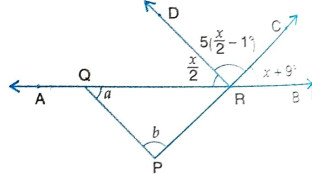
In Fig , $a+b=$
- A
$117^{\circ}$
- B
$130^{\circ}$
- C
$127^{\circ}$
- D
$158^{\circ}$
AnswerC. $127^{\circ}$
Since $A R B$ is a straight line.
$
\begin{array}{ll}
\therefore & \frac{x}{2}+5\left(\frac{x}{2}-1^{\circ}\right)+x+90^{\circ}=180^{\circ} \\
\Rightarrow & 4 x+4^{\circ}=180^{\circ} \Rightarrow 4 x=176^{\circ} \Rightarrow x=44^{\circ}
\end{array}
$
Using exterior angle property in $P Q R$, we obtain$
\begin{aligned}
& \angle Q R C=a+b \\
\Rightarrow \quad & \frac{x}{2}+5\left(\frac{x}{2}-1^{\circ}\right)=a+b \Rightarrow a+b=3 x-5^{\circ} \Rightarrow a+b=3 \times 44^{\circ}-5=127^{\circ}
\end{aligned}
$
View full question & answer→MCQ 541 Mark
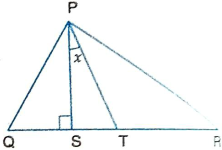
In Fig , if $P T$ is the bisector of $\angle Q P R$ in $\triangle P Q R, \angle P Q R=50^{\circ}, \angle P R Q=30^{\circ}$ and $P S \perp Q R$, then $x=$
- A
$40^{\circ}$
- B
$20^{\circ}$
- C
$30^{\circ}$
- D
$10^{\circ}$
AnswerD. $10^{\circ}$
Using angle sum property in $\triangle P Q R$, we obtain$
\begin{array}{ll}
& \angle P Q R+\angle P R Q+\angle R P Q=180^{\circ} \\
\Rightarrow & 50^{\circ}+30^{\circ}+\angle R P Q=180^{\circ} \Rightarrow \angle R P Q=100^{\circ} \\
\therefore \quad & \angle Q P T=\frac{1}{2} \angle R P Q=50^{\circ} \quad[\because P T \text { is bisector of } \angle Q P R]
\end{array}
$
Using exterior angle property in $\triangle P Q S$, we obtain$
\begin{array}{ll}
& \angle P S T=\angle P Q S+\angle Q P S \Rightarrow 90^{\circ}=50^{\circ}+\angle Q P S \Rightarrow \angle Q P S=40^{\circ} \\
\therefore & x=\angle Q P T-\angle Q P S=50^{\circ}-40^{\circ}=10^{\circ}
\end{array}
$
View full question & answer→MCQ 551 Mark
- A
$180^{\circ}$
- B
$360^{\circ}$
- C
$240^{\circ}$
- D
$300^{\circ}$
AnswerB. $360^{\circ}$
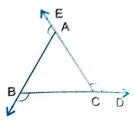
Using exterior angle property in $\triangle A B C$, we obtain
$\angle A C D=\angle A+\angle B, \angle C B F=\angle A+\angle C$ and, $\angle B A E=\angle B+\angle C$
$\therefore$ $\angle B A E+\angle C B F+\angle A C D=(\angle B+\angle C)+(\angle A+\angle C)+(\angle A+\angle B)$
$=2(\angle A+\angle B+\angle C)=2 \times 180^{\circ}=360^{\circ}$
View full question & answer→MCQ 561 Mark
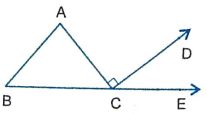
In a $\triangle A B C$, it is given that $\angle A: \angle B: C=3: 2: 1$ and $\angle A C D=90^{\circ}$. If $B C$ is produced to $E$, then $\angle E C D=$
- A
$60^{\circ}$
- B
$30^{\circ}$
- C
$50^{\circ}$
- D
$40^{\circ}$
View full question & answer→MCQ 571 Mark
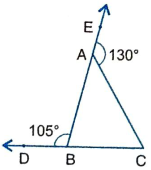
In Fig , sides $C B$ and $B A$ of $\triangle A B C$ are produced to $D$ and $E$ respectively. If $\angle A B D=105^{\circ}$ and $\angle C A E=130^{\circ}$, then $\angle A C B=$
- A
$50^{\circ}$
- B
$55^{\circ}$
- C
$75^{\circ}$
- D
$130^{\circ}$
AnswerB. $55^{\circ}$
We have, $\angle C A E=130^{\circ}$$
\therefore \quad \angle B A C=180^{\circ}-130^{\circ}=50^{\circ} \quad\left[\because \angle B A C+\angle C A E=180^{\circ}\right]
$
Using exterior angle property in $\triangle A B C$, we obtain$
\begin{array}{ll}
& \angle A B D=\angle B A C+\angle A C B \\
\Rightarrow \quad & 105^{\circ}=50^{\circ}+\angle A C B \Rightarrow \angle A C B=105^{\circ}-50^{\circ}=55^{\circ}
\end{array}
$
View full question & answer→MCQ 581 Mark
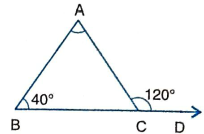
In Fig , $\angle A C D=120^{\circ}$ and $\angle A B C=40^{\circ}$, then $\angle B A C=$
- A
$80^{\circ}$
- B
$60^{\circ}$
- C
$50^{\circ}$
- D
$40^{\circ}$
AnswerA. $80^{\circ}$
In $\triangle A B C$, side $B C$ is produced to $D$. Using exterior angle property, we obtain$
\begin{array}{ll}
& \angle A C D=\angle A B C+\angle B A C \\
\Rightarrow \quad & 120^{\circ}=40^{\circ}+\angle B A C \Rightarrow \angle B A C=80^{\circ}
\end{array}
$
View full question & answer→MCQ 591 Mark
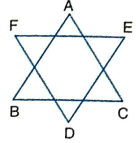
In Fig , $\angle A+\angle B+\angle C+\angle D+\angle E+\angle F=$
- A
$180^{\circ}$
- B
$360^{\circ}$
- C
$540^{\circ}$
- D
$90^{\circ}$
AnswerB. $360^{\circ}$
Using angle sum property in $\triangle^{\prime} s A B C$ and $D E F$, we obtain$
\begin{array}{ll}
& \angle A+\angle B+\angle C=180^{\circ} \text { and } \angle D+\angle E+\angle F=180^{\circ} \\
\Rightarrow \quad & \angle A+\angle B+\angle C+\angle D+\angle E+\angle F=180^{\circ}+180^{\circ}=360^{\circ}
\end{array}
$
View full question & answer→MCQ 601 Mark
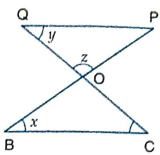
In Fig , $B C \| P Q, B P$ and $C Q$ intersect at $O$. If $x+y=80^{\circ}$ and $x-y=55^{\circ}$, then $z=$
- A
$80^{\circ}$
- B
$55^{\circ}$
- C
$90^{\circ}$
- D
$100^{\circ}$
AnswerD. $100^{\circ}$
It is given that $B C \| P Q$ and transversal $B P$ cuts them at $B$ and $P$ respectively.$
\begin{array}{ll}
\therefore & \angle C B P=\angle B P Q \\
\Rightarrow & \angle B P Q=x
\end{array}
$
Using angle sum property in $\triangle O P Q$, we obtain$
\angle P+\angle Q+\angle P O Q=180^{\circ} \Rightarrow x+y+z=180^{\circ} \Rightarrow 80^{\circ}+z=180^{\circ} \Rightarrow z=100^{\circ} \quad\left[\because x+y=80^{\circ} \text { (given) }\right]
$
View full question & answer→MCQ 611 Mark
In a $\triangle A B C$, if $\angle A=\angle B+\angle C$, then $\triangle A B C$ is
AnswerC. right triangle
We have,
\[
\angle A=\angle B+\angle C \Rightarrow \angle A+\angle A=\angle A+\angle B+\angle C \Rightarrow 2 \angle A=180^{\circ} \Rightarrow \angle A=90^{\circ}
\]
Hence, $\triangle A B C$ is a right triangle.
View full question & answer→MCQ 621 Mark
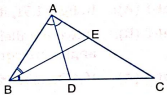
In Fig. ABC is a triangle in which $\angle B=2 \angle C$. D is a point on side BC such that AD bisects $\angle B A C$ and $A B=C D$. BE is the bisector of $\angle B$. The measure of $\angle B A C$ is
- ✓
$72^{\circ}$
- B
$73^{\circ}$
- C
$74^{\circ}$
- D
$95^{\circ}$
AnswerCorrect option: A. $72^{\circ}$
(a) $72^{\circ}$
[Hint: $\triangle A B E \cong \triangle B C E$ ]
View full question & answer→MCQ 631 Mark
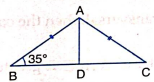
In fig. ABC is an isosceles triangle such that AB = AC and AD is the median to base BC. Then, $\angle B A D=$
- ✓
$55^{\circ}$
- B
$70^{\circ}$
- C
$35^{\circ}$
- D
$110^{\circ}$
AnswerCorrect option: A. $55^{\circ}$
View full question & answer→MCQ 641 Mark
$D, E, F$ are the mid-point of the sides $B C, C A$ and $A B$ respectively of $\triangle A B C$. Then $\triangle D E F$ is congruent to triangle
View full question & answer→MCQ 651 Mark
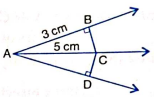
In Fig. if AC is bisector of $\angle B A D$ such that $A B=3 cm$ and $A C=5 cm$, then CD =
View full question & answer→MCQ 661 Mark
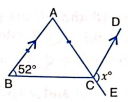
In Fig. ABC is an isosceles triangle whose side AC is produced to E. Through C, CD is drawn parallel to BA. The value of x, is
- A
$52^{\circ}$
- B
$76^{\circ}$
- C
$156^{\circ}$
- ✓
$104^{\circ}$
AnswerCorrect option: D. $104^{\circ}$
View full question & answer→MCQ 671 Mark
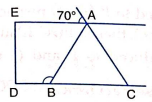
In Fig. if $A E \| D C$ and $A B=A C$, the value of $\angle A B D$ is
- A
$70^{\circ}$
- ✓
$110^{\circ}$
- C
$120^{\circ}$
- D
$130^{\circ}$
AnswerCorrect option: B. $110^{\circ}$
View full question & answer→MCQ 681 Mark
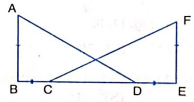
In Fig. $A B \perp B E$ and $F E \perp B E$. If $B C=D E$ and $A B=E F$, then $\triangle A B D$ is congruent to
- A
$\triangle E F C$
- B
$\triangle E C F$
- C
$\triangle C E F$
- ✓
$\triangle F E C$
AnswerCorrect option: D. $\triangle F E C$
View full question & answer→MCQ 691 Mark
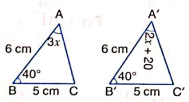
In Fig. the measure of $\angle B^{\prime} A^{\prime} C^{\prime}$ is
- A
$50^{\circ}$
- ✓
$60^{\circ}$
- C
$70^{\circ}$
- D
$80^{\circ}$
AnswerCorrect option: B. $60^{\circ}$
View full question & answer→MCQ 701 Mark
If $A B C$ and $D E F$ are two triangles such that $\triangle A B C \cong \triangle F D E$ and $A B=5 cm, \angle B=40^{\circ}$ and $\angle A=80^{\circ}$. Then, which of the following is true?
- A
$D F=5 cm, \angle F=60^{\circ}$
- B
$D E=5 cm, \angle E=60^{\circ}$
- ✓
$D F=5 cm, \angle E=60^{\circ}$
- D
$D E=5 cm, \angle D=40^{\circ}$
AnswerCorrect option: C. $D F=5 cm, \angle E=60^{\circ}$
View full question & answer→MCQ 711 Mark
Which of the following is not a criterion for congruence of triangles?
MCQ 721 Mark
In an isosceles triangle, if the vertex angle is twice the sum of the base angles, then the measure of vertex angle of the triangle is
- A
$100^{\circ}$
- ✓
$120^{\circ}$
- C
$110^{\circ}$
- D
$130^{\circ}$
AnswerCorrect option: B. $120^{\circ}$
View full question & answer→MCQ 731 Mark
In a $\triangle A B C$, if AB = AC and BC is produced to D such that $\angle A C D=100^{\circ}$ then $\angle A=$
- ✓
$20^{\circ}$
- B
$40^{\circ}$
- C
$60^{\circ}$
- D
$80^{\circ}$
AnswerCorrect option: A. $20^{\circ}$
View full question & answer→MCQ 741 Mark
If $\triangle P Q R \cong \triangle E F D$, then $\angle E=$
- ✓
$\angle P$
- B
$\angle Q$
- C
$\angle R$
- D
AnswerCorrect option: A. $\angle P$
View full question & answer→MCQ 751 Mark
If $\triangle P Q R \cong \triangle E F D$, then $E D=$
View full question & answer→MCQ 761 Mark
In triangles ABC and PQR, if $\angle A=\angle R, \angle B=\angle P$ and $A B=R P$, then which one of the following congruence conditions applies:
View full question & answer→MCQ 771 Mark
In triangles ABC and PQR three equality relations between some parts are as follows:
$A B=Q P, \angle B=\angle P$ and $B C=P R$
State which of the congruence conditions applies:
View full question & answer→MCQ 781 Mark
If $\triangle A B C \cong \triangle P Q R$ and $\triangle A B C$ is not congruent to $\triangle R P Q$, then which of the following is not true:
View full question & answer→MCQ 791 Mark
If $\triangle A B C \cong \triangle A C B$, then $\triangle A B C$ is isosceles with
View full question & answer→MCQ 801 Mark
If $\triangle A B C \cong \triangle L K M$, then side of $\triangle L K M$ equal to side AC of $\triangle A B C$ is
View full question & answer→MCQ 811 Mark
In $\triangle R S T$ (See Fig.) what is the value of x?
- A
- B
$90^{\circ}$
- C
$80^{\circ}$
- ✓
View full question & answer→MCQ 821 Mark
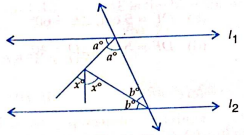
In Fig. if $l_1 \| l_2$, the value of x is
View full question & answer→MCQ 831 Mark
The side BC of $\triangle A B C$ is produced to a point D. The bisector of $\angle A$ meets side BC in L. If $\angle A B C=30^{\circ}$ and $\angle A C D=115^{\circ}$, then $\angle A L C=$
- A
$85^{\circ}$
- ✓
$72 \frac{1}{2}^{\circ}$
- C
$145^{\circ}$
- D
AnswerCorrect option: B. $72 \frac{1}{2}^{\circ}$
View full question & answer→MCQ 841 Mark
In a $\triangle A B C, \angle A=50^{\circ}$ and BC is produced to a point D. If the bisectors of $\angle A B C$ and $\angle A C D$ meet at $E$, then $\angle E=$
- ✓
$25^{\circ}$
- B
$50^{\circ}$
- C
$100^{\circ}$
- D
$75^{\circ}$
AnswerCorrect option: A. $25^{\circ}$
View full question & answer→MCQ 851 Mark
The bisects of exterior angles at B and C of $\triangle A B C$ meet at O. If $\angle A=x^{\circ}$, then $\angle B O C=$
- A
$90^{\circ}+\frac{x^{\circ}}{2}$
- ✓
$90^{\circ}-\frac{x^{\circ}}{2}$
- C
$180^{\circ}+\frac{x^{\circ}}{2}$
- D
$180^{\circ}-\frac{x^{\circ}}{2}$
AnswerCorrect option: B. $90^{\circ}-\frac{x^{\circ}}{2}$
View full question & answer→MCQ 861 Mark
If the bisectors of the acute angles of a right triangle meet at O, then the angle at O between the two bisectors is
- A
$45^{\circ}$
- B
$95^{\circ}$
- ✓
$135^{\circ}$
- D
$90^{\circ}$
AnswerCorrect option: C. $135^{\circ}$
View full question & answer→MCQ 871 Mark
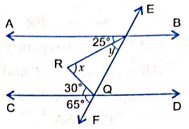
In Fig., AB and CD are parallel lines and transversal EF intersects them at P and Q respectively. If $\angle A P R=25^{\circ}, \angle R Q C=30^{\circ}$ and $\angle C Q F=65^{\circ}$, then
- ✓
$x=55^{\circ}, y=40^{\circ}$
- B
$x=50^{\circ}, y=45^{\circ}$
- C
$x=60^{\circ}, y=35^{\circ}$
- D
$x=35^{\circ}, y=60^{\circ}$
AnswerCorrect option: A. $x=55^{\circ}, y=40^{\circ}$
View full question & answer→MCQ 881 Mark
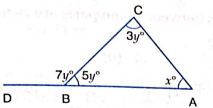
In Fig. what is the value of x?
MCQ 891 Mark
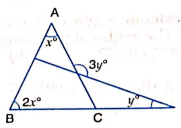
In Fig. what is y in terms of x?
- ✓
$\frac{3}{2} x$
- B
$\frac{4}{3} x$
- C
- D
$\frac{3}{4} x$
AnswerCorrect option: A. $\frac{3}{2} x$
View full question & answer→MCQ 901 Mark
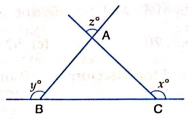
In Fig. what is z in terms of x and y?
- A
- ✓
- C
$180^{\circ}-(x+y)$
- D
$x+y+360^{\circ}$
View full question & answer→MCQ 911 Mark
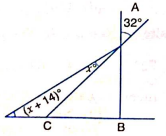
In Fig. if $A B \perp B C$ , then x =
View full question & answer→MCQ 921 Mark
The base BC of triangle ABC is produced both ways and the measure of exterior angles formed are $94^{\circ}$ and $126^{\circ}$. Then, $\angle B A C=$
- A
$94^{\circ}$
- B
$54^{\circ}$
- ✓
$40^{\circ}$
- D
$44^{\circ}$
AnswerCorrect option: C. $40^{\circ}$
View full question & answer→MCQ 931 Mark
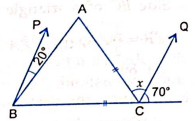
In Fig. if BP ||CQ and AC = BC then the measure of x is
- A
$20^{\circ}$
- B
$25^{\circ}$
- ✓
$30^{\circ}$
- D
$35^{\circ}$
AnswerCorrect option: C. $30^{\circ}$
View full question & answer→MCQ 941 Mark
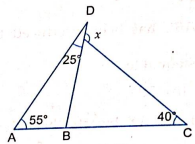
In Fig. the value of x is
- A
$65^{\circ}$
- B
$80^{\circ}$
- C
$95^{\circ}$
- ✓
$120^{\circ}$
AnswerCorrect option: D. $120^{\circ}$
View full question & answer→MCQ 951 Mark
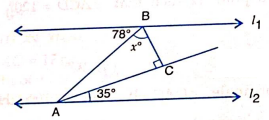
In Fig. for which value of x is $I_1 \| I_2$ ?
View full question & answer→MCQ 961 Mark
If the measures of angles of a triangle are in the ratio of 3 : 4 : 5 what is the measure of the smallest angle of the triangle?
- A
$25^{\circ}$
- B
$30^{\circ}$
- ✓
$45^{\circ}$
- D
$60^{\circ}$
AnswerCorrect option: C. $45^{\circ}$
View full question & answer→MCQ 971 Mark
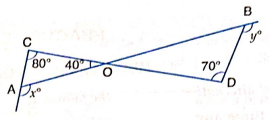
In Fig. x + y =
MCQ 981 Mark
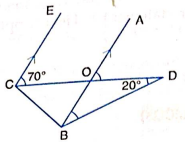
In Fig. if EC ||AB, $\angle E C D=70^{\circ}$ and $\angle B D O=20^{\circ}$, then $\angle O B D$ is
- A
$20^{\circ}$
- ✓
$50^{\circ}$
- C
$60^{\circ}$
- D
$70^{\circ}$
AnswerCorrect option: B. $50^{\circ}$
View full question & answer→MCQ 991 Mark
Line segments AB and CD intersect at O such that AC|| DB . If $\angle C A B=45^{\circ}$ and $\angle C D B=55^{\circ}$, then $\angle B O D=$
- A
$100^{\circ}$
- ✓
$80^{\circ}$
- C
$90^{\circ}$
- D
$135^{\circ}$
AnswerCorrect option: B. $80^{\circ}$
View full question & answer→MCQ 1001 Mark
In a $\triangle A B C$, if $\angle A=60^{\circ}, \angle B=80^{\circ}$ and the bisectors of $\angle B$ and $\angle C$ meet at $O$, then $\angle B O C=$
- A
$60^{\circ}$
- ✓
$120^{\circ}$
- C
$150^{\circ}$
- D
$30^{\circ}$
AnswerCorrect option: B. $120^{\circ}$
View full question & answer→