Questions · Page 1 of 3

Do as directed; [1 M ]

🎯

Test yourself on this topic

50 questions · timed · auto-graded

Question 11 Mark
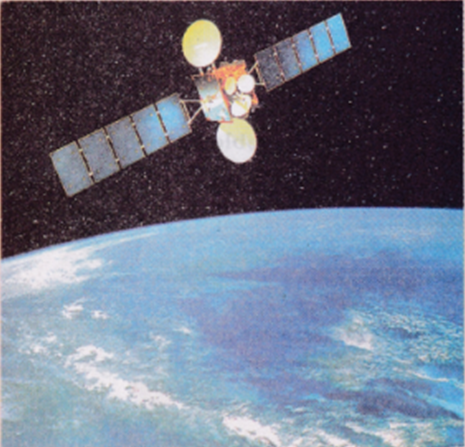
A satellite goes round the earth in a circular orbit with constant speed. Is the motion uniform or accelerated? This photograph shows a man-made 'communication satellite' going round the earth in a circular orbit (or circular path). We can see the dish antennae and solar panels (made of solar cells) clearly in this photograph. This photograph shows a watch. The tip of seconds 'hand of this watch moves rapidly on the dial of the watch. The tips of minutes' hand and hours' also move on the dial but they move slowly.

Answer
It is accelerated motion as the velocity is changing continuously.
View full question & answer
Question 21 Mark
Write the formula for acceleration. Give the meaning of each symbol which occurs in it.
Answer
$\text{Acceleration}=\frac{\text{Final velocity}-\text{Initial velocity}}{\text{Time taken}}$$\text{a}=\frac{\text{v}-\text{u}}{\text{t}}$
View full question & answer
Question 31 Mark
State which of the following situations are possible and give an example for each of these: an object moving with an acceleration but with uniform speed.
Answer
Possible When a car is moving in a circular track with constant speed, it is accelerating due to change in direction of motion.
View full question & answer
Question 41 Mark
Change the speed of $6\ m/s$ into $km/h.$
Answer
$6\text{m}/\text{s}$$=6\times\Big(\frac{3600}{1000}\Big)\text{km}/\text{hr}=21.6\text{km}/\text{hr}$
View full question & answer
Question 51 Mark
State whether displacement is a scalar or a vector quantity.
Answer
Distance is considered as a scalar quantity because it shows only magnitude, there is not use of direction.
View full question & answer
Question 71 Mark
The velocity of a body increases by $10\ m/s$ in every one second. What physical quantity does the body represent and what is its magnitude?
Answer
Rate of change of velocity is known as acceleration. Since, if is sfraight line motion so the physical quantity will be" unifrom acceleration"$\overrightarrow{\text{a}}=\frac{\Delta\text{v}}{\text{t}}$
$=\frac{20-10}{1}=10\text{m/s}^{2}$
$\overrightarrow{\text{a}}=10\text{m/s}^{2}$
physical quantity = uniform acceleration.
View full question & answer
Question 81 Mark
State which of the following situations are possible and give an example for each of these: an object moving in a certain direction with an acceleration in the perpendicular direction.
Answer
Possible A car is moving in a circular track, its acceleration is perpendicular to the direction of motion.
View full question & answer
Question 91 Mark
Under what condition(s) is the magnitude of average velocity of an object equal to its average speed?
Answer
The magnitude of average velocity of an object is equal to its average speed, only when an object is moving in a straight line.
View full question & answer
Question 101 Mark
Which of the two can be zero under certain conditions average speed of a moving body or average velocity of a moving body?
Answer
Average velocity of a moving body can be zero.
View full question & answer
Question 111 Mark
What type of motion is represented by the tip of the ‘seconds’ hand’ of a watch? Is it uniform or accelerated?
Answer
The tip of the ‘seconds’ hand’ of a watch represents uniform circular motion. It is an accelerated motion.
View full question & answer
Question 121 Mark
Name the physical quantity which gives us an idea of how slow or fast a body is moving.
Answer
Speed gives an idea of how slow or fast a body is moving.
View full question & answer
Question 141 Mark
A body goes round the sun with constant speed in a circular orbit. Is the motion uniform or accelerated?
Answer
The motion is accelerated.
View full question & answer
Question 161 Mark
If the acceleration of the particle is constant in magnitude but not in direction, then what type of path does the particle follow?
Answer
The particle will follow any curved path (circular or elliptical etc.) except straight line path. Because in straight line path direction of acceleration remains same.
View full question & answer
Question 181 Mark
What does the path of an object look like when it is in uniform motion?
Answer
The path of an object looks like line, zigzag line and curve etc. Explanation: Uniform motion refers only to speed of the object. Speed is described by distance traveled by an object with time. Uniform motion i.e. speed conveys no information regarding the direction of the object. If object continues to move in fixed direction, then path will look like the straight line. Otherwise with varying direction & uniform motion, there could be various paths like straight line, zigzag line, circle, curve and many more.
View full question & answer
Question 191 Mark
Write the SI unit of the both distance and displacement.
Answer
The S.I. unit of both distance and displacement is metre.
View full question & answer
Question 201 Mark
If the velocity-time graph of an object is parallel to $X-$axis, then what does it mean$?$ Can it be parallel to $Y-$axis$?$
Answer
If the velocity time graph of an abject is parallel to $x-$axis then it doesn't parallel to $y$ axis but it is parallel to $x-$axis. It means the body moves with constant velocity.
View full question & answer
Question 221 Mark
Convert a speed of $54\ km/h$ into $m/s.$
Answer
We have to convert $5\ km/h$ into m/s.$54\text{km/hr}=\frac{(54)(1000)}{3600}\text{m/s}$
$=15\text{m/s}$
View full question & answer
Question 231 Mark
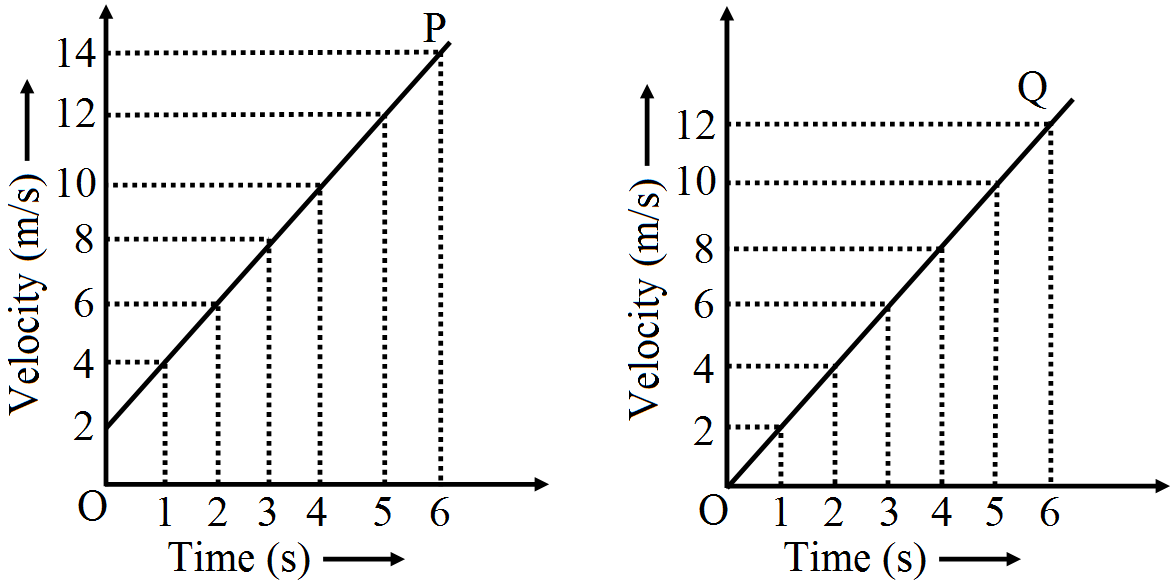
Velocity-time graphs of two objects $P$ and $Q$ are as given below:

Which object starts from rest$?$
Answer
The object in Graph $Q$ starts from rest as when time is zero, velocity is also zero.
View full question & answer
Question 241 Mark
The displacement of a moving object in a given interval of time is zero. Would the distance travelled by the object also be zero? Give reason for your answer.
Answer
No, because if a body takes a round trip such that its final position is same as the starting position, then the displacement of the body is zero but the distance travelled is non-zero.
View full question & answer
Question 251 Mark
What can you say about the motion of a body if its speed-time graph is a straight line parallel to the time axis?
Answer
The Speed of the body is constant or uniform.
View full question & answer
Question 261 Mark
State whether speed is a scalar or a vector quantity. Give reason for your choice.
Answer
Speed is a scalar quantity as it has magnitude only, it has no specified direction.
View full question & answer
Question 271 Mark
What does the odometer of an automobile measure?
Answer
The odometer of an automobile measures the distance covered by an automobile.
View full question & answer
Question 291 Mark
Which of the following is true for displacement?
  1. It cannot be zero.
  2. Its magnitude is greater than the distance travelled by the object.
Answer
None of the statement is true for displacement First statement is false because displacement can be zero. Second statement is also false because displacement is less than or equal to the distance travelled by the object.
View full question & answer
Question 301 Mark
What is the quantity which is measured by the area occupied below the velocity -time graph?
Answer
The area below velocity-time graph gives the distance covered by the object.
View full question & answer
Question 311 Mark
What is the other name of negative acceleration?
Answer
Negative acceleration is also called retardation.
View full question & answer
Question 321 Mark
Give two examples of bodies having non-uniform motion.
Answer
  1. Motion of a bus on a road.
  2. Motion of a racing horse.
View full question & answer
Question 331 Mark
Name the physical quantity obtained by dividing ‘Distance travelled’ by ‘Time taken’ to travel that distance.
Answer
Speed is defined as the distance travelled per unit time.
View full question & answer
Question 341 Mark
What does the slope of a distance-time graph indicate?
Answer
The slope of a distance-time graph indicates speed.
View full question & answer
Question 351 Mark
What name is given to the speed in a specified direction?
Answer
Speed of a body in a specified direction is called velocity.
View full question & answer
Question 361 Mark
An object has moved through a distance. Can it have zero displacement? If yes, support your answer with an example.
Answer
Yes,an object can have zero displacement even when it has moved through a distance.This happens when final position of the object coincides with its initial position. For example,if a person moves around park and stands on place from where he started then here displacement will be zero.
View full question & answer
Question 371 Mark
Does the motion of second’s hand of a watch represent uniform velocity or uniform speed?
Answer
The seconds hand of the watch represents uniform motion. It moves with constant or uniform speed. It would have had a uniform or constant velocity if it travels in a specified direction in a straight line and moves over equal distance in equal intervals of time.
View full question & answer
Question 381 Mark
Define average speed.
Answer
The "total distance" traveled by a "body in a definite interval of time" is known as "average speed". By derivation it is represented as, Average/ quad speed $=\Big(\frac{\text{Total distance}}{\text{Total timetaken}}\Big)$ Speed is a scalar quantity. So it does not have a unit. the "instantaneous speed" is the "limit of the average speed" as the "duration of the time interval" approaches zero."
View full question & answer
Question 391 Mark
Give SI unit of angular velocity.
Answer
The SI unit of angular velocity is radians per second. But it may be measured in other units as well (such as degrees per second, degrees per hour, etc.).
View full question & answer
Question 401 Mark
State which of the following situations are possible and give an example for each of these:
an object with a constant acceleration but with zero velocity.
Answer
Possible
When a ball is thrown up at maximum height, it has zero velocity, although it will have constant acceleration due to gravity, which is equal to $9.8 \mathrm{~m} / \mathrm{s}^2$.
View full question & answer
Question 411 Mark
What is the displacement of a satellite when it makes a complete round along its circular path?
Answer
The displacement is always zero when satellite makes a complete round along its circular path. It is because of the fact that initial and final positions coincide in one complete round.
View full question & answer
Question 421 Mark
Under which condition is the magnitude of average velocity equal to average speed?
Answer
When the object moves in a single straight line, the magnitude of average velocity equal to average speed.
View full question & answer
Question 441 Mark
What does the slope of a speed-time graph indicate?
Answer
The slope of a speed-time graph indicates acceleration.
View full question & answer
Question 451 Mark
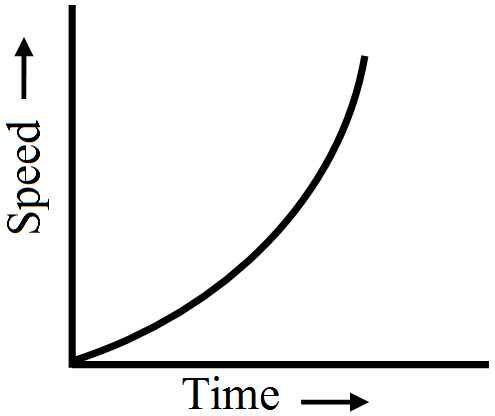
What conclusion can you draw about the acceleration of a body from the speed-time graph shown below?
Answer
It represents non-uniform acceleration.
View full question & answer
Question 461 Mark
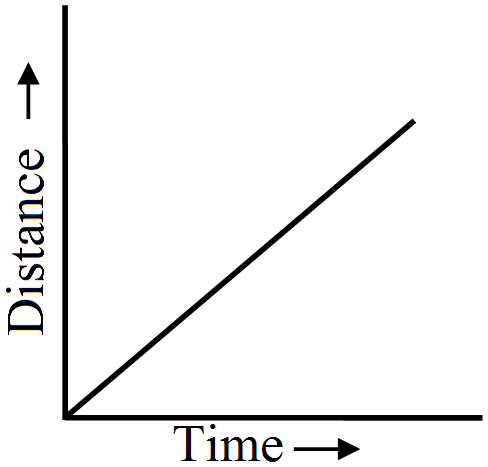
What conclusion can you draw about the speed of a body from the following distance-time graph?
Answer
The body has uniform speed.
View full question & answer
Question 471 Mark
What can you say about the motion of a body whose distance-time graph is a straight line parallel to the time axis?
Answer
The body is not moving. It is stationary.
View full question & answer
Question 481 Mark
Area under the velocity-time graph line is $40m.$ What physical quantity does this area represent$?$
Answer
It represent the distance covered is $40$ metre.
View full question & answer
Question 491 Mark
State whether the following statement is true or false: Earth moves round the sun with uniform velocity.
Answer
No, earth moves round the sun with uniform speed, but its velocity changes continuously.
View full question & answer
Do as directed; [1 M ] - Science STD 9 Questions - Vidyadip