MCQ 511 Mark
A boy is sitting on a merry$-$go$-$round which is moving with a constant speed of $10 \mathrm{\sim ms}^{-1}$. This means that the boy is:
- A
- B
Moving with no acceleration.
- ✓
- D
Moving with uniform velocity.
AnswerAcceleration is the rate of change of velocity, and the velocity of the merry$-$go$-$round is changing with respect to time. Thus, it will move in an accelerated motion.
View full question & answer→MCQ 521 Mark
A body is projected vertically upward from the ground. Taking vertical upward direction as positive and point of projection as origin, the sign of displacement of the body from the origin when it is at height h during upward and downward journey will be:
MCQ 531 Mark
Velocity-time graph of a body with uniform velocity is a straight line:
- ✓
Parallel to $x-$axis
- B
Parallel to $y-$axis
- C
Inclined to $x-$axis
- D
Inclined to $y-$axis
AnswerCorrect option: A. Parallel to $x-$axis
Velocity-time graph of an object moving with uniform velocity.
The slope of a Velocity–time graph of an object moving in rectilinear motion with uniform velocity is straight line and parallel to $x-$axis when velocity is taken along $y-$axis and time is taken along $x-$axis.
View full question & answer→MCQ 541 Mark
A particle moves on the $x−$ axis. When the particle's acceleration is positive and increasing then
View full question & answer→MCQ 551 Mark
Using the $v - t$ graph, one can conclude:
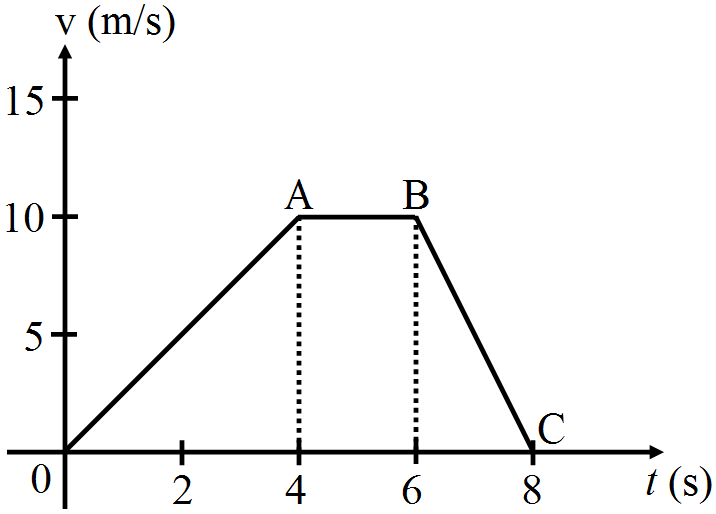
- Displacement in $(0 - 4)$ seconds is equal to the displacement in $(4 - 6)$ seconds.
- Acceleration is $2.5^{-2} ms$ in $OA$ and zero in $AB.$
- Acceleration is negative in time $(6 - 8)$ seconds.
- A
Only $A$ is correct.
- B
Only $B$ is correct.
- ✓
Only $C$ is correct.
- D
All the three are correct.
AnswerCorrect option: C. Only $C$ is correct.
For the statement$(A):\ $ Displacement in $(0 - 4)s$ increasing and Displacement in $(4 - 6)s$ is Constant. So, both the displacement of time $(0 - 4)s$ and $(4 - 6)s$ are not equal to each other.
For the statement$(B):\ $
Acceleration$(OA) =\frac{10}{4}=2.5\text{ ms}$
Acceleration$(AB) =\frac{10}{(4+6)}=1\text{ ms}$
For the statement$(C):\ $As we see that in the graph, part $BC$ is decreasing simultaneously from $10\ m$ to $0$. Hence, Statement $C$ is the correct one.
View full question & answer→MCQ 561 Mark
If body having initial velocity zero is moving with uniform acceleration 8m/ sec2.The distance travelled by it in fifth second will be:
- ✓
$36$ metres
- B
$40$ metres
- C
$100$ metres
- D
AnswerCorrect option: A. $36$ metres
$36$ metres
View full question & answer→MCQ 571 Mark
A car is travelling at a speed of $90\ km/h$. Brakes are applied so as to produce a uniform acceleration of – $0.5 \mathrm{~m} / \mathrm{s}^2$. Find how far the car will go before it is brought to rest?
- A
$8100\ m$
- B
$900\ m$
- ✓
$625\ m$
- D
$620\ m$
AnswerCorrect option: C. $625\ m$
$625\ m$
View full question & answer→MCQ 581 Mark
Odometer is to mileage as compass is to:
AnswerAn odometer is an instrument used to measure mileage.
A compass is an instrument used to determine direction.
Choices $a, b$ and $c$ are incorrect because none is an instrument.
View full question & answer→MCQ 591 Mark
A balloon is rising vertically up at constant speed $10 \ m/ s$.A stone is dropped from it when the balloon is at a height of $40\ m$. otal distance covered by the stone before reaching the ground is (take $g=10 m/ s2)$
- A
$40\ m$
- B
$45\ m$
- ✓
$50\ m$
- D
$60\ m$
AnswerCorrect option: C. $50\ m$
$50\ m$
View full question & answer→MCQ 601 Mark
If a bus travelling at $20\ m/ s$ is subject to a steady deceleration of $5 \mathrm{~m} / \mathrm{s}^2$, how long will it take to come rest:
- A
$400s$
- B
$0.4s$
- C
$40s$
- ✓
$4s$
AnswerUsing first equation of motion
$v = u + at,$
we have
$0 = 20 + (−5)t$
$\Rightarrow 5t = 20$
$\Rightarrow t = 4s$
View full question & answer→MCQ 611 Mark
Leaves are the food factories of plant. But, how does cactus $($desert plants$)$ carry out photosynthesis?
View full question & answer→MCQ 621 Mark
In uniform circular motion:
- A
Both velocity and speed are constant
- B
Speed is constant but velocity changes
- ✓
Both speed and velocity change
- D
Velocity is constant but speed changes
AnswerCorrect option: C. Both speed and velocity change
In a Uniform Circular Motion, the magnitude of velocity, which is speed remains constant.
But the direction of velocity, which is tangential to the circle, keeps changing.
So velocity also changes.
View full question & answer→MCQ 631 Mark
If the displacement of an object is proportional to square of time, then the object moves with:
AnswerWhen the rate of change of velocity with time of a body is constant then the object is said to be uniformly accelerated.
Or in other words in uniform acceleration, the displacement of an object is proportional to square of time.
View full question & answer→MCQ 641 Mark
Is it possible to have an accelerated motion with a constant speed? Name such type of motion:
AnswerCorrect option: A. Yes, Uniform Circular Motion.
Yes it is possible. Let us take an example, circular motion.
In this it has acceleration because direction of motion is changing but it has constant speed along tangential.
Hence it is possible.
View full question & answer→MCQ 651 Mark
If a body is moving on a circular path of radius $21\ cm$ with velocity of $2\ m/s$, then time taken by the body to complete half revolution is:
AnswerWe know that Speed $(v)$
$=\frac{\text{Distance}}{\text{Time}}$
Here, Distance = Circumference of the circular path
$=2\pi\text{r}$
$=\frac{2\times22}{7\times21}=132$
and, Speed
$=2\text{sec}$
This gives, Time
$=\frac{132}{2}=66\text{m/sec}$
Total time $=66\text{Sec}$
then time taken by the body to complete half revolution is:
$=\frac{66}{2}=33\text{sec}$
View full question & answer→MCQ 661 Mark
Which of the following defines displacement correctly:
- A
Change in position in a certain direction
- B
- ✓
- D
AnswerDisplacement is the linear distance between the initial and final positions.
So, it is change in position in a certain direction.
View full question & answer→MCQ 671 Mark
A particle is moving in a circular path of radius r. Its displacement after moving through half the circle would be:
- A
- B
$r$
- ✓
$2r$
- D
$\frac{2}{\text{r}}$
AnswerDisplacement is the minimum distance between the initial position and final position.
After moving half circle ($A$ to $B$) displacement will be $AB$
$AB$ is diameter i.e. $2r$
View full question & answer→MCQ 681 Mark
A bridge is 400m long. A $150\ m$ long train crosses the bridge at a speed of 50\ m/s. Time taken by the train to cross it.
AnswerTrain Length $= 150m$
Bridge length $= 400m$
Distance covered by train to cross bridge = Train Length + Bridge length
$= 150 + 400$
$= 550m$
$\text{Speed of train}=\frac{\text{Distance}}{\text{Time}}$
So,
$\text{Time}=\frac{\text{Distance}}{\text{Speed of train}}$
$=\frac{550}{50}$
$=11\text{sec}$
Time taken by the train to cross a bridge is $11sec.$
View full question & answer→MCQ 691 Mark
Which of the following is true about distance and time.
- A
Distance and time are always directly proportional to each other.
- B
Distance and time are always indirectly proportional to each other.
- ✓
Distance and time are directly proportional when the velocity is constant.
- D
Distance and time are indirectly proportional when the velocity is constant.
AnswerCorrect option: C. Distance and time are directly proportional when the velocity is constant.
Explanation:
Speed$=\frac{\text{Time}}{\text{Distance}} $
For uniform velocity, Distance $∝$ Time
View full question & answer→MCQ 701 Mark
Suppose a boy is enjoying a ride on a merry-go-round which is moving with a constant speed of $10\ m \mathrm{s}^{-1}$. It implies that the boy is:
- A
- B
Moving with no acceleration.
- ✓
- D
Moving with uniform velocity.
AnswerIn merry-go-round, the speed is constant but velocity is not constant, because its direction goes on changing i.e., there is acceleration in the motion.
So, we can say that the boy is in accelerated motion.
View full question & answer→MCQ 711 Mark
he numerical ratio of displacement to distance for a moving object is:
AnswerCorrect option: D. Equal to $1$ or less than $1$
Displacement is always smaller than or equal to displacement.
View full question & answer→MCQ 721 Mark
Physical quantity corresponding to the rate of change of displacement is:
AnswerVelocity is the rate of change of displacement
View full question & answer→MCQ 731 Mark
A ball is travelling with uniform translatory motion.This means that
AnswerCorrect option: C. All parts of the ball have the same velocity $($magnitude and direction$)$ and the velocity is constant.
In uniform translatory motion, all parts of the ball have the same velocity in magnitude and direction and this velocity is constant.
View full question & answer→MCQ 741 Mark
A man is 25m behind a bus, when bus starts accelerating at $2 m/ s^2$ and man starts moving with constant velocity of $10 m/ s.$ Time taken by him to board the bus is _________?
View full question & answer→MCQ 751 Mark
Which one of the following is most likely not a case of uniform circular motion?
- A
Motion of the earth around the sun.
- B
Motion of a toy train on a circular.
- ✓
Motion of a racing car on a circular tracki.
- D
Motion of hours' hand on the dial.
AnswerCorrect option: C. Motion of a racing car on a circular tracki.
View full question & answer→MCQ 761 Mark
Larger the slope of a displacement$-$time graph:
AnswerThe slope of a displacement$-$time graph with time axis measures velocity.
Larger slope $($steeper graph$)$ means the displacement is changing with a faster rate with respect to the time.
Faster rate of change of change of distance with respect to time simply means the body has a larger velocity.
View full question & answer→MCQ 771 Mark
For a body which has turned by $300^\circ $ in a circle of radius $r,$
AnswerCorrect option: A. Distance travelled is $\frac{5}{3}\pi\text{r}.$
Distance travelled is $\frac{5}{3}\pi\text{r}.$
View full question & answer→MCQ 781 Mark
A particle starts from the origin at $t = 0\ s$ with a velocity of $10.0$ j m/ s and moves in the xy−plane with a constant acceleration of the ms$^{−2}$. Then y−coordinate of the particle in $2$ sec is
- ✓
$24 \ m$
- B
$16\ m$
- C
$8\ m$
- D
$12 \ m$
AnswerCorrect option: A. $24 \ m$
A. $24\ m$
View full question & answer→MCQ 791 Mark
A bus moving along a straight line at $20m/s$ undergoes an acceleration of $4 \mathrm{~m} / \mathrm{s}^2$. After $2$ seconds, its speed will be:
- A
$8\ m/s$
- B
$12\ m/s$
- C
$16\ m/s$
- ✓
$28\ m/s$
AnswerCorrect option: D. $28\ m/s$
Acceleration of the moving object is $4 \mathrm{~m} / \mathrm{s}^2$
Initial velocity is $20\ m/s$.
Time taken is $2$ sec.
By applying $1^{\text {st }}$ equation of motion we get,$v = u + at$
$= 20 + 2(4)$
$= 28\ m/s$
View full question & answer→MCQ 801 Mark
Which of the following statement is correct regarding velocity and speed of a moving body?
- A
Velocity of a moving body is always higher than its speed.
- B
Speed of a moving body is always higher than its velocity.
- C
Speed of a moving body is its velocity in a given direction.
- ✓
Velocity of a moving body is its speed in a given direction.
AnswerCorrect option: D. Velocity of a moving body is its speed in a given direction.
Velocity is a vector quantity having a magnitude and a specific direction. So, velocity is nothing but speed in a particular direction.
View full question & answer→MCQ 811 Mark
A particle is moving in a circular path of radius $r.$ The displacement after half a circle would be:
- A
$\text{Zero}$
- B
$\pi\text{r}$
- ✓
$2\text{r}$
- D
$2\pi\text{r}$
AnswerCorrect option: C. $2\text{r}$
Given, after half the circle, the particle will reach the diametrically opposite point i.e., from point A to point $6$. And we know displacement is shortest path between initial and final point.
Displacement after half circle $= AB = OA + OB$ [v Given, $OA $and $06 = r]$
Hence, the displacement after half circle is $2r.$
View full question & answer→MCQ 821 Mark
If the particle completes one rotation along a circular track having radius $14\ m$ in $44$ seconds then the value of speed it’s speed is…
- A
$1\ m/s.$
- ✓
$2\ m/s.$
- C
$3\ m/s.$
- D
$4\ m/s$
AnswerCorrect option: B. $2\ m/s.$
$2\ m/s.$
View full question & answer→MCQ 831 Mark
Which of the following is a measurement of velocity:
AnswerCorrect option: B. $35 \ km/ h$ north
Velocity is defined as speed plus direction so unit of velocity should be unit of speed plus direction
So option B has unit of speed km/h and direction as north.
View full question & answer→MCQ 841 Mark
- A body moving in a circle has an acceleration directed towards the centre.
- Uniform circular motion is an example of variable acceleration.
- Linear velocity of a body moving in a circle differs with the distance from the axis.
- ✓
$'A\ ', 'B\ '$ and $'C\ '$ all are true statements.
- B
$'A\ ’$ is true, $'B\ '$ is false and $'C\ '$ is true statements.
- C
$'A\ ', 'B\ '$ and $'C\ '$ all are false statements.
- D
$'A\ ’$ is false, $'B\ '$ is true and $'C\ '$ is true statements.
AnswerCorrect option: A. $'A\ ', 'B\ '$ and $'C\ '$ all are true statements.
A body moving at constant speed in a circular path experiences an acceleration directed towards the centre of the circular path. This acceleration is called a centripetal acceleration and is provided by a centripetal force.
Uniform circular motion can be well$-$illustrated by swinging a tennis ball on a string in a circle over your head at a constant speed. The acceleration vector is considered variable because its direction changes, even though its magnitude is constant.
Thus, for a given angular velocity $ω$, the linear velocity $v$ of the particle is directly proportional to the distance of the particle from the centre of the circular path $($i.e$)$ for a body in a uniform circular motion, the angular velocity is the same for all points in the body but linear velocity is different.
View full question & answer→MCQ 851 Mark
- A
Direction of motion is fixed
- ✓
Direction of motion changes continuously
- C
- D
AnswerCorrect option: B. Direction of motion changes continuously
View full question & answer→MCQ 861 Mark
A bus begin to move with an acceleration of $1 \mathrm{~m} / \mathrm{s}^2$. A man who is 48m behind the bus starts running at $10\ m/s$ to catch the bus. The man will be able to catch the bus after.
AnswerVelocity of man $= 10\ m/s$
$s = 48m$
Acceleration of man with respect to bus = Acceleration of man - Acceleration of bus
$= 0 - (1) = - 1m/s$
Applying second equation of motion,
$\text{s}=\text{ut}+\frac{1}{2}\text{at}^{2}$
$48=10\text{t}-\frac{1}{2}\text{t}^{2}$
solving we get,
$t = 12sec$ or $t = 8sec$
therefore the minimum time is $8$ seconds.
View full question & answer→MCQ 871 Mark
Particles $P$ and $Q$ are undergoing uniform horizontal circular motions along concentric circles of different radii in clockwise sense $P $completes each round in $2\ min$ while $Q$ does it is 5min time required by $Q$ to make one revolution around $P$ is.
AnswerCorrect option: A. $3min.$
Time required by $Q$ to move around $P$
$=$ Time taken by $Q$ for for one complete round - Time taken by $P$ for one complete round
$= 5min - 2min$
$= 3min.$
View full question & answer→MCQ 881 Mark
Which of the following is a correct measure of velocity?
- A
$30s$
- B
$30\ m/s$
- C
$30$ South
- ✓
$30\ m/s$, South
AnswerCorrect option: D. $30\ m/s$, South
$30\ m/s$, South
View full question & answer→MCQ 891 Mark
Which of the following is not an example of a motion with a constant speed but variable velocity:
- ✓
A car moving at $80\ kmph$ on a straight road
- B
A car moving at $80\ kmph$ on a square track
- C
A car moving at $80\ kmph$ on a circular track
- D
A car moving at $80\ kmph$ on a zig-zag path
AnswerCorrect option: A. A car moving at $80\ kmph$ on a straight road
A part from motion on straight road, for all other cases, direction of motion changes although the speed remains uniform.
So, speed remaining constant, velocity is variable for all other cases.
View full question & answer→MCQ 901 Mark
A car accelerates uniformly from 18km/h to $36\ km/ h$ in $5s$. The distance covered by the car will be:
- A
$1\ m$
- B
$18\ m$
- ✓
$37.5\ m$
- D
AnswerCorrect option: C. $37.5\ m$
$37.5\ m$
View full question & answer→MCQ 911 Mark
The accelerated motion of a body changes due to change in:
AnswerThe accelerated motion of a body changes due to a change in speed, direction of motion, velocity.
As acceleration posses magnitude and direction.
Its magnitude changes by a change in speed, velocity, and direction can be changed by the direction of motion and velocity.
View full question & answer→MCQ 921 Mark
A car of mass $1000\ kg$ is moving with a velocity of $10 \mathrm{~ms}^{-1}$. If the velocity-time graph for this car is a horizontal line parallel to the time axis, then the velocity of car at the end of $25s$ will be:
- A
$25 \mathrm{~ms}^{-1}$
- B
$40 \mathrm{~ms}^{-1}$
- ✓
$10 \mathrm{~ms}^{-1}$
- D
$250 \mathrm{~ms}^{-1}$
AnswerCorrect option: C. $10 \mathrm{~ms}^{-1}$
It is given that the velocity time curve is parallel to $x$ axis hence velocity is constant with time and acceleration is $0.$
View full question & answer→MCQ 931 Mark
A car is moving on a circular track of radius R covering equal distance in equal intervals of time. This shows that the car has
- A
uniform speed and acceleration of constant magnitude
- B
Non-uniform velocity and acceleration
- C
uniform velocity and zero acceleration
- ✓
Both $(1)$ and $(2)$
AnswerCorrect option: D. Both $(1)$ and $(2)$
Both $(1)$ and $(2)$
View full question & answer→MCQ 941 Mark
Starting from rest objects $1$ falls freely for $4$ seconds and object $2$ falls freely for $8$ seconds.Compared to object $1$, object $2$ falls
View full question & answer→MCQ 951 Mark
The graph below shows the distance travelled and the time taken by four cars.
Which car travelled the slowest:
- A
Car $1$
- B
Car $2$
- C
Car $3$
- ✓
Car $4$
AnswerCorrect option: D. Car $4$
The slope of the distance-time graph represents the velocity.
The slope for the car $4$ is minimum, so its speed is also minimum.
View full question & answer→MCQ 961 Mark
A truck covers $40\ km$ with an average speed of $80\ m/h$. then it travels an average speed of 40km/h. the average speed of the truck for the total distanced covered is:
- A
$40\ km/h$
- B
$45\ km/h$
- C
$48\ km/h$
- ✓
$53\ km/h$
AnswerCorrect option: D. $53\ km/h$
$53\ km/h$
View full question & answer→MCQ 971 Mark
The displacement - time graph of a particle moving along a straight line is given below. Find the time at which its velocity is equal to zero.
AnswerThe slope of displacement - time graph gives us the velocity.
From the given graph, we see that the slope at $t=2$ is $0.$
View full question & answer→MCQ 981 Mark
The area of speed time graph is $…$
View full question & answer→MCQ 991 Mark
A body suffers retardation of $1 \mathrm{\sim ms}^{-2}$means:
AnswerCorrect option: C. Its velocity decreases by $1 \mathrm{\sim ms}^{-1}$ per second
Acceleration is the rate of change of the velocity of an object with respect to time.
Positive acceleration means increase in velocity with time and negative acceleration means decrease in velocity per unit time.
Negative acceleration is also called retardation.
So retardation means rate of decrease of velocity per second.
View full question & answer→MCQ 1001 Mark
Slope of a velocity $–$ time graph gives:
AnswerSlope of velocity$-$time graph gives acceleration.
Because slope of the curve $=\frac{\text{v}}{\text{t}},$ where $\frac{\text{v}}{\text{t}}=$ acceleration.
View full question & answer→