Question 12 Marks
Find the energy possessed by an object of mass $10\ kg$ when it is at a height of $6\ m$ above the ground. $\left[g=9.8 \mathrm{~ms}^{-1}\right]$
AnswerMass of the object $=10 \mathrm{~kg}$
Height from the ground $=6 \mathrm{~m}$
To find the potential energy
So,
P.E $=\mathrm{mgh}$
So,
$=\mathrm{mgh}$
$=10 \times 9.8 \times 6$
$=588 \text { joule }$
View full question & answer→Question 22 Marks
A trolley is pushed along a road with a force of $400N$ through a distance of $60m$ in 1 minute. Calculate the power developed.
AnswerForce, $F = 400N$
Distance, $s = 60m$
Time taken, $t = 1$ minute $= 60s$
Work done, $W = F \times s = 400 \times 60$
$\text{Power}=\frac{\text{Work done}}{\text{Time taken}}$
$=\frac{400\times60}{60}=400\text{W}$
View full question & answer→Question 32 Marks
State law of conservation of energy.
AnswerThe law of conservation of energy is a law of science that states that energy cannot be created or destroyed, but only changed from one form into another or transferred from one object to another.
View full question & answer→Question 42 Marks
Two bodies having equal masses are moving with uniform speeds of $v$ and $2v$ respectively. Find the ratio of their kinetic energies.
AnswerLet masses of bodies be $m.$
Velocity of one body, $v_1 = v$
Velocity of another body, $v_2 = 2v$
$\text{KE}_1=\frac{1}{2}\text{mv}_1^2=\frac{1}{2}\text{mv}^2$
$\text{KE}_1=\frac{1}{2}\text{mv}_2^2=\frac{1}{2}\text{m}(2\text{v})^2$
$\frac{\text{KE}_1}{\text{KE}_2}=\frac{\text{v}^2}{4\text{v}^2}=\frac{1}{4}$
View full question & answer→Question 52 Marks
In an experiment to measure his power, a student records the time taken by him in running in a flight of steps on a staircase. Use the following data to calculate the power of the student: Number of steps = $28$ Height of each step = $20cm$ Time taken = $5.4s$ Mass of student = $55kg$ Acceleration = $9.8ms^{-2}$ Due to gravity.
Answer$\text { No. of steps }=28 \text { Height of each steps }=28 \mathrm{~cm} \text { Tptal height }=20 \times 28=560 \mathrm{~cm}=5.6 \text { Mass of student }=55 \mathrm{~kg} \mathrm{~g}=$
$9.8 \mathrm{~m} / \mathrm{s}^2 \text { time }=5.4 \mathrm{~s} \text { Work done }=\mathrm{m} \times \mathrm{g} \times \mathrm{h}=55 \times 9.8 \times 5.6=3018.4 J \text { Power }=\frac{\text { Work done }}{\text { Time }}$
$=\frac{3018.4}{5.4}=559 \mathrm{~W}$
View full question & answer→Question 62 Marks
Does the transfer of energy take place when you push a huge rock with all your might and fail to move it? Where is the energy you spend going?
AnswerWhen we push a huge rock, there is no transfer of muscular energy to the stationary rock. Also, there is no loss of energy because muscular energy is transferred into heat energy, which causes our body to become hot.
View full question & answer→Question 72 Marks
A man is instructed to carry a package from the base camp at $B$ to submit $A$ of a hill at a height of $1200$ metres. The man weighs $800N$ and the package weighs $200N$. If $g = 10m/s^2$,
- How much work does man do against gravity$?$
- What is the potential energy of the package at $A$ if it is assumed to be
AnswerWeight of man $=M g=800 \mathrm{~N}$ Weight of package $=m g=200 \mathrm{~N}$ Total weight of man and package $=\mathrm{Mg}+\mathrm{mg}=(\mathrm{M}+$ $\mathrm{m}) \mathrm{g}=1000 \mathrm{~N}$ Height of the summit, $\mathrm{h}=1200 \mathrm{~m}$
i. Work done $=(M+m) \times g \times h$
$=1000 \times 1200=12 \times 105 \mathrm{~J}$
ii. Potential energy of the package $=\mathrm{m} \times \mathrm{g} \times \mathrm{h}$
$=200 \times 1200=2.4 \times 105 \mathrm{~J}$
View full question & answer→Question 82 Marks
The work done by a force acting obliquely is given by the formula: $\text{W} =\text{F}\cos\theta\times\text{s}.$ What will happen to the work done if angle between the direction of force and motion of the body is increased gradually? Will it increase, decrease or remain constant?
AnswerThe work done will decrease as the angle between the direction of force and direction of motion is increased gradually because,$\text{W} =\text{F}\cos\theta\times\text{s}.$
And $\cos\theta$ decreases as the angle $\theta$ is increased.
View full question & answer→Question 92 Marks
An electric heater uses $600kJ$ of electrical energy in $5$ minutes. Calculate its power rating.
AnswerEnergy consumed $= 600kJ$
Time taken $= 5$ minutes $= 300s$
$\text{Power}=\frac{\text{Energy}}{\text{Time}}$
$=\frac{600}{300}=2\text{kW}$
View full question & answer→Question 102 Marks
A boy weighing $40kg$ carries a box weighing $20kg$ to the top of a building $15m$ high in $25$ seconds. Calculate the power. $(g = 10m/s^2)$
AnswerMass of the boy $=40 \mathrm{~kg}$ Mass of the box $=20 \mathrm{~kg}$ Total mass $=60 \mathrm{~kg}$ Height $\mathrm{h}=15 \mathrm{~m} \mathrm{~g}=\mathrm{m} / \mathrm{s}^2$ Work done $=\mathrm{m} \times \mathrm{g} \times$ $\mathrm{h}=60 \times 15 \times 10=9000 \mathrm{~J}$ Power $=\frac{\text { Work done }}{\text { Time }}$ $=\frac{9000}{25}=360 \mathrm{~W}$
View full question & answer→Question 112 Marks
How fast should a man of $50kg$ run so that his kinetic energy be $625J?$
AnswerMass $= 50kg$
Kinetic energy $= 625J$
$\text{KE}=\frac{1}{2}\text{mv}^2$
$625=\frac{1}{2}\times50\times\text{v}^2$
$\text{V}=\sqrt{\frac{625\times2}{50}}=5\text{m}/\text{s}$
View full question & answer→Question 122 Marks
How much work is done when a force of $2N$ moves a body through a distance of $10\ cm$ in the direction of force$?$
AnswerForce, $F = 2N$
Distance, $s = 10\ cm = 0.1m$
Work done $W = F × s = 2 × 0.1 = 0.2J$
View full question & answer→Question 132 Marks
Why it is required to use kilowatt-hour as commercial unit of energy.
AnswerCommercial Unit of Energy. The SI unit joule is too small to express very large quantities of energy.
Hence we use a bigger unit called kilowatt hour (kWh) to express energy.
$1kWh$ is the amount of energy consumed by an electrical gadget in one hour at the rate of $1000J/s$ or $1kW.$
Commercial Unit Of Energy $= kWh\ SI$
Unit Of Energy $=$ Joule$(J)$
$1kWh = 1kW \times 1h$
$\Rightarrow 1000W \times 3600s$
$1$ watt $-$ second $= 1$ joule
$1kWh = 3600000J$
View full question & answer→Question 142 Marks
A force of $50N$ acts on a body and moves it a distance of $4m$ on a horizontal surface. Calculate the work done if the direction of force is at an angle of $60^\circ $ to the horizontal surface.
AnswerForce, $F = 50N$
Distance, $s = 4m$
Angle between direction of force and direction of motion $\theta=60^\circ$
Work done, $\text{W}=\text{F}\cos\theta\times\text{s}$
$=50\times\cos60^\circ\times4$
$=50\times0.5\times4=100\text{J}$
View full question & answer→Question 152 Marks
A ball thrown vertically upwards returns to the thrower. How do the kinetic and potential energies of the ball change$?$
AnswerVertically upward. so the final velocity is $0.$ and gravitational force is $+ g.$ Then equations is$-\text{u}=\text{at}$
$\text{s}=\text{ut}+\frac{1}{2\text{at}^2}$
$-\text{u}^2=2\text{gs}$
View full question & answer→Question 162 Marks
The potential energy of a freely falling object decreases progressively. Does this violate the law of conservation of energy? Why?
AnswerNo. The process does not violate the law of conservation of energy. This is because when the body falls from a height, then its potential energy changes into kinetic energy progressively. A decrease in the potential energy is equal to an increase in the kinetic energy of the body. During the process, total mechanical energy of the body remains conserved. Therefore, the law of conservation of energy is not violated.
View full question & answer→Question 172 Marks
Write the relation between power, energy and time.
AnswerWith power and energy, power is units of energy divided by time. The same difference as distance and velocity. The units of power are watts, the units of energy are joules. A watt is one joule divided by one second.
View full question & answer→Question 182 Marks
A ball is dropped from a height of $10m$. If the energy of the ball reduces by $40\%$ after striking the ground, how much high can the ball bounce back? $(g = 10ms^{-2})$
Answer$\text{mgh}=\text{m}\times10\times10=100\text{mJ}$
Energy is reduced by $40\%$
then the remaining energy is $60mJ$
Therefore $60\text{m}=\text{m}\times10\times\text{h}'\ \text{or}\ \text{h}'=6\text{m}$
View full question & answer→Question 192 Marks
Can any object have momentum even if its mechanical energy is zero? Explain.
AnswerNo. Since mechanical energy is zero, there is no potential energy and no kinetic energy. Kinetic energy being zero, velocity is zero. Hence, there will be no momentum.
View full question & answer→Question 202 Marks
Find the energy in kWh consumed in $10h$ by a machine of power $500W.$
AnswerPower $= 500W = 0.5kW$ Time $= 10hr$
$\text{Power}=\frac{\text{Energy}}{\text{Time}}$
Energy $=$ Power $\times $ Time
Energy consumed by one device $= 0.5 \times 10 = 5kWh$
Energy consumed by four devices $= 4 \times 5 = 20kWh$ or $20$ units
View full question & answer→Question 212 Marks
If $784J$ of work was done in lifting a $20kg$ mass, calculate the height through which it was lifted. $(8 = 9.8m/s^2)$
AnswerWork done, $\mathrm{W}=784 \mathrm{~J}$ Mass, $\mathrm{m}=20 \mathrm{~kg} \mathrm{~g}=9.8 \mathrm{~m} / \mathrm{s}^2 \mathrm{~W}=\mathrm{m} \times \mathrm{g} \times \mathrm{h} 784=20 \times 9.8 \times \mathrm{hh}=\frac{784}{20 \times 9.8}=4 \mathrm{~m}$
View full question & answer→Question 222 Marks
Five electric fans of $120$ watts each are used for $4$ hours. Calculate the electrical energy consumed in kilowatt hours.
AnswerPower of $1$ fan $= 120W$
Power of $5$ fans $= 5 \times 120 = 600$
$W = 0.6\ kW$ Time $= 4$
hours Electrical energy $= 0.6 \times 4 = 2.4\ kWh$
View full question & answer→Question 232 Marks
Give one example each of a body possessing: $(i)$ kinetic energy, and $(ii)$ potential energy.
Answer
- Kinetic energy: A moving cricket ball has kinetic energy.
- Potential energy: A stretched rubber band has potential energy.
View full question & answer→Question 242 Marks
What is the work done by the force of gravity on a satellite moving round the earth? Justify your answer.
AnswerWork is done whenever the given two conditions are satisfied:
- A force acts on the body.
- There is a displacement of the body by the application of force in or opposite to the direction of force.
If the direction of force is perpendicular to displacement, then the work done is zero. When a satellite moves around the Earth, then the direction of force of gravity on the satellite is perpendicular to its displacement. Hence, the work done on the satellite by the Earth is zero.
View full question & answer→Question 252 Marks
Mention the commercial unit of energy. Express it in terms of joules. Calculate the energy in joule consumed by a device of $60W$ in $1$ hour.
AnswerThe comercial unit of energy is kwh $1kwh = 3.6 \times 10^6J$$\text{power}=\frac{\text{work}}{\text{time}}$
$60=\frac{\text{work}}{1}$
$\therefore\text{work}=60\times1$
$=60\text{J}$
View full question & answer→Question 262 Marks
A boy weighing $40kg$ makes a high jump of $1.5m$.
- What is his kinetic energy at the highest point$?$
- What is his potential energy at the highest point? $(8 = 10m/s^2)$.
AnswerMass of boy, $\mathrm{m}=40 \mathrm{~kg}$
Height, $\mathrm{h}=1.5 \mathrm{~m}$
Acceleration due to gravity, $\mathrm{g}=10 \mathrm{~m} / \mathrm{s}^2$
i. At highest point, velocity, $v=0$
Therefore $KE =0$
ii. $P E=m \times g \times h$
$=40 \times 10 \times 1.5=600 \mathrm{~J}$
View full question & answer→Question 272 Marks
To what height should a body of mass $5kg$ be raised so that its potential energy is $490J? [g = 9.8\ m/ s^2]$
AnswerWe know that, potential energy due to gravitation is given by $P.E. =$ mgh where,
$m$ is the mass, $g$ is the gravity $h$ is the height Given, $m = 5kg\ P.E. = 490$ joules $g = 9.8m/ s^2$
$490=9.8\times5\times\text{h}$
$\text{h}=\frac{490}{(9.8\times5)}$
$\text{h}=\frac{490}{49}$
$\text{h}=10\text{m}$
Hence, the body should be raised to the height of 10m
View full question & answer→Question 282 Marks
What is the rate at which energy is transformed to other form called?
AnswerEnergy transformation is when energy changes from one form to another like in a hydroelectric dam that transforms the kinetic energy of water into electrical energy. While energy can be transferred or transformed, the total amount of energy does not change this is called energy conservation.
View full question & answer→Question 292 Marks
A boy tries to push a truck parked on the roadside.The truck does not move at all. Another boy pushes a bicycle moves through a certain distance. In which case was the work done more: on the truck or on the bicycle? Give a reason to support your answer.
AnswerWork done is more when the boy pushes a bicycle because the force applied by him on the bicycle results in the motion of the bicycle. On the other hand, the boy trying to push a heavy truck parked on the roadside results in zero work, as there is no motion in the truck.
View full question & answer→Question 302 Marks
By how much will the kinetic energy of a body increase if its speed is doubled?
AnswerKinetic energy will become four times when the speed is doubled because kinetic energy is directly proportional to square of speed of the body.$\text{K.E.}\propto\text{v}^2$
View full question & answer→Question 312 Marks
Certain force acting on a $20kg$ mass changes its velocity from $5m s^{–1}$ to $2m s^{–1}$. Calculate the work done by the force.
AnswerKinetic energy is given by the expression, $(\text{E}_\text{k})_\text{v}=\frac{1}{2}\text{mv}^2$
Where, $E_k$ = Kinetic energy of the object moving with a velocity,
$v$ Kinetic energy when the object was moving with a velocity $5 m s^{-1}$
$(\text{E}_\text{k})_\text{5}=\frac{1}{2}\times20\times(5)^2=250\text{J}$
Kinetic energy when the object was moving with a velocity
$2 m s^{-1}(\text{E}_\text{k})_\text{2}=\frac{1}{2}\times20\times(2)^2=40\text{J}$
View full question & answer→Question 322 Marks
Can there be displacement of an object in the absence of any force acting on it? Think. Discuss this question with your friends and teacher.
AnswerSuppose an object is moving with constant velocity. The net force acting on it is zero. But, there is a displacement along the motion of the object. Hence, there can be a displacement without a force.
View full question & answer→Question 332 Marks
Write the formula for work done on a body when the body moves at an angle to the direction of force. Give the meaning of each symbol used.
Answer$\text{W}=\text{F}\cos\theta\times\text{s}$Where, $W$ is work done.
$F$ is the force applied.
$\theta$ is the angle between the direction of force and the direction of motion of the body.
$s$ is the distance moved by the body.
View full question & answer→Question 342 Marks
Illustrate the law of conservation of energy by discussing the energy changes which occur when we draw a pendulum bob to one side and allow it to oscillate. Why does the bob eventually come to rest? What happens to its energy eventually? Is it a violation of the law of conservation of energy?
AnswerThe law of conservation of energy states that energy can be neither created nor destroyed. It can only be converted from one form to another. Consider the case of an oscillating pendulum.
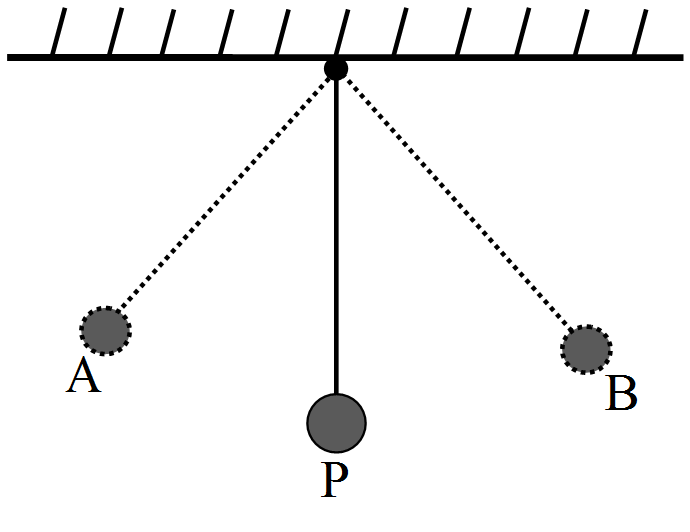
When a pendulum moves from its mean position $P$ to either of its extreme positions $A$ or $B,$ it rises through a height h above the mean level $P.$ At this point, the kinetic energy of the bob changes completely into potential energy. The kinetic energy becomes zero, and the bob possesses only potential energy. As it moves towards point $P,$ its potential energy decreases progressively. Accordingly, the kinetic energy increases. As the bob reaches point $P,$ its potential energy becomes zero and the bob possesses only kinetic energy. This process is repeated as long as the pendulum oscillates. The bob does not oscillate forever. It comes to rest because air resistance resists its motion. The pendulum loses its kinetic energy to overcome this friction and stops after some time. The law of conservation of energy is not violated because the energy lost by the pendulum to overcome friction is gained by its surroundings. Hence, the total energy of the pendulum and the surrounding system remain conserved. View full question & answer→Question 352 Marks
What is power$?$ How do you differentiate kilowatt from kilowatt hour? The Jog Falls in Karnataka state are nearly $20m$ high. $2000$ tonnes of water falls from it in a minute. Calculate the equivalent power if all this energy can be utilized$? (g = 10ms^{-2})$
AnswerPower is the rate of doing work. kilowatt is the unit of power and kilowatt hour is the unit of energy. $h = 20m,$ and mass $=2000\times10^3\text{kg}=2\times10^6\text{kg}$
$\text{Power}=\frac{\text{mgh}}{\text{t}}=\frac{2\times10^6\times10\times20}{60}\text{W}$
$=\frac{4}{6}\times10^7\text{W}=\frac{2}{3}\times10^7\text{W}$
View full question & answer→Question 362 Marks
A car is being driven by a force of $2.5 \times 1010 \mathrm{~N}$. Travelling at a constant speed of $5 \mathrm{~m} / \mathrm{s}$, it takes 2 minutes to reach a certain place. Calculate the work done.
AnswerForce, $\mathrm{F}=2.5 \times 10^{10} \mathrm{~N}$
Velocity, $\mathrm{v}=5 \mathrm{~m} / \mathrm{s}$
Time, $\mathrm{t}=2$ minutes $=120 \mathrm{~s}$
Distance, $\mathrm{s}=\mathrm{v} \times \mathrm{t}=5 \times 120=600 \mathrm{~m}$
Work done, $W=F \times s=2.5 \times 10^{10} \times 600 \mathrm{~m}=15 \times 10^{12} \mathrm{~J}$
View full question & answer→Question 372 Marks
Is it possible that a force is acting on a body but still the work done is zero? Explain giving one example.
AnswerYes, it is possible that a force is acting on a body but still work done is zero. For example, in the case of a man pushing a wall, the work done is zero despite of non-zero force, since there is no displacement of the wall.
View full question & answer→Question 382 Marks
In each of the following a force, $F$ is acting on an object of mass, $m.$ The direction of displacement is from west to east shown by the longer arrow. Observe the diagrams carefully and state whether the work done by the force is negative, positive or zero.

AnswerCase I: In this case, the direction of force acting on the block is perpendicular to the displacement. Therefore, work done by force on the block will be zero.
Case II: In this case, the direction of force acting on the block is in the direction of displacement. Therefore, work done by force on the block will be positive.
Case III: In this case, the direction of force acting on the block is opposite to the direction of displacement. Therefore, work done by force on the block will be negative.
View full question & answer→Question 392 Marks
A bulb lights up when connected to a battery. State the energy change which takes place:
- In the battery.
- In the bulb.
Answer
- Chemical energy to electrical energy.
- Electrical energy to heat and light energy.
View full question & answer→Question 402 Marks
State and define $SI$ unit of power.
AnswerPower The rate of doing work is called power. Its $SI$ unit is watt.
View full question & answer→Question 412 Marks
A person of mass $50\ kg$ climbs a tower of height $72$ metres. Calculate the work done. $\left(8=9.8 \mathrm{~ms}^{-2}\right)$
AnswerMass of the person, $\mathrm{m}=50 \mathrm{~kg}$
Height of tower, $\mathrm{h}=72 \mathrm{~m}$
Acceleration due to gravity $=9.8 \mathrm{~m} / \mathrm{s}^2$
Work done $\mathrm{W}=\mathrm{m} \times \mathrm{g} \times \mathrm{h}=50 \times 9.8 \times 72=35280 \mathrm{~J}$
View full question & answer→Question 422 Marks
How does energy varies in an oscillating pendulum$?$ Express how many times potential energy and kinetic energy attain maximum in an oscillation$?$
Answer$PE$ is maximum twice that is at the extreme ends at the mean position $KE$ is maximum $=$ mgh But mechanical energy $(PE + KE)$ remains constant throughout in accordance with the law of conservation of energy.
View full question & answer→Question 432 Marks
A man $X$ goes to the top of a building by a vertical spiral staircase. Another man $Y$ of the same mass goes to the top of the same building by a slanting ladder. Which of the two does more work against gravity and why$?$
AnswerThe work done by both $X$ and $Y$ are equal because irrespective of whether they reach the top of building by using a spiral or slanted ladder, the vertical distance moved by them against the gravity is same.
View full question & answer→Question 442 Marks
What is the work done against gravity when a body is moved horizontally along a frictionless surface?
AnswerThe work done against gravity is zero when a body is moved horizontally along a frictionless surface because force of gravity acts perpendicular to the direction of motion.
View full question & answer→Question 452 Marks
A force of $5N$ is acting on an object. The object is displaced through $2m$ in the direction of the force. If the force acts on the object all through the displacement, then work done is $5N × 2m = 10Nm$ or $10J.$

AnswerWhen a force $F$ acts on an object to displace it through a distance $S$ in its direction, then the work done $W$ on the body by the force is given by: Work done $=$ Force $×$ Displacement $W = F × S$ Where, $F = 7N$
$S = 8m$ Therefore, work done, $W = 7 × 8 = 56Nm = 56J$
View full question & answer→Question 462 Marks
What kind of energy transformations takes place at a coal-based thermal power station?
AnswerAt a coal-based thermal power station, the chemical energy of coal is transformed into heat energy, which is further converted into kinetic energy and electrical energy.
View full question & answer→Question 472 Marks
A certain household consumes $650$ units of electricity in a month. How much is this electricity in joules?
AnswerEnergy consumption $=650$ units $=650 \mathrm{kWh} 1 \mathrm{kWh}=3.6 \times 10^6 \mathrm{~J} 650 \mathrm{kWh}=3.6 \times 650 \times 10^6=2.34 \times 10^9 \mathrm{~J}$
View full question & answer→Question 482 Marks
A mass of $10\ kg$ is at a point $A$ on a table. It is moved to a point $B.$ If the line joining $A$ and $B$ is horizontal, what is the work done on the object by the gravitational force? Explain your answer.
AnswerWork done by gravity depends only on the vertical displacement of the body.
It does not depend upon the path of the body.
Therefore, work done by gravity is given by the expression,
$W = mgh$
Where, Vertical displacement, $h = 0$
$\therefore W = mg × 0 = 0$
Hence, the work done by gravity on the body is zero.
View full question & answer→Question 492 Marks
Can any object have mechanical energy even if its momentum is zero? Explain.
AnswerYes, mechanical energy comprises both potential energy and kinetic energy. Momentum is zero which means velocity is zero. Hence, there is no kinetic energy but the object may possess potential energy.
View full question & answer→Question 502 Marks
How much electrical energy in joules does a $100$ watt lamp consumes:
- In $1$ second$?$
- In $1$ minute$?$
AnswerPower $= 100W$
- time $= 1s$
energy $=$ power $\times $ time $= 100 J$
- time $= 1$ minute $= 60 s$
energy $=$ power $\times $ time
$= 100 \times 60 = 6kJ$ View full question & answer→