Questions · Page 1 of 2

SHORT ANSWER QUESTIONS(3 Mark)

🎯

Test yourself on this topic

50 questions · timed · auto-graded

Question 13 Marks
Answer the following questions briefly.How is migration a determinant factor of population change?
Answer
Migration a Determinant Factor:
  • Migration is the movement’ of people across regions and territories.
  • Migration can be internal (within the country) or international (between the countries).
  • Migration is a determinant factor of population change as it changes its size and composition.
  • Internal migration does not change the size of the population but influences the distribution of population within the nation.
  • In India, most migrations have been from rural to urban areas because of the ‘push’ factors in rural areas. These push factors are adverse conditions of poverty and unemployment in the rural areas. The ‘pull’ factors of the city are In terms of increased employment opportunities and better living conditions.
  • These ‘push’ and ‘pull’ factors have led to increased migration from rural to urban areas and rapid rise in the urban population.
  • There has been a significant increase in the number of ‘million plus cities’ from 25 to 35 in just one decade i.e., 1991-2001.
View full question & answer
Question 23 Marks
What kind of migration takes place when a poor farmer in Bihar leaves his village and comes to Delhi for work?
Answer
The kind of migration takes place when a poor farmer in Bihar leaves his village The new migrants coming to Delhi were rural landlords, lawyers, teachers, traders and small shopkeepers. Partition changed their lives, and their occupations. They had to take up new jobs as hawkers, vendors, carpenters and ironsmiths.
View full question & answer
Question 33 Marks
Sex ratio in the country has always remained unfavourable to females. What are its reasons?
Answer
  1. Preferential treatment is given to a male child and female children get neglected in most Indian homes.
  2. The infant mortality rate in India is high and female infant mortality rate is still higher.
  3. Women generally have lower social, political and economic status in the Indian society. We find dowry deaths, opposition to widow remarriages and low nutritional levels in women.
View full question & answer
Question 43 Marks
Answer the following questions briefly.Discuss the major components of population growth.
Answer
The major components of population growth are birth rates, death rates and migration.
The natural increase of population is the difference between birth rates and death rates.
Birth Rate: Birth rate is the number of live births per thousand person in a year. It is a major component of growth, because in India birth rates have always been higher than death rates.
Death Rate: Death rate is the number of deaths per thousand persons in a year. The main cause of the rate of growth of the Indian population has been the rapid decline in death rates.
Migration Migration is the movement of people across regions and territories. Migration can be internal (within the country) or international (between the countries).
Internal migration does not change the size of the population, but influences the distribution of population within the nation.
View full question & answer
Question 53 Marks
What is census? When was the first census held in India? Which type of information can we get through census?
Answer
  1. A census is an official enumeration of population done periodically.
  2. In India, the first census was held in the year 1872. The first complete census, however, was taken in the year 1881. Since then, the censuses have been held regularly every tenth year.
  3. The Indian census is the most comprehensive source of demographic, social and economic data.
View full question & answer
Question 63 Marks
What is meant by occupational structure? Classify occupations in three categories.
Answer
The distribution of the population according to different types of occupations is referred to as the occupational structure. An enormous variety of occupations are found in any country. These occupations can be classified into three categories-primary, secondary and tertiary .
  1. Primary activities include agriculture, animal husbandry, building and construction work, etc.
  2. Secondary activities include manufacturing industry, building and construction work, etc.
  3. Tertiary activities include transport, communications, commerce, administration and other services.
View full question & answer
Question 73 Marks
What can be the reasons for the declining death rate in India?
Answer
The substantial improvement is the result of many factors including improvement in public health, prevention of fatal diseases and application of medical practices in diagnosis and treatment of ailments.
View full question & answer
Question 83 Marks
What is age composition? How does it affect the population’s social and economic structure?
Answer
The age composition of a population refers to the number of people in different age groups in a country.
  1. It is one of the most basic characteristics of population.
  2. To an important degree, a person’s age influences what he needs, buys, does and his capacity to perform.
  3. Consequently, the number and percentage of a population found within the children, working age and aged groups are notable determinants of the population’s social and economic structure.
View full question & answer
Question 93 Marks
What do you know about the size and distribution of India’s population on the basis of the 2011 Census?
Answer
According to the Census 2011 data:
  1. UP with a population size of 199.5 million people is the most populous state of India.
  2. The Himalayan state of Sikkim has a population of just about 0.6 million and Lakshadweep has a population of only 64 thousand people.
  3. Almost half of India’s population live in just five states:
  1. UP.
  2. Maharashtra.
  3. Bihar.
  4. West Bengal.
  5. Andhra Pradesh.
View full question & answer
Question 103 Marks
What do you mean by sex ratio? Why is it important to know about it? What is meant by unfavourable sex ratio?
Answer
  1. Sex ratio is defined as the number of females per 1000 males in the population.
  2. This information is an important social indicator to measure the extent of equality between males and females in a society at a given time.
  3. The sex ratio in the country has always remained unfavourable to females. It means that the number of females per 1000 males has always remained low in our country. This is clear from the following table:
Census Years
Sex Ratio (Females per 1000 males)
1951
946
1961
941
1971
930
1981
934
1991
929
2001
933
2011
943
India: Sex ratio 1951-2011
View full question & answer
Question 113 Marks
Census is primarily considered with which three main characteristic questions about the population. Explain them.
Answer
The three main questions on which census is primarily concerned with are:
  1. A census provides us information regarding the population of the country.
  2. It is the most comprehensive source of demographic, social and economic data.
  3. It provides us with information regarding population size and distribution.
View full question & answer
Question 123 Marks
What is sex ratio? How is it calculated?
Answer
Sex ratio is defined as the number of females per 1,000 males in the population. This information is an important social indicator, to measure the extent of equality between males and females in a society, at a given time.
The sex ratio in India has always remained unfavourable for females. The sex ratio of India in 1951 was 946 females per 1,000 males and in 2011, it declined to 945 females per 1,000 males.
View full question & answer
Question 133 Marks
What is meant by age composition of population?
Answer
  1. Age composition refers to the number of people in different age, groups in a country. It is the most basic characteristic of a population.
  2. To an important degree, a person's age influences what he needs, buys, does and his capacity to perform.
  3. Consequently, the number and percentage of a population found within the children, working age and aged groups are notable determinants of the population's social and economic structure.
View full question & answer
Question 143 Marks
Describe the broad categories the population of a nation is generally grouped into?
Answer
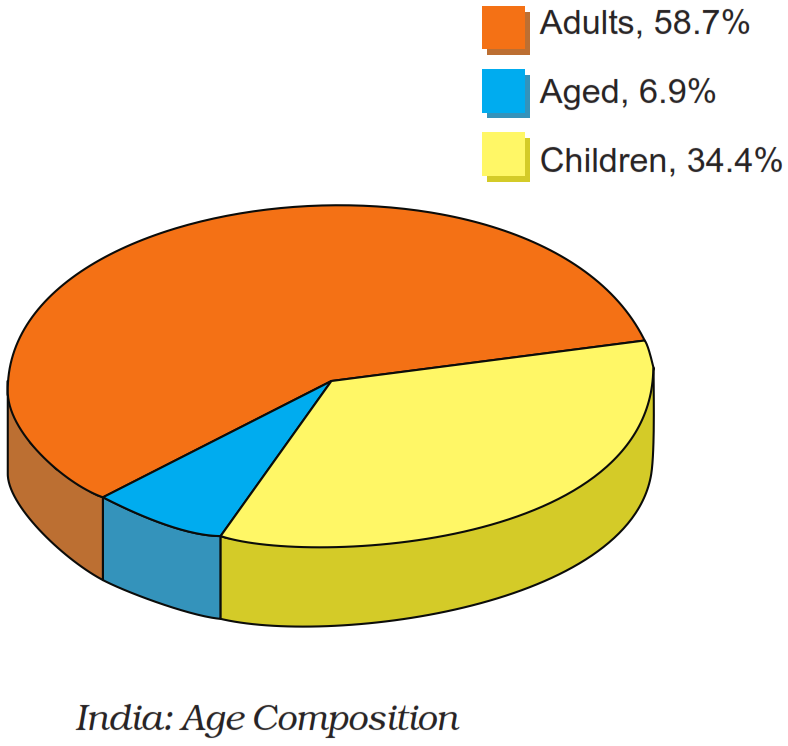
The population of a nation is, generally, grouped into three broad categories:
  1. Children (generally below 15 years): They are economically unproductive and need to be provided with food, clothing, education and medical care.
  2. Working Age (15-59 years): They are economically productive and biologically reproductive. They comprise the working population.
  3. Aged (Above 59 years): They can be economically productive though they may have retired. They may be working voluntarily but they are not available for employment through recruitment.
View full question & answer
Question 153 Marks
Answer the following questions briefly.Why is the rate of population growth in India declining since 1981?
Answer
Since 1981, the rate of growth started declining gradually, because of popularised.
  1. Family planning measures were adopted, leading to decline in the birth rate.
  2. Awareness about advantages of small family came to be recognised.
  3. There was a growth of nuclear families occured which adopted the small family norm.
  4. Promotion of family planning programme by the government.
View full question & answer
Question 163 Marks
What is demographic divide? In which year is this divide seen in India and why?
Answer
When there is a sudden fluctuation in population or the growth rate declines, it is called demographic divide.
  1. In India, it took place in 1981 as the rate of growth started declining gradually.
  2. It happened as the birth rate declined rapidly during this period.
  3. Since 1981, birth rates declined, resulting in a gradual decline in the rate of population growth.
View full question & answer
Question 173 Marks
What is meant by age composition? Why is it important to know the age composition?
Answer
The age composition of a population refers to the number of people in different age groups in a country.
  1. It is one of the most basic characteristics of a population. To an important degree, a person’s age influences what he/ she needs, buys, does and his/ her capacity to perform.
  2. Consequently, the number and percentage of a population found within the children, working age and aged groups are notable determinants of the population’s social and economic structure.
View full question & answer
Question 183 Marks
Describe the three broad categories of the population of a nation.
Answer
The population of a nation is generally grouped into the following three categories:
  1. Children (generally below 15 years): The group of population that comes under this category is economically unproductive and needs to be provided with food, clothing, education and medical care.
  2. Working Age (15-59 years): They are economically productive and biologically reproductive. They comprise the working population.
  3. Aged (above 59 years): They can be economically productive though they may have retired. They may be working voluntarily but they are not available for employment through recruitment.
View full question & answer
Question 193 Marks
The National Population Policy (NPP) 2000 plays an important role in improving individual health and welfare.
Answer
It is a fact that the NPP 2000 has done a great job in improving the health and welfare of the people in general. The policy has provisions of imparting free and compulsory school education up to 14 years of age. It emphasises on delayed marriage for girls. It also aims at achieving universal immunisation of children against all vaccine preventable diseases. These measures will definitely improve the situation and help in making India a prosperous country.
View full question & answer
Question 203 Marks
What is migration? Which are the two types of migration? Describe the trends of migration in India.
Answer
  1. Migration is the movement of people across regions and territories.
  2. Migration can be internal or international.
  3. In India, most migrations have been from rural to urban areas because of the push factor in rural areas. These are adverse conditions of poverty and unemployment in the rural areas and the ‘pull’ of the city in terms of increased employment opportunities and better living conditions.
View full question & answer
Question 213 Marks
What are the improvements made in the health status of the people in India?
Answer
  1. Health is an important component of population composition, which affects the process of development. Hence, it is essential to pay attention on the health of the people.
  2. Sustained efforts of government programmes have registered significant improvements in the health condition of the Indian population. As a result, death rates have declined considerably. Death rates have declined from 25 per 1000 population in 1951 to 7.2 per 1000 in 2011 and life expectancy at birth has increased from 36.7 years in 1951 to 67.9 years in 2011.
  3. The substantial improvement is the result of many factors including improvement in public health, prevention of infectious diseases and application of modern medical practices in diagnosis and treatment of ailments.
View full question & answer
Question 223 Marks
Distinguish between population growth and population change.
Answer
Population Growth
Population Change
It refers to the increase in the number of inhabitants of a region during a specific period of time.
It refers to the change in the distribution, composition or size of a population during a specific period of time.
Natural increase of population and immigration are the major components causing population growth.
Natural increase, immigration and emigration are the major components causing population change.
View full question & answer
Question 233 Marks
What do you mean by the term migration? What are its types? Explain them.
Answer
Migration is the movement of people across regions and territories. Migration can be internal and international. Internal migration occurs within the country and international migration occurs between the countries.
Internal migration does not change the size of the population but influences the distribution of population within the countries. Migration plays an important role in changing the composition and distribution of population.
View full question & answer
Question 243 Marks
What are the advantages of having a healthy population?
Answer
The advantages of having a healthy population are:
  • A healthy individual is much more efficient and productive than an unhealthy individual.
  • He or she is able to realise his or her potential, and play an important role in social and national development.
  • Absenteeism is low where the workers are healthy.
View full question & answer
Question 253 Marks
What is occupational structure? How are occupations generally classified?
Answer
The distribution of the population according to different types of occupation is referred to as Occupational Structure.
Occupations are generally classified as:
  1. Primary activities: These include agriculture, animal husbandry, forestry, fishing, mining and quarrying, etc.
  2. Secondary activities: These include the manufacturing industry, building and construction work, etc.
  3. Tertiary activities: These include transport, communication, commerce, administration and other services.
View full question & answer
Question 263 Marks
What does the National Population Policy indicate?
Answer
  1. The NPP 2000 provides a policy framework for imparting free and compulsory school education upto 14 years.
  2. It reduces the infant mortality rate to below 30 per thousand live births.
  3. It helps in achieving universal immunisation of children against all vaccine-preventable diseases.
  4. It has promoted delayed marriage for girls and has made family welfare a people-centred programme.
View full question & answer
Question 273 Marks
Which areas are sparsely populated in India and why?
Answer
Sparsely populated areas of India are high mountain regions of Jammu and Kashmir and Arunachal Pradesh and desert parts of Rajasthan.
Reasons:
  1. Extremely cold climatic condition, which makes living difficult.
  2. High and snow covered areas do not favour any kind of habitation.
  3. There are few regions which are fertile but they, too, are small and scattered. Besides that, it is difficult to approach these areas since there are no good means of transportation and communication available.
  4. Desert area of Rajasthan is arid, hot and dry region. It has sandy soils, not suitable for cultivation. So, it does not favour any habitation.
View full question & answer
Question 283 Marks
Who are adolescents? Why do they need more attention?
Answer
Adolescents are those who come in the age-group of 10 to 19 years. They constitute one-fifth of the total population of India.They need more attention because of the following reasons:
  1. Adolescents are the most important resource for the future.
  2. Nutrition requirements of adolescents are higher than those of a normal child or adult.
  3. Poor nutrition can lead to deficiency and stunted growth. But the diet available for the Indian adolescents is inadequate in all nutrients. A large number of adolescent girls suffer from anaemia.
View full question & answer
Question 293 Marks
Approximately how much proportion of India's population is engaged in the occupation of agriculture?
Answer
According to 2011 Agricultural Census of India, an estimated 61.5% of the 1300 million Indian population is rural and dependent on agriculture. Thenumber of farming households is 159.6 million.
View full question & answer
Question 303 Marks
What has been the trend of growth rate since 1981? Why?
Answer
Since 1981, the rate of growth started declining gradually. During this period, birth rates declined rapidly. Which is a positive indicator of the efforts of birth control.
View full question & answer
Question 313 Marks
Who is a literate person according to the Census 2011? Why is literacy considered important for the quality of the population?
Answer
According to the Census 2011 data, a person aged 7 years and above who can read and write with understanding in any language is treated as literate.
Literacy is considered very important for the quality of a population because of the following:
  1. Only a well-informed and educated citizen can make intelligent choices and undertake research and development projects.
  2. Low levels of literacy are a serious obstacle for economic improvement.
View full question & answer
Question 323 Marks
When did the first Family Planning Programme started in India?
Answer
India was the first country in the world to establish a government family planning program way back in 1952. According to 2011 Family Welfare Programme, some major achievements are as follows: Awareness of one or more methods of contraception.
View full question & answer
Question 333 Marks
How proportion of people working in different activities varies in developed and developing countries?
Answer
Developed nations have a high proportion of people in secondary and tertiary activities, whereas developing countries tend to have a higher proportion of their workforce engaged in primary activities.
View full question & answer
Question 343 Marks
Which age groups of population are economically unproductive?
Answer
Population of a nation is generally grouped into three broad categories:
  1. Children: Economically unproductive and needs to be provided with the necessities of life.
  2. Aged: They can be economically productive even after retirement.
View full question & answer
Question 353 Marks
Explain the following table showing India's population and population growth rates during 1951-2011.
Answer
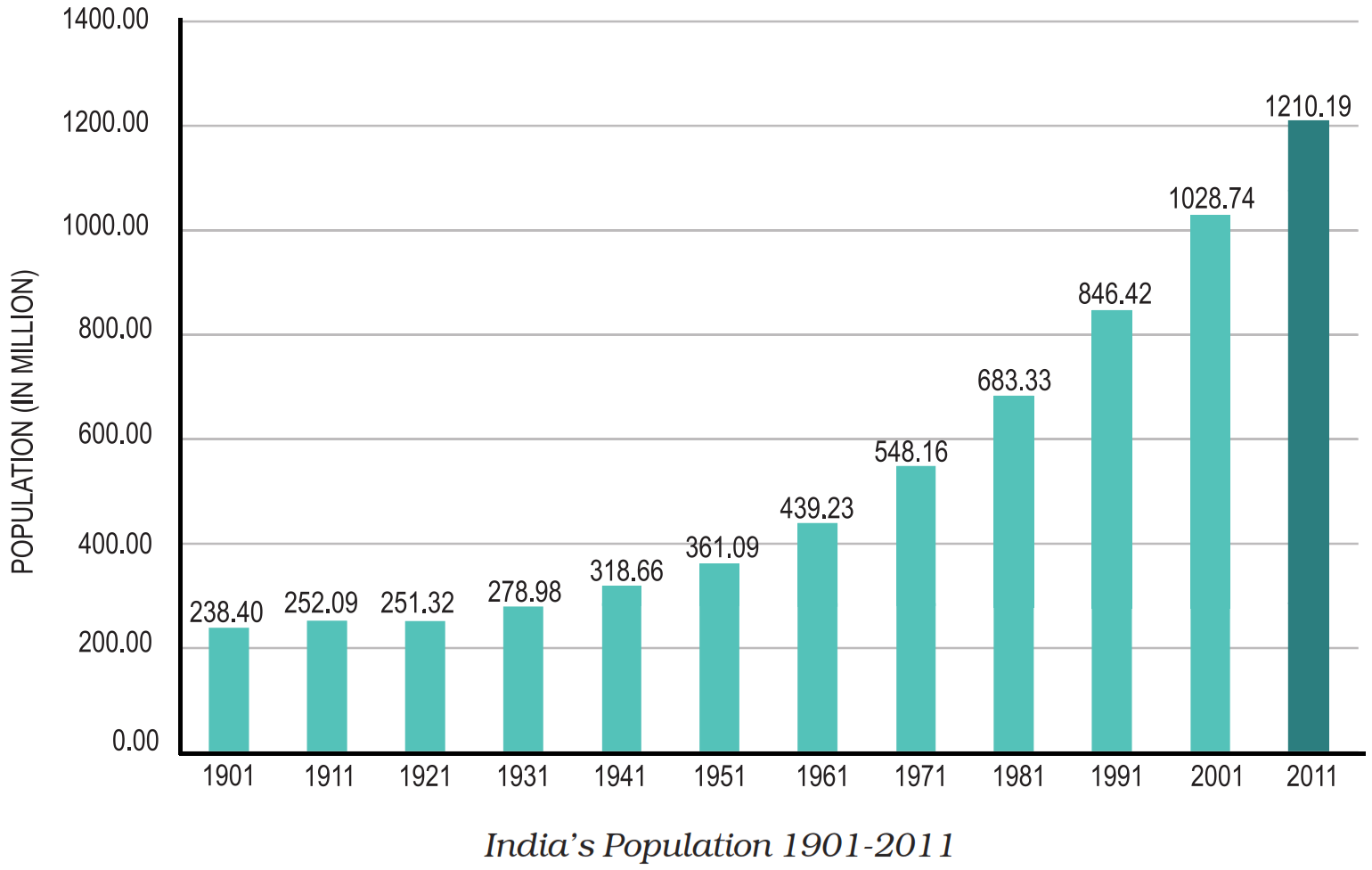
  1. The above table reveals that from 1951 to 1981, the annual rate of pupulation growth was steadily increasing which explains the rapid increase in population from 361.09 million in 1951 to 683.33 million in 1981.
  2. Since 1981, however, the rate of growth stated declining gradually. During the period, birth rates declined rapidly.
  3. Still 182.32 million people were added to the total population in the 1990s alone. In the Census year 2011 India's population became approx. 1210.19 million.
View full question & answer
Question 363 Marks
What do you mean by growth of population? How is it calculated?
Answer
Growth of population or population growth refers to the change in the number of inhabitants of a country during a specific period of time, say during the last ten years.
It can be expressed in two ways:
  1. Absolute Numbers. It is obtained by simply subtracting the earlier population from the later population. It is referred to as the ‘absolute increase’.
  2. Annual Growth Rate. When the rate or pace of population is studied in per cent per annum and increase is 2 per cent, i.e., there was an increase of two persons for every 100 persons in the base population, this is referred to as the annual growth rate.
View full question & answer
Question 373 Marks
Name the state in India leading in sex ratio. Also, explain two main reasons for the highest sex ratio in this state.
Answer
Kerala is leading in sex ratio in the country. Kerala has a sex ratio of 1084 females per 1000 males, whereas India sex ratio is 943 females per 1000 male.
Two main reasons for the highest sex ratio in this state:
  1. Higher literacy rates: They are much literate. Their literacy helps them not to have any discrimination based on gender.
  2. Lack of female infanticide trend: As majority in Kerala don’t consider a girl as a burden and heavily associate the gender with Prosperity.
View full question & answer
Question 383 Marks
We can reduce the population growth rate by providing better educational opportunities to women. Support the statement with facts.
Answer
Education acts through several pathways to decrease birth rates among women in developing countries. Economically, income increases by at least 10% for every additional year of school. Because education is associated with permanent increases in income, it allows women to more substantially focus their efforts on improving the quality of life of a few children, rather than improving the quantity of children with the hopes of only a fraction of offspring surviving into adulthood.
View full question & answer
Question 393 Marks
What is the importance of people in this world?
Answer
  1. People are important for the development of the economy and society.
  2. People make use of resources. They themselves are also resources, but with varying quality.
  3. Coal is but a piece of rock, until people are able to invent technology to obtain it and make it a ‘resource’.
View full question & answer
Question 403 Marks
Name any one process due to which population changes.
Answer
There are three main processes of change of population: birth rates, death rates and migration. The natural increase of population is the difference between birth rates and death rates. Birth Rate The number of live births per 1000 persons is called the birth rate.
View full question & answer
Question 413 Marks
Describe the population density zones of India.
Answer
The three population density zones of India are:
  1. High density zone: The Northern plains, above 500 people per sq. km.
  2. Moderate or medium density zone: Mountain region, 250-500 people per sq. km.
  3. Low density zone: Plateau region, below 250 people per sq. km.
View full question & answer
Question 423 Marks
What does the 2011 census data reveal?
Answer
  1. The 2011 census data reveals that India's population is 1.21 billion. These 1.21 billion people are unevenly distributed over country's vast area.
  2. Uttar Pradesh is the most populous state of India. It accounts for about 19 percent of the country's population. On the other hand, the Himalayan state, Sikkim, has a population of just about 0.6 million and Lakshadweep has only 64,429 people.
  3. Almost half of India's population lives in just five states-Uttar Pradesh, Maharashtra, Bihar, West Bengal and Andhra Pradesh.
View full question & answer
Question 433 Marks
Answer the following questions briefly.Define age structure, death rate and birth rate.
Answer
Age Structure: Age Structure means the number of people in different age groups in a given population.
Death Rate: Death rate is the number of deaths per thousand persons In a year.
Birth Rate: Birth rate is the number of live births per thousand persons in a year.
View full question & answer
Question 443 Marks
How does migration affect the population?
Answer
Migration affect the population of the two particular areas. It increases the population of the place (new place), where people migrate in search of good facilities and decreases the population of the area where people migrate from. It is an unnatural cause that changes the population.
View full question & answer
Question 453 Marks
Give an example of annual growth rate of population.
Answer
Global human population growth amounts to around 83 million annually, or 1.1% per year. The global population has grown from 1 billion in 1800 to 7.616 billion in 2018.
View full question & answer
Question 463 Marks
Who is a literate person, according to the Census 2011? Why is it essential to raise the level of literacy?
Answer
According to the Census 2011, a person aged 7 years and above, who can read and write with understanding in any language, is treated as 'literate'.
  1. Literacy is a very important quality of population. Obviously, only an informed and educated citizen can make intelligent choices and undertake research and development projects.
  2. Low levels of literacy are a serious obstacle for economic improvement. It is a good sign that there has been a steady improvement in the literacy level in India.
  3. The literacy rate in the country as per the Census 2011 was 73 percent; 80.9 percent for males and 64.6 percent for females.
View full question & answer
Question 473 Marks
A healthy population is an asset to the country. Expalin it.
Answer
A healthy population is an asset to the country. A healthy individual is much more efficient and productive than an unhealthy individual.A healthy individual is able to realise his/her potential and play an important role in social and national development. A nation can grow fast if it has a healthy population.
View full question & answer
Question 483 Marks
India has population of about 1200 million crores, but still it is underdeveloped. Why?
Answer
India is undeveloped because the average productivity level of its population is low. This in turn is due to the poor standard of education and health of most people in India. Hence, India's level of human capital is low even though the population is very high at over 133 crores. Due to the low level of human capital, India remains undeveloped.
View full question & answer
Question 493 Marks
Enumerate the reasons for sparse population in states like Arunachal Pradesh, Mizoram and Jammu and Kashmir.
Answer
Net sown area in Arunachal Pradesh, Mizoram and Manipur is low mainly due to the hilly and rocky terrain. They are also largely covered by dense forests, which will need to be cut to develop agriculture. Andaman and Nicobar Islands are covered by dense tropical forests and so net sown area is low.
View full question & answer
Question 503 Marks
Migration is an important determinant of population change. Explain.
Answer
  1. Migration is the movement of people across different states and regions. When people migrate within the boundaries of the country, it is called internal migration. International migration refers to the migration of people between countries.
  2. Migration is an important determinant of population change as it not only changes the size of population but also affects the population composition of urban and rural areas.
View full question & answer
SHORT ANSWER QUESTIONS(3 Mark) - Social Science STD 9 Questions - Vidyadip