Questions

M.C.Q (1 Marks)

🎯

Test yourself on this topic

30 questions · timed · auto-graded

MCQ 11 Mark
The circumferences of two circles are in the ratio 3 : 4. The ratio of their areas is:
  • A
    3 : 4
  • B
    4 : 3
  • 9 : 16
  • D
    16 : 9
Answer
Correct option: C.
9 : 16
Let the the radii of the two circles be r and R, the circumferences of the circles be c and C and the areas of the two circles be a and A.
Now,
$\frac{\text{c}}{\text{C}}=\frac{3}{4}$
$\Rightarrow\frac{2\pi\text{r}}{2\pi\text{R}}=\frac{3}{4}$
$\Rightarrow\frac{\text{r}}{\text{R}}=\frac{3}{4}$
Now, the ratio between their areas is given by
$\frac{\text{a}}{\text{A}}=\frac{\pi\text{r}^2}{\pi\text{R}^2}$
$=\Big(\frac{\text{r}}{\text{R}}\Big)^2$
$=\Big(\frac{3}{4}\Big)^2$
$=\frac{9}{16}$
Hence, the correct answer is option (c).
View full question & answer
MCQ 21 Mark
The length of an arc of the sector of angle $\theta^\circ$ of a circle with radius R is:
  • A
    $\frac{2\pi\text{R}\theta}{180}$
  • $\frac{2\pi\text{R}\theta}{360}$
  • C
    $\frac{\pi\text{R}^2\theta}{180}$
  • D
    $\frac{\pi\text{R}^2\theta}{360}$
Answer
Correct option: B.
$\frac{2\pi\text{R}\theta}{360}$
View full question & answer
MCQ 31 Mark
The length of the minute hand of a clock is $21\ cm$. The area swept by the mmute hand in $10$ minutes is:
  • $231\ cm^2$
  • B
    $210\ cm^2$
  • C
    $126\ cm^2$
  • D
    $252\ cm^2$
Answer
Correct option: A.
$231\ cm^2$
Angle subtends by the minute hand in $1$ minute $= 6^\circ$
$\therefore$ Angle subtends by the minute hand in $10$ minutes $= 60^\circ$
Now,
Area of the sector $=\frac{\theta}{360}\pi\text{r}^2=\frac{60^\circ}{360^\circ}\times\frac{22}{7}(21)^2=231\text{cm}^2$
Hence, the correct answer is option $(a).$
View full question & answer
MCQ 41 Mark
If the sum of the areas of two circles with radii $R_1$ and $R_2$ is equal to the area of a circle of radius $R,$ then:
  • A
    $\text{R}_1+\text{R}_2=\text{R}$
  • B
    $\text{R}_1+\text{R}_2<\text{R}$
  • C
    $\text{R}_1^2+\text{R}_2^2<\text{R}^2$
  • $\text{R}_1^2+\text{R}_2^2=\text{R}^2$
Answer
Correct option: D.
$\text{R}_1^2+\text{R}_2^2=\text{R}^2$
Because the sum of the areas of two circles with radii $R_1$ and $R_2$ is equal to the area of a circle with
Radius $R$, we have:
$\pi\text{R}_1^2+\pi\text{R}_2^2=\pi\text{R}^2$
$\Rightarrow\pi\big(\text{R}_1^2+\text{R}_2^2\big)=\pi\text{R}^2$
$\Rightarrow\text{R}_1^2+\text{R}_2^2=\text{R}^2$
View full question & answer
MCQ 51 Mark
If the circumference of a circle and the perimeter of a square are equal, then:
  • A
    Area of the circle $=$ area of the square
  • $($area of the circle$) > ($area of the square$)$
  • C
    $($area of the circle$) < ($area of the square$)$
  • D
    None of these
Answer
Correct option: B.
$($area of the circle$) > ($area of the square$)$
Let rbe the radius of the circle.
We know:
Circumference of the circle $=2\pi\text{r}$
Now,
Let a be the side of the square.
We know:
Perimeter of the square $= 4a$
Now,
$2\pi\text{r}=4\text{a}$
$\Rightarrow\text{r}=\frac{4\text{a}}{2\pi}$
$\therefore$ Area of the circle $=\pi\text{r}^2$
$=\pi\times\Big(\frac{4\text{a}}{2\pi}\Big)^2$
$=\pi\times\frac{16\text{a}^2}{4\pi^2}$
$=\frac{4\text{a}^2}{\pi}$
$=\frac{4\times7\text{a}^2}{22}$
$=\frac{14\text{a}^2}{11}$
Also,
Area of the square $= a^2$
Clearly, $\frac{14\text{a}^2}{11}>\text{a}^2$
$\therefore$ Area of the circlr $ > $ Area of the square
View full question & answer
MCQ 61 Mark
The diameter of a wheel is 84cm. How many revolutions Will it make to cover 792m?
  • A
    200
  • B
    250
  • 300
  • D
    350
Answer
Correct option: C.
300
let d cm be the diameter of the wheel.
We know:
Circumference of the wheel $=\pi\times\text{d}$
$=\Big(\frac{22}{7}\times84\Big)\text{cm}$
$=264\text{cm}$
Now,
Number of revolutions to cover 792m $=\Big(\frac{792\times1000}{264}\Big)$
$=300$
View full question & answer
MCQ 71 Mark
The area of circle is equal to the sum of the areas of two circles of radii 24cm and 7cm. The diameter of
the new circle is:
  • A
    25cm
  • B
    31cm
  • 50cm
  • D
    62cm
Answer
Correct option: C.
50cm
Let rem be the radius of the new circle.Now,
Area of the new circle = Area of the circle with radius 24cm + Area of the circle with radius 7cm Thus. we have:
$\pi\text{r}\text{r}^2=\pi\text{r}_1^2+\pi\text{r}_2^2$
$\Rightarrow\pi\text{r}^2=\big[\pi\times(24)^2+\pi\times(7)^2\big]\text{cm}^2$
$\Rightarrow\pi\text{r}^2=\big[\pi\times576+\pi\times49\big]\text{cm}^2$
$\Rightarrow\pi\text{r}^2=\pi\times(576+49)\text{cm}^2$
$\Rightarrow\text{r}^2=625\pi\text{cm}^2$
$\Rightarrow\text{r}^2=625$
$\Rightarrow\text{r}=25$
$\therefore$ Diameter of the new circle $=(25\times2)\text{cm}$
$=50\text{cm}$
View full question & answer
MCQ 81 Mark
The radius of a wheel is 0.25m. How many revolutions will it make in covering 11km?
  • A
    2800
  • B
    4000
  • C
    5500
  • 7000
Answer
Correct option: D.
7000
Distance covered in 1 revolulion $=2\pi\text{r}$$=\Big(2\times\frac{22}{7}\times0.25\Big)\text{m}$
$=\Big(2\times\frac{22}{7}\times\frac{25}{100}\Big)\text{m}$
$=\frac{11}{7}\text{m}$
Number of revolutions taken to cover 11km $=\Big(11\times1000\times\frac{7}{11}\Big)$
$=7000$
View full question & answer
MCQ 91 Mark
The area of a circle is $38.5\ cm^2$. The circumference of the circle is:
  • A
    $6.2\ cm$
  • B
    $12.1\ cm$
  • C
    $11\ cm$
  • $22\ cm$
Answer
Correct option: D.
$22\ cm$
Let the radius be $r \ cm.$
We know,
Area of a circle
$=\pi\text{r}^2\text{cm}^2$
Thus, we have:
$\pi\text{r}^2=38.5$
$\Rightarrow\frac{22}{7}\times\text{r}^2=38.5$
$\Rightarrow\text{r}^2=\Big(38.5\times\frac{7}{22}\Big)$
$\Rightarrow\text{r}^2=\Big(\frac{385}{10}\times\frac{7}{22}\Big)$
$\Rightarrow\text{r}^2=\frac{49}{4}$
$\Rightarrow\text{r}=\frac{7}{2}$
Now,
Circumference of the circle $=2\pi\text{r}$
$=2\times\frac{22}{7}\times\text{r}$
$=\Big(2\times\frac{22}{7}\times\frac{7}{2}\Big)$
$=22\text{cm}$
View full question & answer
MCQ 101 Mark
The radii of two concentric circles are $19 \ cm$ and $16 \ cm$ respectively. The area of the ring enclosed by these circles is:
  • A
    $320\ cm^2$
  • $330\ cm^2$
  • C
    $332\ cm^2$
  • D
    $340\ cm^2$
Answer
Correct option: B.
$330\ cm^2$
$R = 19\ cm$ and $r = 16\ cm$
Thus. we have:
Area of the ring $=\pi\big(\text{R}^2-\text{r}^2\big)$
$=\pi(\text{R}+\text{r})(\text{R}-\text{r})$
$=\big|\frac{22}{7}\times(19+16)\times(19-16)\big|\text{cm}^2$
$=\Big(\frac{22}{7}\times35\times3\Big)\text{cm}^2$
$=330\text{cm}^2$
View full question & answer
MCQ 111 Mark
The circumference of a circle is equal to the sum of the circumference of two circles having diameters 36cm and 20cm. The radius of the new circle is:
  • A
    16cm
  • 28cm
  • C
    42cm
  • D
    56cm
Answer
Correct option: B.
28cm
Let rem be the radius of the new circle.
We know:
Circumference of the new circle = Circumference of the circle with diameter 36cm + Circumference of the circle with diameter 20cm
Thus, we have:
$2\pi\text{r}=2\pi\text{r}_1+2\pi\text{r}_2$
$\Rightarrow2\pi\text{r}=(2\pi\times18)+(2\pi\times10)$
$\Rightarrow2\pi\text{r}=2\pi\times(18+10)$
$\Rightarrow2\pi\text{r}=(2\pi\times28)$
$\Rightarrow2\pi\text{r}=\Big(2\times\frac{22}{7}\times28\Big)$
$\Rightarrow2\pi\text{r}=176$
$\Rightarrow2\times\frac{22}{7}\times\text{r}=176$
$\Rightarrow\text{r}=\Big(176\times\frac{7}{44}\Big)$
$\Rightarrow\text{r}=28\text{cm}$
View full question & answer
MCQ 121 Mark
The perimeter of a circular field is $242m.$ The area of the field is:
  • A
    $9317m^2$
  • B
    $18634m^2$
  • $4658.5m^2$
  • D
    None of these
Answer
Correct option: C.
$4658.5m^2$
Let the radius be $r \ cm.$
We know,
Cirumference of the circle $=2\pi\text{r}$
Thus, we have:
$2\pi\text{r}^2=242$
$\Rightarrow2\times\frac{22}{7}\times\text{r}=242$
$\Rightarrow\frac{44}{7}\times\text{r}=242$
$\Rightarrow\text{r}=\Big(242\times\frac{7}{44}\Big)$
$\Rightarrow\text{r}=\frac{77}{2}$
$\therefore$ Area of the circle $=\pi\text{r}^2$
$=\Big(\frac{22}{7}\times\frac{77}{2}\times\frac{77}{2}\Big)\text{m}^2$
$=4658.5\text{m}^2$
View full question & answer
MCQ 131 Mark
The area of a square is the same as the area of a circle. Their perimeters are in the ratio:
  • A
    $1:1$
  • B
    $2:\pi$
  • C
    $\pi:2$
  • $\sqrt{\pi}:2$
Answer
Correct option: D.
$\sqrt{\pi}:2$
Let a be side of the square.
We know
Area of a square $= a^2$
Let $r$ be the radius of the circle.
We know:
Area of a circle $=\pi\text{r}^2$
Because the area of the square is the same as the area of the circle, we have:
$\text{a}^32=\pi\text{r}^2$
$\Rightarrow\frac{\text{r}^2}{\text{a}^2}=\frac{1}{\pi}$
$\Rightarrow\frac{\text{r}}{\text{a}}=\frac{1}{\sqrt{\pi}}$
$\therefore$ Ratio of their perimeters
$=\frac{2\pi\text{r}}{4\text{a}}$
$\big[$because perimeter o the circle is $2\pi\text{r}$ and perimeter of the square. is $4a\big]$
$=\frac{\pi\text{r}}{2\text{a}}$
$=\frac{\pi}{2}\times\frac{\text{r}}{\text{a}}$
$=\frac{\pi}{2}\times\frac{1}{\sqrt{\pi}}\Big[\text{Since}\frac{\text{r}}{\text{a}}=\frac{1}{\sqrt{\pi}}\Big]$
$=\frac{\sqrt{\pi}}{2}$
$=\sqrt{\pi}:2$
View full question & answer
MCQ 141 Mark
The difference between the circumference and radius of a circle is $37\ cm.$ The area of the circle is:
  • A
    $111\ cm^2$
  • B
    $184\ cm^2$
  • $154\ cm^2$
  • D
    $259\ cm^2$
Answer
Correct option: C.
$154\ cm^2$
Let the radius be $r \ cm.$
We know,
cirumference of the circle $=2\pi\text{r}$
Thus, we have:
$2\pi\text{r}^2-\text{r}=37$
$\Rightarrow\text{r}(2\pi-1)=37$
$\Rightarrow\text{r}\Big(2\times\frac{22}{7}-1\Big)=37$
$\Rightarrow\text{r}\Big(\frac{37}{7}\Big)=37$
$\Rightarrow\text{r}=\Big(37\times\frac{7}{37}\Big)$
$\Rightarrow\text{r}=7\text{cm}$
Now,
Circumference of the circle $=\pi\text{r}^2$
$=\Big(\frac{22}{7}\times7\times7\Big)\text{cm}^2$
$=154\text{cm}^2$
View full question & answer
MCQ 151 Mark
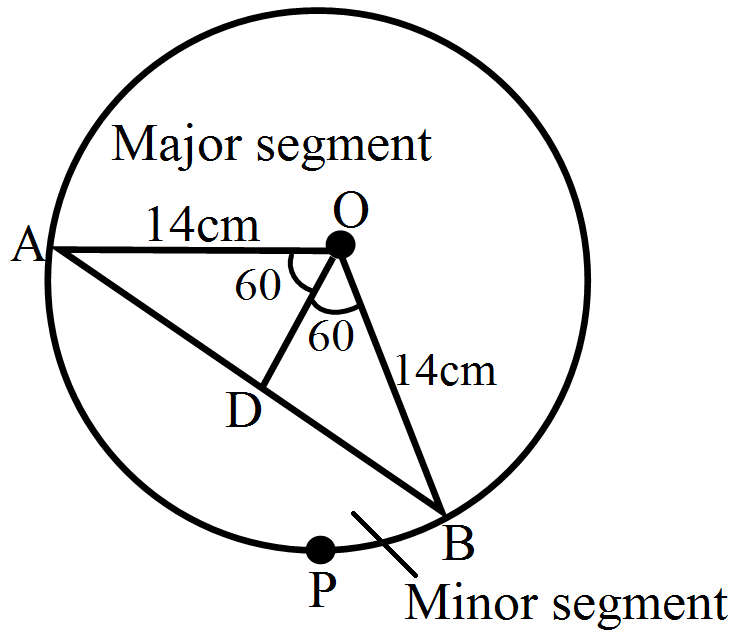
In a circle of radius $14\ cm.$ an arc subtends an angle of $120^\circ$ at the centre. If $\sqrt{3}=1.73$ then the area of the segment of the circle is:
  • $120.56\ cm^2$
  • B
    $124.63\ cm^2$
  • C
    $118.24\ cm^2$
  • D
    $130.57\ cm^2$
Answer
Correct option: A.
$120.56\ cm^2$

Radius of the circle, $r = 14\ cm$
Draw a perpendicular $OD$ to chord $AB.$ It will bisect $AB.$
$\angle\text{A}=180^\circ-(90^\circ+60^\circ)=30^\circ$
$\cos30^\circ=\frac{\text{AD}}{\text{OA}}$
$\Rightarrow\frac{\sqrt{3}}{2}=\frac{\text{AD}}{14}$
$\Rightarrow\text{AD}=7\sqrt{3}$
$\Rightarrow\text{AB}=2\times\text{AD}=14\sqrt{3}\text{cm}$
$\sin30^\circ=\frac{\text{OD}}{14}$
$\Rightarrow\text{OD}=7\text{cm}$
Area of minor segment $=$ Area of sector $\text{OAPB} -$ Area of tringle $\text{AOB}$
$=\frac{\theta}{360^\circ}\pi(\text{OA})^2-\frac{1}{2}\times\text{OD}\times\text{AB}$
$=\frac{120^\circ}{360^\circ}\times\frac{22}{7}(14)^2-\frac{1}{2}\times7\times14\sqrt{3}$
$=205.33-84.77$
$=120.56\text{cm}^2$
Hence, the correct answer is option $(a).$
View full question & answer
MCQ 161 Mark
The area of the sector of angle $\theta^\circ$ of a circle with radius R is:
  • A
    $\frac{2\pi\text{R}\theta}{180}$
  • B
    $\frac{\pi\text{R}^2\theta}{180}$
  • C
    $\frac{2\pi\text{R}\theta}{360}$
  • $\frac{\pi\text{R}^2\theta}{360}$
Answer
Correct option: D.
$\frac{\pi\text{R}^2\theta}{360}$
View full question & answer
MCQ 171 Mark
The area of a circle is $49\pi\text{ cm}^2.$ Its circumference is:
  • A
    $7\pi\text{ cm}$
  • $14\pi\text{ cm}$
  • C
    $21\pi\text{ cm}$
  • D
    $28\pi\text{ cm}$
Answer
Correct option: B.
$14\pi\text{ cm}$
Let the radius be r cm.We know,
Area of a circle
$=\pi\text{r}^2$
Thus, we have:
$\pi\text{r}^2=49$
$\Rightarrow\text{r}^2=49$
$\Rightarrow\text{r}^2=\sqrt{49}$
$\Rightarrow\text{r}=7$
Now,
Circumference of the circle $=2\pi\text{r}$
$=\Big(2\times\frac{22}{7}\times\frac{7}{2}\Big)\text{cm}$
$=14\pi\text{ cm}$
View full question & answer
MCQ 181 Mark
If the sum of the circumferences of two circles with radii $R_1$ and $R_2$ is equal to the circumference of a circle of radius $R,$ then:
  • $\text{R}_1+\text{R}_2=\text{R}$
  • B
    $\text{R}_1+\text{R}_2>\text{R}$
  • C
    $\text{R}_1+\text{R}_2<\text{R}$
  • D
    $\text{None of these}$
Answer
Correct option: A.
$\text{R}_1+\text{R}_2=\text{R}$
Because the sum of the circumferences of two circles with radii $R_1$ and $R_2$ is equal to the circumference of a circle with radius $R.$ we have:
$2\pi\text{R}_1+2\pi\text{R}_2=2\pi\text{R}$
$\Rightarrow2\pi(\text{R}_1+\text{R}_2)=2\pi\text{R}$
$\Rightarrow\text{R}_1+\text{R}_2=\text{R}$
View full question & answer
MCQ 191 Mark
The diameter of a wheel is 40cm. How many revolutions will it make in covering 176m?
  • 140
  • B
    150
  • C
    160
  • D
    166
Answer
Correct option: A.
140
Distance covered by the wheel in 1 revolution $=\pi\text{d}$
$=\Big(\frac{22}{7}\times40\Big)\text{cm}$
$=\frac{880}{7}\text{cm}$
$=\frac{880}{7\times100}\text{m}$
Number of revolutions required to cover 176m $=\bigg(\frac{176}{\frac{880}{7\times100}}\bigg)$
$=\Big(176\times100\times\frac{7}{880}\Big)$
$=140$
View full question & answer
MCQ 201 Mark
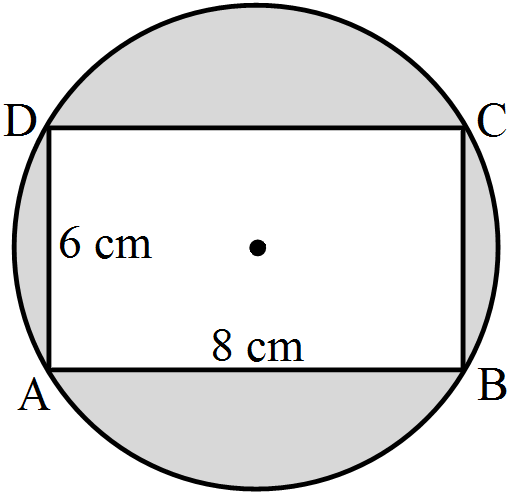
In the given figure, $\text{ABCD}$ is a rectangle inscribed in a circle having length $8 \ cm$ and breadth $6 \ cm$. If $\pi=3.14$ then the area of the shaded region is:
  • A
    $264\ cm^2$
  • B
    $266\ cm^2$
  • C
    $272\ cm^2$
  • None of the above
Answer
Correct option: D.
None of the above
Join $AC$.
Now, $AC$ is the diameter of the circle.
We have:
$AC^2 = AB^2 + BC^2 [$By pythagoras' theorem$]$
$\Rightarrow\text{AC}^2=\big\{(8)^2+(6)^2\big\}\text{cm}^2$
$\Rightarrow\text{AC}^2=(64+36)\text{cm}^2$
$\Rightarrow\text{AC}^2=100\text{cm}^2$
$\Rightarrow\text{AC}=10\text{cm}$
$\therefore$ Radius of the circle $=\frac{10}{2}\text{cm}$
$=5\text{cm}$
Now,
Area of the shaded region $=$ Area of the circle with radius $5\ cm -$ Area of the rectangle $\text{ABCD}$
$=\big|(3.14\times5\times5)-(8\times6)\big|\text{cm}^2$
$=\Big|\Big(\frac{314}{100}\times25\Big)-48\Big|\text{cm}^2$
$=\Big(\frac{157}{2}-48\Big)\text{cm}^2$
$=\frac{61}{2}\text{cm}^2$
$=30.5\text{cm}^2$
View full question & answer
MCQ 211 Mark
The area of a sector of a circle with radius r, making an angle of x° at the centre is:
  • A
    $\frac{\text{x}}{180}\times2\pi\text{r}$
  • B
    $\frac{\text{x}}{180}\times\pi\text{r}^2$
  • C
    $\frac{\text{x}}{360}\times2\pi\text{r}$
  • $\frac{\text{x}}{360}\times\pi\text{r}^2$
Answer
Correct option: D.
$\frac{\text{x}}{360}\times\pi\text{r}^2$
The area of a sector of a circle with radius r making an angle of x° at the centre is $\frac{\text{x}}{360}\times\pi\text{r}^2.$
View full question & answer
MCQ 221 Mark
In a circle of radius 21cm. an arc subtends an angle of 60° at the centre. The length of the arc is:
  • A
    21cm
  • 22cm
  • C
    18.16cm
  • D
    23.5cm
Answer
Correct option: B.
22cm
We have, $\text{r}=21\text{cm}$ and $\theta=60^\circ$
Length of arc $=\frac{\theta}{360^\circ}\times2\pi\text{r}\frac{60^\circ}{360^\circ}\times2\times\frac{22}{7}\times21=22\text{cm}$
Hence, the correct answer is option (b)
View full question & answer
MCQ 231 Mark
On decreasing the radius of a circle by 30%, its area is decreased by:
  • A
    30%
  • B
    60%
  • C
    45%
  • None of these
Answer
Correct option: D.
None of these
Let the original radiusThus, we have;
Original area $=\pi\text{r}^2$
Also,
New radius = 70% of r
$=\Big(\frac{70}{100}\times\text{r}\Big)$
$=\frac{7\text{r}}{10}$
New area $=\pi\times\Big(\frac{7\text{r}}{10}\Big)^2$
$=\frac{49\pi\text{r}^2}{100}$
Decrease in the area $=\Big(\pi\text{r}^2-\frac{49\pi\text{r}^2}{100}\Big)$
$=\frac{59\pi\text{r}^2}{100}$
Thus, we have:
Decrease in the area $=\Big(\frac{59\pi\text{r}^2}{100}\times\frac{1}{\pi\text{r}^2}\times100\Big)\%$
$=51\%$
View full question & answer
MCQ 241 Mark
On increasing the diameter of a circle by 40%, its area will be increased by:
  • A
    40%
  • B
    80%
  • 96%
  • D
    82%
Answer
Correct option: C.
96%
Let d the original diameter.Radius $=\frac{\text{d}}{2}$
Thus, we have:
Original area $=\pi\times\Big(\frac{\text{d}}{2}\Big)^2$
$=\frac{\pi\text{d}^2}{4}$
New diameter =140% of d
$=\Big(\frac{140}{100}\times\text{d}\Big)$
$=\frac{7\text{d}}{5}$
Now,
New radius $=\frac{7\text{d}}{5\times2}$
$=\frac{7\text{d}}{10}$
New area $=\pi\times\Big(\frac{7\text{d}}{10}\Big)^2$
$=\frac{49\pi\text{d}^2}{10}$
Increase in the area $=\Big(\frac{49\pi\text{d}^2}{10}-\frac{\pi\text{d}^2}{4}\Big)$
$=\frac{24\pi\text{a}^2}{100}$
$=\frac{6\pi\text{a}^2}{25}$
We have:
Increase in the area $=\Big(\frac{6\pi\text{a}^2}{25}\times\frac{4}{\pi\text{a}^2}\times100\Big)\%$
$=96\%$
View full question & answer
MCQ 251 Mark
In making 1000 revolutions, a wheel covers 88km. The diameter of the wheel is:
  • A
    14m
  • B
    24m
  • 28m
  • D
    40m
Answer
Correct option: C.
28m
Distance covered by the wheel in 1 revolution $=\Big(\frac{88\times1000}{1000}\Big)\text{m}$
$=88\text{m}$
We have:
Circumference of the wheel = 88m
Now, let the diameter of the wheel be d m.
Thus. we have
$\pi\text{d}=88$
$\Rightarrow\frac{22}{7}\times\text{d}=88$
$\Rightarrow\text{d}=\Big(88\times\frac{7}{22}\Big)$
$\Rightarrow\text{d}=28\text{m}$
View full question & answer
MCQ 261 Mark
If the perimeter of a square is equal to the circumference of a circle then the ratio of their areas is:
  • A
    $4:\pi$
  • $\pi:4$
  • C
    $\pi:7$
  • D
    $7:\pi$
Answer
Correct option: B.
$\pi:4$
Let the side of the square be a and the radius of the circle be r.
Now, Perimeter of circle = Circumference of the circle
$\Rightarrow4\text{a}=2\pi\text{r}$
$\Rightarrow\frac{\text{a}}{\text{r}}=\frac{\pi}{2}$
Now,
$\frac{\text{Area of square}}{\text{Area of circle}}=\frac{\text{a}^2}{\pi\text{r}^2}$
$=\frac{1}{\pi}\times\Big(\frac{\text{a}}{\text{r}}\Big)^2$
$=\frac{1}{\pi}\times\frac{\pi^2}{4}$
$=\frac{\pi}{4}$
$=\pi:4$
Hence, the correct answer is option (b).
View full question & answer
MCQ 271 Mark
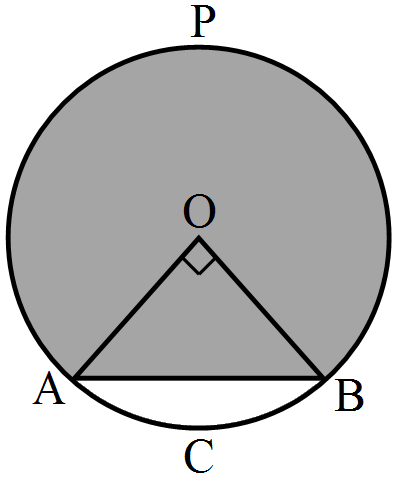
A chord of a circle of radius $10\ cm$ subtends a right angle at the centre. The area of the minor segments $(\text{given, }\pi=3.14)$ is:
  • A
    $32.5\ cm^2$
  • B
    $34.5\ cm^2$
  • $28.5\ cm^2$
  • D
    $30.5\ cm^2$
Answer
Correct option: C.
$28.5\ cm^2$

Area of minor segment $=$ Area of sector $\text{AOBC} -$ Area of right triangle $\text{AOB}$
$=\frac{90^\circ}{360^\circ}.\pi(\text{OA})^2-\frac{1}{2}\times\text{OA}\times\text{OB}$
$=\frac{1}{4}\times3.14\times(10)^2-\frac{1}{2}\times10\times10$
$=78.5-50$
$=28.5\text{cm}^2$
Hence, the correct answer is option $(c).$
View full question & answer
MCQ 281 Mark
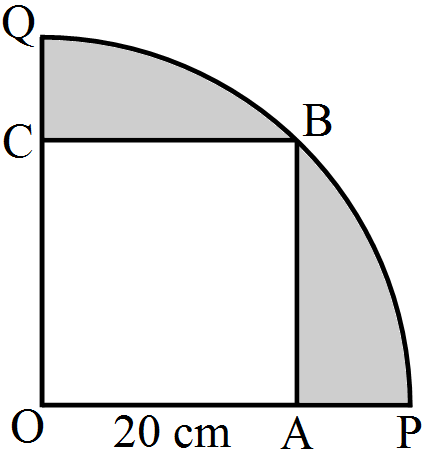
In the given figure, a square $\text{OABC}$ has been inscribed in the quadrant $\text{OPBQ.}$ If $OA = 20\ cm,$ then the area of the shaded region is: $\big[\text{Take }\pi=3.14\big]$
  • A
    $214\ cm^2$
  • $228\ cm^2$
  • C
    $242\ cm^2$
  • D
    $248\ cm^2$
Answer
Correct option: B.
$228\ cm^2$

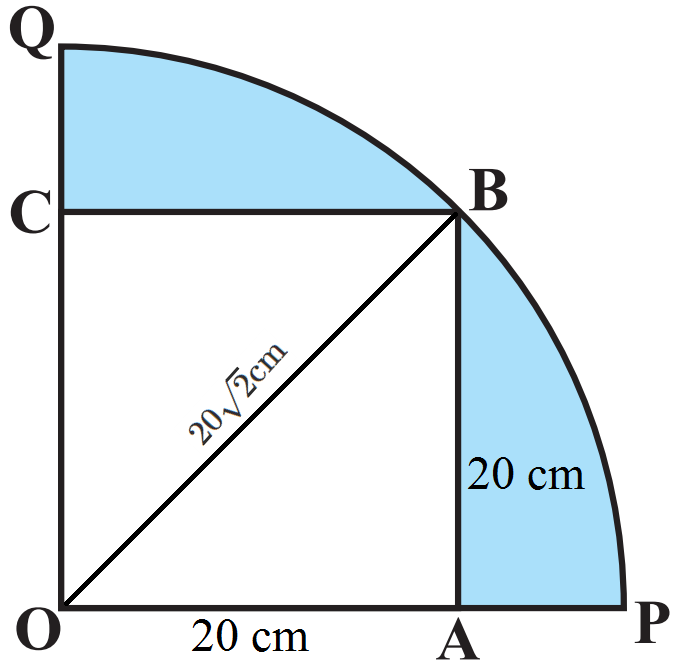
Join $OB.$
Now, $OB$ is the radius of the circle.
We have:
$OB^2 = OA^2 + AB^2 [$By] pythagoras' theorem$]$
$\Rightarrow\text{OB}^2=\big\{(20)^2+(20)^2\big\}\text{cm}^2$
$\Rightarrow\text{OB}^2=(400+400)\text{cm}^2$
$\Rightarrow\text{OB}^2=800\text{cm}^2$
$\Rightarrow\text{OB}=20\sqrt{2}\text{cm}$
Hence, the radius of the circle is $20\sqrt{2}\text{cm}.$
Now,
Area of the shaded region $=$ Area of the quadrant $-$ Area of the square $\text{OABC}$
$=\Big|\Big(\frac{1}{4}\times3.14\times20\sqrt{2}\times20\sqrt{2}\Big)-(20\times20)\Big|\text{cm}^2$
$=\Big|\Big(\frac{1}{4}\times\frac{314}{100}\times800\Big)-400\Big|\text{cm}^2$
$=(628-400)\text{cm}^2$
$=228\text{cm}^2$
View full question & answer
MCQ 291 Mark
The areas of two circles are in the ratio 9 : 4. The ratio of their circumferences is:
  • 3 : 2
  • B
    4 : 9
  • C
    2 : 3
  • D
    81 : 16
Answer
Correct option: A.
3 : 2
Let the the radii of the two circles be r and R, the circumferences of the circles be c and C and the areas of the two circles be a and A.
Now,
$\frac{\text{a}}{\text{A}}=\frac{9}{4}$
$\Rightarrow\frac{\pi\text{r}^2}{\pi\text{R}^2}=\Big(\frac{3}{2}\Big)^2$
$\Rightarrow\frac{\text{r}}{\text{R}}=\frac{3}{2}$
Now, the ratio between their circumferences is given by
$\frac{\text{c}}{\text{C}}=\frac{2\pi\text{r}}{2\pi\text{R}}$
$=\frac{\text{r}}{\text{R}}$
$=\frac{3}{2}$
Hence, the correct answer is option (a)
View full question & answer
MCQ 301 Mark
The areas of two concentric circles are $1386\ cm^2$ and $962.5\ cm^2$. The width of the ring is:
  • A
    $2.8\ cm$
  • $3.5\ cm$
  • C
    $4.2\ cm$
  • D
    $3.8\ cm$
Answer
Correct option: B.
$3.5\ cm$
Let $r \ cm$ and $R \ cm$ be the radii of two concentric circles.
Thus. we have:
$\pi\text{r}^2=1386$
$\Rightarrow\frac{22}{7}\times\text{R}^2=1386$
$\Rightarrow\text{R}^2=\Big(1386\times\frac{7}{22}\Big)\text{cm}^2$
$\Rightarrow\text{R}^2=441\text{cm}^2$
$\Rightarrow\text{R}=21\text{cm}$
Also,
$\pi\text{r}^2=962.2$
$\Rightarrow\frac{22}{7}\times\text{r}^2=962.2$
$\Rightarrow\text{r}^2=\Big(962.2\times\frac{7}{22}\Big)\text{cm}^2$
$\Rightarrow\text{r}^2=\Big(\frac{962.2}{10}\times\frac{7}{22}\Big)\text{cm}^2$
$\Rightarrow\text{r}^2=\frac{1225}{4}\text{cm}^2$
$\Rightarrow\text{r}=\frac{35}{2}\text{cm}$
$\therefore$ Width of the ring $=(\text{R}-\text{r})$
$=\Big(21-\frac{35}{2}\Big)\text{cm}$
$=\frac{7}{2}\text{cm}$
$=3.5\text{cm}$
View full question & answer
M.C.Q (1 Marks) - Maths STD 10 Questions - Vidyadip